This Tuesday, July 24th at 12:30 PM, there will be a showing of The Leisure Seeker @ Seniors in the Park, in the Starin community building.
Paolo Virzì directs the one-hour, fifty-two-minute film: “Traveling in their family Leisure Seeker vintage recreational vehicle, John and Ella Spencer take one last road trip from Boston to the Hemingway House in the Florida Keys before his Alzheimer’s and her cancer can catch up with them.”
The cast includes Donald Sutherland as John Spencer, Helen Mirren as Ella Spencer, Janel Moloney as Jane Spencer, and Kirsty Mitchell as Jennifer Ward.
Monday in Whitewater will be partly sunny with a high of eighty-two. Sunrise is 5:38 AM and sunset 8:24 PM, for 14h 48m 19s of daytime. The moon is a waxing gibbous with 83.2% of its visible disk illuminated.
Today is the six hundred seventeenth day.Days since Trump’s election, with 11.9.16 as the first day.
Whitewater’s Urban Forestry Commission meets at 4:30 PM, and the Whitewater School Board will meet at Central Office at 7 PM.
WASHINGTON — When President Trump declassified a memo by House Republicans in February that portrayed the surveillance of a former campaign adviser as scandalous, his motivation was clear: to give congressional allies and conservative commentators another avenue to paint the Justice Department’s investigation into Russian election interference as tainted from the start.
But this past weekend, Mr. Trump’s unprecedented decision, which he made over the objections of law enforcement and intelligence officials, had a consequence that revealed his gambit’s shaky foundation. The government released the court documents in which the F.B.I. made its case for conducting the surveillance — records that plainly demonstrated that key elements of Republicans’ claims about the bureau’s actions were misleading or false.
….
Mr. Trump’s portrayal, which came as the administration is trying to repair the damage from his widely criticized meeting with President Vladimir V. Putin of Russia, revived the claims put forward in February by Republicans on the House Intelligence Committee. But in respect after respect, the newly disclosed documents instead corroborated rebuttals by Democrats on the panel who had seen the top-secret materials and accused Republicans of mischaracterizing them to protect the president.
Maria Butina, the Russian woman charged in federal court lastweek with acting as an unregistered agent of her government, received financial support from Konstantin Nikolaev, a Russian billionaire with investments in U.S. energy and technology companies, according to a person familiar with testimony she gave Senate investigators.
Butina told the Senate Intelligence Committee in April that Nikolaev provided funding for a gun rights group she represented, according to the person. A spokesman for Nikolaev confirmed that he was in contact with her as she was launching the gun rights group in Russia between 2012 and 2014. He declined to confirm whether Nikolaev gave her financial support.
Nikolaev’s fortune has been built largely through port and railroad investments in Russia. He also sits on the board of American Ethane, a Houston ethane company that was showcased by President Trump at an event in China last year, and is an investor in a Silicon Valley start-up.
So let us take an account of what is being smashed by Donald Trump. In viewing our European allies as a “foe” intent on exploitation, Trump is smashing an alliance that has encouraged peaceful relations within Europe and jointly resisted terrorism and Russian aggression. By questioning NATO’s Article 5 and the principle of collective security, he is smashing a system that has turned a continent prone to war and genocide into a flawed but functioning community of free nations. By ignoring and denying the moral power of American ideals and expressing a deeply un-American dictator envy, Trump is smashing our sense of national mission along with the hopes of oppressed people everywhere.
And for what? For a form of extreme nationalism that serves someone else’s nation? For a definition of strength that trades away the tremendous advantage of our defining ideals? This is a work of demolition without the inconvenience of new architecture. Yet among his Republican supporters, none dare call it idiocy.
It was then that Browder turned from investment to full-time advocacy, traveling the world to persuade one Western parliament after another to pass a measure that was as groundbreaking as it would appear obvious: a law, commemoratively named the Magnitsky Act, that bars individuals (from Russia and elsewhere) who are complicit in human rights abuses and corruption from traveling to the West, owning assets in the West and using the financial system of the West. Boris Nemtsov, then Russia’s opposition leader (who played a key role in convincing Congress to pass the law in 2012), called the Magnitsky Act “the most pro-Russian law in the history of any foreign Parliament.”
It was the smartest approach to sanctions. It avoided the mistake of targeting Russian citizens at large for the actions of a small corrupt clique in the Kremlin and placed responsibility directly where it is due. It was also the most effective approach. The people who are in charge of Russia today like to pose as patriots, but in reality, they care little about the country. They view it merely as a looting ground, where they can amass personal fortunes at the expense of Russian taxpayers and then transfer those fortunes to the West. In one of his anti-corruption reports, Nemtsov detailed the unexplained riches attained by Putin’s personal friends such as Gennady Timchenko, Yuri Kovalchuk and the Rotenberg brothers, noting that they are likely “no more that the nominal owners … and the real ultimate beneficiary is Putin himself.” Similar suspicions were voiced after the publication of the 2016 Panama Papers, which showed a $2 billion offshore trail leading to another close Putin friend, cellist Sergei Roldugin. Some of the funds in his accounts were linked with money from the tax fraud scheme uncovered by Magnitsky.
Volumes of research, hours of expert testimony and countless policy recommendations have been dedicated to finding effective Western approaches to Putin’s regime. The clearest and the most convincing answer was provided, time and again, by the Putin regime itself. It was the Magnitsky Act that Putin tasked his foreign ministry with trying to stop; it was the Magnitsky Act that was openly tied to the ban on child adoptions; it was the Magnitsky Act that was the subject of the 2016 Trump Tower meeting attended by a Kremlin-linked lawyer; it is advocating for the Magnitsky Act that may soon land any Russian citizen in prison. It was the Magnitsky Act that Putin named as the biggest threat to his regime as he stood by Trump’s side in Helsinki.
….
Vladimir Putin has left no doubt: The biggest threat to his regime is the Magnitsky Act, which stops its beneficiaries from doing what has long become their raison d’être — stealing in Russia and spending in the West. It is time for more Western nations to adopt this law — and for the six countries that already have it to implement it with vigor and resolve.
Sunday in Whitewater will be partly sunny, with an occasional shower, and a high of seventy-seven. Sunrise is 5:37 AM and sunset 8:25 PM, for 14h 48m 19s of daytime. The moon is a waxing gibbous with 76.1% of its visible disk illuminated.
Today is the six hundred sixteenth day.Days since Trump’s election, with 11.9.16 as the first day.
The Atlanta Campaign had begun two months earlier, in May, but a decisive battle was fought on July 22. Union forces met 37,000 Confederate troops in a battle that some historians consider one of the most desperate and bloody of the war. Although 20 percent of Confederate forces were killed, wounded, or missing at the end of the day, the South still controlled the city. The 1st, 12th, 16th, 17th, 22nd, 25th, 26th, 31st Wisconsin Infantry regiments and the 5th Wisconsin Light Artillery were engaged in the Battle of Atlanta.
By wide margins, Americans give President Trump negative marks for his conduct during a summit with Russian President Vladimir Putin last week and for his casting doubt on U.S. intelligence conclusions that Russia interfered in the 2016 presidential election, a new Washington Post-ABC News poll finds.
….
The Post-ABC poll conducted Wednesday through Friday finds that overall, 33 percent of Americans approve of Trump’s handling of his meeting with Putin while 50 percent disapprove. A sizable 18 percent say they have no opinion. A slightly larger 56 percent disapprove of Trump expressing doubts about U.S. intelligence agencies’ conclusion that Russia tried to influence the outcome of the 2016 election. On both questions, those who say they “strongly disapprove” of Trump’s performance outnumber those who say they “strongly approve” by better than 2 to 1.
Invited by a reporter at Monday’s news conference to denounce Russian electoral interference, Trump’s first response was a rhetorical question based on a false premise: “You have groups that are wondering why the FBI never took the server. Why haven’t they taken the server?”
To those not steeped in Trump-friendly blogs and cable programs, it might have seemed like a bizarre non sequitur. But regular viewers of Fox News would have understood “where is the server?” as shorthand for a fanciful theory that it was not Russian hackers but an insider at the Democratic National Committee who made off with DNC emails that were published by WikiLeaks. According to this narrative, DNC officials have denied law enforcement access to their computer systems to conceal an “inside job,” and the attribution of the theft to Russian intelligence was made without this obviously crucial piece of evidence. Trump has raised questions about the supposedly “missing” server again and again on Twitter.
Yet the answer to those questions is embarrassingly simple: The FBI did get all the relevant information from the DNC’s network. The incident-response firm hired by the DNC, CrowdStrike, had exact digital copies of the systems that U.S. authorities say were targeted by a Russian military operation in 2016, as well as logs showing the intruders’ actions in the system as they occurred. As CrowdStrike, the DNC and senior FBI officials have all repeatedly made clear, all the data captured by CrowdStrike — which would be far more useful for forensic purposes than having access to the physical machines after the fact — was promptly handed over to the FBI. That the government had this information, along with a mountain of other evidence, is also obvious from the indictment that special counsel Robert Mueller’s office made public this month. That document includes a meticulously detailed account of the DNC hack, including how the initial intrusion was achieved, the specific hacking tools and malware that were installed, and the types of data that were ultimately exfiltrated. “Why haven’t they taken the server?” Well, in the only sense that matters for forensic analysis, they have.
Butina is just a minor figure in what appears to be a broader ongoing inquiry into the relationships between Russia, conservative American organizations like the National Rifle Association, and Donald Trump’s presidential campaign. For months, federal investigators have been looking into whether the NRA or other conservative organizations were used by the Russian government or Russian oligarchs to funnel money to the Trump campaign during the 2016 election.
Investigators working with special counsel Robert Mueller have repeatedly questioned Russian oligarchs traveling to the United States about whether they made cash donations directly or indirectly to Trump’s campaign or his inauguration, CNN reported earlier this year. In at least one case, they stopped a Russian oligarch when his private plane landed in New York.
Butina has attracted the attention of federal investigators mainly because of her connections to this shadowy intersection of powerful Russians and right-wing Americans. In fact, it was Butina’s work for Alexander Torshin, a close political ally of Russian President Vladimir Putin, that made her a target of federal investigators. Torshin — not Butina — is the Russian figure whose involvement with the NRA and American conservatives brings the Trump-Russia case closer to Russian organized crime and Putin.
For decades, the National Rifle Association has promoted its hardline politics with appeals to patriotism, freedom, and the staunch defense of the Second Amendment. But now, the controversial gun lobbying group finds itself deeply caught up in a wide-ranging effort to sabotage American democracy by an enemy foreign power.
Federal prosecutors unsealed charges this week against 29-year-old Russian national Maria Butina, a self-styled gun activist with long-running ties to the NRA who worked for Alexander Torshin, a high-level Russian government and banking official from President Vladimir Putin’s party. Butina, who was a graduate student at American University until this spring, began traveling to the United States in 2014 and operated as a “covert Russian agent,” according to an FBI affidavit. She acted as an unregistered foreign agent and participated in a multiyear conspiracy to infiltrate conservative political groups including the NRA, federal prosecutors say, in order to “advance the interests of the Russian Federation.”
Butina and Torshin worked together in attempts to cultivate Republican politicians and eventually Donald Trump’s presidential campaign. Under Torshin’s direction, “the covert influence campaign involved substantial planning, international coordination, and preparation,” according to court documents, which detail some of the evidence gathered by the FBI on Butina’s connections to a Russian intelligence agency and Russian oligarchs. Torshin, who for years also traveled to America for NRA events and was among Russian officials sanctioned by the Treasury Department in April, is referred to only as a “Russian official” in the court documents. But his identity has since been confirmed in multiple news reports, and he appears with Butina in both the United States and Russia throughout several years’ worth of social-media posts previously documented by Mother Jones.
Saturday in Whitewater will be variably cloudy, with a couple of showers, and a high of seventy-five. Sunrise is 5:36 AM and sunset 8:26 PM, for 14h 50m 10s of daytime. The moon is a waxing gibbous with 67.5% of its visible disk illuminated.
Today is the six hundred fifteenth day.Days since Trump’s election, with 11.9.16 as the first day.
The First Battle of Bull Run (the name used by Union forces), also known as the First Battle of Manassas[1] (the name used by Confederate forces), was fought on July 21, 1861 in Prince William County, Virginia, just north of the city of Manassas and about 25 miles west-southwest of Washington, D.C. It was the first major battle of the American Civil War. The Union’s forces were slow in positioning themselves, allowing Confederate reinforcements time to arrive by rail. Each side had about 18,000 poorly trained and poorly led troops in their first battle. It was a Confederate victory, followed by a disorganized retreat of the Union forces.
….
Both armies were sobered by the fierce fighting and many casualties, and realized that the war was going to be much longer and bloodier than either had anticipated. The Battle of First Bull Run highlighted many of the problems and deficiencies that were typical of the first year of the war. Units were committed piecemeal, attacks were frontal, infantry failed to protect exposed artillery, tactical intelligence was nil, and neither commander was able to employ his whole force effectively. McDowell, with 35,000 men, was only able to commit about 18,000, and the combined Confederate forces, with about 32,000 men, committed only 18,000.[12]
Politically speaking, Trump’s devotion to his pro-Putin line doesn’t make sense. Yes, the GOP base is impressionable, and perhaps Republican voters would accept it if Trump came out and said, “You bet, Russia helped get me elected, and wasn’t that a good thing? We couldn’t let Crooked Hillary win!” But nobody would say his odd solicitousness toward the Kremlin leader is a political winner, and it certainly causes an unnecessary amount of friction with Republicans in Congress. He’s kept it up at great political cost to himself, and that suggests either that he is possessed by an anomalous level of conviction on this one issue, despite his extraordinary malleability on everything else—or that he’s beholden to Putin in some way.
You don’t have to buy Jonathan Chait’s sleeper agent theory of Trump to believe that something is deeply weird about all this. Nor do you need to be convinced that Putin is hanging onto a recording of something untoward that may have taken place in a certain Moscow hotel room. You don’t even have to buy the theory that Trump’s business is overly dependent on illicit flows of Russia money, giving Putin leverage. As Julia Ioffe posits, the kompromat could well be the mere fact of the Russian election meddling itself.
As for my argument that Trump’s collection of misfit toys was too incompetent, and too riven by infighting, to collaborate with Russia, this one might still be true. There were certainly sporadic, repeated attempts by some on or around the campaign to collaborate, but we don’t know if, or how, those flirtations were consummated. But certainly, the intent was there, as Donald Trump, Jr. has said publicly. They were all too happy to accept Russian help, even if they weren’t sure they would be enough to win in the end.
Now we need to ask a new question: Was data also at the heart of the relationship between the Trump campaign and Russia? Nearly a year ago, I speculated that the Trump campaign might have shared data with the Russian Internet Research Agency, the team that created fake personas and put up fake Facebook pages with the goal of spreading false stories about Hillary Clinton. The Russians certainly seemed to know what they were doing. On the one hand, the Russian team targeted people who they thought might be moved to support Trump by anti-immigration slogans and messages; on the other hand, they targeted black voters with messages designed to discourage them from voting at all.
The latest indictment produced by special counsel Robert S. Mueller III’s investigation, together with President Trump’s strange performance in Helsinki, suggests a different hypothesis: that Russia shared data with the Trump campaign, and not vice versa. The indictment explains that the Russian hackers who broke into the servers of the Democratic Congressional Campaign Committee and the Democratic National Committee not only stole the now- infamous emails but also stole data. “The Conspirators,” reads the indictment, “searched for and identified computers within the DCCC and DNC networks that stored information related to the 2016 U.S. presidential election.” They then “gathered data by creating backups, or ‘snapshots,’ of the DNC’s cloud-based systems” and “moved the snapshots to cloud-based accounts they had registered with the same service thereby stealing the data from the DNC.”
….
Did they share this information with the Trump campaign? If so, the timing is interesting. In October, a few weeks after the hackers broke into the DNC servers, New York Times journalist Maggie Haberman observeda major shift in the way the Trump campaign was spending its advertising budget. Access to Democratic Party data would, of course, have been useful in redirecting that spending. At about the same time, Trump also began using a curious set of conspiratorial slogans and messages, all lifted directly from Russian state television and websites. From Barack Obama “founded ISIS” to Hillary Clinton will start “World War III,” Trump repeated them at his rallies and on his Twitter feed. It was as if he had some reason to believe they would work.
In 2016, the campaign of the Republican nominee for president was approached multiple times by representatives of the Russian government offering to help them win the election. These offers were welcomed with enthusiasm. The campaign was also led for a time by a political consultant with deep financial and personal ties to a Russian oligarch and a Kremlin puppet in Ukraine.
Multiple members of the Trump team had contacts with the Russian government that they later lied to conceal.
As part of its attack on the American electoral system, Russian intelligence hacked into Democratic Party systems. Some of the information it found there was released publicly and promoted gleefully by Republicans at all levels in order to help the Trump campaign; information relating to down-ballot campaigns was passed to Republicans, who used it in order to maintain their hold on the House of Representatives.
Amid the insistence from the intelligence community that in 2018 Russia will likely attempt to once again penetrate the computer systems of state election agencies, Republicans this week killed an effortto provide funding to states to bolster the security of their election systems.
As part of a lengthy effort to infiltrate the National Rifle Association, an important Republican interest group, an alleged Russian spy began a romance with a Republican activist, met multiple Republican leaders and fostered a relationship between American gun advocates and Russians. On the night of Trump’s victory, she messaged “I am ready for further orders” to her handler, a Russian banker named Alexander Torshin who is close to Putin.
The NRA dramatically increased its spending on the 2016 presidential campaign from past years, pouring $30 million into their effort to elect Trump. The FBI is investigating whether that money may have illegally come from Russia, funneled to the organization by Torshin.
The Trump administration has announced a change to IRS rules so that groups like the NRA will no longer have to identify their donors on their tax forms, making such money almost impossible to trace in the future.
Over the last few years, the Christian right, another key part of the GOP coalition, has grown increasingly close to Putin, whom they see as an ally in a global clash of civilizations between Christianity and Islam.
In Congress, Republicans have undertaken an aggressive campaign to discredit and, many of them plainly hope, shut down the probe into the Russian attack on America. Though they mounted seven separate investigations of Benghazi, they are nearly united in their position that no further investigation into a hostile foreign power’s attempt to manipulate the American electoral system is necessary.
Fox News, which functions as the propaganda arm of the Republican Party, has aired relentless attacks on the Russia investigation and calls for it to be shut down.
Despite the mountain of unambiguous evidence of the Russian attack in 2016, the overwhelming majority of Republican voters continue to say no such attack occurred.
Hard-core Trump supporters are beginning to argue that even if Russia did attack the American electoral system, it was actually a good thing because it helped Donald Trump get elected.
Natan Sharansky remembers The Essay That Helped Bring Down the Soviet Union (“It championed an idea at grave risk today: that those of us lucky enough to live in open societies should fight for the freedom of those born into closed ones”):
Fifty years ago this Sunday, this paper devoted three broadsheet pages to an essay that had been circulating secretly in the Soviet Union for weeks. The manifesto, written by Andrei Sakharov, championed an essential idea at grave risk today: that those of us lucky enough to live in open societies should fight for the freedom of those born into closed ones. This radical argument changed the course of history.
Sakharov’s essay carried a mild title — “Thoughts on Progress, Peaceful Coexistence and Intellectual Freedom” — but it was explosive. “Freedom of thought is the only guarantee against an infection of mankind by mass myths, which, in the hands of treacherous hypocrites and demagogues, can be transformed into bloody dictatorships,” he wrote. Suddenly the Soviet Union’s most decorated physicist became its most prominent dissident.
For this work and other “thought crimes” the Soviet authorities stripped Sakharov of his honors, imprisoned many of his associates and, eventually, exiled him to Gorky.
In 1968, when this work was published, I was a 20-year-old mathematician studying at the Moscow equivalent of M.I.T. Although we dared not discuss it, my peers and I lived a life of double-think: toeing the Communist Party line in public, thinking independently in private. Like so many others, I read Sakharov’s essay in samizdat — a typewritten copy duplicated secretly, spread informally and read hungrily.
Its message was unsettling and liberating: You cannot be a good scientist or a free person while living a double life. Knowing the truth while collaborating in the regime’s lies only produces bad science and broken souls.
You might know a Tiger, a Tigger or a Mr. Whiskers. But how many cats are really living in the streets and sleeping on the couches of the District?
By spending $1.5 million over three years, a consortium of scientists and animal welfare organizations thinks it can find out with an initiative known as the DC Cat Count, which launches Tuesday.
The cat census, organized by the Humane Rescue Alliance, the Humane Society of the United States, PetSmart Charities and the Smithsonian Conservation Biology Institute, will help animal advocates understand how many felines are in the city and how to cope with cats that don’t have a home.
….
The project is planned to last three years, with the $1.5 million price tag funded by animal advocacy nonprofit groups.
From far away in Whitewater, Wisconsin, it might appear as though no one would have an answer to the question of how many cats are in Washington, D.C.
Friday in Whitewater will be mostly cloudy, with scattered showers, and a high of seventy-three. Sunrise is 5:35 AM and sunset 8:27 PM, for 14h 51m 57s of daytime. The moon is a waxing gibbous with 57.9% of its visible disk illuminated.
Today is the six hundred fourteenth day.Days since Trump’s election, with 11.9.16 as the first day.
Apollo 11 was the spaceflight that landed the first two people on the Moon. Mission commander Neil Armstrong and pilot Buzz Aldrin, both American, landed the lunar module Eagle on July 20, 1969, at 20:17 UTC. Armstrong became the first person to step onto the lunar surface six hours after landing on July 21 at 02:56:15 UTC; Aldrin joined him about 20 minutes later. They spent about two and a quarter hours together outside the spacecraft, and collected 47.5 pounds (21.5 kg) of lunar material to bring back to Earth. Michael Collins piloted the command module Columbia alone in lunar orbit while they were on the Moon’s surface. Armstrong and Aldrin spent 21.5 hours on the lunar surface before rejoining Columbia in lunar orbit.
During my 27 years as a Foreign Service officer, I was present at a number of summit meetings between U.S. and Soviet or Russian leaders, during both Republican and Democratic administrations. Some summits went well. Some went poorly. In every case, however, the American public knew very quickly—usually within hours—what agreements their president had reached with his Soviet or Russian counterpart.
Three days now have passed since Presidents Donald Trump and Vladimir Putin met in Helsinki. Russian officials are talking about agreements coming out of that meeting, but Americans have no idea what was agreed. This is not normal.
What we do know about Helsinki largely comes from the joint Trump-Putin press briefing, perhaps the most embarrassing post-summit press conference performance ever by an American president. The presidents described the topics they discussed but offered no detail on any agreements.
The summit did not produce a joint statement, which typically offers the vehicle to record and report on agreements reached. Following a more normal summit, National Security Advisor John Bolton or Secretary of State Mike Pompeo, who took part in the larger meeting following the Trump-Putin one-on-one session, would have briefed the press on the summit results, including any agreements. Alternatively, Bolton or another senior National Security Council official would have briefed the press on background.
LOS ANGELES (Reuters) – With one week left on a court-ordered deadline to reunite children and parents separated by U.S. immigration officials, government lawyers reported on Thursday that 364 of some 2,500 families with children aged 5 and older have been brought back together.It was unclear from the status report, filed as part of an American Civil Liberties Union lawsuit challenging parent-child separations at the border, exactly how many more reunifications were likely.
President Donald Trump has indicated that he is willing to slap tariffs on every Chinese good imported to the U.S. should the need arise.
“I’m ready to go to 500,” the president told CNBC’s Joe Kernen in a “Squawk Box” interview aired Friday.
The reference is to the dollar amount of Chinese imports the U.S. accepted in 2017 — $505.5 billion to be exact, compared with the $129.9 billion the U.S. exported to China, according to Census Bureau data.
Less than a week after Deputy Attorney General Rod Rosensteinannounced Special Counsel Robert Mueller‘s indictment of 12 Russian military intelligence or G.R.U. officers for 2016 election hacking, Microsoft says the cyber criminals are at it again.
Speaking on a panel at the Aspen Security Forum on Thursday, Tom Burt, Microsoft’s vice president for customer security and trust, said that his team had discovered a spear-phishing campaign targeting three candidates running for election in 2018. Analysts traced them to a group Microsoft has nicknamed Strontium, which is closely tracked by every major threat intelligence company and is widely accepted to be run by the GRU, Russia’s military intelligence agency.
Burt declined to name the candidates during the event, citing privacy concerns, and didn’t say which party they belonged to, but implied they were candidates of note and running for reelection.
“They were all people who, because of their positions, might have been interesting targets from an espionage standpoint, as well as an election disruption standpoint,” Burt said.
“Earlier this year, we did discover that a fake Microsoft domain had been established as the landing page for phishing attacks,” said … Burt … “And we saw metadata that suggested those phishing attacks were being directed at three candidates who are all standing for election in the midterm elections.”
(…)
Microsoft took down the fake domain and worked with the federal government to block the phishing messages. Burt said that none of the targeted campaign staffers were infected.
Burt did not specify whether the hacking attempts originated from Russia.
GRU hackers are believed to be behind a number of global hack-and-leak operations aimed at entities adversarial to Russia, including French President Emmanuel Macron’s 2017 campaign and the World Anti-Doping Agency, whose reports led to Russia’s ban from the 2018 Olympics over its massive doping program.
In recent weeks, officials from the Department of Homeland Security have insisted that though they’re watchful of potential Russian hacking, they’ve seen no sustained campaign against election systems.
(…)
When asked by BuzzFeed News, Microsoft also declined to address which parties it had seen targeted … A representative from the Democratic National Committee, Xochitl Hinojosa, didn’t address whether any Democrats had been targeted, but told BuzzFeed News that “We saw the Russians attack our democracy in 2016 and we know they’re a threat in 2018, 2020 and beyond. Unfortunately, the President refuses to acknowledge this serious threat to our country, and House Republicans are refusing to increase funding for election security.”
DES MOINES, Iowa — A flurry of tornadoes swept through central Iowa, injuring at least 17 people Thursday, flattening buildings in three cities and forcing an evacuation of a hospital. The tornadoes formed unexpectedly and hit the cities of Marshalltown, Pella and Bondurant as surprised residents ran for cover.
Hardest hit appeared to be Marshalltown, a city of 27,000 people about 50 miles northeast of Des Moines, where brick walls collapsed in the streets, roofs were blown off buildings and the cupola of the historic courthouse tumbled 175 feet to the ground.
One tornado slammed into an agricultural machinery plant in Iowa as some people were working, injuring at least seven people. That tornado hit in the town of Pella, about 40 miles southeast of Des Moines.
Whitewater, like many small towns, is marketing mad: claims, professions, insistence, publicizing, and declarations exceed actual conditions. Newly-increased fines over Whitewater’s available parking spaces on campus illustrate this problem.
The local campus is large, relative to the non-campus parts of the city, and that places pressure on both campus and non-campus residents for parking spaces. To address this problem, the campus police department has quadrupled fines for parking without a permit in the wrong spot on campus (“No one likes getting a parking ticket, and now it may feel even worse for those at the University of Wisconsin-Whitewater”).
Campus police chief Kiederlen wants compliance and others’ attention, and he’s settled on an old-school way to get it.
He assures the community that these fines will apply to those on campus, and that for others (non-students in town) there’s a possibility of a waiver. (Ironically, one supposes that this is Kiederlen’s version of a catch and release program for non-campus residents.)
The program is unwittingly counter-productive. The university wants to assure the whole community that it’s a good partner, that it’s a ‘college of distinction,’ that everyone should enjoy music on campus, and that there’s a sesquicentennial anniversary to celebrate, but you’ll have to talk to campus police if you want to get out of a hundred-dollar ticket.
(Obvious point: I’ve not received a ticket on campus; these remarks are not delivered after having received one.)
A few such tickets to residents, however – even if later waived – will cause a frustration that can only exacerbate a town-gown divide that this university has faced under this and former chancellors. (Saunders, Telfer, Kopper: not one of them made this relationship meaningfully better.)
In the end, this university cannot help but undermine its own messaging time and again. (Indeed, the media relations team mostly deals in dull and boilerplate statements, and is better at demanding exorbitant fees for public records requests from students than advancing an effective, persuasive message. Note to all concerned: one should expect a different response to such a demand, if ever a request were made.)
Structural problems (like parking) have been poorly addressed and not as structural solutions (e.g., building garages), and enforcement solutions (fine them until they comply!) are a poor and counter-productive substitute.
Thursday in Whitewater will be increasingly cloudy, with a couple of showers and a thunderstorm this afternoon, and a high of seventy-eight. Sunrise is 5:34 AM and sunset 8:28 PM, for 14h 53m 43s of daytime. The moon is a waxing crescent with 47.3% of its visible disk illuminated.
Today is the six hundred thirteenth day.Days since Trump’s election, with 11.9.16 as the first day.
Whitewater’s Community Involvement and Cable Television Commission meets today at 5 PM.
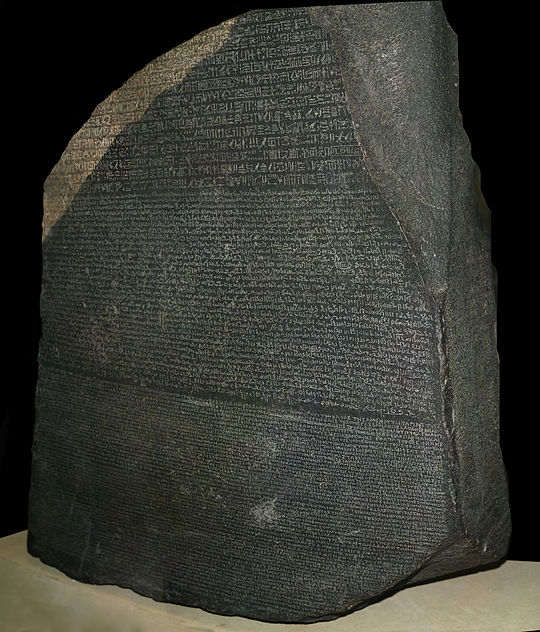
The Rosetta Stone is a granodiorite stele, found in 1799, inscribed with three versions of a decree issued at Memphis, Egypt in 196 BC during the Ptolemaic dynasty on behalf of King Ptolemy V. The top and middle texts are in Ancient Egyptian using hieroglyphic script and Demotic script, respectively, while the bottom is in Ancient Greek. As the decree has only minor differences between the three versions, the Rosetta Stone proved to be the key to deciphering Egyptian hieroglyphs.
Napoleon’s 1798 campaign in Egypt came at (and helped cause) the beginning of a burst of Egyptomania in Europe, and especially France. A corps of 167 technical experts (savants), known as the Commission des Sciences et des Arts, accompanied the French expeditionary army to Egypt. On July 15, 1799, French soldiers under the command of Colonel d’Hautpoul were strengthening the defences of Fort Julien, a couple of miles north-east of the Egyptian port city of Rosetta (modern-day Rashid). Lieutenant Pierre-François Bouchard spotted a slab with inscriptions on one side that the soldiers had uncovered.[36] He and d’Hautpoul saw at once that it might be important and informed General Jacques-François Menou, who happened to be at Rosetta.[A] The find was announced to Napoleon’s newly founded scientific association in Cairo, the Institut d’Égypte, in a report by Commission member Michel Ange Lancret noting that it contained three inscriptions, the first in hieroglyphs and the third in Greek, and rightly suggesting that the three inscriptions were versions of the same text. Lancret’s report, dated July 19, 1799, was read to a meeting of the Institute soon after July 25. Bouchard, meanwhile, transported the stone to Cairo for examination by scholars. Napoleon himself inspected what had already begun to be called la Pierre de Rosette, the Rosetta Stone, shortly before his return to France in August 1799.[9]
The Russian woman arrested this week on charges of being a foreign agent has ties to Russian intelligence operatives and was in contact with them while in the United States, federal prosecutors said Wednesday.
Maria Butina, 29, also cultivated a “personal relationship” with an American Republican consultant as part of her cover and offered sex to at least one other person “in exchange for a position within a special interest organization,” according to a court filing.
After a hearing on Wednesday afternoon, U.S. Magistrate Judge Deborah A. Robinson denied Butina’s request to be released on bail, finding that no combination of conditions would ensure her return to court.
WASHINGTON — For four years, a Russian accused of being a covert agent pursued a brazen effort to infiltrate conservative circles and influence powerful Republicans while she secretly was in contact with Russian intelligence operatives, a senior Russian official and a billionaire oligarch close to the Kremlin whom she called her “funder,” federal prosecutors said on Wednesday.
The woman, Maria Butina, carried out her campaign through a series of deceptions that began in 2014, if not earlier, prosecutors said. She lied to obtain a student visa to pursue graduate work at American University in 2016. Apparently hoping for a work visa that would grant her a longer stay, she offered one American sex in exchange for a job. She moved in with a Republican political operative nearly twice her age, describing him as her boyfriend. But she privately expressed “disdain” for him and had him do her homework, prosecutors said.
In a dramatic two-hour hearing in Federal District Court here, prosecutors said that Ms. Butina, who is charged with conspiracy and illegally acting as an agent of the Russian government, was the point person in a calculated, long-term campaign intended to steer high-level politicians toward Moscow’s objectives. Though prosecutors did not name any party or politician, Ms. Butina’s efforts were clearly aimed at Republican leaders, especially those with White House aspirations in 2016, including Donald J. Trump.
Walker posed for a photo with her at a National Rifle Association meeting in Tennessee in 2015. In the photo, Walker stood between Butina and Alexander Torshin, who is not named in court filings but is the “Russian official” who gave Butina orders as part of the conspiracy, according to the New York Times.
At the time of the photo at the NRA event, Walker was preparing to launch his presidential bid. Soon afterward, Butina attended Walker’s event announcing his campaign launch.
Walker said he has not been contacted by authorities and knows of no one from his campaign who has been.
Walker said he did not recall whether he spoke Russian to her but did take one semester of the language in college.
Asked if he remembered talking to her, Walker said, “Well, I do now because it’s all over the media. But to me, it’s just another person we met.”
In a court filing Wednesday, prosecutors alleged Butina was in touch with Russian intelligence operatives and once offered sex to someone in exchange for a position with an unnamed special interest group
(Walker remembered his college Russian, these years later? Perhaps, but his brief use of that language was surely meant to catch her notice, to impress. It was, in any event, a shallow effort: unless one is prepared for a full conversation, one does better to speak naturally in one’s own language.)
Walker’s encounter with Butina had been reported previously by news organizations including Mother Jones and Rolling Stone, thanks to pictures posted by Butina on her social media pages.
In a blog post attributed to Butina from April 2015, she posted a picture of herself with Walker, writing that she “did not hear any aggression towards our country, the president or my compatriots.” She also posted a picture from July 2015 taken from the crowd at Walker’s official presidential campaign kickoff July 13, 2015.
….
Butina’s connections to another Wisconsin politician were far more pronounced.
In late 2015, a group she ran helped pay for a delegation from the National Rifle Association to visit Russia. That delegation included former Milwaukee County Sheriff David Clarke.
(I’ve never been a member of the National Rifle Association, but as others have remarked, after numerous reports of ties to Russian operatives, one has reason to wonder what nation the word ‘national’ truly describes.)
After a short time bystanders got out of their cars and rushed to help the woman out of the opening.
The bridge operator was made aware of the incident and did not move the bridge span until everyone was off of the bridge, the Menasha Police Department said.
The woman was taken to a local hospital and treated primarily for facial injuries, police said.
Over at The Atlantic, Danielle Pletka of the conservative American Enterprise Institute scolds critics of Trump, as she believes The Anti-Trump Hysteria Isn’t Helping:
President Donald Trump’s press conference with Russia’s Vladimir Putin was a debacle. The president went from an anodyne prepared statement to a question-and-answer session that ping-ponged between stunning and appalling (with a bit of emetic thrown in for good measure). Suffice it to say, it was a new low from a chief executive who is redefining the term.
But the reaction on Twitter from the foreign-policy establishment was almost as untethered as Trump himself.
….
But it’s Trump’s words that are terrible. His policies are, in the main, not. The United States has crushed Russia beneath escalating sanctions, pulled out of the dreadful Iran deal, armed the Ukrainian opposition to Putin, stood up to China’s theft of American intellectual property, actually bombed Syrian chemical-weapons sites, and increased defense spending. Sure, there’s plenty to dislike in Trump’s foreign policy, including his trade wars, his dismissal of allies, his toying with nato, and his Obama-esque desire to skip out of Syria. But his stupid rhetoric masks a mostly normal, if not always sensible or desirable, foreign policy. And Trump’s national-security strategy is at least coherent when compared with the incoherent global retreat embraced by the last administration.
Pletka’s analysis – really a rationalization of Trumpism – is powerfully silly, twice over.
First, consider her claim that somehow those criticizing Trump for breaking decades of foreign policy norms are ‘almost’ as unhinged as Trump’s own conduct. Indeed, by her assessment, Trump is unhinged, but we should all be oh-so-careful in reply. This is part of the Trumpists’ broader civility debate: Trump says anything vulgar he wants, and in reply to acerbic criticism, his followers demand – of all things – civility.
After a man vomits all over his dinner guests, Pletka asks that he be very gently removed from the dining room.
Second, there’s her false distinction between words and actions, as though – absurdly – diplomacy had no linguistic foundation. Trump can say what he wants, but others should (under Pletka’s analysis) give no credence to those words. Perhaps Pletka thinks that if a man doesn’t beat his spouse, but ‘merely’ threatens and berates her each day, that she should disregard those mere words, and think only of his absence of action.
Words are actions, for goodness’ sake.
As for actions, on which Pletka seeks to exonerate Trump, she offers a string of falsehoods. We’ve not crushed Russia under sanctions (she’s still in Ukraine, still holding the seized territory of Crimea, still murdering expatriates abroad, still propping up the poison-gas-using regime in Syra, and still at work to interfere in another American election this fall). Pletka thinks the Iran deal was terrible, but she’ll need to show that Trump has a better alternative; if she lives to be a hundred, she’ll not be able to show Trump capable of such.
On NATO, NAFTA, the TPP, relations with Canada & Mexico, treatment of migrants, a starry-eyed view of Kim Jong-un, and on international trade with the European Union, there’s nothing ‘mostly normal’ about Trump’s foreign policy.
At home, of course, Trump exhibits a bigoted, authoritarian, self-dealing impulse that’s unlike anything American has seen from a modern president. That conduct has national and international implications that Pletka crudely ignores.
If opposing Trump in strenuous terms means that Pletka thinks us unhelpful, then we many millions who oppose him have every reason to go on being unhelpful and disappointing her again and again.
Wednesday in Whitewater will be mostly sunny with a high of seventy-nine. Sunrise is 5:33 AM and sunset 8:28 PM, for 14h 55m 25s of daytime. The moon is a waxing crescent with 37% of its visible disk illuminated.
Today is the six hundred twelfth day.Days since Trump’s election, with 11.9.16 as the first day.
Whitewater’s Parks & Recreation Board agenda lists a meeting time of 5:30 PM today.
On this day in 1865, four Wisconsin regiments muster out: “The 3rd and 18th Wisconsin Infantry regiments and the 1st and 6th Wisconsin Light Artillery batteries mustered out.”
So many people at the higher ends of intelligence loved my press conference performance in Helsinki. Putin and I discussed many important subjects at our earlier meeting. We got along well which truly bothered many haters who wanted to see a boxing match. Big results will come!So many people at the higher ends of intelligence loved my press conference performance in Helsinki. Putin and I discussed many important subjects at our earlier meeting. We got along well which truly bothered many haters who wanted to see a boxing match. Big results will come!
(Many of Trump’s remarks have this same childish character, with their habitual mixture of weak thinking, evident insecurity, and stunted expression. The ‘higher ends of intelligence,’ however odd, is an expression Trump uses to awe the ignorant or slow-witted into believing that somewhere, someplace, there are supposedly clever people who support Trump’s approach, and so others should fall in line.)
Russian Foreign Minister Sergey Lavrov, a master of diplomatic verbosity and sardonic barbs, summed up the results of the Helsinki summit in just three exuberant words: “better than super.”
After four years of getting short shrift by his American counterparts, Russian President Vladimir Putin was standing side by side with President Trump, who lavished him with the words of praise, respect and awe normally only heard on Russian state television.
When Putin militarily intervened in Ukraine in 2014, President Barack Obama called Russia a “regional power” that threatened its neighbors out of weakness, not strength. Russia’s annexation of Crimea set off a precipitous decline in relations with the United States. When he took office, Trump could not reverse the trend because of accusations that Moscow interfered in the 2016 election.
And then, without any change in Kremlin policy, Trump agreed to sit down one-on-one with Putin.
It’s hard to know what to say after a day—a week—like the one we’ve just experienced. On one hand, none of it should’ve come as a surprise. The full frontal assault on our closest allies in the EU and NATO, like the assault on the free press and the pointless flattery of Vladimir Putin, stretch back two years to the 2016 campaign. Donald Trump has spent this past week doing exactly what he said he would do before his election, and doubling down on the denials that anything but his own genius helped him win that election. And yet, no matter how many times we’ve heard “NO COLLUSION!,” there’s something about watching it unfold in real time that stuns in a way that—like catching a cheating partner after months of suspicion or seeing a loved one die after a terminal illness—no amount of intellectual knowing, understanding, or expecting can prepare you for.
After Trump and Putin met in Helsinki, many pundits and politicians struggled to understand what it is they saw, to rationalize it, to explain it away, to speculate on what kinds of kompromat the Russians could have on Trump, when the answer—like infidelity or death—was staring them, us, in the face. Yes, Putin has something on Trump: He helped him win. That’s the kompromat.
Facing the press after his meeting with Trump, Putin admitted—openly, arrogantly—that yes, he had wanted Trump to win in 2016. But we had known that as early as…2016. His state-run media didn’t do much to hide their boss’s preference: anyone but Hillary Clinton. I remember constantly explaining that summer why Putin preferred Trump to Clinton. Through the spring of 2016, Kremlin TV was clear that it wasn’t that Putin wanted Trump to win, it was that he wanted Clinton to lose. The propaganda machine—and, as we now know, the covert influence machine—got behind Bernie Sanders, Donald Trump, Jill Stein—anyone who wasn’t Clinton.
(There’s likely more Putin has on Trump, but Ioffe’s core claim is right: Putin helped elect Trump, and that alone is a powerful lever.)
For the Kremlin, the summit was only the beginning.
Russian commentators and politicians declared the meeting here between Presidents Trump and Vladimir Putin a triumph, concluding that Trump was finally serious about fulfilling his campaign promise to improve relations with Moscow.
“It is here in Helsinki where the first step toward a better future was made,” government newspaper Rossiyskaya Gazeta proclaimed.
Now, Russian officials are waiting to see whether Trump’s words will translate into action or fall flat in the face of a U.S. establishment that they view as determined to reverse the thaw.
Andrei Klimov, deputy head of the foreign affairs committee in Russia’s upper house of parliament, said in an interview Tuesday that he expected senior U.S. and Russian officials to meet repeatedly in the next six months and hammer out a “road map” toward resolving contentious issues and deepening cooperation.
In 1865, cartoonist Oscar Harpel drew A Proper Family Re-Union, depicting notorious American traitors Benedict Arnold and Jefferson Davis drinking a treason toddy of Satan’s creation.
I’ll not presume to make the theological claim that Trump will, in fact, one day find himself in the company of those three, but as a political matter, America’s going to need a bigger cartoon.
A biting cartoon showing Confederate president Jefferson Davis in league with both the devil and Revolutionary War traitor Benedict Arnold. Arnold and Davis stir a cauldron of “Treason Toddy,” a brew into which the devil drops miniature black slaves. The devil holds a pitchfork and gloats, “I feel proud of my American sons–Benedict and Jeff.” Davis, dressed in a bonnet, shawl, and dress (see “The Chas-ed “Old Lady” of the C.S.A.,” no. 1865-11) [popular accounts at the time claimed Davis disguised himself to avoid Union capture], explains to his fellow traitor, “Well, Arnold, the C.S.A. [Confederate States of America] are “done gone” so I have come home.” Arnold greets him, “Welcome, Davis! Thou shalt be warmly received by thy father.” At the cauldron base, marked “1865,” lie two skulls, marked “Libby” and “Andersonville,”–no doubt intended to represent Union victims of the two notorious Confederate prisons Libby and Andersonville. Copperheads writhe on the ground. Near Davis’s feet are a bag of “Stolen Gold” and a valise marked with his initials and “C.S.A. 1865.”
This Wednesday, July 18th at 12:30 PM, there will be a showing of Loving Vincent @ Seniors in the Park, in the Starin community building.
Dorota Kobiela & Hugh Welchman direct the one-hour, thirty-four-minute animated biography:
A year after the death of the artist, Vincent van Gogh, Postman Roulin gets his slacker son, Armand, to hand deliver the artist’s final letter written to his now late brother, Theo, to some worthy recipient after multiple failed postal delivery attempts. Although disdainful of this seemingly pointless chore, Armand travels to Auvers-sur-Oise where a purported close companion to Vincent, Dr. Gachet, lives. Having to wait until the doctor returns from business, Armand meets many of the people of that village who not only knew Vincent, but were apparently also models and inspirations for his art. In doing so, Armond becomes increasingly fascinated in the psyche and fate of Van Gogh as numerous suspicious details fail to add up. However, as Armond digs further, he comes to realize that Vincent’s troubled life is as much a matter of interpretation as his paintings and there are no easy answers for a man whose work and tragedy would only be truly appreciated in the future. Written by Kenneth Chisholm (kchishol@rogers.com)
Filmmaking for “[e]ach of the film’s 65,000 frames is an oil painting on canvas, using the same technique as Van Gogh, created by a team of 125 painters.[10] The film premiered at the 2017 Annecy International Animated Film Festival.[2] It won Best Animated Feature Film Award at the 30th European Film Awards in Berlin and was nominated for Best Animated Feature at the 90th Academy Awards.”
The cast includes Robert Gulaczyk as Vincent van Gogh, Douglas Booth as Armand Roulin, Jerome Flynn as Paul Gachet, and Saoirse Ronan as Marguerite Gachet.” The film is rated PG-13 by the MPAA.