One reads that the Janesville Gazette is activating a full-site paywall (three free articles a month, day pass for a dollar, Facebook comment authorization, etc.). The stated reason is that the Gazette needs money (“Digital advertising and marketing don’t generate enough revenue to cover the expenses of our local journalism”).
A few observations:
1. Private Enterprise. The Gazette‘s a private concern, and a private concern can set fees and limitations of this kind. My interest here is to write about whether this change makes any sense; one writes about this the way one writes about other legitimate but misguided efforts.
2. The Three-Article-Per-Month Limit. Odd, very odd, to price the Gazette so high. Ordinarily, one would pick the median articles per month, and set the paywall above that number. (See, for example, how The Atlantic is doing just that beginning next year.)
Setting the paywall limit at the median makes sense – half of one’s readers aren’t affected; the other half (the more motivated ones at the top of the readership scale) are the ones who are more likely to subscribe, anyway.
That simply can’t be the approach here, because if the Gazette‘s median readership is three articles a month, the paper’s on its last legs anyway.
Far more likely is that the Gazette has priced the paper even below the median, meaning they expect far more than half of their readers to be subscription prospects. That’s simply nutty: the Gazette‘s unrealistic to expect a greater percentage of prospects than half their existing digital readers.
(Again, the only other explanation would be if they have very few digital readers, so they expect more than half of a very small – presumably motivated – number.)
Either they’re worse off than anyone understands, or they’ve worse in understanding than anyone’s so far imagined.
3. Paywall Priorities. A paywall that kicks in quickly will force readers either to subscribe or select very carefully. Among those who select carefully, there’s likely to be a priority for the attention-grabbing & sensational. Crime, scandal, etc. will take priority over stories about hobbies and clubs.
Press releases – from Whitewater or elsewhere – will fall at the bottom of a non-subscriber’s priority list. Flacks from local government, school districts, colleges, or clubs can forget about non-subscribers wasting their three articles per month on press releases.
Throwing those press releases to the wind would probably get more readers than expecting non-subscribers to read them.
4. FOMO. One of the reasons one looks at a story is for what it says, and to know what others are reading. So sometimes one reads for fear of missing out. If, however, potential readers conclude that few people are subscribers anyway, and that what’s behind the paywall doesn’t get much notice, they won’t bother to look at what’s behind the paywall, either. They won’t feel that they’re missing out.
5. The Sensational. One way to entice people to pay to read stories is to make them increasingly sensational (“Extraterrestrials Abduct Janesville City Manager, Ask Him What the Hell’s Wrong with City’s Streets”).
But the sensational – about actual crimes, controversies – brings the risk of the defamatory. There’s an increased risk of liability if the paper isn’t thoroughly reviewing hard-hitting, attention-seeking stories about real events.
6. Demographics. A paywall like this will affect those who care more about the Janesville Gazette – those in, naturally, Janesville. That’s of course by design. The change will have less impact in peripheral areas that care less.
In those peripheral areas, there’s an opportunity for other publications to erode whatever readership the Gazette has.
Area competitors to the Gazette must be thrilled right now.
Tuesday in Whitewater will be partly cloudy with a high of forty-two. Sunrise is 7:21 AM and sunset 4:23 PM, for 9h 01m 42s of daytime. The moon is a waxing crescent with 1.6% of its visible disk illuminated. Today is the {tooltip}four hundred fifth day.{end-texte}Days since Trump’s election, with 11.9.16 as the first day.{end-tooltip}
Whitewater’s Common Council meets tonight at 6:30 PM.
Washington’s poorly fed, ill-equipped army staggered into Valley Forge, weary from long marches. Winds blew as the 12,000 Continentals prepared for winter’s fury. Only about one in four of them had shoes, and many of their feet had left bloody footprints from the marching.[4] Grounds were selected for brigade encampments, and defense lines were planned and begun.
The first properly constructed hut appeared in three days. One hut required 80 logs, and timber had to be collected from miles away. A hut could go up in one week with the use of only one axe. These huts provided sufficient protection from the moderately cold and wet conditions of a typical Pennsylvania winter. By the beginning of February, construction was completed on 2,000 huts. They provided shelter, but did little to offset the critical shortages that continually plagued the army.[5]
On this day in 1862, the Wisconsin 1st Light Artillery prepares for Vicksburg Campaign.
White House lawyers are expected to meet with special counsel Robert S. Mueller III’s office late this week seeking good news: that his sprawling investigation’s focus on President Trump will soon end and their client will be cleared.
But people familiar with the probe say that such assurances are unlikely and that the meeting could trigger a new, more contentious phase between the special counsel and a frustrated president, according to administration officials and advisers close to Trump.
People with knowledge of the investigation said it could last at least another year — pointing to ongoing cooperation from witnesses such as former Trump campaign adviser George Papadopoulos and former national security adviser Michael Flynn, as well as a possible trial of two former Trump campaign officials. The special counsel’s office has continued to request new documents related to the campaign, and members of Mueller’s team have told others they expect to be working through much of 2018, at a minimum….
(Trump will either have to expect a lengthy, properly thorough inquiry or precipitate a constitutional crisis.)
The president worried that Gorsuch would not be “loyal,” one of the people said, and told aides that he was tempted to pull Gorsuch’s nomination — and that he knew plenty of other judges who would want the job….
Trump was especially upset by what he viewed as Gorsuch’s insufficient gratitude for a lifetime appointment to the nation’s highest court, White House officials said. The judge sent the president a handwritten letter dated March 2, thanking him for the nomination and explaining how grateful he was, according to a copy obtained by The Post.
“Your address to Congress was magnificent,” Gorsuch wrote. “And you were so kind to recognize Mrs. Scalia, remember the justice, and mention me. My teenage daughters were cheering the TV!”
(Thank goodness Gorsuch’s fawning note – “magnificent” – turned up – he might have been out of an appointment otherwise.)
Last year, Eliot Cohen rallied dozens of fellow veterans of Republican administrations, people like him who had served in the upper reaches of the Pentagon, State Department and National Security Council, to warn against Donald Trump winning the White House. He would become, the group open letter Cohen organized said, “the most reckless president in American history.”
A year later, Cohen, a top official in President George W. Bush’s administration, and another charter #NeverTrump proselytizer, his fellow conservative Max Boot, hardly back down when asked whether their predictions of global gloom and doom had been proven right in the first year of the Trump presidency. Both men, lifelong Republicans and historically minded policy intellectuals, offered unequivocal yeses in a joint interview for this week’s Global Politico podcast – and castigated former friends inside the party they’ve both now renounced as “Vichy Republicans” for collaborating with a president they believe is not fit to hold office.
Boot pronounced Trump both “incredibly erratic and unpredictable,” though he allowed that “some of the worst-case scenarios that we imagined have yet, mercifully, come to pass.” Just because Trump has not yet destroyed NATO, launched a trade war with China or torn up NAFTA, lifted sanctions on Russia in a grand bargain with Vladimir Putin, or started a war with North Korea, Boot argued, does not mean he won’t.
“It’s true, they haven’t started World War III yet,” Cohen added. “That’s a pretty low bar.”
(Opposition was right during the campaign, is right now, and will be right until Trump meets his political ruin. Autocratic, bigoted, ignorant, conflicted, and fawning of America’s enemies merits only opposition.)
MADISON – From laundry and legal services to computer upgrades and health care, state taxpayers spent $653 million last year on private workers, part of a growing reliance on outside firms to do public business.
In the final term of Democratic Gov. Jim Doyle, these payments dropped, falling from $490 million in 2006 to $417 million in 2010, according to figures from the state Department of Administration.
But under the first six years of GOP Gov. Scott Walker, spending on contractors rose by 57%, or several times the rate of inflation for that period. Contractors are often more expensive than state employees — but not always, officials said….
Overall, state jobs haven’t been cut under Walker — they’ve actually risen by nearly 3% during his time in office to 70,400 full-time positions, according to the Legislature’s budget office.
But outsourcing has risen more quickly. The Walker administration says the increase has been driven in part by a once-in-a-generation overhaul of state computers and by a shortage of state workers in some jobs….
(Wisconsin’s not spending less – she’s increasing and redistributing spending.)
Over at The Atlantic, there’s an interview with Rabbi Sharon Brous, the senior rabbi at IKAR, a non-denominational synagogue in California. See‘I’ve Spent My Life Studying These Books That Say Decency Actually Matters.’ Rabbi Brous describes religious belief among progressives in contemporary America, and two of her observations are particularly suited even to Whitewater (or other small towns). Emma Green conducts the interview —
On the need for interfaith outreach:
Emma Green: You’ve been hanging out with William Barber, right? Wasn’t he recently at IKAR?
Rabbi Brous: Before launching the Poor People’s Campaign, he did a series of massive town halls around the country. They called to ask whether I would speak the night before Rosh Hashanah. And I said, ‘I’ll happily do that if William will come to share a little bit of his Torah with us the next day.’ It was an incredibly powerful moment for our community, and I think for him, too.
There is a bigger national conversation happening right now, and Jews are a part of it. It is about progressive religious voices not being afraid to say there’s decent, and there’s indecent. There are people who are fighting for dignity, and people who are fighting to deprive other people of their dignity. We have to be willing to stand up and fight with a prophetic voice.
One unites and allies with others, including new friends from faraway places, to a general advantage.
On faith and political controversy:
Rabbi Brous: I went to give a talk at a [synagogue] in the early spring, and I asked the rabbi in advance of the talk, ‘Are there any hot-button issues I should avoid?’ I don’t really go there to get them in trouble; I want to make sure I know where the community is. And he said, ‘You can talk about anything you want, but not politics.’ He said, ‘We have three Trump supporters in the community’—three, out of a community of 1800 families—‘and they will go ballistic.’ He was told, after the inauguration, not to say the word ‘Pharoah’ because it seems political, like an attack on Trump. Rabbis are being told, because there are three people who think that the most profoundly indecent candidate for president that we have ever seen, and the most unqualified, reckless, bigoted and indecent candidate has risen to power, that now we can’t speak Torah anymore because it might make people think we’re uncomfortable with that person and his values.
For me, I say what I need to say. I’m not looking to build the biggest, widest tent so that any person with any political perspective should and could feel absolutely comfortable here. I think in those environments, we become so neutral and so numb that we can’t actually say something.
The new normal is not normal. I’m glad I’m not in an environment where I’m afraid to say out loud, ‘This is not okay.’ I say that not because I’m a political pundit, but because I’m a rabbi, and I’ve spent my life studying these books that say decency actually matters….
There’s great truth, and sadness, in her observation. Formerly, in a place like Whitewater, a few local notables – mostly mediocre and wholly entitled – expected and received undeserved deference for their ill-considered positions and self-promoting claims. Theirs was a kind of big-government conservatism, with public resources disproportionately controlled and unevenly distributed. They walked around like they owned the place.
Their own errors were That Which Paved the Way for something worse, and beyond their control: a brassy, loud, ignorant nativism that doesn’t think – and so doesn’t care – about anyone outside itself. SeeOld Whitewater and Populism.
Neither Old Whitewater nor a new Populism deserves deference and appeasement. These Old Whitewater men and women who are silent in the face of Trumpism either implicitly support its aims or are too weak to resist.
Men and women, having as children graduated from crawling to walking, shouldn’t willingly return to their original method of locomotion.
Rabbi Brous wisely offers a better way: say what one needs to say.
Monday in Whitewater will be increasingly sunny with a high of forty-one. Sunrise is 7:21 AM and sunset 4:22 PM, for 9h 01m 50s of daytime. The moon is new, with 0.1% of its visible disk illuminated. Today is the {tooltip}four hundred fourth day.{end-texte}Days since Trump’s election, with 11.9.16 as the first day.{end-tooltip}
Whitewater’s Library Board meets at 6:30 PM, and the Whitewater Unified School Board at 6:15 PM (closed session at 6:15 PM, open session beginning at 7 PM).
On this day in 1865, the Thirteenth Amendment goes into effect. On this day in 1863, the Milwaukee Sentinel calls for better pay for soldiers: “If any men deserve to be well paid it is the men who are enduring the hardships and running the risks of a war like this.”
Unless you’ve been living under a rock — or are the aging executive chairman of News Corp. — you know that Fox News has been ground zero in the epidemic of sexual assault scandals in which powerful men have abused younger, more vulnerable women. Fox, of course, has been slammed by a series of sexual harassment cases that cost the company tens of millions in settlement money and ended the careers of Bill O’Reilly, Roger Ailes, Eric Bolling and Fox News co-president Bill Shine (who was accused of covering up a culture of sexual predation).
So it was more than a bit stunning that News Corp.’s executive chairman Rupert Murdoch chose to brush off the epidemic of sexual harassment that has bludgeoned his company — especially during a cultural firestorm in which star news personalities, entertainment moguls and politicians have been forced out of their jobs (and in a few egregious cases now face criminal investigations) for accused sexual misconduct. Everywhere the code of silence that protected abusive men is crumbling — but the elderly news tycoon seems oblivious….
(He does need to go, but he won’t, and even if he does go, Lachlan Murdoch – likely to run the news side of things – will prove no better.)
There’s a certain corporate mind-set that allows a sexual harassment culture to germinate and thrive for decades. And it was on display Thursday, as 21st Century Fox mogul Rupert Murdoch was interviewed by Sky’s Ian King about the company’s deal to sell its entertainment assets to Walt Disney Co. for $52 billion. When King asked whether Fox News’s troubles with sexual harassment over the past two years had harmed the company, Murdoch riffed:
“All nonsense, there was a problem with our chief executive, sort of, over the years, isolated incidents,” replied Murdoch. “As soon as we investigated it he was out of the place in hours, well, three or four days. And there’s been nothing else since then. That was largely political because we’re conservative. Now of course the liberals are going down the drain — NBC is in deep trouble. CBS, their stars. I mean there are really bad cases and people should be moved aside. There are other things which probably amount to a bit of flirting.”
What a grasp of history: Under the always-vigilant supervision of Murdoch himself, that chief executive, the late Roger Ailes, spent two decades at Fox gathering accusers. The stories ranged from the merely gross — like the time he went after Megyn Kelly in the 2000s: “He tried to grab me three times. Make out with me, which he didn’t. But I had to shove him off of me. And he came back. And I shoved him again, and he came back a third time. And then when I shoved him off a third time he asked me when my contract was up,” said Kelly — to the barbaric, like the psychological torture he visited upon a Fox News booker….
There’s more than one way to harass women. A raft of men in recent weeks have paid for accusations of sexual harassment with their companies, their jobs, their plum political posts. But one point has been overlooked in the scandals: Men can be belittling, cruel and deeply damaging without demanding sex. (Try sloughing off heaps of contempt with your self-esteem intact.) We have no consensus — and hardly any discussion — about how we should treat behaviors that are misogynist and bullying but fall short of breaking the law.
Twenty years ago, when I was a Moscow correspondent for the Baltimore Sun, two Americans named Matt Taibbi and Mark Ames ran an English-language tabloid in the Russian capital called the eXile. They portrayed themselves as swashbuckling parodists, unbound by the conventions of mainstream journalism, exposing Westerners who were cynically profiting from the chaos of post-Soviet Russia.
A better description is this: The eXile was juvenile, stunt-obsessed and pornographic, titillating for high school boys. It is back in the news because Taibbi just wrote a new book, and interviewers are asking him why he and Ames acted so boorishly back then. The eXile’s distinguishing feature, more than anything else, was its blinding sexism — which often targeted me….
(Taibbi and Ames: Americans in Moscow who behaved like the worst of Russia – and of America – to their fellow Americans living abroad.)
In March of 1968, as part of a tour of US cities to shine a light on poverty and drum up support for the recently-launched Poor People’s Campaign, the Rev Dr Martin Luther King Jr visited the northwest Mississippi town of Marks. He saw a teacher feeding schoolchildren a meager lunch of a slice of apple and crackers, and started crying.
Earlier this month, officials from the United Nations embarked on a similar trip across the US, and what they observed was a crisis of systemic poverty that Dr King would have recognized 50 years ago: diseases like hookworm, caused by open sewage, in Butler County, Alabama, and breathtaking levels of homelessness in Los Angeles’ Skid Row, home to 55,000 people….
The morally troubling conditions Dr King witnessed across the country cemented his call, along with leaders in the labor movement, tenant unions, farm workers, Native American elders and grassroots organizers, for a campaign to foster a revolution of values in America.
Half a century later, the conditions that motivated the 1968 Poor People’s Campaign have only worsened, making the need for a new moral movement more urgent than ever. Compared to 1968, 60% more Americans are living below the official poverty line today – a total of 41 million people. The gap between our government’s discretionary spending on the military versus anti-poverty programs has grown from two-to-one at the height of the Vietnam war to four-to-one today….
Sunday in Whitewater will be cloudy with a high of thirty-seven. Sunrise is 7:20 AM and sunset 4:22 PM, for 9h 02m 01s of daytime. The moon is new, with .03% of its visible disk illuminated. Today is the {tooltip}four hundred third day.{end-texte}Days since Trump’s election, with 11.9.16 as the first day.{end-tooltip}
On this day in 1903, the Wright Brothers successfully achieve controlled, human-powered flight:
the Wrights finally took to the air on December 17, 1903, making two flights each from level ground into a freezing headwind gusting to 27 miles per hour (43 km/h). The first flight, by Orville at 10:35 am, of 120 feet (37 m) in 12 seconds, at a speed of only 6.8 miles per hour (10.9 km/h) over the ground, was recorded in a famous photograph.[41] The next two flights covered approximately 175 and 200 feet (53 and 61 m), by Wilbur and Orville respectively. Their altitude was about 10 feet (3.0 m) above the ground.[76] The following is Orville Wright’s account of the final flight of the day:
Wilbur started the fourth and last flight at just about 12 o’clock. The first few hundred feet were up and down, as before, but by the time three hundred ft had been covered, the machine was under much better control. The course for the next four or five hundred feet had but little undulation. However, when out about eight hundred feet the machine began pitching again, and, in one of its darts downward, struck the ground. The distance over the ground was measured to be 852 feet; the time of the flight was 59 seconds. The frame supporting the front rudder was badly broken, but the main part of the machine was not injured at all. We estimated that the machine could be put in condition for flight again in about a day or two.[77]
European doubts about their achievement turned into effusive praise after their 1908 public exhibition:
The brothers’ contracts with the U.S. Army and a French syndicate depended on successful public flight demonstrations that met certain conditions. The brothers had to divide their efforts. Wilbur sailed for Europe; Orville would fly near Washington, D.C.
Facing much skepticism in the French aeronautical community and outright scorn by some newspapers that called him a “bluffeur”, Wilbur began official public demonstrations on August 8, 1908 at the Hunaudières horse racing track near the town of Le Mans, France. His first flight lasted only one minute 45 seconds, but his ability to effortlessly make banking turns and fly a circle amazed and stunned onlookers, including several pioneer French aviators, among them Louis Blériot. In the following days, Wilbur made a series of technically challenging flights, including figure-eights, demonstrating his skills as a pilot and the capability of his flying machine, which far surpassed those of all other pioneering aircraft and pilots of the day.[103][104]
The French public was thrilled by Wilbur’s feats and flocked to the field by the thousands, and the Wright brothers instantly became world-famous. Former doubters issued apologies and effusive praise. L’Aérophile editor Georges Besançon wrote that the flights “have completely dissipated all doubts. Not one of the former detractors of the Wrights dare question, today, the previous experiments of the men who were truly the first to fly …”[105] Leading French aviation promoter Ernest Archdeacon wrote, “For a long time, the Wright brothers have been accused in Europe of bluff … They are today hallowed in France, and I feel an intense pleasure … to make amends.”[106]
A lawyer for the Trump transition team on Saturday accused a federal agency of illegally and unconstitutionally turning over thousands of emails to the Special Counsel’s Office.
Specifically, the General Services Administration (GSA) turned over emails written during the transition — the period between Election Day 2016 and Inauguration Day 2017 — and the Trump campaign is claiming in a letter that the decision to do so violated the law.
Officials with both the Special Counsel’s Office and GSA, however, pushed back against the Trump campaign lawyer’s claims in the hours after the letter was issued….
Loewentritt read to BuzzFeed News a series of agreements that anyone had to agree to when using GSA materials during the transition, including that there could be monitoring and auditing of devices and that, “Therefore, no expectation of privacy can be assumed.”
[GSA Deputy Counsel Lenny] Loewentritt told BuzzFeed News that the GSA initially “suggested a warrant or subpoena” for the materials, but that the Special Counsel’s Office determined the letter route was sufficient.
As to whether the Trump campaign should have been informed of the request, Loewentritt said, “That’s between the Special Counsel and the transition team.”
Asked about Langhofer’s letter and Loewentritt’s statements — and after publication of this story — a spokesperson for the Special Counsel’s Office, Peter Carr, told BuzzFeed News, “When we have obtained emails in the course of our ongoing criminal investigation, we have secured either the account owner’s consent or appropriate criminal process.”
If Mueller didn’t follow the law, a court would suppress the evidence so it couldn’t be used. The reason Trump’s lawyers are writing letters to Congress instead of Mueller or a court is because their legal arguments have no merit. https://t.co/6Vy7jwKcY4
The right-wing commentary and President Trump’s criticism of the FBI are part of a vicious circle. The TV hosts encourage Trump, then Trump supplies sound bites for their shows, and then the hosts are even more emboldened.
With Mueller’s investigation of Russian interference in the 2016 election reaching closer to Trump’s inner circle, Fox hosts like Sean Hannity continue to demand Mueller’s firing. Every night, Hannity tells millions of viewers that Mueller’s probe is a corrupt plot to take down Trump and reverse the outcome of the election. Trump is a big fan of Hannity’s show, and the two men speak on a regular basis.
“The anti-Mueller rhetoric in conservative media right now is part of a feedback loop,” Nicole Hemmer, the author of a book about conservative media, “Messengers of the Right,” told CNNMoney.
“Conservative media personalities know Trump hates the investigation and wants it shut down,” she said in an email. “They bash the investigation and Mueller, and when Trump sees that happening (say, on ‘Fox & Friends’) it reinforces his belief that the investigation is illegitimate and that he should do something to end it. The likely consequence is that this increases the odds of Trump attempting to fire Mueller.”
Hemmer added: “We’ll have to wait and see whether internal restraints within the White House — lawyers and advisers — are enough to stop him from doing that.”
(One’s best, reasoned guess is that Trump will not exercise restraint, but will plunge America into a constitutional crisis. The question afteward: Which side was one on?)
From the airwaves of conservative media to the hearing rooms of the House of Representatives, Republican allies of the White House are attacking the Department of Justice investigation into Russian interference in the 2016 presidential election.
GOP voices are accusing the team assembled by special counsel Robert Mueller of bias against President Trump — and they’re appearing to set the stage for some action. Senior Justice Department officials are defending the investigation, which has already secured indictments or guilty pleas against four people with ties to the Trump campaign.
Here, we consider a few ways the White House or its allies could disrupt the special counsel probe.
1. Find a way to replace the attorney general….
2. Fire Justice Department officials who refuse to dismiss the special counsel, until you find one who will….
3. Pressure the Justice Department to investigate the investigators….
THE CACOPHONOUS and frequently confusing debates over the Russia investigations by special counsel Robert S. Mueller III and several committees of Congress tend to obscure some big and virtually uncontested truths: that the regime of Vladimir Putin intervened in the 2016 election with the intention of harming U.S. democracy; that it will almost certainly seek to do so again; and that there has been no concerted effort to defend the country from this national security threat.
We say “virtually uncontested” because the principal dissenter from this consensus, which unites U.S. intelligence agencies and a large bipartisan majority in Congress, is President Trump — who continues to shove away the conclusive proof about Russia’s actions compiled by American intelligence professionals and to obstruct efforts by his Cabinet and staff to respond to them.
A comprehensive report by Post reporters Greg Miller, Greg Jaffe and Philip Rucker contains dismaying evidence of the resulting dysfunction. Mr. Trump has never held a Cabinet-level meeting on the Russian intervention or on how to prevent its recurrence. At the National Security Council, it is understood that to bring up the Russian threat is to risk enraging the president. The same goes for the CIA officials who conduct Mr. Trump’s daily intelligence briefing; they sometimes leave material on Russia out of the oral session, so as not to send the session “off the rails,” in the words of a former senior official.
On December 12, Jeff Bezos’ rocket company Blue Origin launched a rocket test out of its base in West Texas. The launch included its Crew Capsule 2.0, which Blue Origin has adorned with giant windows for viewing. Following is a transcript of the video.
This is Blue Origin’s New Shepard rocket. Blue Origin launched the rocket out of West Texas. This is the first time the company has launched this capsule.
On top of the rocket is Crew Capsule 2.0 with giant windows. There was a crash test dummy in this flight. The rocket touched down on a landing site. The capsule used parachutes to land in the desert.
The flight peaked 61 miles above Earth. Blue Origin plans to launch tourists to space in a similar capsule by 2019.
Saturday in Whitewater will be partly cloudy with a high of thirty-nine. Sunrise is 7:19 AM and sunset is 4:22 PM, for 9h 02m 18s of daytime. The moon is a waning crescent with 2.5% of its visible disk illuminated. Today is the {tooltip}four hundred second day.{end-texte}Days since Trump’s election, with 11.9.16 as the first day.{end-tooltip}
On this day in 1773, the Sons of Liberty in Boston, Massachusetts hold the Boston Tea Party. On this day in 1864, Wisconsinites fight in defense of the Union: “the 8th, 14th, 24th, 33rd, 44th, and 45th Wisconsin Infantry regiments and the 6th Wisconsin Light Artillery were engaged in the Battle of Nashville, Tennessee. By the end of the day, 6,000 Confederate troops were killed, wounded or missing and Union forces had largely destroyed the Confederate ability to wage war in the region.”
The Trump administration is prohibiting officials at the nation’s top public health agency from using a list of seven words or phrases — including “fetus” and “transgender” — in any official documents being prepared for next year’s budget.
Policy analysts at the Centers for Disease Control and Prevention in Atlanta were told of the list of forbidden words at a meeting Thursday with senior CDC officials who oversee the budget, according to an analyst who took part in the 90-minute briefing. The forbidden words are “vulnerable,” “entitlement,” “diversity,” “transgender,” “fetus,” “evidence-based” and “science-based.”
In some instances, the analysts were given alternative phrases. Instead of “science-based” or “evidence-based,” the suggested phrase is “CDC bases its recommendations on science in consideration with community standards and wishes,” the person said. In other cases, no replacement words were immediately offered….
Fr. James Martin’s observation on this federal prohibition is spot on:
“Don’t you see that the whole aim of Newspeak is to narrow the range of thought? In the end we shall make thoughtcrime literally impossible, because there will be no words in which to express it,” George Orwell, “1984.” https://t.co/sz8GwsggwFhttps://t.co/OJDPVhvp7f
Memo to the President: Your attacks on the FBI aren’t working.
President Trump has apparently decided that attacking federal law enforcement is a good defense strategy in L’Affaire Russe. Conservative media outlets have picked up the cry, devoting hours of air time to the absurd proposition that the FBI is corrupt and biased in favor of Hillary Clinton—and against the President.
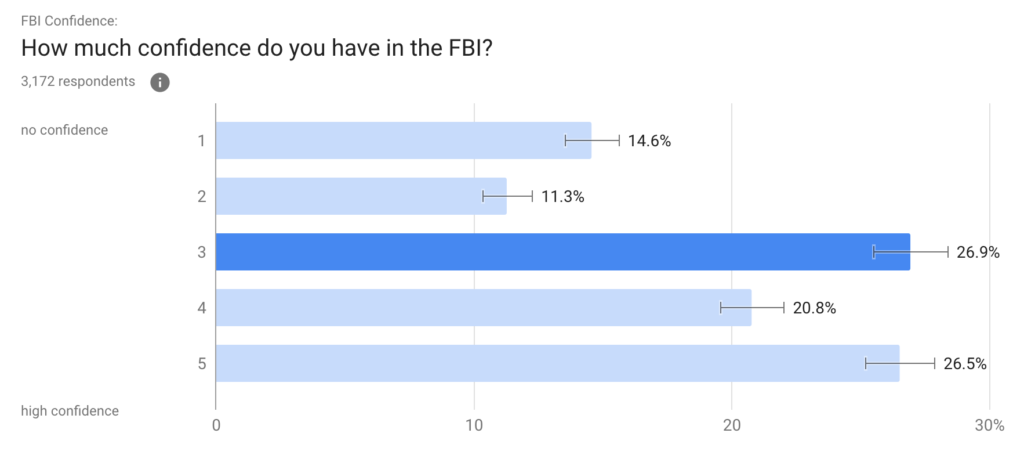
The other day, curious about the impact of such attacks on public opinion, we put a very simple poll in the field using Google Surveys. It asked one question, polled between December 5-7: “How Much Confidence Do You Have in the FBI?”
The answer was striking:
The average confidence rating for the FBI in this poll measured in at 3.34. That compares favorably to any other institution we poll on, save the military, which had an average confidence score of 3.78. The question polled here is subtly different from our other polls, which measure confidence in institutions as protectors of national security. This one asks about confidence in general—on the theory that the President’s attacks on the Bureau have been general attacks, not limited to the national security function. That said, the FBI’s rating was notably higher than the next highest institution, the intelligence community more broadly, which had an average confidence measure of 3.04. Forty-seven percent of respondents give the FBI higher confidence ratings, either 4 or 5. And fully 74 percent repose at least some confidence in the Bureau—that is, give it at least a rating of 3. By contrast, only 26 percent give the FBI lower confidence ratings, that is a rating of only 1 or 2.
(It’s important, however, that Trump only needs the support of politicians and Fox News to create a feedback loop in which the FBI is demonized to precipitate action against the bureau or Special Counsel Mueller. Afterward, an American majority will be left to respond to Trump’s actions. )
LONDON — At $1 billion, it is the most expensive embassy ever constructed. But its designers say the new American chancery on the Thames River marks a paradigm shift: The U.S. Embassy here will exude openness while hiding all the clever ways it defends itself from attack.
After decades of building American embassies that look brutalist or bland, like obvious fortresses, the soon-to-be-opened chancery in London is a crystalline cube, plopped down in the middle of a public park, without visible walls.
The building does not shout, “Spies work here!” or “Stand back!” even though this city has been subjected to terrorist attacks. Instead, the vibe is modernist museum, which also happens to issue visas and might have a few hidden bunkers somewhere.
Instead of blast walls, there is a perimeter pond, with recycled-water waterfalls and deep trenches — and on the roof, arrays of solar panels that will produce enough juice to run the building and give extra watts back to the grid….
(A billion is a vast sum, but if it should be a billion, then at least an open design, to match the character of our people. Long after everything of Trump has been swept away, we will yet be a free and welcoming society.)
….The fiscal bureau memo to Assembly Minority Leader Gordon Hintz, D-Oshkosh, now reveals the previously unknown cost of local road improvements on top of the $252.4 million in state bonding that was authorized to pay for the nearby expansion of Interstate 94.
“It’s really concerning that we’re going to be taking $134 million from rehab projects around the state of Wisconsin and we’re going to be paying for local road projects around the Foxconn project,” Hintz said. “A memo like this today highlights the absolute absence of transparency, accountability and credibility on this project.”
It’s unclear which statewide road projects would be affected if money is used instead to improve roads in Racine County.
But fiscal bureau analyst John Wilson-Tepeli explained in the memo that because the roads in Racine County were local roads when the 2017-19 budget was adopted it is “unlikely” that the work was accounted for in the state highway rehabilitation fund during the budget debate.
“Therefore, the use of state highway rehabilitation funding to complete this work near the Foxconn site would likely result in the delay of other, previously planned rehabilitation projects on state highways,” Wilson-Tepeli wrote….
Faster than a speeding bullet, more powerful than a locomotive, cooler than a cucumber in a bowl of hot sauce, it’s Piper the Aviation Bird Dog, ready for duty. Alongside his handler Brian Edwards, the dynamic duo protects the planes at Cherry Capital Airport from bird strikes. Birds can pose a huge threat to flight safety, but when they see Piper on his way, geese, ducks and gulls flee the runways. It’s an important job, but not one without its share of fun.
Friday in Whitewater will be cloudy with a high of thirty-two. Sunrise is 7:19 AM and sunset 4:21 PM, for 9h 02m 38s of daytime. The moon is a waning crescent with 6.3% of its visible disk illuminated. Today is the {tooltip}four hundred first day.{end-texte}Days since Trump’s election, with 11.9.16 as the first day.{end-tooltip}
On this day in 1791, following Virginia’s ratification, the Bill of Rights (those ratified from among proposed amendments) receives the required number of ratifications to take effect. On this day in 1847, Wisconsin’s Second Constitutional Convention convenes in Madison: “On this date the first draft of the Wisconsin Constitution was rejected in 1846. As a result, Wisconsin representatives met again to draft a new constitution in 1847. New delegates were invited, and only five delegates attended both conventions. The second convention used the failed 1846 constitution as a springboard for their own, but left out controversial issues such as banking and property rights for women that the first constitution attempted to address. The second constitution included a proposal to let the people of Wisconsin vote on a referendum designed to approve black suffrage.”
Recommended for reading in full —
Greg Miller, Greg Jaffe and Philip Rucker report Doubting the intelligence, Trump pursues Putin and leaves a Russian threat unchecked:
In the final days before Donald Trump was sworn in as president, members of his inner circle pleaded with him to acknowledge publicly what U.S. intelligence agencies had already concluded — that Russia’s interference in the 2016 election was real.
Holding impromptu interventions in Trump’s 26th-floor corner office at Trump Tower, advisers — including Trump’s son-in-law, Jared Kushner, and designated chief of staff, Reince Priebus — prodded the president-elect to accept the findings that the nation’s spy chiefs had personally presented to him on Jan. 6.
They sought to convince Trump that he could affirm the validity of the intelligence without diminishing his electoral win, according to three officials involved in the sessions. More important, they said that doing so was the only way to put the matter behind him politically and free him to pursue his goal of closer ties with Russian President Vladimir Putin.
“This was part of the normalization process,” one participant said. “There was a big effort to get him to be a standard president.”
But as aides persisted, Trump became agitated. He railed that the intelligence couldn’t be trusted and scoffed at the suggestion that his candidacy had been propelled by forces other than his own strategy, message and charisma….
(Every day Trump holds power he threatens America from within and invites threats from without.)
Washington Republicans have put the fiasco of Alabama’s special election behind them, but their electoral nightmare may just be beginning.
Roy Moore’s stunning defeat Tuesday night was met with quiet sighs of relief throughout the GOP establishment, where the culture-warring ex-judge and accused child abuser was widely regarded as radioactive. Yet even as Moore’s political obituaries were being written, party strategists were bracing for the army of Moore-like insurgents they expect to flood next year’s Republican primaries.
Indeed, Breitbart News chief Steve Bannon has already pledged to field challengers for every incumbent Republican senator up for reelection next year (with the exception of Ted Cruz). And even if Bannon fails to deliver on his threat, many in the GOP worry that experienced, fully-vetted candidates are going to struggle to beat back a wave of rough-edged Trump imitators who lean into the white identity politics that the president ran on in 2016….
Back in September, Vox Day, a Gamergate holdover who has assumed the position of racist alt-right figurehead, published a handful of brief excerpts from what he described as the “Andrew Anglin” style guide. For the blissfully unaware, Anglin is a neo-Nazi troll and propagandist who runs The Daily Stormer, one of the more prominent sites of the white supremacist web. The passages selected by Vox Day in his blog post suggested that Anglin is persnickety about detail and presentation ? except on the subject of the Jews, who are to be blamed “for everything.”
HuffPost has acquired the 17-page document in its entirety, as well as transcripts from an IRC channel where the document was shared in an effort to recruit new writers. It’s more than a style guide for writing internet-friendly neo-Nazi prose; it’s a playbook for the alt-right….
The guide is particularly interested in ways to lend the site’s hyperbolic racial invective a facade of credibility and good faith. Or at the very least, in how to confuse its readers to the point where they can’t tell the difference. The Daily Stormer, for instance, uses block quotes for much the same reason Richard Spencer stuffs himself into vests. In explaining why a writer should heavily block-quote mainstream news articles, the guide notes that it allows writers to borrow some of mainstream media’s air of scrupulousness and good hygiene.
The Daily Stormer also takes steps to mimic what’s already familiar, couching its caustic ideology in something comfortable and easy to digest….
(These malevolent racists are more extreme than the average Trumpist, but they are also the direction in which Trumpism is moving.)
….Such debates intensified last year when President Trump was elected with the overwhelming support of white evangelical voters after a vitriolic campaign that alienated many Americans. Most recently, after Senate candidate Roy Moore drew strong majorities of white evangelicals in Alabama despite reports of his pursuit of teenage girls when he was in his 30s, some Christians across the country said they weren’t sure they wanted to be associated with the word anymore.
Even two of the grandchildren of Billy Graham, the famed evangelist who helped popularize the term, are abandoning the word. “The term has come to represent white Republicans and .?.?. sometimes close-mindedness and superiority,” said granddaughter Jerushah Armfield, a writer and pastor’s wife in South Carolina.
Jen Hatmaker, a Texas-based author with a large evangelical following, sees “a mass exodus” from the label in her community. “The term feels irreversibly tainted, and those of us who don’t align with the currently understood description are distancing ourselves to preserve our consciences,” she said….
(A genuine faith will last long after Trump and all he represents is ruined; for now, his presence confuses and befouls.)
Over these eighteen months, Paul Ryan’s gone from opposition, to appeasement, to support of Trump’s key aims. Perhaps Ryan would have done better with Clinton as president, where he might have been a counterweight to a fundamentally rational chief executive. As it is, Ryan is a lightweight in the face of a fundamentally autocratic, ignorant, and bigoted chief executive. Ryan’s a weak man in a time when a more resolute man or woman is needed.
Speculation about his departure doesn’t upset, it reassures – toadying to Trumpism makes a man or woman unfit for federal service, just as Trump, himself, is unfit. Ryan’s crawled, hopped, croaked, and squatted in the mud long enough.
….Ryan has made it known to some of his closest confidants that this will be his final term as speaker. He consults a small crew of family, friends and staff for career advice, and is always cautious not to telegraph his political maneuvers. But the expectation of his impending departure has escaped the hushed confines of Ryan’s inner circle and permeated the upper-most echelons of the GOP. In recent interviews with three dozen people who know the speaker—fellow lawmakers, congressional and administration aides, conservative intellectuals and Republican lobbyists—not a single person believed Ryan will stay in Congress past 2018.
Here’s how Ryan’s spokeswoman, former Walker aide AshLee Strong, phrased her denial:
“This is pure speculation,” Ryan spokeswoman AshLee Strong said in a statement. “As the speaker himself said today, he’s not going anywhere any time soon.”
That’s a flimsy denial.
No doubt, there are local influencers, movers-and-shakers, dignitaries – whatever – who will miss Paul Ryan when he does depart. They’ve probably enjoyed the illusion that they were that much more important for their exaggerated closeness to a Very Important Person.
Among reasonable men & woman, Ryan won’t be missed: A man or woman who can’t stand up to Trump is overdue for sitting down.
Thursday in Whitewater will be sunny with a high of twenty-seven. Sunrise is 7:18 AM and sunset 4:21 PM, for 9h 03m 04s of daytime. The moon is a waning crescent with 11.5% of its visible disk illuminated. Today is the {tooltip}four hundredth day.{end-texte}Days since Trump’s election, with 11.9.16 as the first day.{end-tooltip}
Whitewater’s Police & Fire Commission meets at 6:30 PM.
On this day in 1911, Norwegian explorer Roald Amundsen and his team become the first people to reach the South Pole. On this day in 1893, historian Frederick Jackson Turner delivers his address on the “Significance of the Frontier in American History” at the forty-first annual meeting of the State Historical Society of Wisconsin.
In December 2016, South Carolina Senator Lindsey Graham emerged as one of the strongest Republican critics of Donald Trump, and particularly, of his ties with Russia. Graham called for a bipartisan investigation, warning that while the Kremlin had targeted the Democrats this time, it could be the Republicans next. He noted that Russians had hacked his email, and proclaimed: “Russian hacking during the U.S. presidential election is not a Republican or Democrat issue. It’s an American issue. We must stand together.”
One year later, Lindsey Graham is taking a different stand–alongside Donald Trump at his golf course, which Graham deemed “spectacular” in his latest bout of gushing sycophancy toward the POTUS he once rejected. On November 30, Graham slammed the press for characterizing Trump as “some kind of kook not fit to be president,” directly contradicting his own words from 2016, when he said: “I think he’s a kook. I think he’s crazy. I think he’s unfit for office”….
Given that some of Graham’s worst fears about Trump’s Kremlin ties and mental state have been legitimized, what accounts for the senator’s changed attitude toward the president? There are a variety of possible rationales available for conjecture, many of which apply to the GOP at large. Opportunism may play a role, as Graham complies with Trump in order to pursue right-wing extremist economic policies and war. Blackmail may also be an issue, given that Graham has admitted his email was hacked, as was the RNC’s, by Russia. Trump has derided and threatened members of Congress and private citizens, and it’s not a stretch to imagine him unleashing his fire– publicly or privately–on Graham.
Graham’s radical change in rhetoric is reminiscent of the behavior one sees in autocratic regimes when potential political opponents are mollified or threatened into compliance. But the truly troubling question is not what is driving his changed behavior, but what it means for the rest of the GOP, especially as speculation mounts that the Trump administration could end Mueller’s investigation and propagandists recast Republicans like James Comey and Mueller as enemies of the state. In 2016, Graham initiated the call for an investigation into Trump’s Kremlin ties. In 2018, judging by his recent actions, Graham may lead the way in ensuring there are no consequences for what investigators have discovered….
A forged document accusing the top Democrat in the Senate of sexual harassment copied language verbatim from a real sexual-harassment complaint filed against Rep. John Conyers.
On Tuesday afternoon, right-wing social media personalities Charles Johnson and Mike Cernovich boasted of obtaining a document that would put a senator out of a job….
The senator was Minority Leader Charles Schumer of New York, Axios first reported.
But the document was fake. A copy of the document obtained by The Daily Beast purports to be draft lawsuit complaint against Schumer by a former staffer, accusing him of sexual harassment. Schumer’s office told The Daily Beast the document and her signature are forgeries. Schumer’s office said the senator was not in Washington, D.C. or the United States during several dates in the document when he is said to have harassed the staffer.
“The document is a forged document and every allegation is false,” Schumer spokesperson Matt House told The Daily Beast. “We have turned it over to the Capitol Police and asked them to investigate and pursue criminal charges because it is clear the law has been broken. We believe the individual responsible for forging the document should be prosecuted to the fullest extent of the law to prevent other malicious actors from doing the same”….
The Conyers complaint references “House Rule 23” and a “mediation” process between Conyers and his accuser. The fake Schumer complaint also describes allegations as falling under “House Rule 23,” which of course does not exist in the Senate. The “mediation” process in the Schumer document was never mentioned again.
(White nationalists – and that’s the alt-right most simply defined – are perverse, but imitatively so. Copying another document must have seemed clever to them, even when using a term for a House procedure that would be inapplicable in the Senate.)
Roy Moore’s failed run for Alabama’s Senate seat tested white evangelicals’ allegiance to the Republican Party. Would they vote for a candidate who shares their conservative views on social issues even though he was accused of sexual misconduct by multiple women?
Exit polls suggest they did just that, with 80 percent of white evangelicals who voted selecting Moore in Tuesday’s special election, which was narrowly won by Doug Jones, the Democratic candidate.
Part of Moore’s campaign strategy was to appeal to Christian nationalism — the belief that God has a uniquely Christian purpose for the United States. It has long made him a polarizing figure nationwide but has also kept him popular in his own state.
Andrew Whitehead, a sociologist at Clemson University in South Carolina who studies Christian nationalism, said evangelicals are the religious group most likely to identify with Christian nationalism. Alabama has one of the highest percentages of white evangelicals, and, he said, more than half of Southerners identify with a Christian nationalist narrative.
“The view is that God can use anybody as long as they’re promoting Christian nationalist or ideals or values,” Whitehead said. “It’s all about a quest for power and what serves the purpose in the political moment”….
(Trumpist evangelicals push this false – and indeed heretical – ideology, and dare other religious people to challenge it. So be it – act utilitarianism is not a Christian tenet, and never was, never will be.)
….But who are we kidding [about a Trump course correction]? The Obama White House considered a course correction [after Republican Scott Brown’s election in Massachusetts] because for all its flaws it was a rational and functional place, capable of doing cost-benefit analyses and changing strategies as the political situation altered. And team Obama decided to stay the course for what were debatable but also rational reasons — the theory that a sweeping health care bill would be simply worth the political pain and midterm election losses required to get it passed.
No such rationality exists in the Trump White House, no such cost-benefit analyses are conducted, no such vision for what the president wants as his legacy exists. You can’t change course without a map; you can’t change your plan when you don’t have one to begin with. Maybe we’ll get a new and “presidential” Trump for a few days or even a couple of weeks after this debacle; maybe there will be talk of reaching out beyond the Hannity demographic and trying to act like the president of all Americans for a while. But none of it should be taken seriously. Trump can control himself for a short time here and there, but tomorrow is always another day. And Twitter is always waiting — filled with liberals asking for a triggering, all the haters and losers waiting to get owned.
No, there will be no course correction — only the Trump we’ve seen so far, the Trump who would rather have the G.O.P. fall in ruins around him than give up on his feuds and insults and absurd behavior, the Trump who made Senator Doug Jones our strange reality, and the Trump who is also responsible for the larger wave that’s building, building, for next fall.
Midweek in Whitewater will see afternoon snow showers with a high of thirty-four. Sunrise is 7:17 AM and 4:21 PM, for 9h 03m 33s of daytime. The moon is a waning crescent with 18.8% of its visible disk illuminated. Today is the {tooltip}three hundred ninety-ninth day.{end-texte}Days since Trump’s election, with 11.9.16 as the first day.{end-tooltip}
Whitewater’s University Tech Park Board meets at 8 A.M.
On this day in 1864, the 3rd Wisconsin Light Artillery reaches the front lines of Savannah, Georgia.
For all the national attention that’s been paid to the grisly particulars of Alabama’s special election over the past few weeks—the lurid details of the sexual-abuse accusations against Roy Moore; the performative shrieks of “Fake News!” from the candidate and his defenders—the true political consequences of the race will likely reach well beyond a single Senate race in 2017.
In fact, many Republicans in Washington believe the voters who are heading to the polls on Tuesday could end up playing a pivotal role in the fight for the soul of the GOP.
Republican leaders have been keeping an especially wary eye on Alabama ever since former White House chief strategist Steve Bannon announced his intention to recruit primary challengers for (virtually) every Republican senator up for reelection in 2018.
“There’s a time and season for everything,” Bannon said in a speech at the Values Voters Summit in October, “and right now it’s a season of war against the GOP establishment.”
(I’m neither a Republic nor a Democrat, and remain convinced that if there’s a metaphorical war to be fought it’s one against Trumpism, and those politicians and operatives who advance that autocratic, bigoted view. Still, better that a defective candidate like Moore lost, in an of itself: he was unfit.)
The race to replace Attorney General Jeff Sessions in the Senate featured votes spanning nearly four full months, with one bizarre turn after another, and ended Tuesday night with Democrat Doug Jones pulling off the upset over Republican Roy Moore, who faced allegations that he had sexually harassed and assaulted teenage girls while he was in his 30s.
Let’s break down the whole thing via winners and losers.
WINNERS
Democrats’ Senate majority hopes
At the start of the cycle, the math for Democrats winning the Senate majority in 2018 — even in a very good environment — appeared prohibitive. They had only two bona fide pickup opportunities, they needed three pickups, and they had to defend 10 swing and red states that President Trump won. The map was just brutal.
But since then, they’ve gotten the news they need to at least put the Senate in play. Potential takeovers in Arizona and Nevada look increasingly promising. An open seat has popped up in Tennessee, where last week Democrats landed popular former governor Phil Bredesen as a candidate, and now they’ve nabbed one of the three pickups they needed a year early in Alabama. The math is still tough, but it’s clearly within the realm of possibility now. And with Democrats claiming a double-digit lead on the generic ballot, things are very much looking up….
(I expected Moore to win; his defeat is a welcome surprise. As for the rest, one has no reason to relent, locally or elsewhere, until every last part of Trumpism meets its political ruin.)
The IMF warned, in its recent Financial Sector Assessment Report, of China’s financial fragility, pointing to high levels of corporate debt and funding through wealth management products. The report found growing risks within the banking system, particularly outside of the Big Four state-owned banks. Although China’s central bank brushed aside the warning tone of the report, these cautions should ring true with analysts who have been closely monitoring the debt pileup across multiple sectors.
In response to the report, China’s central bank has stated that the IMF description did not entirely reflect the results of the stress tests, and that the banking system is well capitalized. This contradicts the IMF account that covered stress tests on 33 banks with RMB 171 trillion in total assets and RMB 20 trillion in off-balance sheet WMPs. The results of these tests found potentially vast under capitalization of joint stock and city commercial banks, given an economic shock. These banks have been responsible for much of the growth in the banking sector since 2011, the report states….
There’s a well-worn joke that has circulated among religion writers for at least the past decade: every year, someone publishes a piece prophesying the “rise” of the Religious Left. And every year, the prediction turns out to be laughably overblown.
And then 2017 happened. These days, nobody’s laughing at the Religious Left.
Granted, the core catalyst for this shift was something few expected: the election of Donald Trump. His rise caught many by surprise, and sparked innumerable signal fires within activist spheres—a metaphorical call to arms against an enemy who threatens virtually every progressive cause at once….
To be fair, the Religious Left was never exactly napping. Aspects of the movement—which constitutes an amorphous group of interfaith activists that goes by many names and takes many forms—have operated since America’s founding, marching and praying in support of abolition, labor reform, and civil rights. Recent years have seen their public influence eclipsed by the rising influence of the Religious Right, however, even as they continued to fight for immigrants, gun violence prevention, and LGBTQ rights—often as a crucial component of larger progressive campaigns.
But Trump’s rise gave progressive people of faith a powerful reason to coalesce, forging unusual alliances while offering a moral counterweight to the president’s rhetoric and policies. The presence of religion among the “resistance,” broadly defined, was almost immediate: when a Republican member of the Electoral College in Texas declared in late 2016 he would not cast his ballot for Donald Trump, he cited his Catholic faith as a core driver of his decision….
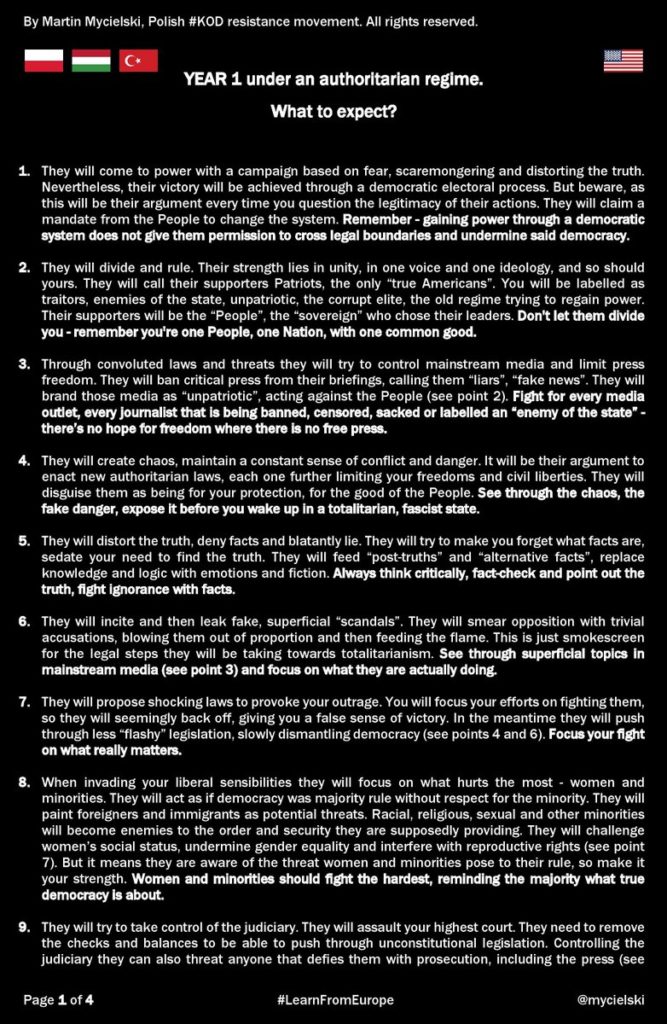
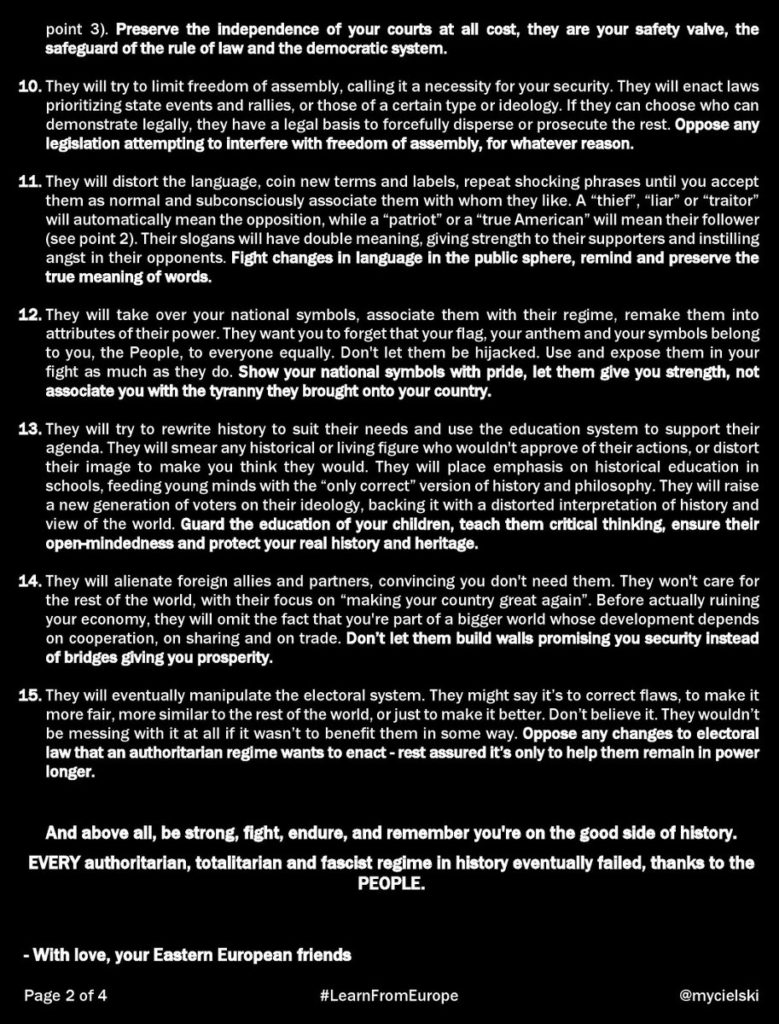
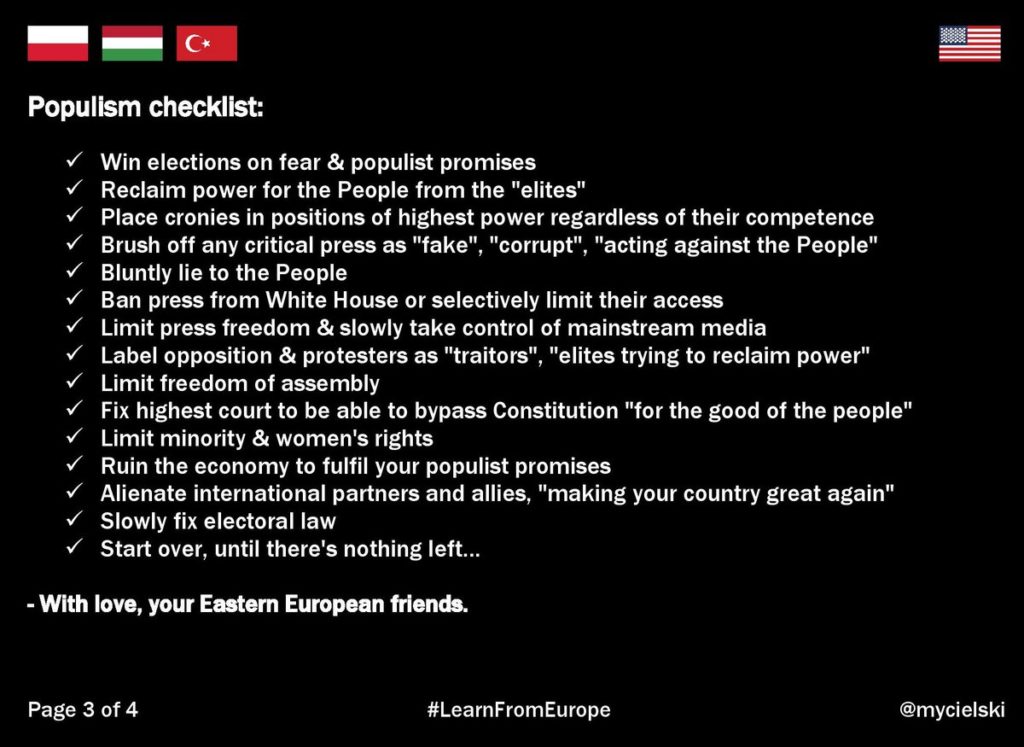
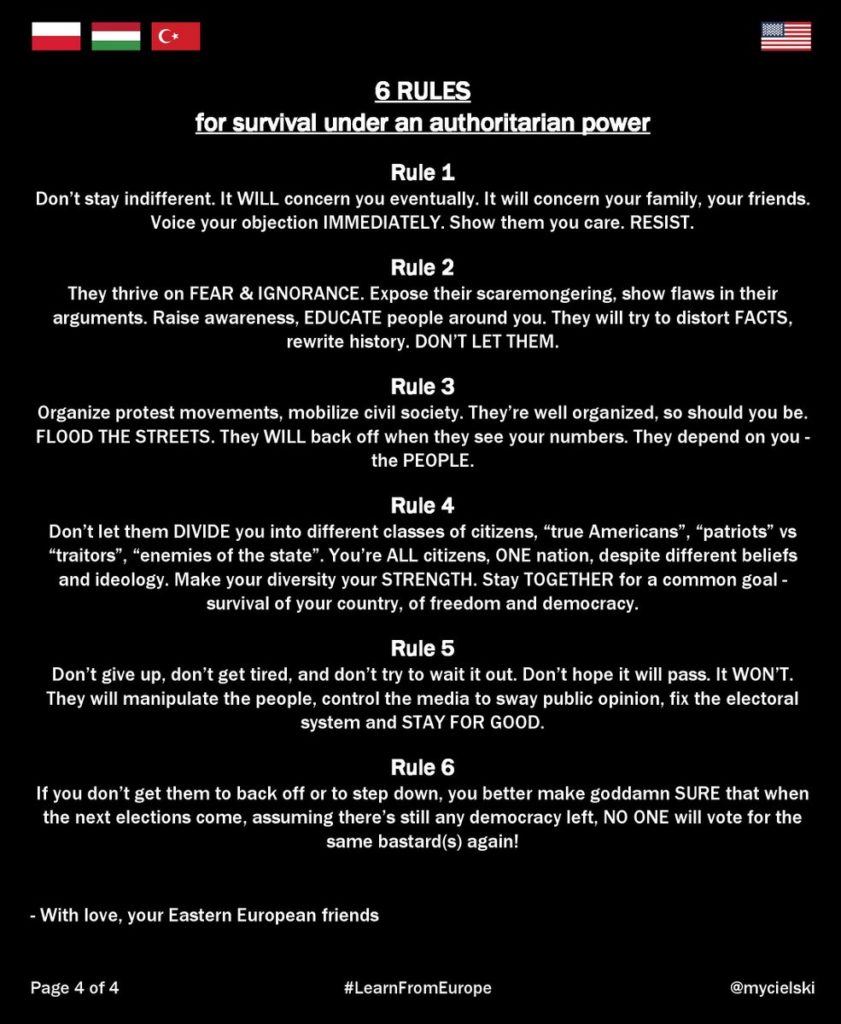
European journalist Martin Mycielski has prepared a Complete Four-Page Guide to Surviving an Authoritarian Regime (“in graphic form, With love, your Eastern European friends.”) As he now sees the return of authoritarianism to his native Poland, we now see the beginning of it in America.

 One reads that the Janesville Gazette is activating a full-site paywall (three free articles a month, day pass for a dollar, Facebook comment authorization, etc.). The stated reason is that the Gazette needs money (“Digital advertising and marketing don’t generate enough revenue to cover the expenses of our local journalism”).