Vin Scully delivers a story, flawlessly, about a snake and a baby rabbit while calling a Dodgers-Giants game. It’s hard to overstate how difficult this is.
Scully is astonishingly gifted, and worthy of the praise he’s received throughout his career.
Vin Scully delivers a story, flawlessly, about a snake and a baby rabbit while calling a Dodgers-Giants game. It’s hard to overstate how difficult this is.
Scully is astonishingly gifted, and worthy of the praise he’s received throughout his career.
Good morning, Whitewater.
Midweek in the city will be partly cloudy with a high of seventy-two. Sunrise is 6:35 AM and sunset 7:04 PM, for 12h 29m 46s of daytime. The moon is a waxing gibbous with 98.2% of its visible disk illuminated.
There’s a Fire Department Business Meeting scheduled for tonight at 7 PM.
On this day in 1812, dictator & imperialist Napoleon captures Moscow, but doesn’t find what he expects:
On September 14, 1812, Napoleon moved into the empty city that was stripped of all supplies by its governor, Feodor Rostopchin. Relying on classical rules of warfare aiming at capturing the enemy’s capital (even though Saint Petersburg was the political capital at that time, Moscow was the spiritual capital of Russia), Napoleon had expected TsarAlexander I to offer his capitulation at the Poklonnaya Hill but the Russian command did not think of surrendering.
As Napoleon prepared to enter Moscow he was surprised to have received no delegation from the city. At the approach of a victorious general, the civil authorities customarily presented themselves at the gates of the city with the keys to the city in an attempt to safeguard the population and their property. As nobody received Napoleon he sent his aides into the city, seeking out officials with whom the arrangements for the occupation could be made. When none could be found, it became clear that the Russians had left the city unconditionally.[67]
In a normal surrender, the city officials would be forced to find billets and make arrangements for the feeding of the soldiers, but the situation caused a free-for-all in which every man was forced to find lodgings and sustenance for himself. Napoleon was secretly disappointed by the lack of custom as he felt it robbed him of a traditional victory over the Russians, especially in taking such a historically significant city.[67]
Before the order was received to evacuate Moscow, the city had a population of approximately 270,000 people. As much of the population pulled out, the remainder were burning or robbing the remaining stores of food, depriving the French of their use. As Napoleon entered the Kremlin, there still remained one-third of the original population, mainly consisting of foreign traders, servants and people who were unable or unwilling to flee. These, including the several hundred strong French colony, attempted to avoid the troops.
Napoleon would later retreat from Russia entirely, having lost most of the Grande Armée, and having caused on both sides the deaths of over one-half million people in the campaign.
For Wednesday, JigZone offers a cat puzzle:
Over at the Wall Street Journal, there’s a story about how e-commerce has changed rural life:
MANGUM, Okla.—Vince Bledsoe, a United Parcel Service Inc. delivery man in this remote tiny town, remembers the exact moment he knew that e-commerce had changed the way rural America shops.
He was taping up a package a few months ago to one of the town’s 3,000 residents and noticed it contained a bottle of bleach. “It wasn’t lavender [scented] or anything,” he recalls. “It was just a bottle of plain Clorox.”
See, E-Commerce is a Boon for Rural America, But It Comes With a Price @ Wall Street Journal (subscription req’d).
The price that the Journal mentions is the cost of shipping to small, rural destinations.
As much as the Web may have changed small-town shopping expectations, it’s changed small-town politics, too.
Both in style and substance, rural communities are exposed to high-caliber written analyses, from across the country, that often leave local politicians’ explanations looking weak, and local publications that flack for those politicians looking laughable.
Honest to goodness, Americans from every part of the country are capably and effectively parsing and critiquing national stories on Facebook, Twitter, and in blog posts, but somehow local politicians carry on as though in their towns no one knew about those media or those critiques.
We’re an educated and competitive people, in a town with a university, but when officials here speak and write in defense of their proposals they sometimes do so as though this were a city of weak-minded children.
That notion couldn’t be more misguided. Whitewater is filled with sharp, capable residents who deserve policy standards to match.
Here’s a suggestion: go onto the Twitter feeds or websites of major newspapers, and watch how effectively many common people from across America are critiquing reporting during the election.
There’s much that’s unimpressive, but at those national publications one will also find powerful, immediate critiques of reporters’ & officials’ lazy thinking and tired assumptions.
We can easily do as well as readers who are capably taking America’s leading publications to task.
Good morning, Whitewater.
Tuesday in the city will see thunderstorms this morning, then cloudy skies in the afternoon, with a high of seventy-five. Sunrise is 6:33 AM and sunset 7:06 PM, for 12h 32m 39s of daytime. The moon is a waxing gibbous with 86.1% of its visible disk illuminated.
On this day in 1862, Union soldiers discover Robert E. Lee’s Special Order 191, battle plans for a Maryland campaign:
Special Order 191 (series 1862) (the “Lost Dispatch,” and the “Lost Order“) was a general movement order issued by Confederate Army General Robert E. Lee in the Maryland Campaign of the American Civil War. A lost copy of this order was recovered in Frederick County, Maryland, by Union Army troops, and the subsequent military intelligence gained by the Union played an important role in the Battle of South Mountain and Battle of Antietam….
The order was drafted on or about September 9, 1862, during the Maryland Campaign. It gave details of the movements of the Army of Northern Virginia during the early days of its invasion of Maryland. Lee divided his army, which he planned to regroup later: according to the precise text Maj. Gen. Stonewall Jackson was to move his command to Martinsburg while McLaws’s command and Walker’s command “endeavored to capture Harpers Ferry.” Maj. Gen. James Longstreet was to move his command northward to Boonsborough. D. H. Hill‘s division was to act as rear guard on the march from Frederick.
Lee delineated the routes and roads to be taken and the timing for the investment of Harpers Ferry. Adjutant Robert H. Chiltonpenned copies of the letter and endorsed them in Lee’s name. Staff officers distributed the copies to various Confederate generals. Jackson in turn copied the document for one of his subordinates, Maj. Gen. D. H. Hill, who was to exercise independent command as the rear guard. Hill said the only copy he received was the one from Jackson.[1]
About noon [2] on September 13, Corporal Barton W. Mitchell of the 27th Indiana Volunteers, part of the Union XII Corps, discovered an envelope with three cigars wrapped in a piece of paper lying in the grass at a campground that Hill had just vacated. Mitchell realized the significance of the document and turned it in to Sergeant John M. Bloss. They went to Captain Peter Kopp, who sent it to regimental commander Colonel Silas Colgrove, who carried it to the corps headquarters. There, an aide to Brig. Gen. Alpheus S. Williams recognized the signature of R. H. Chilton, the assistant adjutant general who had signed the order. Williams’s aide, Colonel Samuel Pitman, recognized Chilton’s signature because Pitman frequently paid drafts drawn under Chilton’s signature before the war. Pitman worked for a Detroit bank during the period when Chilton was paymaster at a nearby army post.[3]Williams forwarded the dispatch to Maj. Gen. George B. McClellan, the commander of the Army of the Potomac. McClellan was overcome with glee at learning planned Confederate troop movements and reportedly exclaimed, “Now I know what to do!” He confided to a subordinate, “Here is a paper with which, if I cannot whip Bobby Lee, I will be willing to go home.”[4]
McClellan stopped Lee’s invasion at the subsequent Battle of Antietam, but many military historians believe he failed to fully exploit the strategic advantage of the intelligence because he was concerned about a possible trap (posited by Maj. Gen. Henry W. Halleck) or gross overestimation of the strength of Lee’s army.
JigZone has a puzzle of a flamingo for today:
Good morning, Whitewater.
Our week begins with sunny skies and a high of seventy-eight. Sunrise is 6:32 AM and sunset 7:08 PM, for 12h 35m 31s of daytime. The moon is a waxing gibbous with 78% of its visible disk illuminated.
A Whitewater’s Landmarks Commission subcommittee is scheduled to meet at 9:30 AM, the Community Development Authority at 5 PM, and the Planning Commission at 6:30 PM.
On this day in 1940, a French teenager discovers a cave with astonishing Upper Paleolithic art:
Lascaux (Lascaux Caves) … is the setting of a complex of caves in southwestern France famous for its Paleolithic cave paintings. The original caves are located near the village of Montignac, in the department of Dordogne. They contain some of the best-known Upper Paleolithic art. These paintings are estimated to be circa 17,300 years old.[citation needed] They primarily consist of images of large animals, most of which are known from fossil evidence to have lived in the area at the time. In 1979, Lascaux was added to the UNESCO World Heritage Sites list along with other prehistoric sites in the Vézère valley.[3]
….On September 12, 1940, the entrance to Lascaux Cave was discovered by 18-year-old Marcel Ravidat. Ravidat returned to the scene with three friends, Jacques Marsal, Georges Agnel, and Simon Coencas, and entered the cave via a long shaft. The teenagers discovered that the cave walls were covered with depictions of animals.[4][5] The cave complex was opened to the public in 1948.[6] By 1955, the carbon dioxide, heat, humidity, and other contaminants produced by 1,200 visitors per day had visibly damaged the paintings and introduced lichen on the walls. The cave was closed to the public in 1963 to preserve the art. After the cave was closed, the paintings were restored to their original state and were monitored daily. Rooms in the cave include the Hall of the Bulls, the Passageway, the Shaft, the Nave, the Apse, and the Chamber of Felines.
Lascaux II, a replica of the Great Hall of the Bulls and the Painted Gallery located 200 meters away from the original, was opened in 1983, so that visitors may view the painted scenes without harming the originals.[5] Reproductions of other Lascaux artwork can be seen at the Centre of Prehistoric Art at Le Thot, France.
On this day in 1892, three schools open at UW-Madison:
On this date the School of Economics, Political Science and History at UW-Madison opened under the leadership of Professor Richard T. Ely. [Source: University of Wisconsin-Madison]
It’s ships for the Monday JigZone puzzle:
From 2010, Steve Jobs describes Apple’s product choices, under conditions of market approval or rejection. Companies offer, but markets decide:
This Tuesday, September 13th at 12:30 PM, there will be a showing of Concussion @ Seniors in the Park, in the Starin community building.
Concussion is about the research of pathologist Dr. Bennet Omalu concerning brain damage in football players who experience repeated concussions during play.
The film stars Will Smith, Alec Baldwin, Albert Brooks, with a run time of two hours, three minutes, and a PG-13 rating from the MPAA.
One can find more information about Concussion at the Internet Movie Database.
Enjoy.
Good morning, Whitewater.
Sunday in the city will be sunny with a high of seventy-four. Sunrise is 6:31 AM and sunset 7:10 PM, for 12h 38m 22s of daytime. The moon is a waxing gibbous with 69.3% of its visible disk illuminated.
Crater Lake National Park is always beautiful:
Today is the fifteenth anniversary of terrorist attacks in New York, Pennsylvania, and at the Pentagon.
In Wisconsin history on this day, auto racing begins, and a hospital is dedicated:
1903 – Auto racing debuts at The Milwaukee Mile
On this date William Jones of Chicago won a five-lap speed contest, setting the first track record with a 72 second, 50 mph lap in the process. The Milwaukee Mile was originally a private horse track, in existence since at least 1876, and is the oldest, continuously operating auto racing facility in the world. [Source: Wisconsin State Fair History of the Milwaukee Mile]
1912 – St. Mary’s Hospital Dedicated
On this date St. Mary’s Hospital in Madison was dedicated. Madison architect Ferdinand Kronenberg designed the 70-bed red brick facility which cost over $170,000 to complete. [Source: Bishops to Bootleggers: A Biographical Guide to Resurrection Cemetery, p.35]
How and when did wild wolves turn into domestic pets? Science tells us that humans were behind the domestication of what is now man’s best friend—but the timeline of the transformation has always been mysterious. In this video, Atlantic science writer Ed Yong explains the surprising origin of dogs in light of new research.
Via The Atlantic.
See, also, A New Origin Story for Dogs.
Good morning, Whitewater.
Saturday in town will be rainy in the morning, giving way to partly cloudy skies and a daytime high of seventy degrees. Sunrise is 6:30 AM and sunset 7:11 PM, for 12h 41m 14s of daytime. The moon is a waxing gibbous with 59.8% of its visible disk illuminated.
NASA this week launched the OSIRIS-REx probe to take a sample from an asteroid and return that sample for study. The launch used an Atlas V rocket from the United Launch Alliance:
On this day in 1813, Oliver Perry defeats a Royal Navy Squadron at the Battle of Lake Erie:
On September 10, 1813, Perry’s command fought a successful fleet action against a squadron of the Royal Navy in the Battle of Lake Erie. It was at the outset of this battle that Perry famously said, “If a victory is to be gained, I will gain it.”[21] Initially, the exchange of gunfire favored the British. Perry’s flagship, the USS Lawrence, was so severely disabled in the encounter that the British commander, Robert Heriot Barclay, thought that Perry would surrender it, and sent a small boat to request that the American vessel pull down its flag. Faithful to the words of his battle flag, “DON’T GIVE UP THE SHIP” (a paraphrase of the dying words of Captain James Lawrence, the ship’s namesake and Perry’s friend),[22][23] Perry, with Lawrence’s chaplain and purser as the remaining able crew, personally fired the final salvo,[24]and then had his men row him a half-mile (0.8 km) through heavy gunfire to transfer his command to USS Niagara.
Once aboard, Perry dispatched Niagara‘s commander, Captain Jesse Elliot, to bring the other schooners into closer action while he steered the Niagara toward the damaged British ships. Like Nelson’s Victory at Trafalgar, Niagara broke the opposing line. Perry’s force pounded Barclay’s ships until they could offer no effective resistance and surrendered. Although he had won the battle aboard Niagara, he received the British surrender on the deck of the recaptured Lawrence to allow the British to see the terrible price his men had paid.[21]
Perry’s battle report to General William Henry Harrison was famously brief: “We have met the enemy and they are ours; two ships, two brigs, one schooner and one sloop.”[22][C]
Although the engagement was small compared to Napoleonic naval battles such as the Battle of Trafalgar, the victory had disproportionate strategic importance, opening Canada up to possible invasion, while simultaneously protecting the entire Ohio Valley.[3][27] The loss of the British squadron directly led to the critical Battle of the Thames, the rout of British forces by Harrison’s army, the death of Tecumseh, and the breakup of his Indian alliance.[26] Along with the Battle of Plattsburgh, it was one of only two significant fleet victories of the war.[3]
Over at the Huffington Post, there’s a story about a picture that Redditor jmankruse took of a cat in a woodpile.
See if you can spot the feline:
Amanda Carpenter, a sometime political operative and current CNN commentator, became stuck in an Amtrak station elevator in February, and she posted on Twitter at the time to describe her situstion. Seven months later, an Amtrak representative tweeted back to ask if she still needed help:
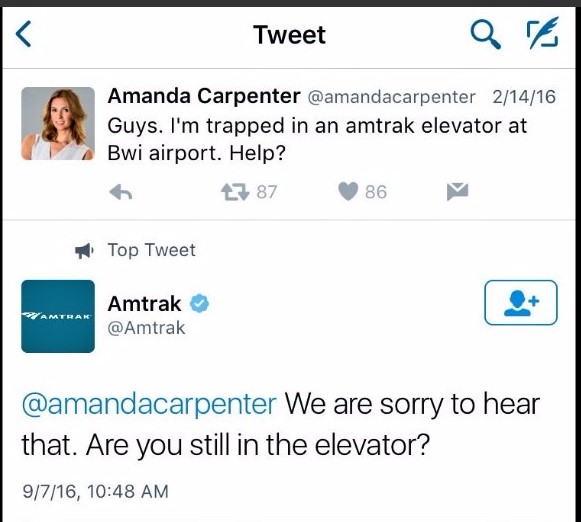
Carpenter obviously pushed the elevator’s help button also; her tweet was a way to hold Amtrak publicly accountable at the time.
So, was Amtrak surprisingly slow in its response, about as expected, or surprisingly fast in reply (where about expected and surprisingly fast are about your estimation of Amtrak’s abilities, not whether someone should be rescued promptly). Needless to say, the elevator should have been working properly so that passengers never risked being stuck inside.