
Author Archive for JOHN ADAMS
Daily Bread
Daily Bread for 2.29.16
by JOHN ADAMS •
Good morning, Whitewater.
Leap Day in Whitewater will be partly cloudy and windy, with a high of forty-seven. Sunrise is 6:29 and sunset 5:44, for 11h 14m 49s of daytime. The moon is a waning gibbous with 63.8% of its visible disk illuminated.
On this day in 2004, Lord of the Rings: The Return of the King wins big:
Perhaps the most attention-grabbing, trailblazing performer in film in 2003 did not receive an Academy Award nomination for Best Actor–but he was honored nonetheless. The eerily lifelike quality of Gollum, the computer-generated (CG) creature who simpered and schemed his way through The Lord of the Rings film trilogy, remained one of the most awe-inspiring aspects of the trilogy’s final installment, The Return of the King. At the 76th Academy Awards ceremony, held on this day in 2004, the film won a record-tying 11 Oscars, including Best Picture, Best Director (Peter Jackson) and Best Visual Effects.
On this day in 1956, a prominent Wisconsin Republican passes away, after taking the party in a different direction:
1956 – Father of Modern Wisconsin Republican Party dies
On this day William J. Campbell, a major contributor the Wisconsin Republican Party, died at his home in Oshkosh. A lumber broker and former University of Wisconsin regent, Campbell never held public office, but was generally given credit for the founding of the Republican Voluntary Committee, the working party organization in the state. State Attorney General Vernon W. Thomson hailed Campbell as a “true political pioneer” for steering the selection of GOP candidates away from the “domination of Robert M. LaFollette, Sr.” An ardent opponent of the “nomination paper” method of endorsing candidates for office, Campbell founded the Republican Voluntary Committee in 1925, in large part as a means of circumventing state limitations on spending by the statutory Republican Party. [Source: Milwaukee Journal 2/29/1956, Section 2 p. 12]
It’s a tape measure puzzle today from JigZone:
Adventure, Nature
Million Dollar Highway Drive Through
by JOHN ADAMS •
Assault Awareness & Prevention, University
‘A Trust Betrayed’: The Update on the Title IX Claims Against UW-Whitewater
by JOHN ADAMS •
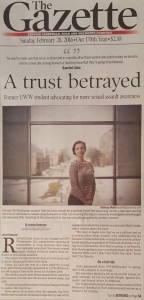
Over at the Gazette, above the fold, there’s a frontpage story about Ms. Raechel Liska, an honors graduate of UW-Whitewater, and her Title IX claim against UW-Whitewater for failing to address properly her sexual assault complaint. The story refers also to an earlier Title IX complaint against the school (the two complaints are now joined administratively), and the account of a
third student that corroborates the experiences of the two Title IX complainants.
See, from Andrea Anderson, A Trust Betrayed, http://www.gazettextra.com/20160227/former_uw_w_student_stands_up_for_more_awareness_around_sexual_assault (subscription req’d).
Ms. Anderson’s story publishes significant new information about the claims, and more detail about what’s already been published.
The story reveals that there are at least three, not two, women who allege the same administrative misconduct and concealment. Two of those women have filed Title IX complaints, and a third submitted a supporting statement:
“Liska has encouraged at least one other student to come forward and submit supplemental testimony to be attached to Liska’s Title IX claim.
Sarah, a senior at UW-W who agreed to let The Gazette use her first name, learned about Liska through the media. In her testimony, Sarah wrote she experienced a similar response as Liska from UW-W after reporting she was sexually assaulted by another student.
Sarah claims Mackin did not inform her of her Title IX rights and felt as if Mackin “talked down” to her and “never addressed the actual problem that I was having: I was abused by another UW-Whitewater student and I was terrified,” according to the testimony.
UW-W police talked to the accused, but Sarah still felt the university was minimizing her fears of retaliation from the man, Sarah wrote.
Sarah could not file her own Title IX complaint because the deadline had passed, Held said. Sarah was given the option to add testimony to Liska’s claim and did so to help push for improvement in UW-W’s response to sexual assault victims.
It was “distressing to realize that, after talking to Raechel about her interactions with the school, I wasn’t alone in this treatment. It made me want to change the way the University deals with cases like mine and Raechel’s,” Sarah said in her testimony.”
 “Liska has encouraged at least one other student to come forward and submit supplemental testimony to be attached to Liska’s Title IX claim.
Most of these cases are resolved administratively, and that’s the goal of the claimants here. How this will be resolved, of course, I do not know; successful resolutions need good terms and a sincere effort to carry them out.
I’ve no connection whatever to these claimants or their lawyers. That’s both by nature and design – having seen more than one tragedy in this small & beautiful, but sometimes troubled city, I simply don’t believe, for politics or policy, in close. On the contrary, it’s distance that makes one’s work, as an ongoing chronicle, possible.
I would hope that these claimants, as people with unique hopes and aspirations, find whatever measure of remedy they are seeking, so fully and completely as possible.
See, also, other posts that are part of a category on Assault Awareness and Prevention dedicated to this topic.
Daily Bread
Daily Bread for 2.28.16
by JOHN ADAMS •
Good morning, Whitewater.
We’ll have a mild Sunday with afternoon showers and a high of fifty-seven. Sunrise is 6:41 and sunset 5:43, for 11h 11m 57s of daytime. The moon is a waning gibbous with 72.4% of its visible disk illuminated.
Friday’s FW poll asked readers which movie they favored in the Best Picture category at the Academy Awards ceremony tonight. Of the eight nominees, 29.27% of respondents chose The Revenant, 26.83% chose The Martian, 14.63% chose Bridge of Spies, with remaining contenders each receiving fewer than ten percent of responses.
Here’s schedule of posts for the week ahead, with other posts possible (if there are changes to these scheduled posts I’ll explain why):
- Today: DB, a post about UW-Whitewater and Title IX, evening post
- Monday: DB, weekly music post, WHEN GREEN TURNS BROWN post, evening post
- Tuesday: DB, weekly education post, evening post
- Wednesday: DB, weekly film post, a post on relative sizes among demographic groups, evening post
- Thursday: DB, a food post, a post on Whitewater’s economy, evening post
- Friday: DB, weekly poll, weekly cataloging, a post on Whitewater’s economy
- Saturday: DB, weekly Animation post, evening post
On this day in 1844, Pres. Tyler survives a shipboard explosion:
On February 28, she departed Alexandria, Virginia on a pleasure and demonstration cruise down the Potomac with President John Tyler, his Cabinet, former first lady Dolley Madison, and approximately four hundred guests on board. The guests viewed the firing of the ship’s guns and then retired below decks for lunch and refreshments. When they were summoned once more to view another test firing, the firing of Stockton’s Peacemaker caused the gun to burst, sending shrapnel into the crowd. Instantly killed were Secretary Upshur, Secretary Gilmer, Capt. Beverly Kennon, who was Chief of the Bureau of Construction, Equipment and Repairs, Virgil Maxcy of Maryland, who had served as Chargé d’Affaires to Belgium from 1837 to 1842, Colonel David Gardiner of New York, the father of Julia Gardiner (who afterwards became the President’s fiancée), the President’s valet, a black slave named Armistead, and two sailors. It also injured about 20 people, including Capt. Stockton. The President was unharmed, having been below decks when the gun exploded.[1] When Julia Gardiner, who was aboard, found out her father had died in the explosion she fainted, not waking up until Tyler was carrying her off the ship.[2]
Science/Nature
How Leap Year Works
by JOHN ADAMS •
Animation
Saturday Animation: Forms in Nature
by JOHN ADAMS •
Daily Bread
Daily Bread for 2.27.16
by JOHN ADAMS •
Good morning, Whitewater.
We’ll have a mild Saturday with mostly sunny skies and a high of fifty-four. Sunrise is 6:32 and sunset 5:41 for 11h 09m 05s of daytime. The moon is a waning gibbous with 80.3% of its visible disk illuminated.
On this day in 1782, the British House of Commons votes against further war in America. Esmond Wright, in Franklin of Philadelphia, describes Britain’s position:
The surrender at Yorktown on October 17, 1781, and the loss of Cornwallis’s army, ended any remaining British hopes of victory on the American mainland. Defeats at the hands of the French in the West Indies in 1781 and early 1782 drove home to Britain the need for an end to hostilities. On February 27, 1782, the House of Commons voted against continuing the American war and authorized the government to make peace with the former colonies. The king threatened to abdicate. On March 20, North resigned and was succeeded by Rockingham, with Shelburne as the secretary of state responsible for colonial affairs, charged to open negotiations with the American peace commissioners.
On this day in 1904, Wisconsin loses her second state capitol building:
1904 – Second State Capitol Burns
On this date fire destroyed the second State Capitol building in Madison. On the evening of the 26th, the generator was turned off for the night. The only lights visible were two gas jets serving the night watchman. At approximately 2 a.m., night watchman Nat Crampton smelled smoke and followed the odor to a recently varnished ceiling, already in flames. A second watchman arrived to assist, but there was no water pressure with which to operate a hose. The fire department encountered a similar situation upon arrival. Governor Robert M. La Follette telegraphed fire departments in Janesville and Milwaukee for assistance. La Follette was at the capitol, directing efforts to douse the fire and entering the burning building to retrieve valuable papers. The fire was completely extinguished by 10 p.m. the next day. Losses were estimated to be close to $1 million.
Animals
Vildsvinscurling / Wild boar curling
by JOHN ADAMS •
Cats
Friday Catblogging: What Different Meows Mean
by JOHN ADAMS •
Film
Friday Poll: Best Picture 2016
by JOHN ADAMS •
The Academy Awards are this Sunday, February 28th, with the Red Carpet beginning at 6 PM CT and the Ceremony at 7:30 PM CT.
There are eight nominees for Best Picture, and I have embedded the trailers to those films, immediately below.
What’s your favorite?
Daily Bread
Daily Bread for 2.26.16
by JOHN ADAMS •
Good morning, Whitewater.
Friday in town will be mostly cloudy with a high of thirty-six. Sunrise is 6:34 and sunset 5:40, for 11h 06m 14s of daytime. The moon is a waning gibbous with 87.2% of its visible disk illuminated.
On this day in 1917, Pres. Wilson learns of the Zimmermann Telegram:
In a crucial step toward U.S. entry into World War I, President Woodrow Wilson learns of the so-called Zimmermann Telegram, a message from German Foreign Secretary Arthur Zimmermann to the German ambassador to Mexico proposing a Mexican-German alliance in the event of a war between the U.S. and Germany.
On February 24, 1917, British authorities gave Walter Hines Page, the U.S. ambassador to Britain, a copy of the Zimmermann Telegram, a coded message from Zimmermann to Count Johann von Bernstorff, the German ambassador to Mexico. In the telegram, intercepted and deciphered by British intelligence in late January, Zimmermann instructed his ambassador, in the event of a German war with the United States, to offer significant financial aid to Mexico if it agreed to enter the conflict as a German ally. Germany also promised to restore to Mexico the lost territories of Texas, New Mexico and Arizona.
The State Department promptly sent a copy of the Zimmermann Telegram to President Wilson, who was shocked by the note’s content and the next day proposed to Congress that the U.S. should start arming its ships against possible German attacks. Wilson also authorized the State Department to publish the telegram; it appeared on the front pages of American newspapers on March 1. Many Americans were horrified and declared the note a forgery; two days later, however, Zimmermann himself announced that it was genuine.
It’s a spiral ginger plant today from JigZone:
Nature, Space
The Most Powerful Space Telescope Ever
by JOHN ADAMS •
Restaurant, Review
Review: The SweetSpot Bakehouse
by JOHN ADAMS •
One can order cakes as either rounds (six, eight, and ten inches), and traditional sheets (one-fourth, one-half, and full), or cupcakes of a regular or small size. Batters range from traditional (white, chocolate, yellow, marble) to the somewhat-less-traditional (lemon, almond, carrot, or red velvet). After having the red velvet, you may find it becomes part of your traditional menu, as it’s memorable enough to impress, but subtle enough to fit most tastes. The red velvet, with a buttercream icing, is a treat as either a cake or a cupcake. (I’ve carried the red velvet cupcakes to friends far outside the town, in places with intense competition among bakeries, and yet to find a recipient who wasn’t impressed.)
They’ve easily the talent to bake a fine wedding cake, or larger cake for another, special event.
I’ve had a good part of the menu, on many visits over two months’ time (and on other, earlier visits that are not part of this review).
You’ll find a daily choice of donuts, Danishes, cupcakes, muffins, scones, cookies, and croissants. My favorites include the raspberry croissants and blueberry muffins. There’s a cream cheese coffee cake muffin that’s perfect for someone looking for the richest possible muffin on earth. I’ve yet to find a scone that my wife did not like, among a number of seemingly-endless varieties.
Holiday offerings over Christmas included fruit pies and fruitcakes, both of which were excellent. The fruitcake may not look like what one has seen elsewhere, as they’re not so colorful as what one often sees. Often, that’s because mass-produced fruitcakes (of poor quality) rely on poor but colorfully-dyed ingredients. Having spent almost a lifetime enjoying fruitcake, since I was a small child, I can say the Bakehouse’s is among the softest I’ve had, and that’s a highly-desirable quality. Fruitcake gets a bad reputation, and is a joke to many, because it’s so poorly prepared. If you’ve shied away from fruitcake at Christmas, this coming holiday will be your chance to try a fine cake.
Inside, the Bakehouse has six stools along a window counter, and three tables (two small, one larger). Patrons entering on Main Street will see the kitchen as they walk in, with small seating area to the left from the door. Outside, there’s a drive-thru window that I’ve used successfully many times.
Aside from the principal offering of baked goods, the Bakehouse has an all-day breakfast menu (bagels, breakfast sandwiches, oatmeal, granola), and a small lunch offering (soup of the day, grilled cheese, and a ham & cheese croissant).
The coffee’s from the Just Coffee Co-Op, a Madison-based roaster. It’s a small roaster, with a colorful history, but I don’t think of it as a match for Ancora or Colectivo. It’s easily better than anything you’ll find at a fast-food restaurant, and probably better than at many restaurants in town. Some of what I’ve had in town tastes like instant coffee, instant coffee being one of the many mistakes of previous generations, now thankfully – for the most part – behind us.
Service is relatively quick in this small environment, either inside or at the drive-thru. Most patrons aren’t staying, though, so on my visits I’ve yet to see all the seats inside occupied.
I wrote about the SweetSpot Cafe recently, as a follow-up to an earlier review, and I’d say I prefer the Bakehouse on Main over the Cafe near Cravath. The Bakehouse is mainly one thing (with a bit added on) and does that one thing well.
Enjoy.
LOCATION: 1185 West Main Street, Whitewater, WI 53190 (262) 473-5080. See, Google Map and directions embedded at the beginning of this review.
ONLINE http://www.sweetspotwhitewater.com/bakehouse/ and http://sweetspotwhitewater.com/Downloads/CakeMenu.pdf
OPEN: Mon-Fri 6 AM-6 PM, Sat & Sun 6 AM -3 PM.
PRICES: Croissant and coffee for about $5, classic cakes from $15 for a 6-inch round cake to $75 for a full sheet, speciality cakes for about 30% more.
RESERVATIONS: Unnecessary for regular service, including some cakes awaiting purchase; obviously needed for specific cake orders.
DRINKS: Coffee, tea, juice.
SOUND: None that I noticed.
SERVICE: Friendly, relaxed.
VISITS: Many (morning, afternoon, evening).
RATING: 3.5 of 4. Easily recommended.


RATING SCALE: From one to four stars, representing the full experience of food, atmosphere, service, and pricing.
INDEPENDENCE: This review is delivered without financial or other connection to the establishment or its owner. The dining experience was that of an ordinary patron, without notice to the staff or requests for special consideration.