
Author Archive for JOHN ADAMS
Daily Bread
Daily Bread for 4.19.15
by JOHN ADAMS •
Good morning, Whitewater.
Sunday in Whitewater will have a high of sixty-five, and a forty-percent chance of late afternoon showers. Sunrise is 6:05 and sunset 7:42, for 13h 36m 27s of daytime. We’ve a new moon today.
On Friday’s FW poll, readers had a chance to vote on whether ambulances should pick up animals, after the London Ambulance Service mistakenly made a call to a victim who turned out to be a pigeon, not a person. Over ninety percent of respondents felt that ambulances should be for people, not pigeons.
On this day in 1775, the Battles of Lexington and Concord change America’s relationship to Britain irrevocably:
The Battles of Lexington and Concord were the first military engagements of the American Revolutionary War.[9] They were fought on April 19, 1775, in Middlesex County, Province of Massachusetts Bay, within the towns ofLexington, Concord, Lincoln, Menotomy (present-day Arlington), and Cambridge, near Boston. The battles marked the outbreak of open armed conflict between the Kingdom of Great Britain and thirteen of its colonies on the mainland of British America.
In late 1774 the Suffolk Resolves were adopted to resist the enforcement of the alterations made to the Massachusetts colonial government by the British parliament following the Boston Tea Party. An illegal Patriot shadow government known as the Massachusetts Provincial Congress was subsequently formed and called for local militias to begin training for possible hostilities. The rebel government exercised effective control of the colony outside of British-controlled Boston. In response, the British government in February 1775 declared Massachusetts to be in a state of rebellion. About 700 British Armyregulars in Boston, under Lieutenant ColonelFrancis Smith, were given secret orders to capture and destroy rebel military supplies that were reportedly stored by the Massachusetts militia at Concord. Through effective intelligence gathering, Patriot colonials had received word weeks before the expedition that their supplies might be at risk and had moved most of them to other locations. They also received details about British plans on the night before the battle and were able to rapidly notify the area militias of the British expedition.
The first shots were fired just as the sun was rising at Lexington. The militia were outnumbered and fell back, and the regulars proceeded on to Concord, where they searched for the supplies. At the North Bridge in Concord, approximately 500 militiamen engaged three companies of the King’s troops at about an hour before Noon, resulting in casualties on both sides. The outnumbered regulars fell back from the bridge and rejoined the main body of British forces in Concord.
Having completed their search for military supplies, the British forces began their return march to Boston. More militiamen continued to arrive from neighboring towns, and not long after, gunfire erupted again between the two sides and continued throughout the day as the regulars marched back towards Boston. Upon returning to Lexington, Lt. Col. Smith’s expedition was rescued by reinforcements under Brigadier GeneralHugh Percy a future duke (of Northumberland, known as Earl Percy). The combined force, now of about 1,700 men, marched back to Boston under heavy fire in a tactical withdrawal and eventually reached the safety of Charlestown. The accumulated militias blockaded the narrow land accesses to Charlestown and Boston, starting the Siege of Boston.
Ralph Waldo Emerson, in his “Concord Hymn“, described the first shot fired by the Patriots at the North Bridge as the “shot heard round the world“.[10]
On this day in 1852, Wisconsin establishes a specialized school:
1852 – Wisconsin School for the Deaf Established
On this date a bill was passed by the State Legislature for the establishment and maintenance of a school for deaf children in Walworth County. [Source: History Just Ahead: A Guide to Wisconsin’s Historical Markers edited by Sarah Davis McBride]
Daily Bread
Daily Bread for 4.18.15
by JOHN ADAMS •
Good morning, Whitewater.
Saturday in Whitewater will be mostly sunny with a high of sixty-six. Sunrise is 6:07 and sunset 7:40 for 13h 33m 44s of daytime.
Summer will be here soon, and among its offerings will be a plentiful supply of watermelon. They’re delicious, but they can be beautiful, too:
On this day in 1906, an earthquake devastates San Francisco:
The 1906 San Francisco earthquake struck the coast of Northern California at 5:12 a.m. on Wednesday, April 18.[6] Devastating fires broke out in the city that lasted for several days. As a result, about 3,000 people died and over 80% of San Francisco was destroyed.[7]
The earthquake and resulting fire are remembered as one of the worst natural disasters in the history of the United States[8] alongside the Galveston Hurricane of 1900 and Hurricane Katrina in 2005.[9] The death toll from the earthquake and resulting fire remains the greatest loss of life from a natural disaster in California’s history.
Health, Misconduct
The Tragedy of Dr. Oz
by JOHN ADAMS •
Dr. Mehmet Oz is a cardiothoracic surgeon and vice chairman of the surgery department at Columbia University’s medical school.
Most people know him, sadly, as a celebrity, television star, or as a promoter of quack remedies.
Other prominent physicians across America, at leading institutions, have had enough of the embarrassment that Oz’s sales pitches are to medicine. They’ve asked
Columbia to remove Oz from his position:
In the letter sent via e-mail this week by Dr. Henry I. Miller of Stanford University’s Hoover Institution, the doctors refer to Oz warning his viewers about arsenic in certain apple juice brands and other stances he has taken.
“Dr. Oz has repeatedly shown disdain for science and for evidence-based medicine, as well as baseless and relentless opposition to the genetic engineering of food crops,” the letter states. “Worst of all, he has manifested an egregious lack of integrity by promoting quack treatments and cures in the interest of personal financial gain.”
See, Physicians urge Columbia University to cut its ties with Dr. Oz @ Washington Post. See, also, Half of Dr. Oz’s medical advice is baseless or wrong, study says @ Washington Post.
Columbia has refused, citing Dr. Oz’s academic freedom to speak in public forums as he wishes.
That’s a tenuous defense, as Stanford’s Miller notes that “Oz’s promotion of worthless products that might have side effects and that delay patients’ seeking safe and effective therapies threatens public safety.”
(There’s no First Amendment issue here, as Columbia is a private university. Academic freedom is a separate claim, but it seems weak to me: it’s junk science Oz is peddling, and an academic program has a justification to reject him for demonstrably false bio-medical claims.)
The principal tragedy in all this, of course, is that impressionable people might rely on Oz’s claims and become ill, or waste vast amounts of money without improvement.
There’s another tragedy, though: Oz legitimately earned his position at Columbia, but he’s thrown away a commitment to science for personal financial gain, or additional notoriety, or something else that’s a debasement of medicine.
Neither his past accomplishments, nor his celebrity status, are an excuse for using his abilities for selfish and false ends. That he earned his faculty position does not make right the wrongs he’s been doing by luring people into scams.
Dr. Oz needn’t have done this, but he did do this.
No one in all the world owes him his error, especially since his error may lead to the injury of vulnerable people seeking necessary cures.
No one owes greedy hucksters their quackery.
Each day and every day, one is obligated to use all one has, to the best of one’s abilities, to try – at least to try – to meet the best standards of science and reasoning.
There is no past accomplishment, there is no present status, that relieves the fortunate from their obligation on behalf of the less fortunate to recommit to these goals each morning.
It’s more than sad that Dr. Oz either doesn’t see, or doesn’t care, about this large obligation.
It’s there, nonetheless.
Cats
Friday Catblogging: The Acro-Cats
by JOHN ADAMS •
Animals, Poll, Weird Tales
Friday Poll: Ambulances for People or Pigeons?
by JOHN ADAMS •
In England, a four people called for an ambulance for a sick pigeon. (It’s English slang to refer to women as birds, and so the dispatcher sent the ambulance, assuming the victim was a person, not an animal.)
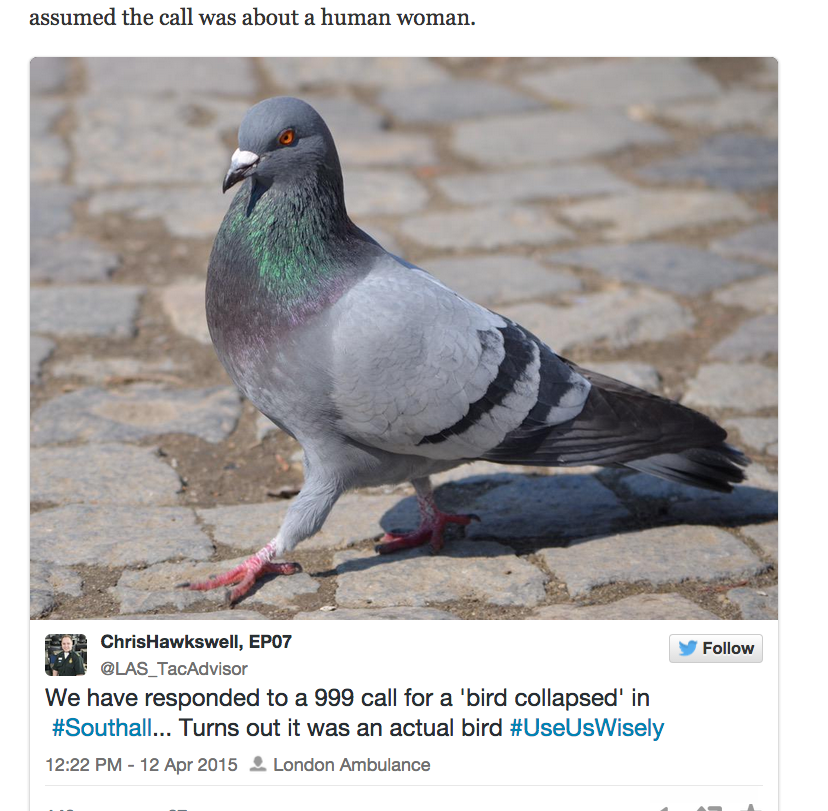
So, were the callers right to call the London Ambulance Service, or was this a waste of resources properly reserved for humans? (The pigeon, by the way, did not survive.)
Daily Bread
Daily Bread for 4.17.15
by JOHN ADAMS •
Good morning, Whitewater.
Friday will be mostly sunny with a high of seventy-five. Sunrise is 6:08 and sunset 7:39, for 13h 30m 59s of daytime. The moon is a waning crescent with 2.5% of its visible disk illuminated.
On this day in 1970, Apollo 13, beset by mechanical problems, successfully returns to Earth with all crew after orbiting the moon:
Apollo 13 was the seventh manned mission in the American Apollo space program and the third intended to land on the Moon. The craft was launched on April 11, 1970, at 13:13 CST from the Kennedy Space Center, Florida, but the lunar landing was aborted after an oxygen tank exploded two days later, crippling the Service Module (SM) upon which the Command Module (CM) depended. Despite great hardship caused by limited power, loss of cabin heat, shortage of potable water, and the critical need to jury-rig the carbon dioxide removal system, the crew returned safely to Earth on April 17.
The flight was commanded by James A. Lovell with John L. “Jack” Swigert as Command Module Pilot and Fred W. Haise as Lunar Module Pilot. Swigert was a late replacement for the original CM pilot Ken Mattingly, who was grounded by the flight surgeon after exposure to German measles.
On this day in 1897, playwright Thorton Wilder is born:
On this date Thornton Wilder was born in Madison. A renowned author and playwright, he taught at the University of Chicago from 1930 to 1937. His plays Our Town (1938) and The Skin of our Teeth (1942) won Pulitzer Prizes and have been performed countless times by school and amateur theatrical companies in the decades since.You can read a 1928 article about his Wisconsin roots in our Wisconsin Local History & Biographies collection. [Source: Thornton Wilder Society]
Here’s Friday’s game in the Puzzability Series Capital Gains:
|
This Week’s Game — April 13-17
|
|||||
|
Capital Gains
|
|||||
|
We’ve got filers all over the globe this week. For each day, we’ve taken the name of a world capital, added a letter, and scrambled all the letters to get a new word that is a type of person or people. The answer phrase, described by each day’s clue, is the capital followed by the longer word. The clue includes the lengths of the answer words in parentheses.
|
|||||
|
Example:
|
|||||
|
Simpletons from Scandinavia (4,5)
|
|||||
|
Answer:
|
|||||
|
Oslo fools
|
|||||
|
What to Submit:
|
|||||
|
Submit the phrase, with the capital first (as “Oslo fools” in the example), for your answer.
|
|||||
 |
|||||
|
Friday, April 17
|
|||||
|


Film
The Latest Star Wars Trailer
by JOHN ADAMS •
Star Wars Episode VII: The Force Awakens will be in theaters 12.18.2015.
Food
Food: The Cronut
by JOHN ADAMS •
Loved by many, reviled by some, but a genuine, privately-created, culinary innovation: the cronut.
Daily Bread
Daily Bread for 4.16.15
by JOHN ADAMS •
Good morning, Whitewater.
Thursday will be partly sunny with a high of sixty-five. Sunrise is 6:10 and sunset 7:38, for 13h 28m 14s of daytime. The moon is a waning crescent with 7.25% of its visible disk illuminated.
On this day in 1947, a new term enters circulation:
Multimillionaire and financier Bernard Baruch, in a speech given during the unveiling of his portrait in the South Carolina House of Representatives, coins the term “Cold War” to describe relations between the United States and the Soviet Union. The phrase stuck, and for over 40 years it was a mainstay in the language of American diplomacy.
Baruch had served as an advisor to presidents on economic and foreign policy issues since the days of Woodrow Wilson. In 1919, he was one of the U.S. advisers at the Paris Peace Conference that ended World War I. During the 1930s, he frequently advised Franklin D. Roosevelt and members of Congress on international finance and issues of neutrality. After World War II, he remained a trusted adviser to the new administration of Harry S. Truman. His speech in April 1947, however, was given in a completely different context. A portrait of the native South Carolinian was to be hung in the state’s House of Representatives, and Baruch was invited for its unveiling. Most guests expected that he would give a brief talk, but Baruch instead launched into a scorching attack on the industrial labor problems in the country. It was only through “unity” between labor and management, he declared, that the United States could hope to play its role as the major force by which “the world can renew itself physically or spiritually.” He called for longer workweeks, no-strike pledges from unions, and no-layoff pledges from management. It was imperative that American business and industry pull itself together, Baruch warned. “Let us not be deceived-we are today in the midst of a cold war. Our enemies are to be found abroad and at home. Let us never forget this: Our unrest is the heart of their success. The peace of the world is the hope and the goal of our political system; it is the despair and defeat of those who stand against us. We can depend only on ourselves.”
On this day in 1944, a capital ship enters service:
1944 – USS Wisconsin Commissioned
On this date the USS Wisconsin battleship was put into active duty for service during World War II. The ship, decommissioned in 1948, was recommissioned in 1951 for service in the Korean War. [Source: United States Navy]
The Wisconsin served again as late as Desert Storm.
Here’s Thursday’s game from Puzzability:
|
This Week’s Game — April 13-17
|
|||||
|
Capital Gains
|
|||||
|
We’ve got filers all over the globe this week. For each day, we’ve taken the name of a world capital, added a letter, and scrambled all the letters to get a new word that is a type of person or people. The answer phrase, described by each day’s clue, is the capital followed by the longer word. The clue includes the lengths of the answer words in parentheses.
|
|||||
|
Example:
|
|||||
|
Simpletons from Scandinavia (4,5)
|
|||||
|
Answer:
|
|||||
|
Oslo fools
|
|||||
|
What to Submit:
|
|||||
|
Submit the phrase, with the capital first (as “Oslo fools” in the example), for your answer.
|
|||||
|
|||||
|
Thursday, April 16
|
|||||
|

Science/Nature
Finding the Speed of Light with… Peeps
by JOHN ADAMS •
Assault Awareness & Prevention, Culture, Local Government, Politics, University
The Better Way to Address Sexual Violence on Campus
by JOHN ADAMS •
Neil Heinen is the editorial director of WISC-TV in Madison. I have little idea of his politics; we’ve never met.
I do know, however, that his station’s position on how universities should address allegations of sexual assault is better – ethically and practically – than the approach that UW-Whitewater has adopted.
Heinen is entirely right: no matter how disturbing the allegations, the only ethical response is to support a thorough, impartial, independent inquiry.
By contrast, when a graduate of UW-Whitewater spoke in a television interview – following the filing of a multi-page complaint with the U.S. Department of Education for the mishandling of her sexual assault complaint to the school – Dr. Telfer had the ability or inclination only to issue a dull, prepared statement.
Nothing about the victim, nothing about supporting inquiries concerning years of escalating assault numbers at UW-Whitewater, but instead an administrator’s certainty that students should feel safe.
Whitewater’s political culture is littered with others of this ilk. One cannot imagine a single official in the city – not from the university, not from the school district, not from the city administration – saying anything like what editorial director Heinen said, about a university that he and his station so obviously support.
In fact, Heinen says what he says, undoubtedly, because he does support UW-Madison, and each and every individual attending that school.
Locally, one cannot be a ‘Whitewater Advocate’ while simultaneously ignoring the very ills that afflict Whitewater.
See, also, the It’s On Us Campaign and Not Alone, a site with resources of support for those who have experienced sexual assault .
Anderson, Cartoons & Comics
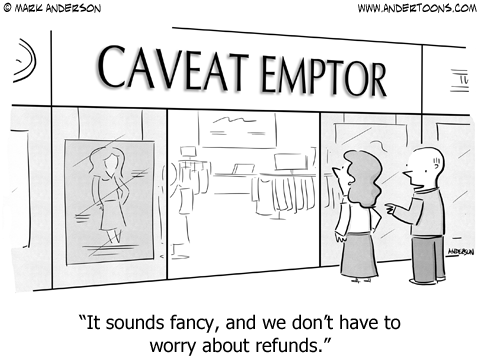
Caveat Emptor
by JOHN ADAMS •
Daily Bread
Daily Bread for 4.15.15
by JOHN ADAMS •
Good morning, Whitewater.
Wednesday in town will be mostly sunny with a high of thirty-three. Sunrise is 6:11 and sunset 7:37, for 13h 25m 28s of daytime. The moon is a waning crescent with 15.2% of its visible disk illuminated.
On this day in 1912, the RMS Titanic sank in the North Atlantic:
RMS Titanic was a British passenger liner that sank in the North Atlantic Ocean in the early morning of 15 April 1912 after colliding with an iceberg during her maiden voyage from Southampton, UK to New York City, US. The sinking resulted in the loss of more than 1,500 passengers and crew making it one of the deadliest commercial peacetime maritime disasters in modern history. The RMS Titanic, the largest ship afloatat the time it entered service, was the second of three Olympic class ocean liners operated by the White Star Line, and was built by the Harland and Wolff shipyard in Belfast with Thomas Andrews as her naval architect. Andrews was among those lost in the sinking. On her maiden voyage, she carried 2,224 passengers and crew.
After leaving Southampton on 10 April 1912, Titanic called at Cherbourg in France and Queenstown (now Cobh) in Ireland before heading west to New York.[2] On 14 April 1912, four days into the crossing and about 375 miles (600 km) south of Newfoundland, she hit an iceberg at 11:40 p.m. ship’s time. The collision caused the ship’s hull plates to buckle inwards along her starboard side and opened five of her sixteen watertight compartments to the sea; the ship gradually filled with water. Meanwhile, passengers and some crew members were evacuated in lifeboats, many of which were launched only partly loaded. A disproportionate number of men were left aboard because of a “women and children first” protocol followed by some of the officers loading the lifeboats.[3] By 2:20 a.m., she broke apart and foundered, with well over one thousand people still aboard. Just under two hours after Titanic foundered, the Cunard liner RMS Carpathia arrived on the scene of the sinking, where she brought aboard an estimated 705 survivors.Under the command of Edward Smith, the ship’s passengers included some of the wealthiest people in the world, as well as hundreds of emigrants from Great Britain and Ireland, Scandinavia and elsewhere throughout Europe seeking a new life in North America. A wireless telegraph was provided for the convenience of passengers as well as for operational use. Although Titanic had advanced safety features such as watertight compartments and remotely activated watertight doors, there were not enough lifeboats to accommodate all of those aboard due to outdated maritime safety regulations. Titanic only carried enough lifeboats for 1,178 people—slightly more than half of the number on board, and one-third her total capacity.
On this day in 1987, the Brewers get a first (for them):
On this date Juan Nieves recorded the Brewers first no-hitter, making him the first Puerto Rican-born pitcher to accomplish this feat in the Major Leauge. [Source: Milwaukee Brewers Timeline]
Here’s the Wednesday game in Puzzability‘s Capital Gains series:
|
This Week’s Game — April 13-17
|
|||||
|
Capital Gains
|
|||||
|
We’ve got filers all over the globe this week. For each day, we’ve taken the name of a world capital, added a letter, and scrambled all the letters to get a new word that is a type of person or people. The answer phrase, described by each day’s clue, is the capital followed by the longer word. The clue includes the lengths of the answer words in parentheses.
|
|||||
|
Example:
|
|||||
|
Simpletons from Scandinavia (4,5)
|
|||||
|
Answer:
|
|||||
|
Oslo fools
|
|||||
|
What to Submit:
|
|||||
|
Submit the phrase, with the capital first (as “Oslo fools” in the example), for your answer.
|
|||||
|
|||||
|
Wednesday, April 15
|
|||||
|
