
All Your Favorite Shows! from ornana on Vimeo.
Author Archive for JOHN ADAMS
Daily Bread
Daily Bead for 5.24.15
by JOHN ADAMS •
Good morning, Whitewater.
Sunday in Whitewater will be rainy, with thunderstorms, and a high of sixty-five. Sunrise is 5:22 and sunset 8:20, for 14h 56m 38s of daytime. The moon is a waxing crescent with 38.6% of its visible disk illuminated.
Friday’s FW poll asked whether, in the effort to save endangered species, a priority should go to pandas (as a high-profile, sharp-looking animal). A majority of respondents (60%) said that we should not prioritize panda survival, but that we should develop a different set of standards.
On this day in 1883, the Brooklyn Bridge opens to traffic:
The bridge—originally referred to as the New York and Brooklyn Bridge and as the East River Bridge[citation needed]— was opened for use on May 24, 1883. The opening ceremony was attended by several thousand people and many ships were present in the East Bay for the occasion. President Chester A. Arthur and Mayor Franklin Edson crossed the bridge to celebratory cannon fire and were greeted by Brooklyn Mayor Seth Low when they reached the Brooklyn-side tower.[26] Arthur shook hands with Washington Roebling at the latter’s home, after the ceremony. Roebling was unable to attend the ceremony (and in fact rarely visited the site again), but held a celebratory banquet at his house on the day of the bridge opening. Further festivity included the performance of a band, gunfire from ships, and a fireworks display.[27]
On that first day, a total of 1,800 vehicles and 150,300 people crossed what was then the only land passage between Manhattan and Brooklyn. Emily Warren Roebling was the first to cross the bridge. The bridge’s main span over the East River is 1,595 feet 6 inches (486.3 m). The bridge cost US$15.5 million in 1883 dollars (about US$379,661,000 in today’s dollars) to build and an estimated number of 27 people died during its construction.[28]
On May 30, 1883, six days after the opening, a rumor that the Bridge was going to collapse caused a stampede, which was responsible for at least twelve people being crushed and killed.[29] On May 17, 1884, P. T. Barnum helped to squelch doubts about the bridge’s stability—while publicizing his famous circus—when one of his most famous attractions, Jumbo, led a parade of 21 elephants over the Brooklyn Bridge.[30][31][32][33]
Sixteen years later, in 1899, Thomas Edison’s company filmed a crossing from Brooklyn into New York:
Animals
Wind Blows a Crane into a Tiger Cage
by JOHN ADAMS •
Crane survives an encounter with two tigers, experiencing only minor injuries before being rescued.
Daily Bread
Daily Bread for 5.23.15
by JOHN ADAMS •
Good morning, Whitewater.
Saturday in town will be mostly sunny, with a high of seventy-seven. Sunrise is 5:24 and sunset 8:19, for 14h 54m 57s of daytime.
On this day in 1934, bank robbers and members of a murderous gang Bonnie and Clyde find that their vicious crime spree comes to an end:
Bonnie Elizabeth Parker (October 1, 1910 – May 23, 1934) and Clyde Chestnut Barrow a.k.a. Clyde Champion Barrow[1] (March 24, 1909 – May 23, 1934) were American outlaws and robbers from the Dallas area who traveled the central United States with their gang during the Great Depression. At times, the gang included Buck Barrow, Blanche Barrow, Raymond Hamilton, W. D. Jones, Joe Palmer,Ralph Fults, and Henry Methvin. Their exploits captured the attention of the American public during the “Public Enemy Era“, between 1931 and 1935. Though known today for his dozen-or-so bank robberies, Barrow preferred to rob small stores or rural gas stations. The gang is believed to have killed at least nine police officers and several civilians. The couple were eventually ambushed and killed near the town of Sailes, Louisiana, in Bienville Parish, Louisiana, by law officers.
On this day in 1908, a Nobel Prize winner is born in Wisconsin:
1908 – John Bardeen Born
On this date double Nobel Prize winner John Bardeen was born in Madison, Wisconsin. Bardeen attended high school in Madison and went on to study Electrical Engineering at the University of Wisconsin where he received a B.S. in 1928 and an M.S. in 1929.After working at Gulf Research Laboratories, Bardeen returned to graduate studies in 1933 at Princeton in mathematical physics. Bardeen, along with Walter H. Brattain and William Shockley were awarded the 1956 Nobel Prize in Physics for “investigations on semiconductors and the discovery of the transistor effect.”
In 1957, Bardeen and two colleagues, L.N. Cooper and J.R. Schrieffer, proposed the first successful explanation of superconductivity.
He shared the 1972 Nobel Prize with L.N. Cooper and J.R. Schrieffer for the theory of superconductivity. He received the distinguished Lomonosov Award of the Soviet Academy of Sciences in 1987. In 1990, Bardeen was one of 11 recipients of the Third Century Award honoring exceptional contributions to American creativity. He was also named by Life Magazine as one of the “100 most influential people of the century.” Dr. Bardeen died on January 30, 1991. [Source: Nobelprize.org]
Cats
Friday Catblogging: ‘My Garbage Cat Wakes Me Up at 3 AM Every Day’
by JOHN ADAMS •
guys!! i made a game where you play as my cat and have to knock stuff over and be the worst! http://t.co/j1v4yrrrZJ pic.twitter.com/EHrPrYzrIV
— Will Herring (@grey2scale) May 14, 2015
That’s not a description of my sweet cat, of course. Game designer Will Herring has a challenging feline, so he created a video game in which players take the role of a cat who wakes its owner each night, by meowing and crying all the time or kneading with its “dumb little paws.” As the cat irritates its owner, the owner’s sleep meter runs down, until the owner admits defeat.
Visit My Garbage Cat Wakes Me Up at 3 AM Every Day to play the game.
Animals, Poll
Friday Poll: A Priority for Pandas?
by JOHN ADAMS •
Giant pandas might go extinct, but so might many other creatures that are less attractive, but would be cheaper to save. The video below, from MinuteEarth, describes the choices humans might have to make between species. (MinuteEarth is a science and conservation site, and they’ve nothing against pandas, so to speak. They’re simply asking about human priorities between threatened species.)
What do you think?
Daily Bread
Daily Bread for 5.22.15
by JOHN ADAMS •
Good morning, Whitewater.
Friday in town will be sunny with a high of seventy. Sunrise is 5:24 and sunset 8:18, for 14h 53m 13s of daytime. The moon is a waxing crescent with 20.3% of its visible disk illuminated.
It’s the birthday of Sir Arthur Conan Doyle:
Sir Arthur Ignatius Conan Doyle KStJ, DL (22 May 1859 – 7 July 1930) was a Scottish writer and physician, most noted for his fictional stories about the detective Sherlock Holmes, which are generally considered milestones in the field of crime fiction.
He is also known for writing the fictional adventures of a second character he invented, Professor Challenger, and for popularising the mystery of the Mary Celeste.[1] He was a prolific writer whose other works include fantasy and science fiction stories, plays, romances, poetry, non-fiction and historical novels….
Doyle’s attitude towards his most famous creation was ambivalent.[26] In November 1891 he wrote to his mother: “I think of slaying Holmes … and winding him up for good and all. He takes my mind from better things.” His mother responded, “You won’t! You can’t! You mustn’t!”.[30] In an attempt to deflect publishers’ demands for more Holmes stories, he raised his price to a level intended to discourage them, but found they were willing to pay even the large sums he asked.[26] As a result, he became one of the best-paid authors of his time.
In December 1893, to dedicate more of his time to his historical novels, Doyle had Holmes and Professor Moriarty plunge to their deaths together down the Reichenbach Falls in the story “The Final Problem“. Public outcry, however, led him to feature Holmes in 1901 in the novel The Hound of the Baskervilles.
In 1903, Doyle published his first Holmes short story in ten years, The Adventure of the Empty House, in which it was explained that only Moriarty had fallen; but since Holmes had other dangerous enemies—especially Colonel Sebastian Moran—he had arranged to also be perceived as dead. Holmes was ultimately featured in a total of 56 short stories – the last published in 1927 – and four novels by Doyle, and has since appeared in many novels and stories by other authors.
Jane Stanford compares some of Moriarty’s characteristics to those of the Fenian John O’Connor Power. ‘The Final Problem’ was published the year the Second Home Rule Bill passed through the House of Commons. ‘The Valley of Fear’ was serialised in 1914, the year Home Rule, the Government of Ireland Act (18 September) was placed on the Statute Book.[31]
Here is the final game in Puzzability‘s series of the week, Prhymetime:
|
This Week’s Game — May 18-22
|
|||||
|
Prhymetime
|
|||||
|
For your viewing pleasure this week, we’re airing a series series every day. Each day’s clues lead to a series of answer words that, in order, rhyme with the title of an Emmy-winning TV series (comedy or drama).
|
|||||
|
Example:
|
|||||
|
Pretending to be sick; tartan pattern
|
|||||
|
Answer:
|
|||||
|
Breaking Bad (faking; plaid)
|
|||||
|
What to Submit:
|
|||||
|
Submit the series title and the rhyming words (as “Breaking Bad (faking; plaid)” in the example) for your answer.
|
|||||
 |
|||||
|
Friday, May 22
|
|||||
|


Science/Nature
The First Marathon on Mars
by JOHN ADAMS •
Food, Restaurant, Review
Restaurant Review: Fin & Hooves
by JOHN ADAMS •
Fin & Hooves is the restaurant at the Whitewater Country Club, on Highway 89 just outside of Whitewater.
Prior to this review, I had not visited the Whitewater Country Club in years, and for dining prior to the opening of Fin & Hooves, I would have had no reason to visit. (I’m not a golfer, although I respect the sport and follow prominent tournaments.) Quite simply, the Whitewater Country Club in its prior form offered nothing adequate for dining or atmosphere.
That’s not true, now: Fin & Hooves gives the entire venue a needed – and significant – boost. I visited three times for this review, and will visit again both for a follow-up review and likely on other occasions simply for my own enjoyment.
This is one of Chef Tyler Sailsbery’s three establishments nearby (The Black Sheep & Casual Joe’s being the other two), and I was not disappointed to find that his commitment to a proper meal and a congenial atmosphere was present here (as I’ve found at The Black Sheep).
He’s taken a property that served poor food in a decrepit dining room and transformed the dining experience of both food and atmosphere.
This review is the composite of three visits (a late lunch, an early dinner, and Sunday brunch). So we’re clear: food, service, and atmosphere all matter, and while they are integrated as a combined experience, I’ll suggest that it’s impossible to enjoy a restaurant that serves poor food. So, however combined, quality of the meal is paramount.
The most important part of air travel is that the plane stays in the air; the most important part of dining is that one receives good preparations.
The food at Fin & Hooves is easily recommended in choices and desirability. It’s simply delicious. This is a New American cuisine, a favorite of mine, with a moderately-sized lunch and dinner menu that offers a combination of appetizers (3), soups (2), salads (3), burgers (3), two chicken selections, and cheesecake. A separate Sunday brunch menu now offers just under a dozen selections, among them omelets (3), skillets (2), sandwiches (2), and traditional plates (3) of pancakes, French toast, or eggs.
The foods used throughout the menu are, I think, locally sourced, and that seems to include meats from nearby Sorg’s. Local sourcing is not a favor to other merchants – it’s a benefit to patrons dining at Fin & Hooves. Fin & Hooves gives diners the local elements they deserve, avoiding the many problems with freshness or quality (especially of fish) that patrons otherwise might face.
Of my particular favorites from among my visits was a salmon omelet that was among the best breakfast preparations of salmon that I’ve ever had: fresh salmon of the right color and soft texture, breaking apart on one’s fork slowly, neither crumbling immediately nor unyielding to that utensil. A portion of feta within was evident but not overpowering, onions caramelized only lightly.
For a lunch visit, I’d recommend the seafood chowder. It’s served as a moderate portion, but even twice as much, in a larger offering, would be welcome. That’s not the intention of the offering now (it’s meant to be paired with a contrasting selection), but on its own it is light enough to enjoy, perhaps with a small portion of salad as an accompaniment.
The burgers are certainly ample (about eight ounces), seasoned properly, and suitable for eating even without a bun.
The sweet pepper chicken, served over potatoes, is a mixture on the plate of a light element (chicken) with a heavier one (mashed potatoes prepared so that they’re thicker than one might have had elsewhere, giving them a more substantial texture).
Looking around the dining room (two rooms, one near the bar and one with a view of the course outside), I remembered not even a trace of the prior establishment’s disappointing furnishings. (I did notice a large mirror in one of the rooms was cracked, but there’s a good chance the placement is in jaunty defiance of superstition, a declaration that broken glass doesn’t decide one’s fate. It doesn’t, of course.)
All three visits were, for me, happy ones. Yet, on one occasion it was noticeable that the young staff seemed concerned about something else that happened recently, before my arrival, or once out-of-earshot while I was there. On one occasion, I saw that a party nearby seemed upset with their orders, although I don’t know why.
It’s my guess that this staff has not had time to settle into a steady, mostly unflappable response to patrons’ concerns or unexpected errors. When they spoke with me on one occasion, my waiters and waitresses were polite, friendly, but almost apologetic over something that must have happened earlier. They seemed overly-worried about my reaction and that of other patrons, as though diners might be upset or impatient.
They had no reason to be worried over any part of my experience, or of those with me when I visited, with this exception: being overly-worried without reason is, itself, a distraction from an experience.
I’ll be back, to enjoy the food, atmosphere, and to visit to see how the servers are growing into their roles.
It’s quite a feat, even now, to have transformed this location so positively.
Recommended.
LOCATION: N9035 Wisconsin 89, Whitewater, WI 53190. (262) 473-3305, (tables), (262) 458-2227 (events).
Online:
http://www.finandhooves.com/
https://www.facebook.com/finandhooves
OPEN:
Closed Monday
Tuesday 11-9pm
Wednesday 11-9pm
Thursday 11-9pm
Friday 11-10pm
Saturday 11-9pm
Sunday Brunch 8:30-2:30
PRICES: Main dish and a drink for about $12-20, depending on selection.
RESERVATIONS: Available.
DRINKS: Full bar, soda, water.
SOUND: Quiet.
SERVICE: Attentive, friendly, but a bit overly-concerned about patrons’ reactions (where there was no reason for that concern).
VISITS: Three (late lunch, early dinner, Sunday brunch).
RATING: Recommended 3.25 of 4.


RATING SCALE: From one to four stars, representing the full experience of food, atmosphere, service, and pricing.
INDEPENDENCE: This review is delivered without financial or other connection to the establishment or its owner. The dining experience was that of an ordinary patron, without notice to the staff or requests for special consideration.
Daily Bread
Daily Bread for 5.21.15
by JOHN ADAMS •
Good morning, Whitewater.
Thursday in town will be partly cloudy with a high of sixty-nine. Sunrise is 5:25 and sunset 8:17, for 14h 51m 26s of daytime. The moon is a waxing crescent with 12.5% of its visible disk illuminated.
Whitewater’s Landmarks Commission meets at 6 PM (for an appreciation dinner) and the city’s Police & Fire Commission at 6:30 PM.
On this day in 1927, Charles Lindbergh completes a solo flight across the Atlantic:
Six well-known aviators had already lost their lives in pursuit of the Orteig Prize [to be awarded to the pilot of the first successful nonstop flight made in either direction between New York City and Paris] when Lindbergh took off from Roosevelt Field on his successful attempt in the early morning of Friday, May 20, 1927. Burdened by its heavy load of 450 U.S. gallons (1,704 liters) of gasoline weighing about 2,710 lb (1,230 kg), and hampered by a muddy, rain-soaked runway, Lindbergh’sWright Whirlwind-powered monoplane gained speed very slowly as it made its 7:52 am (07:52) takeoff run, but its J-5C radial engine still proved powerful enough to allow the Spirit to clear the telephone lines at the far end of the field “by about twenty feet [six meters] with a fair reserve of flying speed”.[52] Over the next 33.5 hours, he and the Spirit—which Lindbergh always jointly referred to as “WE”—faced many challenges, including skimming over both storm clouds at 10,000 ft (3,000 m) and wave tops at as low at 10 ft (3.0 m), fighting icing, flying blind through fog for several hours, and navigating only by the stars (whenever visible), and dead reckoning before landing at Le Bourget Airport at 10:22 pm (22:22) on Saturday, May 21.[53] The airfield was not marked on his map and Lindbergh knew only that it was some seven miles northeast of the city. He initially mistook the airfield for some large industrial complex with bright lights spreading out in all directions. The lights were, in fact, the headlights of tens of thousands of cars all driven by eager spectators now caught in “the largest traffic jam in Parisian history.”[54]
A crowd estimated at 150,000 spectators stormed the field, dragged Lindbergh out of the cockpit, and literally carried him around above their heads for “nearly half an hour”. While some damage was done to the Spirit (especially to the fine linen, silver-painted fabric covering on the fuselage) by souvenir hunters, both Lindbergh and the Spirit were eventually “rescued” from the mob by a group of French military fliers, soldiers, and police, who took them both to safety in a nearby hangar.[55] From that moment on, life would never again be the same for the previously little-known former U.S. Air Mail pilot who, by his successful flight, had achieved virtually instantaneous—and lifelong—world fame.[56]
Today is also the day that a record for a paper airplane is set, in Wisconsin:
1985 – Distance Record Set for Paper Airplane
On this date Tony Feltch of Wisconsin set the world record for longest distance flown by a paper airplane. Feltch’s airplane, launched at the La Crosse Center, flew 193 feet. [Source: Paper Aircraft Association]
Here’s the Thursday game in Puzzability‘s Prhymetime series:
|
This Week’s Game — May 18-22
|
|||||
|
Prhymetime
|
|||||
|
For your viewing pleasure this week, we’re airing a series series every day. Each day’s clues lead to a series of answer words that, in order, rhyme with the title of an Emmy-winning TV series (comedy or drama).
|
|||||
|
Example:
|
|||||
|
Pretending to be sick; tartan pattern
|
|||||
|
Answer:
|
|||||
|
Breaking Bad (faking; plaid)
|
|||||
|
What to Submit:
|
|||||
|
Submit the series title and the rhyming words (as “Breaking Bad (faking; plaid)” in the example) for your answer.
|
|||||
|
|||||
|
Thursday, May 21
|
|||||
|

Blogging, City, Local Government, Politics
Measuring the Strength of a Position
by JOHN ADAMS •
A good way to measure the strength of a position (considering its quality of being strong, its merit, and its desirability) is to ask: would one trade that position for another one?
If the answer is that one would trade, then there’s something better in an alternative by way of greater heft, reason, or enjoyability.
If, by contrast, one would not trade one’s present position for another, then at least one might say that his or her position is stronger than the alternatives.
Standing pat is a bet that the future will not prove one’s constancy false.
Looking at the principal political institutions and factions in Whitewater, there’s not the slightest reason to trade an independent position for membership in any particular clique.
On the contrary, looking at the alternatives, there’s every justification and encouragement in making one’s own way, and staying as far as possible from proponents of one sad scheme or another.
It’s not even a close call, truly; it’s an understatement to say that trading would be unnecessary and unjustified.
Anderson, Cartoons & Comics
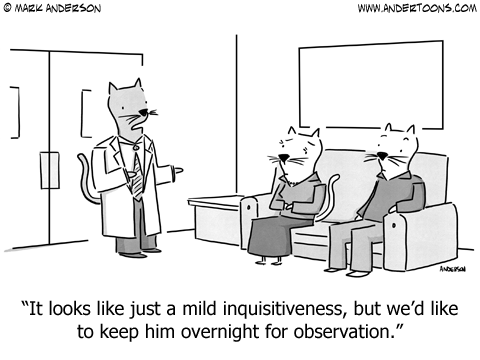
Mild Inquisitiveness
by JOHN ADAMS •
Daily Bread
Daily Bread for 5.20.15
by JOHN ADAMS •
Good morning, Whitewater.
Midweek in Whitewater will be cloudy with a high of fifty-seven. Sunrise is 5:26 and sunset 8:16, for 14h 49m 37s of daytime. The moon is a waxing crescent with 6.6% of its visible disk illuminated.
Whitewater’s CDA Seed Capital Committee meets at 4:30 PM, and the CDA Board meets at 5:30 PM. The Fire & Rescue Task Force has a working session at 6:30 PM.
On this day in 1873, a United States grants a patent for pants:
…San Francisco businessman Levi Strauss and Reno, Nevada, tailor Jacob Davis are given a patent to create work pants reinforced with metal rivets, marking the birth of one of the world’s most famous garments: blue jeans.
Born Loeb Strauss in Buttenheim, Bavaria, in 1829, the young Strauss immigrated to New York with his family in 1847 after the death of his father. By 1850, Loeb had changed his name to Levi and was working in the family dry goods business, J. Strauss Brother & Co. In early 1853, Levi Strauss went west to seek his fortune during the heady days of the Gold Rush.
In San Francisco, Strauss established a wholesale dry goods business under his own name and worked as the West Coast representative of his family’s firm. His new business imported clothing, fabric and other dry goods to sell in the small stores opening all over California and other Western states to supply the rapidly expanding communities of gold miners and other settlers. By 1866, Strauss had moved his company to expanded headquarters and was a well-known businessman and supporter of the Jewish community in San Francisco.
Jacob Davis, a tailor in Reno, Nevada, was one of Levi Strauss’ regular customers. In 1872, he wrote a letter to Strauss about his method of making work pants with metal rivets on the stress points–at the corners of the pockets and the base of the button fly–to make them stronger. As Davis didn’t have the money for the necessary paperwork, he suggested that Strauss provide the funds and that the two men get the patent together. Strauss agreed enthusiastically, and the patent for “Improvement in Fastening Pocket-Openings”–the innovation that would produce blue jeans as we know them–was granted to both men on May 20, 1873.
Strauss brought Davis to San Francisco to oversee the first manufacturing facility for “waist overalls,” as the original jeans were known. At first they employed seamstresses working out of their homes, but by the 1880s, Strauss had opened his own factory. The famous 501 brand jean–known until 1890 as “XX”–was soon a bestseller, and the company grew quickly. By the 1920s, Levi’s denim waist overalls were the top-selling men’s work pant in the United States. As decades passed, the craze only grew, and now blue jeans are worn by men and women, young and old, around the world.
Here’s Puzzability‘s Wednesday game:
|
This Week’s Game — May 18-22
|
|||||
|
Prhymetime
|
|||||
|
For your viewing pleasure this week, we’re airing a series series every day. Each day’s clues lead to a series of answer words that, in order, rhyme with the title of an Emmy-winning TV series (comedy or drama).
|
|||||
|
Example:
|
|||||
|
Pretending to be sick; tartan pattern
|
|||||
|
Answer:
|
|||||
|
Breaking Bad (faking; plaid)
|
|||||
|
What to Submit:
|
|||||
|
Submit the series title and the rhyming words (as “Breaking Bad (faking; plaid)” in the example) for your answer.
|
|||||
|
|||||
|
Wednesday, May 20
|
|||||
|
