
Author Archive for JOHN ADAMS
Poll
Friday Poll: Favorite Easter Candy 2015
by JOHN ADAMS •
Here’s the Fourth Annual FREE WHITEWATER Easter Candy Poll. Chocolate rabbits topped the polls of 2012 & 2013, and jelly beans came in first in 2014.
What’s your favorite?
Technology
Fixed! (I Think…)
by JOHN ADAMS •
Thanks very much to those who wrote me about a problem with this site displaying on some browsers. Your messages have been very much appreciated. I think we’re back in business now, after disabling a pesky plugin that was doing the opposite of what it was supposed to do.
One encounters glitches now and again, but they’re easily overcome with identification and help from so many sharp people in town.
Cheers,
Adams
Daily Bread
Daily Bread 4.3.15
by JOHN ADAMS •
Good morning, Whitewater.
Friday in town will be increasingly cloudy, with a high of forty-eight. Sunrise is 6:32 and sunset 7:23, for 12h 51m 31s of daytime. The moon is a waxing gibbous with 99% of its visible disk illuminated.
On this day in 1865, Union soldiers, including many from Wisconsin, help liberate Richmond:
1865 – (Civil War) Confederate capital seized
When Petersburg, Virginia, fell on the night of April 2, 1865, Confederate leaders hastily abandoned Richmond. The 5th, 6th, 7th, 19th, 36th, 37th and 38th Wisconsin Infantry participated in the occupation of Petersburg and Richmond. The brigade containing the 19th Wisconsin Infantry was the first to enter Richmond on the morning of April 3rd. Their regimental flag became the first to fly over the captured capital of the Confederacy when Colonel Samuel Vaughn planted it on Richmond City Hall.
Here’s the final game in Puzzability‘s Flower Arrangements series:
|
This Week’s Game — March 30-April 3
|
|||||
|
Flower Arrangements
|
|||||
|
We’re having a garden party this week. For each day, we’ve taken a word or phrase, added to it the letters in the name of a flower, and rearranged all the letters to get a new phrase. Both pieces are described in each day’s equation, and the flower name is given.
|
|||||
|
Example:
|
|||||
|
Stop suddenly, as a baseball pitcher in mid-throw + NARCISSUS = cocktails made with vodka and coffee liqueur
|
|||||
|
Answer:
|
|||||
|
Balk, Black Russians
|
|||||
|
What to Submit:
|
|||||
|
Submit both pieces, with the shorter one first (as “Balk, Black Russians” in the example), for your answer.
|
|||||
 |
|||||
|
Friday, April 3
|
|||||
|


Science/Nature
Out There
by JOHN ADAMS •
Corporate Welfare, Development, Gluttony, Government Spending, WEDC
The Failed WEDC’s Revolving Door
by JOHN ADAMS •
People are attracted to good opportunities, and repulsed by bad ones.
At the Wisconsin Economic Development Corporation, there’s no better sign of a failed organization than that the agency has become a building that needs a revolving door:
Since WEDC’s creation in July 2011 by Gov. Scott Walker and lawmakers as a quasi-public replacement to the state Department of Commerce, WEDC has already had two chief executive officers and three chief operating officers…
Who’s next for this group of self-professed development specialists? Someone now working for a school in Texas:
WEDC has struggled with turnover as it tries to stick to its mission of boosting the state’s economy. The state’s flagship jobs agency is hiring its fifth chief financial officer in four years.
Brandon Duck will start later this month as the latest CFO of the Wisconsin Economic Development Corp., replacing Stephanie Walker, who left that position in mid-January because her spouse took a job on the East Coast.
Duck serves as the CFO of a preparatory school in Dallas, Texas, and previously worked as the enterprise risk and compliance director of the State of Wisconsin Investment Board.
Now a few men in Whitewater, more acquainted with their own circle than the needs of this city, think that taxpayer grants for white-collar startups, in a taxpayer built-location, with cheap labor from a publicly-funded university, are the answer to Whitewater’s problems.
I’ll borrow from Gov. Reagan from among his questions for Pres. Carter in their only debate, but about how these millions in grants have affected residents our town: because of them, “are you better off than you were four years ago?”
Only a few in the city could credibly answer affirmatively. They’ve headlines for their scrapbooks.
For thousands of workers, families, students, and retired residents, the WEDC has been ineffectual (and wildly wasteful).
Honest to goodness, only the most scheming or ignorant men would think that – of all possible needs of our city – money for software startups was worthwhile for Whitewater.
The great oddity is that either (1) insight among a few town notables is so poor that they can’t see their headlines don’t move most people, or worse that (2) they are indifferent to anyone except those among their own small number.
There will never be a time – never – when these sort of selfish projects will serve our city’s genuine needs, or that anyone hawking them will gain the approbation of more than a few.
Daily Bread
Daily Bread for 4.2.15
by JOHN ADAMS •
Good morning, Whitewater.
We’ll have a probability of showers today, with a high of sixty-four. Sunrise is 6:33 and sunset 7:22, for 12h 48m 38s of daytime. The moon is a waxing gibbous with 96.3% of its visible disk illuminated.
There’s beauty in hockey, but not just the game. Clearing the ice during a game is almost a synchronized sport all its own:
On this day in 1917, Pres. Wilson asks Congress for a declaration of war against Germany:
Washington, April 2 — At 8:35 o’clock tonight the United States virtually made its entrance into the war. At that hour President Wilson appeared before a joint session of the Senate and House and invited it to consider the fact that Germany had been making war upon us and to take action in recognition of that fact in accordance with his recommendations, which included universal military service, the raising of an army of 500,000 men, and co-operation with the Allies in all ways that will help most effectively to defeat Germany.
Resolutions recognizing and declaring the state of war were immediately introduced in the House and Senate by Representative Flood and Senator Martin, both of the President’s birth-state, Virginia, and they are the strongest declarations of war that the United States has ever made in any war in which it has been engaged since it became a nation. They are the administration resolutions drawn up after conference with the President, and in language approved and probably dictated by him, and they will come before the two Foreign Affairs Committees at meetings which will be held tomorrow morning and will be reported at the earliest practical moment….
Before an audience that cheered him as he has never been cheered in the Capitol in his life, the President cast in the lot of American unreservedly with the Allies and declared for a war that must not end until the issue between autocracy and democracy has been fought out. He recited our injuries at Germany’s hands, but he did not rest our cause on those; he went on from that point to range us with the Allies as a factor in an irrepressible conflict between the autocrat and the people. He showed that peace was impossible for the democracies of the world while this power remained on earth. “The world,” he said, “must be made safe for democracy.”
Here is the Thursday game in the Flower Arrangements series from Puzzability:
|
This Week’s Game — March 30-April 3
|
|||||
|
Flower Arrangements
|
|||||
|
We’re having a garden party this week. For each day, we’ve taken a word or phrase, added to it the letters in the name of a flower, and rearranged all the letters to get a new phrase. Both pieces are described in each day’s equation, and the flower name is given.
|
|||||
|
Example:
|
|||||
|
Stop suddenly, as a baseball pitcher in mid-throw + NARCISSUS = cocktails made with vodka and coffee liqueur
|
|||||
|
Answer:
|
|||||
|
Balk, Black Russians
|
|||||
|
What to Submit:
|
|||||
|
Submit both pieces, with the shorter one first (as “Balk, Black Russians” in the example), for your answer.
|
|||||
|
|||||
|
Thursday, April 2
|
|||||
|

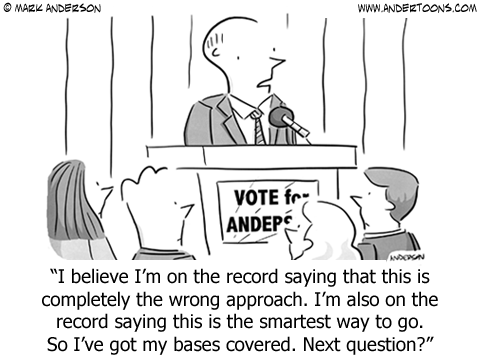
Anderson, Cartoons & Comics, Elections
Covered
by JOHN ADAMS •
Daily Bread
Daily Bread for 4.1.15
by JOHN ADAMS •
Good morning, Whitewater.
We’ll have a warm and sunny Wednesday in town, with a high of sixty-eight. Sunrise is 6:35 and sunset 7:21, for 12h 45m 44s of daytime. The moon is a waxing gibbous with 91.9% of its visible disk illuminated.
A person’s single bad meal, leading to illness, is forever memorable to him or her. How, then, can animal scavengers survive meal after meal of rotting carcasses? Here’s how:
On this day in 1945, Americans landed on Okinawa, the beginning of an intense fight to take that island from Japan. The New York Times reported on the landing the next day:
Guam, Monday, April 2 — The United States Tenth Army landed yesterday morning on Okinawa, main island of the Ryukyus, 362 miles from the Japanese home islands. This morning found the invaders three miles inland and holding two airfields, with the defenders retreating all along the eight-mile landing line.
The veteran doughboys and marines met amazingly light resistance from the minute they landed yesterday at 8:30 A.M. They pushed up the steep slopes from the landing beaches with ease, although the shore was dominated by enemy guns on high ground.
Marines took the Yontan airfield at the northern end of the beachhead while Army troops captured the Katena airdrome in the southern area.
In his second communique on the operation Admiral Chester W. Nimitz at 9:30 A.M. today reported:
“United States forces on Okinawa advanced inland rapidly throughout the first day of the assault and by 18:00 (6 P.M.) on April 1 (East Longitude date), forward elements of the Twenty-fourth Army Corps and Marine Third Amphibious Corps had expanded in the beachhead to a three mile depth at several points. Enemy resistance continued to be light.
The Battle of Okinawa lasted over two months’ time, until the few remaining Japanese soldiers on the island capitulated in mid-June, and was the largest amphibious assault of its kind in the Pacific.
On this day in 1970, Wisconsin’s MLB team is founded:
1970 – Milwaukee Brewers Founded
On this date the Milwaukee Brewers, Inc., an organization formed by Allan H. “Bud” Selig and Edmund Fitzgerald, acquired the Seattle Pilots franchise. The team was renamed the Milwaukee Brewers, a tribute to the city’s long association with brewing industry.
Here’s the Wednesday game from Puzzability:
|
This Week’s Game — March 30-April 3
|
|||||
|
Flower Arrangements
|
|||||
|
We’re having a garden party this week. For each day, we’ve taken a word or phrase, added to it the letters in the name of a flower, and rearranged all the letters to get a new phrase. Both pieces are described in each day’s equation, and the flower name is given.
|
|||||
|
Example:
|
|||||
|
Stop suddenly, as a baseball pitcher in mid-throw + NARCISSUS = cocktails made with vodka and coffee liqueur
|
|||||
|
Answer:
|
|||||
|
Balk, Black Russians
|
|||||
|
What to Submit:
|
|||||
|
Submit both pieces, with the shorter one first (as “Balk, Black Russians” in the example), for your answer.
|
|||||
|
|||||
|
Wednesday, April 1
|
|||||
|

Local Government, Marketing, Politics, Science/Nature
The Cold Fusion Problem
by JOHN ADAMS •
In the late 1980s, scientists Martin Fleischmann and Stanley Pons told the world that they had a device that demonstrated the energy-producing consequences of a nuclear reaction, but at room temperatures. Since humanity had produced energy from nuclear reactions only at very high temperatures, this sort of fusion would have been cold (and more easily-produced) by comparison.
As it turned out, no one reputable could duplicate their efforts, and their astounding claim became an astoundingly embarrassing one. They had been noted scientists, but setting aside the caution that serious inquiry requires, they came to see the false results they undoubtedly hoped to see.
The natural order, not being impressionable of men’s dreams of fame and glory, was unmoved.
For Fleishmann and Pons, and those of their ilk, there’s this problem: once one blunders on the scale that they did, it’s hard to recover. They weren’t any less intelligent or educated the day after others rejected these erroneous claims. They were the same men, after all. Still, their claims were thereafter incredible to others.
Recovery from misunderstanding of evidence, however, is difficult. Recovery from fabricated evidence (a worse act that I do not understand either Fleischmann or Pons to have committed) is more than difficult; it’s almost impossible.
But people want things, want them so very much, for having them and for being seen to have them. Proper positioning, presenting, marketing, and selling depend on whether one seeks something through clear eyes, honest intentions, and accurate assessments.
Whitewater’s had – and still has – a problem with accurate and honest assessments of data. For us, at best, one may charitably call it a cold fusion problem. Occasionally, I’d guess it’s simply fabrication to sell something.
I cannot say why some local men have lived their public lives with a hucksterism so thorough that it’s made them small-town copies of Fleischmann & Pons, if not occasionally worse. It’s enough to know that they have, and that they’ve a powerful need to carry on that way before their own kind and all the city.
Their way won’t last, of course, but it’s not yet finished, either.
Film
Film: 20 Sheets of Paper and a Dozen Ballpoint Pens
by JOHN ADAMS •
Daily Bread
Daily Bread for 3.31.15
by JOHN ADAMS •
Good morning, Whitewater.
Month’s end will be increasingly sunny with a high of fifty-four. Sunrise is 6:37 and sunset 7:20, for 12h 42m 51s of daytime. The moon is a waxing gibbous with 89.5% of its visible disk illuminated.
Whitewater’s Fire & Rescue Task Force meets this afternoon at 5:30 PM.
On this day in 1889, the Eiffel Tower opens to the public:
The Eiffel Tower (French: La tour Eiffel … is an iron lattice tower located on the Champ de Mars in Paris, France. It was named after the engineer Gustave Eiffel, whose company designed and built the tower. Erected in 1889 as the entrance arch to the 1889 World’s Fair, it was initially criticised by some of France’s leading artists and intellectuals for its design, but has become both a global cultural icon of France and one of the most recognizable structures in the world.[1] The tower is the tallest structure in Paris and the most-visited paid monument in the world; 6.98 million people ascended it in 2011.[2] The tower received its 250 millionth visitor in 2010.[2]
The tower is 324 metres (1,063 ft) tall,[2] about the same height as an 81-storey building. Its base is square, 125 metres (410 ft) on a side. During its construction, the Eiffel Tower surpassed the Washington Monument to assume the title of the tallest man-made structure in the world, a title it held for 41 years, until the Chrysler Building in New York City was built in 1930. Because of the addition of the aerial atop the Eiffel Tower in 1957, it is now taller than the Chrysler Building by 5.2 metres (17 ft). Not including broadcast aerials, it is the second-tallest structure in France, after the Millau Viaduct.
The tower has three levels for visitors, with restaurants on the first and second. The third level observatory’s upper platform is 276 m (906 ft) above the ground,[2] the highest accessible to the public in the European Union. Tickets can be purchased to ascend by stairs or lift (elevator) to the first and second levels. The climb from ground level to the first level is over 300 steps, as is the walk from the first to the second level. Although there are stairs to the third and highest level, these are usually closed to the public and it is generally only accessible by lift.
On this day in 1998, the Brewers begin regular-season play as a National League team:
1998 – Brewers Go National
On this date the Milwaukee Brewers played their first game as a National League Team, losing to the Atlanta Braves at Turner Field. The Brewers’ transfer, the first since the American League was formed at the turn of the century, was necessary to create a 16-team National League and a 14-team American League. [Source: “Brewer’s Timeline” on the team’s official Web site].
Here’s the Tuesday game in Puzzability‘s Flower Arrangements series:
|
This Week’s Game — March 30-April 3
|
|||||
|
Flower Arrangements
|
|||||
|
We’re having a garden party this week. For each day, we’ve taken a word or phrase, added to it the letters in the name of a flower, and rearranged all the letters to get a new phrase. Both pieces are described in each day’s equation, and the flower name is given.
|
|||||
|
Example:
|
|||||
|
Stop suddenly, as a baseball pitcher in mid-throw + NARCISSUS = cocktails made with vodka and coffee liqueur
|
|||||
|
Answer:
|
|||||
|
Balk, Black Russians
|
|||||
|
What to Submit:
|
|||||
|
Submit both pieces, with the shorter one first (as “Balk, Black Russians” in the example), for your answer.
|
|||||
|
|||||
|
Tuesday, March 31
|
|||||
|

