
Author Archive for JOHN ADAMS
Daily Bread
Daily Bread for 3.30.15
by JOHN ADAMS •
Good morning, Whitewater.
Monday will be increasingly cloudy with a high of fifty-six. Sunrise is 6:39 and sunset 7:19, for 12h 39m 57s of daytime. The moon is a waxing gibbous with 78.8% of its visible disk illuminated.
On this day in 1867, Secretary of State William Seward signs a treaty (soon thereafter ratified) that proves to be a good deal for America:
U.S. Secretary of State William H. Seward signs a treaty with Russia for the purchase of Alaska for $7 million. Despite the bargain price of roughly two cents an acre, the Alaskan purchase was ridiculed in Congress and in the press as “Seward’s folly,” “Seward’s icebox,” and President Andrew Johnson’s “polar bear garden.”
The czarist government of Russia, which had established a presence in Alaska in the mid-18th century, first approached the United States about selling the territory during the administration of President James Buchanan, but negotiations were stalled by the outbreak of the Civil War. After 1865, Seward, a supporter of territorial expansion, was eager to acquire the tremendous landmass of Alaska, an area roughly one-fifth the size of the rest of the United States. He had some difficulty, however, making the case for the purchase of Alaska before the Senate, which ratified the treaty by a margin of just one vote on April 9, 1867. Six months later, Alaska was formally handed over from Russia to the United States. Despite a slow start in U.S. settlement, the discovery of gold in 1898 brought a rapid influx of people to the territory, and Alaska, rich in natural resources, has contributed to American prosperity ever since.
Puzzability begins a new series with the name of a flower in each clue. Here’s Monday’s game:
|
This Week’s Game — March 30-April 3
|
|||||
|
Flower Arrangements
|
|||||
|
We’re having a garden party this week. For each day, we’ve taken a word or phrase, added to it the letters in the name of a flower, and rearranged all the letters to get a new phrase. Both pieces are described in each day’s equation, and the flower name is given.
|
|||||
|
Example:
|
|||||
|
Stop suddenly, as a baseball pitcher in mid-throw + NARCISSUS = cocktails made with vodka and coffee liqueur
|
|||||
|
Answer:
|
|||||
|
Balk, Black Russians
|
|||||
|
What to Submit:
|
|||||
|
Submit both pieces, with the shorter one first (as “Balk, Black Russians” in the example), for your answer.
|
|||||
 |
|||||
|
Monday, March 30
|
|||||
|


Animation, Film
Sunday Animation: Danny and the Wild Bunch
by JOHN ADAMS •
DANNY AND THE WILD BUNCH – Short Film from robert rugan on Vimeo.
A children’s book author is told that her new manuscript needs to be “darker”, but when her revisions piss off the characters in the book, they come back to make some changes of their own….
Winner “Best Short Film” – Las Vegas Film Festival
Winner “Best Animation” – Catalina Film Festival
Winner “Best Animation” – Asheville Film Festival
Winner “Best Fantasy Short Film” – Beverly Hills Shorts Festival
Winner “Honorable Mention” – LA Underground Film Festival
Official Selection – Bahamas International Film Festival
Official Selection – Golden Door Film Festival
Official Selection – Asheville Cinema Festival
Official Selection – Catalina Film Festival
Official Selection – Las Vegas Film Festival
Official Selection – Cucalorus Film Festival
Official Selection – Indie Memphis Film Festival
Official Selection – Atlanta Shorts Fest
Official Selection – LA Underground Film Festival
Official Selection – Cinequest Film Festival
Official Selection – Sedona International Film Festival
Official Selection – Cleveland International Film Festival
Official Selection – Beverly Hills Shorts Festival
Official Selection – Filmets Badalona Film Festival – Spain
Official Selection – Imaginaria Animation Festival – Italy
Featured On – Shortfil.ms: The Web’s Best Short Films
Featured On – Film Shortage: Best Scripted Shorts Online
Via Vimeo.
Daily Bread
Daily Bread for 3.29.15
by JOHN ADAMS •
Good morning, Whitewater.
Palm Sunday in town will bring rain, with the possibility of sleet in the morning, and a high of forty-four. Sunrise is 6:40 and sunset 7:17, for 12h 37m 03s of daytime. The moon is a waxing gibbous with 70.9% of its visible disk illuminated.
Scientist Patrick Moore contends – absurdly, really – that it would be safe to drink Roundup herbicide. He went on French television to say as much, and when an interviewer offered him a glass to test Moore’s conviction, he became…less confident:
(Moore’s been identified as Monsanto lobbyist, but Monsanto denies any business relationship to him.)
The interviewer’s question seems fair: in this case, why won’t Moore put his claims about others’ risks to his test?
On this day in 1973, the United States completes her withdrawal of combat troops from Vietnam:
U.S. Forces Out of Vietnam; Hanoi Frees the Last P.O.W.
By Joseph B. Treaster
Special to The New York Times
Saigon, South Vietnam, March 29 — The last American troops left South Vietnam today, leaving behind an unfinished war that has deeply scarred this country and the United States.
There was little emotion or joy as they brought to a close almost a decade of American military intervention.
Remaining after the final jet transport lifted off from Tan Son Nhut air base at 5:53 P.M. were about 800 Americans on the truce observation force who will leave tomorrow and Saturday. A contingent of 159 Marine guards and about 50 military attaches also stayed behind.
The fighting men were gone, but United States involvement in South Vietnam was far from ended.
When Gen. Frederick C. Weyand presided over the furling of the colors of the United States Military Assistance Command, Vietnam, this afternoon, he told a handful of American servicemen, “You can hold your heads up high for having been a part of this selfless effort.”
In a second address later on in the afternoon, delivered in halting Vietnamese, General Weyland declared: “Our mission has been accomplished. I depart with a strong feeling of pride in what we have achieved, and in what our achievement represents.”
As the last American commander in Vietnam said good-bye to the huge white tropical building that was sometimes called Pentagon East, a force of 7,200 American civilians employed by the Department of Defense was standing under the eaves.
Daily Bread
Daily Bread for 3.28.15
by JOHN ADAMS •
Good morning, Whitewater.
We’ll have a sunny Saturday with a high of thirty-eight in town. Sunrise is 6:47 and sunset 7:16, for 12h 34m 09s of daytime. The moon is a waxing gibbous with 61.9% of its visible disk illuminated.
For the Friday FW poll, asking whether respondents thought tonight’s NCAA Elite Eight game would go to Wisconsin or Arizona, the response was resounding: 80% responding went with the Badgers.
The Badgers animated video below has had 21,150,678 views on YouTube (and counting):
It’s the anniversary of America’s worst nuclear power accident:
The Three Mile Island accident was a partial nuclear meltdown that occurred on March 28, 1979, in one of the two Three Mile Island nuclear reactors in Dauphin County, Pennsylvania, United States. It was the worst accident in U.S. commercial nuclear power plant history.[2] The incident was rated a five on the seven-point International Nuclear Event Scale: Accident With Wider Consequences.[3][4]
The accident began with failures in the non-nuclear secondary system, followed by a stuck-open pilot-operated relief valve in the primary system, which allowed large amounts of nuclear reactor coolant to escape. The mechanical failures were compounded by the initial failure of plant operators to recognize the situation as a loss-of-coolant accident due to inadequate training and human factors, such as human-computer interaction design oversights relating to ambiguous control room indicators in the power plant’s user interface. In particular, a hidden indicator light led to an operator manually overriding the automatic emergency cooling system of the reactor because the operator mistakenly believed that there was too much coolant water present in the reactor and causing the steam pressure release.[5]
The accident crystallized anti-nuclear safety concerns among activists and the general public, resulted in new regulations for the nuclear industry, and has been cited as a contributor to the decline of a new reactor construction program that was already underway in the 1970s.[6] The partial meltdown resulted in the release of unknown amounts of radioactive gases and radioactive iodine into the environment. Dire predictions were made by anti-nuclear movement activists;[7] however epidemiological studies analyzing the rate of cancer in and around the area since the accident, determined there was a small statistically non-significant increase in the rate and thus no causal connection linking the accident with these cancers can be made.[8][9][10][11][12][13] Cleanup started in August 1979, and officially ended in December 1993, with a total cleanup cost of about $1 billion.[14]
Cats
Friday Catblogging: Cats Stealing Pizza
by JOHN ADAMS •
Poll, Sports
Friday Poll: Badgers or Wildcats?
by JOHN ADAMS •


Now past the Tar Heels, the Wisconsin plays Arizona in a near rematch of last year’s NCAA tournament game (with last year’s seeds being reserved this year). So, what happens? Badgers or Wildcats?
Daily Bread
Daily Bread for 3.27.15
by JOHN ADAMS •
Good morning, Whitewater.
It’s a sunny end to the week, with a high of thirty for Friday. Sunrise is 6:44 and sunset 7:15, for 12h 31m 14s of daytime. The moon is a waxing gibbous with 51.8% of its visible disk illuminated.
On this day in 1912, Americans celebrate a gift of Japanese cherry trees along the Potomac:
In a ceremony on March 27, 1912, First Lady Helen Herron Taft and Viscountess Chinda, wife of the Japanese ambassador, planted the first two of these trees on the north bank of the Tidal Basin in West Potomac Park. At the end of the ceremony, the First Lady presented Viscountess Chinda with a bouquet of ‘American Beauty’ roses. These two trees still stand at the terminus of 17th Street Southwest, marked by a large plaque.[3] By 1915, the United States government had responded with a gift of flowering dogwood trees to the people of Japan.[5]
From 1913 to 1920, trees of the Somei-Yoshino variety, which comprised 1800 of the gift, were planted around the Tidal Basin. Trees of the other 11 cultivars, and the remaining Yoshinos, were planted in East Potomac Park. In 1927, a group of American school children re-enacted the initial planting. In 1934, the District of Columbia Commissioners sponsored a three-day celebration of the flowering cherry trees.
Puzzability‘s Mixed Company series ends with Friday’s game:
|
This Week’s Game — March 23-27
|
|||||
|
Mixed Company
|
|||||
|
The economy may be looking up, but these businesses have fallen to pieces. For each day this week, we started with the name of a current Fortune 500 company. We removed all spaces and punctuation, then divided the string into three-letter chunks. Those chunks, in random order, are the day’s clue.
|
|||||
|
Example:
|
|||||
|
RIC ESS XPR AME ANE
|
|||||
|
Answer:
|
|||||
|
American Express
|
|||||
|
What to Submit:
|
|||||
|
Submit the company name (as “American Express” in the example) for your answer.
|
|||||
|
|||||
|
Friday, March 27
|
|||||
|

Corporate Welfare, Government Spending, Open Government, Planning, Waste Digesters, WGTB
The City of Whitewater Digester Clarification That Could Use a Clarification
by JOHN ADAMS •
There’s a paragraph from Whitewater’s City Manager Update for 3.20.15 that proposes a clarification about the digester project proposed as part of an overall, $20.7 million-dollar upgrade to the city’s wastewater treatment facilities.
First, the city’s clarification (my emphasis added):
Wastewater Treatment Facility Upgrade Clarification
When an issue as complex and technically detailed as the proposed upgrades to the wastewater treatment facility gets in the news, there are bound to be errors and points needing clarification. Such is the case with the wastewater project. One such point of confusion is related to waste digesters. Some in the community believe that part of the proposed project involves the installation of digesters at the wastewater treatment facility. The truth is that the wastewater treatment facility already has two anaerobic digesters on site. The existing digesters were installed when the plant was built in the early 1980s. These digesters have been fully functional and in use for 30 years. What is under consideration as part of the project is the installation of additional equipment within the digesters that would increase operational efficiency within the digesters. Staff thanks all those who have provided coverage of this project whether it be through websites, blogs, or newspapers. Staff further hopes that those covering the project will continue to do so. If anyone in the community has a question regarding the project, they are invited to contact a city staff member for further details.
I’ll offer three points now, in order of importance.
First, the clarification’s implication that what is under consideration is simply an increase in operational efficiency is false, and patently so. This proposal isn’t a matter of degree, but of kind. For city officials to suggest otherwise is either to misunderstand their own project, or to hope that residents misunderstand it.
Second, there’s something risible about the claim that the city’s update aims to set others straight about this ‘complex and technically detailed’ proposal. One can easily demonstrate – and I will — that Wastewater Superintendent Tim Reel has from his earliest discussions before Council, and since, both misrepresented Whitewater’s history with digesters and failed to consider even the simplest facts about his own project. One can show that virtually every presentation he’s given has been riddled with these problems of analysis, foresight, and (it seems) basic candor.
Here’s an opportunity: I’d invite Messrs. Clapper and Reel to consider the City of Whitewater’s recent presentation to the Whitewater School Board (for which, after all, they are responsible). If upon reviewing it they think their explanation of the project is sound, then I’d invite them to consider whether they see clearly what a sound project is. I mean this sincerely: there’s still time to rethink what good work requires.
Third, I have no idea what some residents misunderstand; it’s enough to see and demonstrate that city officials have both a weak grasp of fundamentals, an apparent penchant for withholding key information, and a willingness to flack the project rather than describe it candidly. (That the city update on the digester begins condescendingly, all these problems to be presented, is too funny.)
As for my own, upcoming writing about this proposal, I’ve a tentative start date (mid-April), but still many questions to resolve in my own mind. There’s vital information that the city has not made public (but should have). There’s more than enough to see and show that this is a shallow effort, but still a full assessment requires more information that city government has not provided. There should be an order to getting that information; I’ll follow that order.
Finally, this project is necessarily important for Whitewater, but aspects of it may have a greater appeal, to a wider audience. This proposal may be suitable for a case study on error and overreach. (Many thanks to those helping me see it this way.) That won’t change my work on the project, but may influence how I write about it.
In any event, the start of a long process of published assessment will begin soon.
Daily Bread
Daily Bread for 3.26.15
by JOHN ADAMS •
Good morning, Whitewater.
Thursday in town will be increasingly cloudy with a high of thirty-nine. Sunrise is 6:46 and sunset 7:14, for 12h 28m 19s of daytime. The moon is a waxing crescent with 41.6% of its visible disk illuminated.
On this day in 1953, Jonas Salk makes an announcement:
On March 26, 1953, American medical researcher Dr. Jonas Salk announces on a national radio show that he has successfully tested a vaccine against poliomyelitis, the virus that causes the crippling disease of polio. In 1952–an epidemic year for polio–there were 58,000 new cases reported in the United States, and more than 3,000 died from the disease. For promising eventually to eradicate the disease, which is known as “infant paralysis” because it mainly affects children, Dr. Salk was celebrated as the great doctor-benefactor of his time….
On this day in 1881, a Wisconsin mascot dies in a fire:
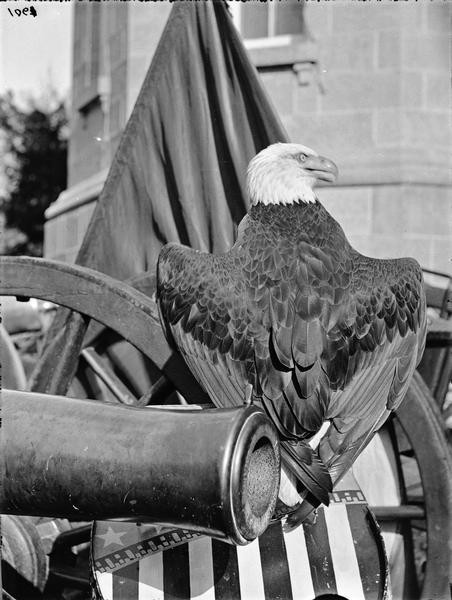
1881 – Old Abe Dies
On this date Old Abe, famous Civil War mascot, died from injuries sustained during a fire at the State Capitol. Old Abe was the mascot for Company C, an Eau Claire infantry unit that was part of the Wisconsin 8th Regiment. During the Capitol fire of 1881, smoke engulfed Old Abe’s cage. One of his feathers survived and is in the Wisconsin Historical Museum. [Source: Wisconsin Lore and Legends, pg. 51]
Here is the Thursday game from Puzzability, in the Mixed Company series:
|
This Week’s Game — March 23-27
|
|||||
|
Mixed Company
|
|||||
|
The economy may be looking up, but these businesses have fallen to pieces. For each day this week, we started with the name of a current Fortune 500 company. We removed all spaces and punctuation, then divided the string into three-letter chunks. Those chunks, in random order, are the day’s clue.
|
|||||
|
Example:
|
|||||
|
RIC ESS XPR AME ANE
|
|||||
|
Answer:
|
|||||
|
American Express
|
|||||
|
What to Submit:
|
|||||
|
Submit the company name (as “American Express” in the example) for your answer.
|
|||||
|
|||||
|
Thursday, March 26
|
|||||
|

Anderson, Cartoons & Comics
Works Best
by JOHN ADAMS •

Daily Bread
Daily Bread for 3.25.15
by JOHN ADAMS •
Good morning, Whitewater.
Midweek in the Whippet City will be mostly cloudy with a high of forty-three. Sunrise is 6:47 and sunset is 7:13, for 12h 25m 24s of daytime. The moon is a waxing crescent with 31.4% of its visible disk illuminated.
Whitewater’s Tech Park Board meets at 8 AM. This afternoon, the CDA’s Seed Capital Committee meets at 4 PM, and the CDA Board at 5 PM.
It’s the one-hundred fourth anniversary of the Triangle Shirtwaist Fire:
The Triangle Shirtwaist Factory fire in Manhattan, New York City on March 25, 1911 was the deadliest industrial disaster in the history of the city, and one of the deadliest in U.S. history. The fire caused the deaths of 146 garment workers – 123 women and 23 men [1] – who died from the fire, smoke inhalation, or falling or jumping to their deaths. Most of the victims were recent Jewish and Italian immigrant women aged 16 to 23;[2][3][4] of the victims whose ages are known, the oldest victim was Providenza Panno at 43, and the youngest were 14-year-olds Kate Leone and “Sara” Rosaria Maltese.[5]
Because the owners had locked the doors to the stairwells and exits, a common practice used to prevent workers from taking unauthorized breaks and pilferage,[6] many of the workers who could not escape the burning building jumped from the eighth, ninth, and tenth floors to the streets below. The fire led to legislation requiring improved factory safety standards and helped spur the growth of the International Ladies’ Garment Workers’ Union, which fought for better working conditions for sweatshop workers.
The factory was located in the Asch Building, at 23–29 Washington Place in the Greenwich Village neighborhood of Manhattan, now known as the Brown Building and part of New York University. The building has been designated a National Historic Landmark and a New York City landmark.[7]
Here’s Puzzability‘s Wednesday game:
|
This Week’s Game — March 23-27
|
|||||
|
Mixed Company
|
|||||
|
The economy may be looking up, but these businesses have fallen to pieces. For each day this week, we started with the name of a current Fortune 500 company. We removed all spaces and punctuation, then divided the string into three-letter chunks. Those chunks, in random order, are the day’s clue.
|
|||||
|
Example:
|
|||||
|
RIC ESS XPR AME ANE
|
|||||
|
Answer:
|
|||||
|
American Express
|
|||||
|
What to Submit:
|
|||||
|
Submit the company name (as “American Express” in the example) for your answer.
|
|||||
|
|||||
|
Wednesday, March 25
|
|||||
|

Film
Film: The Raiders of the Lost Ark Boulder Scene
by JOHN ADAMS •
Daily Bread
Daily Bread for 3.24.15
by JOHN ADAMS •
Good morning, Whitewater.
Tuesday in town will be increasingly cloudy with a high of thirty-eight. Sunrise today is 6:49 and sunset 7:12, for 12h 22m 30s of daytime. The moon is a waxing crescent with 21.7% of its visible disk illuminated.
Whitewater’s Urban Forestry Commission meets today at 4:30 PM.
On this day in 1989, America saw one of the worst oil spills in her history:
The Exxon Valdez oil spill occurred in Prince William Sound, Alaska, on March 24, 1989, when Exxon Valdez, an oil tanker bound for Long Beach, California, struck Prince William Sound’s Bligh Reef at 12:04 a.m.[1] local time and spilled 11,000,000 to 38,000,000 gallons of crude oil[2][3] over the next few days. It is considered to be one of the most devastating human-caused environmental disasters.[4] The Valdez spill was the largest in US waters until the 2010 Deepwater Horizon oil spill, in terms of volume released.[5] However, Prince William Sound’s remote location, accessible only by helicopter, plane, or boat, made government and industry response efforts difficult and severely taxed existing plans for response. The region is a habitat for salmon, sea otters, seals and seabirds. The oil, originally extracted at the Prudhoe Bay oil field, eventually covered 1,300 miles (2,100 km) of coastline,[6] and 11,000 square miles (28,000 km2) of ocean.[7]
It’s Harry Houdini’s birthday:
1874 – Harry Houdini Born
On this date magician Harry Houdini was born in Budapest, though he later claimed to have been born on April 6, 1874, in Appleton, Wisconsin. At the age of 13 he left Appleton, where his family had emigrated, for New York City, and began his career as an escape artist and magician. [Source: Houdini.org]
Here’s the Tuesday game from Puzzability:
|
This Week’s Game — March 23-27
|
|||||
|
Mixed Company
|
|||||
|
The economy may be looking up, but these businesses have fallen to pieces. For each day this week, we started with the name of a current Fortune 500 company. We removed all spaces and punctuation, then divided the string into three-letter chunks. Those chunks, in random order, are the day’s clue.
|
|||||
|
Example:
|
|||||
|
RIC ESS XPR AME ANE
|
|||||
|
Answer:
|
|||||
|
American Express
|
|||||
|
What to Submit:
|
|||||
|
Submit the company name (as “American Express” in the example) for your answer.
|
|||||
|
|||||
|
Tuesday, March 24
|
|||||
|
