
Author Archive for JOHN ADAMS
Daily Bread
Daily Bread for 3.23.15
by JOHN ADAMS •
Good morning, Whitewater.
Spring, but a cold spring: some snow, with a high of thirty-four. Sunrise is 6:51 and sunset 7:10, for 12h 19m 34s of daytime. The moon is a waxing crescent with 13.2% of its visible disk illuminated.
This day in 1839 turns out O.K., OK, okay:
On this day in 1839, the initials “O.K.” are first published in The Boston Morning Post. Meant as an abbreviation for “oll correct,” a popular slang misspelling of “all correct” at the time, OK steadily made its way into the everyday speech of Americans.
During the late 1830s, it was a favorite practice among younger, educated circles to misspell words intentionally, then abbreviate them and use them as slang when talking to one another. Just as teenagers today have their own slang based on distortions of common words, such as “kewl” for “cool” or “DZ” for “these,” the “in crowd” of the 1830s had a whole host of slang terms they abbreviated. Popular abbreviations included “KY” for “No use” (“know yuse”), “KG” for “No go” (“Know go”), and “OW” for all right (“oll wright”).
Of all the abbreviations used during that time, OK was propelled into the limelight when it was printed in the Boston Morning Post as part of a joke. Its popularity exploded when it was picked up by contemporary politicians. When the incumbent president Martin Van Buren was up for reelection, his Democratic supporters organized a band of thugs to influence voters. This group was formally called the “O.K. Club,” which referred both to Van Buren’s nickname “Old Kinderhook” (based on his hometown of Kinderhook, New York), and to the term recently made popular in the papers. At the same time, the opposing Whig Party made use of “OK” to denigrate Van Buren’s political mentor Andrew Jackson. According to the Whigs, Jackson invented the abbreviation “OK” to cover up his own misspelling of “all correct.”
The man responsible for unraveling the mystery behind “OK” was an American linguist named Allen Walker Read. An English professor at Columbia University, Read dispelled a host of erroneous theories on the origins of “OK,” ranging from the name of a popular Army biscuit (Orrin Kendall) to the name of a Haitian port famed for its rum (Aux Cayes) to the signature of a Choctaw chief named Old Keokuk. Whatever its origins, “OK” has become one of the most ubiquitous terms in the world, and certainly one of America’s greatest lingual exports.
On this day in 1864, the 36th musters in:
1864 – (Civil War) 36th Wisconsin Infantry Mustered In
The 36th Wisconsin Infantry mustered in at Camp Randall in Madison. Its brief service included the defense of Washington, D.C., the Battle of Hatcher’s Run, Virginia, and the surrender of General Lee and his army at Appomattox Court House.
Puzzability has a corporate theme this week, in its Mixed Company series:
|
This Week’s Game — March 23-27
|
|||||
|
Mixed Company
|
|||||
|
The economy may be looking up, but these businesses have fallen to pieces. For each day this week, we started with the name of a current Fortune 500 company. We removed all spaces and punctuation, then divided the string into three-letter chunks. Those chunks, in random order, are the day’s clue.
|
|||||
|
Example:
|
|||||
|
RIC ESS XPR AME ANE
|
|||||
|
Answer:
|
|||||
|
American Express
|
|||||
|
What to Submit:
|
|||||
|
Submit the company name (as “American Express” in the example) for your answer.
|
|||||
 |
|||||
|
Monday, March 23
|
|||||
|


Animation, Music
Sunday Animation: Jack and the Giant
by JOHN ADAMS •
Jack and the Giant from Kim Pimmel on Vimeo.
Daily Bread
Daily Bread for 3.22.15
by JOHN ADAMS •
Good morning, Whitewater.
Our Sunday will be mostly cloudy with a high of forty-one. We may have up to an inch of snow overnight, and at the least some rain or sleet. Sunrise is 6:53 and sunset 7:09, for 12h 16m 38s of daytime. The moon is a waxing crescent with 6.5% of its visible disk illuminated.
On March 22, 1765, Britain imposed the Stamp Act of 1765 on her American (and other) colonies. The British thought themselves justified; not all agreed, however:
The debate in Parliament began soon after this meeting. Petitions submitted by the colonies were officially ignored by Parliament. In the debate Charles Townshend said, “…and now will these Americans, children planted by our care, nourished up by our Indulgence until they are grown to a degree of strength and opulence, and protected by our arms, will they grudge to contribute their mite to relieve us from heavy weight of the burden which we lie under?”[26] This led to Colonel Isaac Barré’s response:
They planted by your care? No! Your oppression planted ‘em in America. They fled from your tyranny to a then uncultivated and unhospitable country where they exposed themselves to almost all the hardships to which human nature is liable, and among others to the cruelties of a savage foe, the most subtle, and I take upon me to say, the most formidable of any people upon the face of God’s earth. …
They nourished by your indulgence? They grew by your neglect of ‘em. As soon as you began to care about ‘em, that care was exercised in sending persons to rule over ’em, in one department and another, who were perhaps the deputies of deputies to some member of this house, sent to spy out their liberty, to misrepresent their actions and to prey upon ’em; men whose behaviour on many occasions has caused the blood of those sons of liberty to recoil within them … .
They protected by your arms? They have nobly taken up arms in your defence, have exerted a valour amidst their constant and laborious industry for the defence of a country whose frontier while drenched in blood, its interior parts have yielded all its little savings to your emolument … The people I believe are as truly loyal as any subjects the king has, but a people jealous of their liberties and who will vindicate them if ever they should be violated; but the subject is too delicate and I will say no more.”[27]
Honest to goodness, Townsend’s remarks so nicely summarize a condescending government view, looking at others as though they were children. Britain came to get the comeuppance she deserved from America during the Revolution; in a truly just outcome, British officials would have received even worse.
On this day in 1854, a great Wisconsin inventor, so to speak, is born:
1854 – Eugene Shepard, Father of the Hodag
On this date Eugene Shepard was born near Green Bay. Although he made his career in the lumbering business near Rhinelander, he was best known for his story-telling and practical jokes. He told many tales of Paul Bunyan, the mythical lumberjack, and drew pictures of the giant at work that became famous. Shepard also started a new legend about a prehistoric monster that roamed the woods of Wisconsin – the hodag. Shepard built the mythical monster out of wood and bull’s horns. He fooled everyone into believing it was alive, allowing it to be viewed only inside a dark tent. The beast was displayed at the Wausau and Antigo county fairs before Shepard admitted it was all a hoax. [Source: Badger saints and sinners, by Fred L. Holmes, p.459-474]
Daily Bread
Daily Bread for 3.21.15
by JOHN ADAMS •
Good morning, Whitewater.
We’ve a mostly sunny day with a high of forty-eight ahead. Sunrise is 6:54 and sunset 7:08, for 12h 13m 43s of daytime. The moon is a waxing crescent with just 1.8% of its visible disk illuminated.
How ’bout an aerial tour of faraway Nepal?
Drone over Nepal from Fallout Media on Vimeo.
A quick edit of some aerial drone footage shot over Kathmandu and Annapurna in Nepal.
We did a short trek to Poon Hill which is part of the Annapurna circuit, and I flew the Phantom at Ghandruk and Tadapani villages. Unfortunately my drone had a mishap and I wasn’t able to fly it on the second half of our journey. Next time, flying on an actual mountain summit!DJI Phantom 2 (v2) with GoPro HERO 4.
Music: ‘Dragon Age Inquisition Theme’ by Trevor Morris
Via Fallout Media.
On this day in ’63, Alcatraz shuts down:
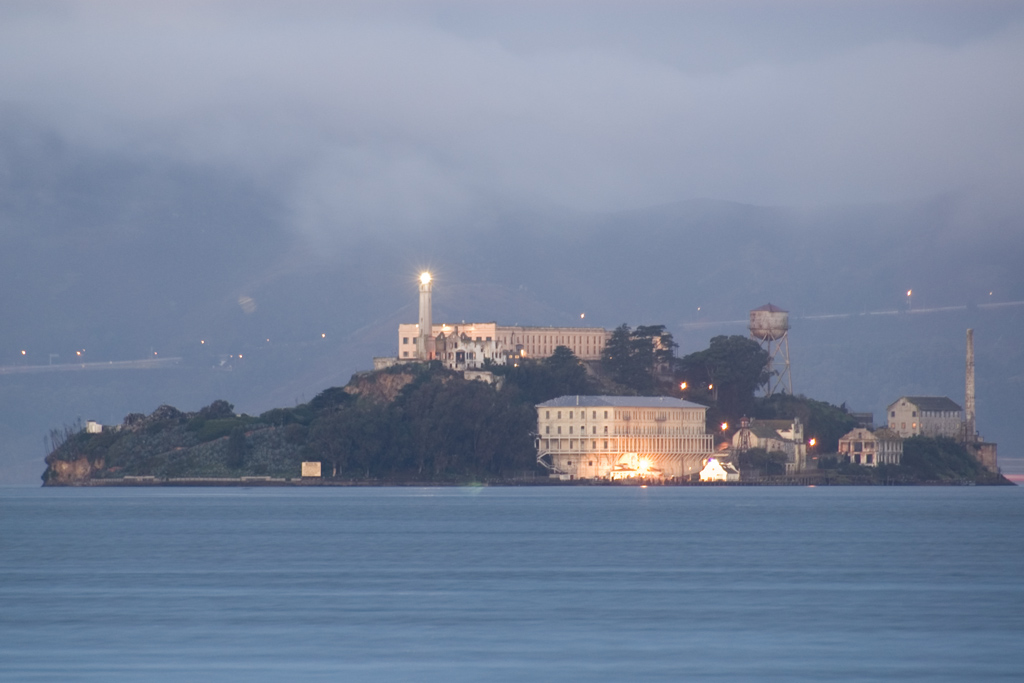
Alcatraz Prison in San Francisco Bay closes down and transfers its last prisoners. At it’s peak period of use in 1950s, “The Rock, or “”America’s Devil Island” housed over 200 inmates at the maximum-security facility. Alcatraz remains an icon of American prisons for its harsh conditions and record for being inescapable.
The twelve-acre rocky island, one and a half miles from San Francisco, featured the most advanced security of the time. Some of the first metal detectors were used at Alcatraz. Strict rules were enforced against the unfortunate inmates who had to do time at Alcatraz. Nearly complete silence was mandated at all times.
Alcatraz was first explored by Juan Manuel de Ayala in 1775, who called it Isla de los Alcatraces (Pelicans) because of all the birds that lived there. It was sold in 1849 to the U.S. government. The first lighthouse in California was on Alcatraz. It became a Civil War fort and then a military prison in 1907.
The end of its prison days did not end the Alcatraz saga. In March 1964, a group of Sioux claimed that the island belonged to them due to a 100-year-old treaty. Their claims were ignored until November 1969 when a group of eighty-nine Native Americans representing the American Indian Movement (AIM) occupied the island. They stayed there until 1971 when AIM was finally forced off the island by federal authorities.
The following year, Alcatraz was added to the Golden Gate National Recreation Area. It is now open for tourism.
Assault Awareness & Prevention, Crime, Misconduct, University
How UW-Whitewater Treated a Sexual Assault Victim
by JOHN ADAMS •
I’ve written before about the handling of sexual assault complaints nationwide and at UW-Whitewater. The more one reads on the matter, the more concerned one becomes, both generally and locally.
There’s a new and troubling story about how UW-Whitewater handled an assault victim’s Title IX assault complaint at WISC-TV. In the report, entitled, Graduate speaks about filing Title IX complaint against UW-Whitewater, one learns that a sexual assault victim felt that her experience filing a complaint – in her own words, was
worse than the assault. Worse. A lot worse. I regret with every… coming forward and saying anything.
In response to these specific injuries, as you’ll see in the video, Chancellor Telfer can bring himself to do no more than issue a general, bland statement that all is well on campus. It is impossible to overstate how unworthy is his response, so far beneath the standard of a man or woman in respect of another’s injuries.
There’s much more to write about this administration’s conduct – and one may be assured that I am committed to that long and thorough effort – as to remain indifferent or silent would be inconceivable. Simply inconceivable.
Above one finds the video and a link to the online story. Below one finds a transcript from WISC-TV of the report.
Transcript: Transcript from WISC-TV.
See, also, the It’s On Us Campaign and Not Alone, a site for those who have experienced sexual assault with resources of support.
Education, Elections, School District
On School Board Candidate Jim Stewart
by JOHN ADAMS •
Jim Stewart, as you may have read from his own news site the Whitewater Banner, is running for school board. He last sat on that board about ten years ago, and for twenty-odd years before that. More recently, he was a member of Whitewater’s Common Council.
His candidacy in 2015 is a puzzle, three times over: (1) it rests on the unsound assumption that one may be a newsman and a politician simultaneously, (2) that there is a need for his presence on the school board despite his own implications to the contrary, and (3) his downplaying of how far from the center he has been on many issues.
Readers here at FREE WHITEWATER know that I favor sound policy over personality.
I’ve no doubt that Mr. Stewart is a wonderful person, but elections in these times require candidates of contemporary thinking, boundless energy, the ability to assess details, to communicate articulately & persuasively, and with a faithful commitment to plain views.
Conflicts Between News and Politics. I’m not a newsman; I don’t want to be one. Mr. Stewart very much sees his site as a news site, and asks and expects the community to treat it that way.
Fair enough – I’m a free-speech advocate; Jim Stewart has a right to present himself as he wishes.
It’s simply odd, however, to deny that reporting the news and being a politician doesn’t present a conflict. No one thinks that Scott Walker should be both governor of Wisconsin and publisher of the Wisconsin State Journal.
(Let’s be clear – Gov. Walker, himself, wouldn’t think that was a good idea, and he’d probably be the first to say so. Mr. Stewart, who has been a Walker supporter, should adopt the governor’s stance and pick a role.)
Consider what this means: it means that one member of the school board would report to the community as news on what the entire board and district did. That’s not impartial news reporting – it’s an inherent advantage to one politician over others. The whole news site, in fact, would act as a kind of campaign advertisement for the politician-publisher. That Mr. Stewart has carried on this way while in office previously does not justify resuming the practice.
The idea that one simply ‘wears different hats’ is silly and unconvincing. However many hats one wears, they sit on the same head. Same thoughts, same intellect, same ideas, same man.
There is no reason – none – to believe that even the most advanced scientist (Isaac Newton, let’s say) could pull this off. If Sir Isaac couldn’t do it, one can guess that it’s not possible for those of us today, either. There is no reason to believe that any local publisher is more intelligent or discerning than Isaac Newton was.
All the rest is a conceit, unconvincing to anyone sensible.
Mr. Stewart should make a choice, as normal publishers and politicians across America would: politics or the news business?
No Compelling Justification for Running. Oddly, by Mr. Stewart’s own statements, it’s clear that he has no policy justification for running against Mr. McCrea or Mrs. Davis.
At his campaign website, Jim Stewart writes that, concerning the five characteristics of an effective school board, “We are fortunate that our School Board measures up well in these characteristics.”
As that is so, and by his own contention that the board has been acting soundly, then he has no claim to replace Dan McCrea. Dan McCrea has been one of the reasons the board has been effective, for goodness’ sake.
At the same time, at a recent campaign forum, Mr. Stewart helpfully reminded attendees that one could vote for two candidates, not one, as he sat next to Mrs. Davis. (Mr. McCrea was not in the room when Mr. Stewart said this.)
As that is so, and Mr. Stewart implies that Mrs. Davis would be a good choice, then he has no compelling reason to advance himself over her.
I’d suggest that voters take Mr. Stewart’s own implied endorsements, and select Kelly Davis and Dan McCrea.
One sees the point: Mr. McCrea and Mrs. Davis are more current on school policy, more energetic, and more powerfully expressive in support of their well-defined views.
Wanting a seat is not enough – there should be a compelling policy justification for his candidacy that Mr. Stewart simply does not offer.
It’s hard to tell which politics Mr. Stewart will really advance. As with the other candidates in the race, he offers a written statement online at http://www.lwvwhitewater.org/elections.html.
Reading through it, one encounters a large number of words, but far fewer actual positions. It’s the longest candidate statement, but simultaneously the least informative. Combined with his statements at candidate events, there’s both hedging and indirection in his responses.
Fiscal Management. Mr. Stewart promises that he’ll be a good fiscal manager, but his record has been one of big-government conservatism, of spending big on dubious projects.
As councilman, he supported tax incremental financing policies that led to Whitewater becoming one of few communities in the entire state with a distressed tax incremental district.
As a member of two economic boards, Mr. Stewart had oversight on an agreement with the federal government that prompted a cease and desist order from the Economic Development Agency for failure to understand basic conflict-of-interest provisions when awarding federal money to contractors.
Flacking endlessly for big-ticket projects has not helped ordinary people in this town meet basic educational and economic needs.
Big-government conservatism is a poor recommendation for these demanding, detail-oriented times. Genuine conservatism would not have committed big money to projects with small rewards.
Clear Views. Mr. Stewart supported Act 10, and has been a champion of those who have pushed that legislation. That’s his right.
Now, however, with an election close at hand, he’s observed that he’s not so sure about Act 10. He declares that it saved millions in public employees’ wages, but then he says he’s not so sure about it….
Mr. Stewart was for it, before (with an election approaching) he might now be kinda-maybe-possibly-a-little-bit-not-sure-if-he’s-against-it-possibly.
Hemming and hawing are poor recommendations for these demanding, detail-oriented times.
Transparency. Much talk is made of Hillary Clinton’s use of a private email system. I’d guess that politicians and commentators of Mr. Stewart’s partisan views have roundly criticized Mrs. Clinton.
That’s quite the coincidence.
As a council member, Mr. Stewart asked for an exception to use his own, private email for public business. In a close vote (in which he voted in his own favor rather than abstain), he was allowed to do so. He assured council members that he would turn over any email that was the subject of a records request.
Secretary Clinton assures us that she, too, will turn over all that’s required of her.
Let’s take them at their word.
One should not be surprised now, however, that Mr. Stewart dismisses open government with the offhand remark that “[t]he current buzz word is “transparency” in all actions of the board, especially for the non-parent group.”
Open government is no “current buzz word” [sic] and transparency doesn’t belong in ill-composed scare quotes.
We should always have open, transparent government.
Mr. Stewart has not been supportive of the same rules of open-government for all, having once sought an exception for himself.
His is a candidacy that’s both a poor fit for these demanding times, and puzzling for the conflict of interest it presents, the lack of a substantive justification, and an unwillingness to be direct about support for past spending priorities that contributed to our present difficulties.
Voters may choose two from among the three candidates running in the April 7th election.
It’s a clear choice from among the alternatives.
I’m supporting Kelly Davis and Dan McCrea for school board, and I hope you will, too.
Previously: On School Board Candidate Dan McCrea, On School Board Candidate Kelly Davis, and On the Whitewater Schools.
I’ll follow with further posts as events suggest.
Daily Bread
Daily Bread for 3.20.15
by JOHN ADAMS •
Good morning, Whitewater.
The end of the work-week will be mostly sunny with a high of fifty-six. Sunrise is 6:56 and sunset 7:07, for 12h 10m 48s of daytime. It’s a new moon today.
Quick note: there will be no poll and cat blogging today, as there usually are on Fridays, as a serious subject from the university makes those posts inapt today. They’ll be back next week.
On this day in 1965, Pres. Johnson places the Alabama National Guard under federal order:
President Lyndon B. Johnson notifies Alabama’s Governor George Wallace that he will use federal authority to call up the Alabama National Guard in order to supervise a planned civil rights march from Selma to Montgomery.
Intimidation and discrimination had earlier prevented Selma’s black population–over half the city–from registering and voting. On Sunday, March 7, 1965, a group of 600 demonstrators marched on the capital city of Montgomery to protest this disenfranchisement and the earlier killing of a black man, Jimmie Lee Jackson, by a state trooper. In brutal scenes that were later broadcast on television, state and local police attacked the marchers with billy clubs and tear gas. TV viewers far and wide were outraged by the images, and a protest march was organized just two days after “Bloody Sunday” by Martin Luther King, Jr., head of the Southern Christian Leadership Conference (SCLC). King turned the marchers around, however, rather than carry out the march without federal judicial approval.
After an Alabama federal judge ruled on March 18 that a third march could go ahead, President Johnson and his advisers worked quickly to find a way to ensure the safety of King and his demonstrators on their way from Selma to Montgomery. The most powerful obstacle in their way was Governor Wallace, an outspoken anti-integrationist who was reluctant to spend any state funds on protecting the demonstrators. Hours after promising Johnson – in telephone calls recorded by the White House – that he would call out the Alabama National Guard to maintain order, Wallace went on television and demanded that Johnson send in federal troops instead.
Furious, Johnson told Attorney General Nicholas Katzenbach to write a press release stating that because Wallace refused to use the 10,000 available guardsmen to preserve order in his state, Johnson himself was calling the guard up and giving them all necessary support. Several days later, 50,000 marchers followed King some 54 miles, under the watchful eyes of state and federal troops. Arriving safely in Montgomery on March 25, they watched King deliver his famous “How Long, Not Long” speech from the steps of the Capitol building. The clash between Johnson and Wallace–and Johnson’s decisive action – was an important turning point in the civil rights movement. Within five months, Congress had passed the Voting Rights Act, which Johnson proudly signed into law on August 6, 1965.
On this day in 1854, the Republican Party is founded in Ripon:
1854 – Republican Party Founded
On this date Free Soilers and Whigs outraged by the passage of the Kansas-Nebraska Act, met in Ripon to consider forming a new political party. The meeting’s organizer, Alvan E. Bovay, proposed the name “Republican” which had been suggested by New York editor Horace Greeley. You can see eyewitness accounts of the meeting, early Republican campaign documents, and other original sources on our page devoted to Wisconsin and the Republican Party. Though other places have claimed themselves as the birthplace of the Republican Party, this was the earliest meeting held for the purpose and the first to use the term Republican. [Source: History of Wisconsin, II: 218-219]
Here’s the final game in Puzzability‘s Green Party series:
|
This Week’s Game — March 16-20
|
|||||
|
Green Party
|
|||||
|
We’ve minted some new questions for jaded solvers. In this St. Patrick’s Day trivia quiz, the answer to each day’s question is a name or title that includes a shade of green.
|
|||||
|
Example:
|
|||||
|
For what 1978 movie did director Michael Cimino suggest that little-known Meryl Streep write her own lines to flesh out her underdeveloped role?
|
|||||
|
Answer:
|
|||||
|
The Deer Hunter
|
|||||
|
What to Submit:
|
|||||
|
Submit the name or title (as “The Deer Hunter” in the example) for your answer.
|
|||||
|
|||||
|
Friday, March 20
|
|||||
|

Education, Elections, School District
On School Board Candidate Dan McCrea
by JOHN ADAMS •
One may say a few things with confidence.
First, those who have followed Whitewater’s schools & politics know Dan McCrea. He’s a member of the school board now, and is seeking re-election.
Second, I’m not typically predisposed toward incumbents.
Third, and this matters to me more than either of the preceding: Dan McCrea’s experience, ability, and outlook makes him easily deserving of re-election.
It would be foolish – odd, really – to ignore his solid presence on our school board. To argue categorically against incumbency would be to overlook his strength as a candidate and representative for the district.
Sound judgment requires that one see and appraise a situation clearly, or at least make a serious attempt to do so.
These are not easy times for Wisconsin. A Great Recession, one that lasted longer as financial-sector recessions do, and imposed policies more celebrated than effective, have only mired us in unwelcome choices and inauspicious alternatives.
We hoped for better in Wisconsin; we’re managing through less than we hoped.
Some will have to be part of Whitewater’s efforts to slip between the shoals. Dan McCrea should be one of those elected for that effort.
He’s done budget work of the kind we need (in past board service, in current board service, and in his profession), he’s knowledgeable about where Whitewater now stands, and he’s likely to choose fairly, reasonably, and perceptively from among alternatives. Mr. McCrea has worked effectively with his colleagues. As a parent of a currently-attending student, he’s knowledgeable about our schools as they are now.
There’s ample reason for returning him to office.
All the candidates in the race prepared a statement of their views, and Dan McCrea’s is online at http://www.lwvwhitewater.org/elections.html. From that statement, consider his remarks on assuring that we have a strong and inspiring faculty:
One of the top three issues for the district is the recruitment and retention of quality teachers and staff. The district is currently working with staff on the implementation of Teachscape, the Wisconsin Department of Public Instruction’s teacher evaluation tool modeled after Charlotte Danielson’s framework for teaching. The model’s four domains include planning and preparation, professional responsibilities, the classroom environment and instruction. Effective teacher evaluation should lead to improved instruction. In addition to focusing on the art of teaching, compensation practices, a culture
that supports innovation in the classroom and aligned professional development will all aid the recruitment and retention of effective educators.
He’s right. This approach will not succeed, however, without forward-looking members of the board. Mr. McCrea has been, and would be, that necessary kind of board member.
Now, I have a theory about Mr. McCrea, having heard him speak these several years, including recently during this campaign.
A guess, but surely a sound one: if one poured all the arguments in the world on Dan McCrea, with all the ability one could summon, still he would stand firm, listen, and respond accordingly based on his best assessment.
That, really, is how policy should be: strong arguments, delivered and answered. There are other ways to look at all this; they’re of little interest, and no lasting value.
We may select two from among three candidates running in the April 7th election. We’re fortunate that Dan McCrea, like Kelly Davis, is among those choices.
I support Dan McCrea for school board, and I hope you will, too.
Previously: On School Board Candidate Kelly Davis and On the Whitewater Schools.
Tomorrow: On School Board Candidate Jim Stewart.
Daily Bread
Daily Bread for 3.19.15
by JOHN ADAMS •
Good morning, Whitewater.
Thursday in town will be mostly cloudy with a high of fifty-one. Sunrise is 6:58 and sunset 7:06, for 12h 07m 52s of daytime. The moon is a waning crescent with 1.3% of its visible disk illuminated.
On this day in 2003, in the evening, Pres. George W. Bush ordered the start of the Iraq War. The New York Times reported the next morning on the start of hostilities:
WASHINGTON, Thursday, March 20— President Bush ordered the start of a war against Iraq on Wednesday night, and American forces poised on the country’s southern border and at sea began strikes to disarm the country, including an apparently unsuccessful attempt to kill Saddam Hussein.
Mr. Bush addressed the nation from the Oval Office at 10:15 p.m. Wednesday night, about 45 minutes after the first attacks were reported against an installation in Baghdad where American intelligence believed Mr. Hussein and his top leadership were meeting. ”On my orders, coalition forces have begun striking selected targets of military importance to undermine Saddam Hussein’s ability to wage war,” the president said.
Speaking deliberately, with a picture of his twin daughters visible behind him, he added, ”These are opening stages of what will be a broad and concerted campaign.”
Mr. Bush sought to tamp down expectations of a quick victory with few casualties by warning that the battles in the days ahead ”could be longer and more difficult than some predict.” [Transcript, Page A20.]
The cost of the war in expenditures alone is estimated now, these may years later, to have been well over a trillion dollars.
Here’s the Thursday game in Puzzability‘s Green Party series:
|
This Week’s Game — March 16-20
|
|||||
|
Green Party
|
|||||
|
We’ve minted some new questions for jaded solvers. In this St. Patrick’s Day trivia quiz, the answer to each day’s question is a name or title that includes a shade of green.
|
|||||
|
Example:
|
|||||
|
For what 1978 movie did director Michael Cimino suggest that little-known Meryl Streep write her own lines to flesh out her underdeveloped role?
|
|||||
|
Answer:
|
|||||
|
The Deer Hunter
|
|||||
|
What to Submit:
|
|||||
|
Submit the name or title (as “The Deer Hunter” in the example) for your answer.
|
|||||
|
|||||
|
Thursday, March 19
|
|||||
|

Education, Elections, Politics, School District
On School Board Candidate Kelly Davis
by JOHN ADAMS •
Whitewater invites people to choose the city, to live here, and to commit to our community’s civic life. We offer our way of life to others, hoping that they will join us in the improvement of our schools, public institutions, and neighborhoods.
Into our small city now comes a talented and educated woman who seeks political office. Kelly Davis has not been here for decades, but she, her husband, and their children have more than enough years in Whitewater for a strong understanding of our schools & community.
Supporting her candidacy is an easy decision: smart, well-read, active, and principled should (and in Kelly Davis’s candidacy easily does) carry the day.
(As with the other candidates in the race, a statement of her views may be found online at http://www.lwvwhitewater.org/elections.html.)
Mrs. Davis has both distinguished educational credentials and experience by profession in tax policy. Her professional work makes her particularly well-suited to the school board’s tasks ahead.
I’ve read her online candidate statement, listened to her speak, and found the positive opinion so many hold of her to be well-justified.
I’m also familiar with her volunteer civic commitments, as she has been active in Whitewater. (To write about Whitewater as I have is to watch and observe civic life closely, even if one does not write about every group or organization. The best observations, in fact, come without becoming a distraction while one observes. Observation and reflection are quiet undertakings.)
Mrs. Davis has a record of successful support for our schools, for prominent Whitewater charitable and athletic events, and of her church in town. That’s a well-rounded portfolio, so to speak. Needless to say, it requires an energetic person to do so much, and do it so well.
Now, I do not contend that Mrs. Davis and I share the same politics, or that she’s likely to agree with my own views on civic life. I do contend, and always will, that agreement on partisan views is unnecessary.
It’s a commitment to honest, principled policy, diligently pursed with integrity whatever one’s ideology, that will advance and uplift our community. Facts are to be advanced, data are to be presented honestly, values are to be professed truly & faithfully: that’s a good path for anyone.
It’s a path Kelly Davis ably walks in Whitewater.
Consider these words, of her own choosing and emphasis, from her candidate statement:
I think it is important to regard a budget as a moral document that shows what we value and consider to be the district’s priorities.
In the end, the only sadness one has about reading her remarks is in wishing that one heard similar sentiments in our public life more often.
Having listened to her speak extemporaneously, and answer questions, it’s clear to me that Kelly Davis will work cooperatively, speak clearly and forthrightly, with regard to all the community. No doubt many others have seen these same traits.
I support Kelly Davis for school board, and I hope you will, too.
Previously: On the Whitewater Schools.
Tomorrow: On School Board Candidate Dan McCrea.
Anderson, Cartoons & Comics
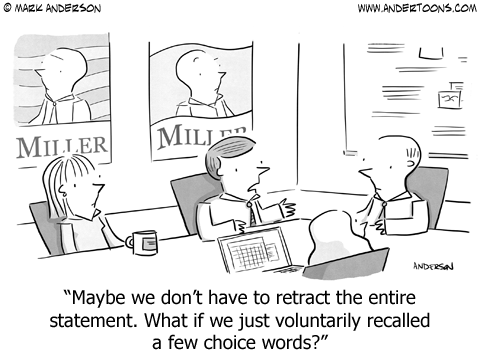
A Few
by JOHN ADAMS •
Daily Bread
Daily Bread for 3.18.15
by JOHN ADAMS •
Good morning, Whitewater.
Midweek in the Whippet City will be partly cloudy with a high of forty-eight. That’s cooler than recently, to be sure, but there’s something to be said for crisp temperatures. Sunrise is 7:00 and sunset 7:05, for 12h 04m 56s of daytime. The moon is a waning crescent with 5.5% of its visible disk illuminated.
On this day in 1925, America experiences a severe tornado strike:
The worst tornado in U.S. history passes through eastern Missouri, southern Illinois, and southern Indiana, killing 695 people, injuring some 13,000 people, and causing $17 million in property damage. Known as the “Tri-State Tornado,” the deadly twister began its northeast track in Ellington, Missouri, but southern Illinois was the hardest hit. More than 500 of the total 695 people who perished were killed in southern Illinois, including 234 in Murphrysboro and 127 in West Frankfort.
A tornado is a dark, funnel-shaped cloud containing violently rotating air that develops in climate conditions that, in the United States, are generally unique to the central and southern plains and the Gulf states. The rotating winds of tornadoes can attain velocities of 300 mph, and its diameter can vary from a few feet to a mile. A tornado generally travels in a northeasterly distance at speeds of 20 to 40 mph and usually covers anywhere between one and more than 100 miles.
The Tri-State Tornado of 1925–which traveled 219 miles, spent more than three hours on the ground, devastated 164 square miles, had a diameter of more than a mile, and traveled at speeds in excess of 70 mph–is unsurpassed in U.S. history.
On this day in 1954, employees of Parker Pen get a bit more:
1954 – Parker Pen Employees Win Wage Increase
On this date employees of Parker Pen in Janesville won a 5-cent-an-hour wage increase in contract negotiations. After the raise, male employees made a base pay of $1.95 an hour while their female counterparts were paid $1.62 an hour. [Source: Janesville Gazette]
Puzzability‘s green-themed series continues with Wednesday’s game:
|
This Week’s Game — March 16-20
|
|||||
|
Green Party
|
|||||
|
We’ve minted some new questions for jaded solvers. In this St. Patrick’s Day trivia quiz, the answer to each day’s question is a name or title that includes a shade of green.
|
|||||
|
Example:
|
|||||
|
For what 1978 movie did director Michael Cimino suggest that little-known Meryl Streep write her own lines to flesh out her underdeveloped role?
|
|||||
|
Answer:
|
|||||
|
The Deer Hunter
|
|||||
|
What to Submit:
|
|||||
|
Submit the name or title (as “The Deer Hunter” in the example) for your answer.
|
|||||
|
|||||
|
Wednesday, March 18
|
|||||
|

Education, Government Spending, Libertarians, Liberty, Public Relations, School District
On the Whitewater Schools
by JOHN ADAMS •
Today is the first of a series of posts about the upcoming, contested WUSD board elections. Three candidates are running for two seats: Kelly Davis, Dan McCrea, and Jim Stewart. In today’s post, I’ll summarize some of my own views.
(I’ve been direct these last several years; it makes sense to state one’s convictions plainly, so that readers will know my perspective.)
Each of the candidates responded to an election survey, and my remarks will mostly follow the ten questions the candidates received. It’s easier to compare everyone’s views if there’s a similar order to their remarks. (The candidates’ replies may be found online at lwvwhitewater.org/elections.html.)
One’s Motivation. Writing is one of many diverse social obligations from which someone may choose. It is its own thing, neither prelude nor postscript to other activities.
To write occasionally about education is not to write about it enough; that one spends less time than one might hope on the subject shouldn’t preclude writing as often as one can.
Philosophy of the School Board’s Role. It is enough to oversee the daily work of a broader curriculum diligent and fairly. This can be done without exaggeration, and where the main subjects of discussion are students over adults, teachers over principals, principals over administration, and administration over the board.
A good rule by which to live: The higher the position, the greater the obligation, and the lower the entitlement.
There is no virtue in ceaselessly announcing oneself. It’s a vulgar, disgusting habit.
School Board’s Relationship to the Community. Treat all people as equals. We are in a community with vast numbers of very sharp people, as is true in any community.
It’s a proud delusion to believe that only a few are capable. Delusion makes for poor policy; pride is a sin.
Some people are disadvantaged, and rightly deserve special consideration. Policymakers and commentators are not among them; they’ve no claim to special needs or entitlement.
Experience with Budgets. Libertarians (as I am) believe in less spending not as an end in itself, but as a path to smaller government. We don’t want less for the sake of penny-pinching – we want less government so that there may be more liberty (believing as we do that a large government makes little room for liberty).
It’s individual liberty that matters to us, and to protect it we seek less of government; to seek less of government is to feed it less.
Some programs, however, are more worthy than others. To believe in less overall is not to doubt the need for priorities.
In this community, for example, I’d rather see money for schools than a single dime for some dishonest WEDC white-collar program. (We’re wasting hundreds of thousands – millions in total – on those projects, as we did on the East Gate project, or any number of other unneeded schemes.)
That’s not our choice, now: these education cuts are statewide in scope. It’s not if, but how.
A consistent philosophy shapes budgets, and assures fidelity to fundamental principles. The fragile deserve protection over the robust, and leaders should take less before workers take less. I’ll advance particular suggestions when the district budget team issues its proposals.
Attracting Teachers. It’s a market economy – one will have to stay at the market rate. That sounds trite, but it’s anything but: no one in this community can counteract the broad competitive forces that draw teachers to one place over another. Prospective employees are not children – they’ll take their best opportunities.
(I would never have curtailed public-sector unionization, by the way – anyone should be able to organize peacefully against government. To the extent that Act 10 has made employees less satisfied, we’ve reduced freedom of association, burdened public employers with a less motivated workforce, and made ourselves less attractive compared to public employers in other states.)
Conflict Resolution. Whitewater’s key problem isn’t conflict, but rather an imposed, mediocre consensus. Our forebears did not found this beautiful republic so that we might become a country of quivering mice.
No one wants a brawl; everyone deserves more than a mediocre go-along-nice-and-quietly consensus. We should be as talented as the country in which we happily live.
Most Important Issue. The budget looms largest, but we should be honest with ourselves that we are not an affluent community. There are many struggling families with children in Whitewater. We simply can’t budget the way that Cedarburg does, for example. We have more children in need by percentage in Whitewater than an affluent community would.
Losing sight of this plain truth would be wrong.
One’s Strengths. It’s enough to work hard each day, assessing where improvement can and should be made. One should be one’s hardest critic. There’s no time for selling oneself.
Common Core. I’ve mentioned a need to discuss the curriculum, but that’s not a criticism of Common Core. I’ve no objections to it; it seems plain to me that teaching is more than adopting Common Core or an alternative.
Keep Common Core (by whatever name), but recognize that a set of standards is only useful if embraced with relish, with a taste and commitment and excitement. Learning’s not a syllabus, nor even a book. It’s the teaching of the book, so to speak, with understanding and excitement.
The obsession with testing and measuring every last part of teaching does not impress. It’s an ignorant person’s idea of being learned, by substituting crude measurement for deeper comprehension.
Be clear, though: there’s every reason to be critical of the flacking of scores, such as ACT scores, for political or economic gain. A properly-educated person does not owe others their manipulations, exaggerations, or schemes for political advantage. Funny, that it might happen concerning a school system, a place that should advance the honest use of data.
Education is more than a shabby PR scheme. Those who take that course deserve not deference, but a rigorous critique.
An agenda, a set of testing standards, even a book is a poor substitute for being well-read, for being properly educated.
Our Charter School. I’m a strong supporter of our charter school, and charter schools generally. An inquiry school, for example, can offer a good education for children.
There we are.
Tomorrow: On School Board Candidate Kelly Davis.