
Author Archive for JOHN ADAMS
Daily Bread
Daily Bread for 7.29.14
by JOHN ADAMS •
Good morning, Whitewater.
We’ve a four-in-ten chance of afternoon thunderstorms today, but otherwise a partly sunny day awaits with a high of seventy-eight.
On this day in 1958, NASA is born:
The National Aeronautics and Space Administration (NASA) is the United States government agency that is responsible for the civilian space program as well as for aeronautics and aerospace research.
PresidentDwight D. Eisenhower established the National Aeronautics and Space Administration (NASA) in 1958[5] with a distinctly civilian (rather than military) orientation encouraging peaceful applications in space science. The National Aeronautics and Space Act was passed on July 29, 1958, disestablishing NASA’s predecessor, the National Advisory Committee for Aeronautics (NACA). The new agency became operational on October 1, 1958.[6][7]
Since that time, most U.S. space exploration efforts have been led by NASA, including the Apollomoon-landing missions, the Skylab space station, and later the Space Shuttle. Currently, NASA is supporting the International Space Station and is overseeing the development of the Orion Multi-Purpose Crew Vehicle, the Space Launch System and Commercial Crew vehicles. The agency is also responsible for the Launch Services Program (LSP) which provides oversight of launch operations and countdown management for unmanned NASA launches.
NASA science is focused on better understanding Earth through the Earth Observing System,[8] advancing heliophysics through the efforts of the Science Mission Directorate’s Heliophysics Research Program,[9] exploring bodies throughout the Solar System with advanced robotic missions such as New Horizons,[10] and researching astrophysics topics, such as the Big Bang, through the Great Observatories and associated programs.[11] NASA shares data with various national and international organizations such as from the Greenhouse Gases Observing Satellite.
In just under a year, as part of that agency’s commitment to exploration, a NASA probe will reach Pluto:
Google-a-Day asks a history question:
What war was ended by the treaty that was ratified by the U.S. Senate on February 6, 1899?
Nature
Iceberg collapse, Bay of Exploits, Newfoundland, Canada
by JOHN ADAMS •
Government Spending, Local Government, Press
In Policymaking, Passion’s a Weak Justification
by JOHN ADAMS •
Alternative title: Passion’s Just Another Word for Nothing Substantive to Say.
Only recently, small-town Evansville rejected a $5.5 million tax-incremental funding demand from the Southern Wisconsin Agricultural Group to locate in that community. See, Demanding Millions from Small-town Evansville.
To accede to SWAG’s demands, Evansville would have had to abandon street repair, water-system upgrades, etc., for lack of funds.
Following Evansville’s practical decision, the Gazette‘s editorialist took this as a chance to declare that All should hope agriculture complex takes root elsewhere in Rock County.
That’s all, as in all should hope for world peace, or all should be kind to puppies.
Evansville strayed from the bigger-government, crony-capitalist conservatism of the Gazette, you see, in a profane and heretical departure from what a few grasping insiders want (a few that insists ‘all’ should likewise want).
The Gazette, piqued, now declares (subscription req’d):
SWAG’s complex, though intriguing, always seemed grand and hard for average residents to picture. Could it generate enough visitors and revenue year-round to stay financially viable? Donors likely would want assurances.
Still, SWAG’s leaders deserve credit for their passion and persistence.
That’s too funny, twice over.
First, this condescending to residents is laughable – ‘average’ residents just couldn’t ‘picture’ the project.
There’s nothing wrong with residents’ abilities or comprehension; the failure of a project like this is evidence of a mediocre leadership that asks too much and explains too little. It’s the curse of lazy, entitled elites.
Second, in the Gazette‘s way of thinking, the Southern Wisconsin Agricultural Group’s passion and persistence are creditable.
They’re not. In this case, SWAG’s energy is no worthier than a pickpocket’s enthusiasm and serial stealing would be.
Good policy is more than desire. Lots of interest groups want – really, really want – taxpayers’ money.
There’s nothing special about wanting to take millions from a small town’s residents.
In the same way, there’s nothing special or compelling about an editorial that contends that a brimming desire for millions is somehow to proponents’ credit.
Music
Monday Music: Pink Martini, Get Happy / Happy Days are Here Again
by JOHN ADAMS •
Daily Bread
Daily Bread for 7.28.14
by JOHN ADAMS •
Good morning, Whitewater.
We’ll have a sunny Monday today with a high of seventy-three. Sunrise today in 5:42 AM and sunset 8:20 PM. The moon is a waxing crescent with just three percent of its visible disk illuminated.
On this day in 1914, Austria-Hungary declares war on Serbia (sometimes written then in English as Servia). Here’s how the New York Times reported the events that were the beginning of a world war:
Austria Formally Declares War on Servia; Russia Threatens, Already Moving Troops; Peace of Europe Now In Kaiser’s Hands
VIENNA, July 28– Upon the issue of the formal declaration of war against Servia today Emperor Franz Josef gave orders for the removal of the Summer Court from Ischl to the capital. His entourage tried to persuade him that Vienna air would not suit him, but the aged Emperor replied:
“I do not want the air of Vienna. I want the atmosphere of headquarters.” The opening of the war has caused the imposition of all kinds of restrictions upon public business. All the railways, of course, are under military control, and the telegraphs are being reserved entirely for the service of the State. The hope is still entertained here that the war will be confined to Austria-Hungary and Servia. The report that Russia and France have intervened in Vienna is incorrect. In official circles here it is maintained that any action by those powers must be supported by the third party to the Triple Entente, namely, Great Britain. It is known that Great Britain and France do not want a European war. Peace among the great powers or war among the great powers must depend on the action of St. Petersburg.
At the Foreign Office here it is freely stated that now that war has begun Austria-Hungary will be bound to no more conditions such as she propounded prior to the outbreak of hostilities.
On this day in 1934, a so-called model village is a model only of industrial strife:
1934 – Two killed, 40 hurt in Kohler riot; National Guard occupies town
On this day, the “model industrial village” of Kohler became an armed camp of National Guard cavalrymen after deadly strike-related rioting. The July 27th violence, which killed two Sheboygan men and injured 40 others, prompted the summoning of 250 Guardsmen to join the 200 special deputy village marshals already present. After striking workers became agitated and began to destroy company property, deputies turned to tear gas, rifles, and shotguns to quell the stone-throwing crowd, resulting in the deaths and injuries. Owner Walter Kohler blamed Communists and outside agitators for the violence, while union leaders blamed Kohler exclusively. Workers at the Kohler plant were demanding better hours, higher wages, and recognition of the American Federation of Labor as their collective bargaining agent. Not settled until 1941, the strike marked the beginning of what was to become a prolonged struggle between the Kohler Company and organized labor in Wisconsin; a second Kohler strike lasted from 1954 to 1965. [Source: Capital Times 7/28/1934, p.1]
Google-a-Day asks a pop culture question:
In the Ke$ha hit song in which she uses the word “love” twelve times in the refrain, what does she say she likes in the very last line?
Animation
Sunday Animation: Emoji Among Us
by JOHN ADAMS •
Emoji Among Us: The Documentary from Dissolve on Vimeo.
Daily Bread
Daily Bread for 7.27.14
by JOHN ADAMS •
Good morning, Whitewater.
We’ll have a Sunday with a high of seventy-seven and a likelihood of showers.
Meanwhile, in Phoenix, it’s a forecast of dust storms:
On this day in 1832, soldiers pursue the Sauk:
On this date American troops resumed their pursuit of Sauk Indians in the Black Hawk War following the battle of Wisconsin Heights. After constructing rafts, the troops led by General Atkinson, now numbering roughly 1,300 men, a third the number of soldiers which began the campaign, crossed the Wisconsin, near Spring Green, and began again the search for the Sauk. The date of the crossing is somewhat contentious, some placing it as early as July 26th and as late as July 28th. [Source: Along the
Black Hawk Trail by William F. Stark, p. 130-131]
Daily Bread
Daily Bread for 7.26.14
by JOHN ADAMS •
Good morning, Whitewater.
Saturday in town will be mostly cloudy, with a high of eighty-three and west winds of five to ten mph.
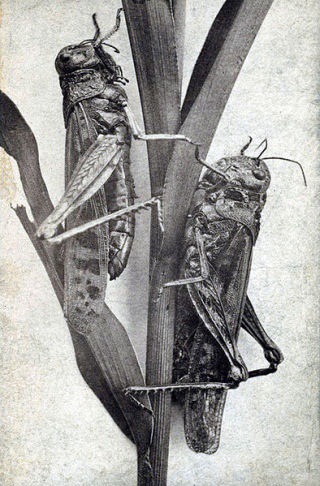
On this day in 1931, grasshoppers torment the Midwest:
…a swarm of grasshoppers descends on crops throughout the American heartland, devastating millions of acres. Iowa, Nebraska and South Dakota, already in the midst of a bad drought, suffered tremendously from this disaster.
Since the very beginning of agriculture, people have struggled to prevent insects from eating their crops. Locusts and grasshoppers, insect cousins, are among the most feared pests. A plague of these insects can occur when conditions cause their populations to suddenly explode. Usually this happens under drought or very dry conditions, since their egg pods are vulnerable to fungus in wet soil. When the soil is very dry, swarms can develop.
Professor Jeff Lockwood of Wyoming describes being in a swarm as follows, They explode from beneath your feet. There’s sort of a rolling wave that forms out it front of you. They hit up against your body and cling against your clothes. It’s almost like being immersed in a gigantic living being. Locusts and grasshoppers undergo a significant transformation when they become part of a swarm. Their wings and jaws grow, enabling them to travel greater distances and increasing their appetite.
The July 1931 swarm was said to be so thick that it blocked out the sun and one could shovel the grasshoppers with a scoop. Cornstalks were eaten to the ground and fields left completely bare. Since the early 1930s, swarms have not been seen in the United States. However, North Africa and parts of the Middle East continue to experience problems with insect swarms, which sometimes includes as many as 1 billion bugs.
On 7.26.1865, regiments from Wisconsin muster out:
The 37th and 38th Wisconsin Infantry regiments mustered out. The 37th had spent its 14-month-long term of service in and around Washington D.C. It participated in the Siege of Petersburg and the Appomattox Campaign in pursuit of General Lee’s army. It lost 247 men during service. The 38th served in the same campaigns as the 37th but was also on duty at Arsenal, Washington, during trial and execution of President Lincoln’s assassins. It lost 113 men during service.
Games/Puzzles
Tricks from Quirkology
by JOHN ADAMS •
Via Quirkology.
Cats
Friday Catblogging: One Fast Cat Exercise Wheel
by JOHN ADAMS •
Ingenious:
Poll
Friday Poll: The Road Rage Incident
by JOHN ADAMS •

In Florida, Joseph Howard Carl’s truck rear-ended another vehicle, after which he leapt out and began pounding on the other driver’s car window.
Here’s what happened:
Carl then jumped out and began banging on the driver’s window and yelling at the woman inside, apparently neglecting to put his pickup into park.
The driver of the other vehicle was frightened and drove away, leaving nothing to hold back Carl’s Dodge 1500 truck.
The truck began to roll, and Carl, standing in front of the vehicle, put out his arms and tried to stop it, but it ran over him, the report said.
Police and paramedics arrived, but Carl refused medical treatment, the report said.
Carl was stumbling and had a strong odor of alcohol, police said. He told police he was coming from Live Oak and had had three beers. Inside the truck, police found an open and cool 16-oz. can of Miller High Life along with numerous other empty beer cans.
So, a series of mishaps or cosmic justice?
Daily Bread
Daily Bread for 7.25.14
by JOHN ADAMS •
Good morning, Whitewater.
Friday presents to us a forty-percent chance of thunderstorms with a high of seventy-eight.
On this day in 1897, Jack London takes a trip:
Jack London leaves for the Klondike to join the gold rush, where he will write his first successful stories.
London was born in San Francisco in 1876. His father, an astrologer named Chaney, abandoned the family, and his mother, a spiritualist and music teacher, remarried. Jack assumed his stepfather’s last name, London.
From an early age, London struggled to make a living, working in a cannery and as a sailor, oyster pirate, and fish patroller. During the national economic crisis of 1893, he joined a march of unemployed workers. He was jailed for vagrancy for a month, during which time he decided to go to college. The 17-year-old London completed a high school equivalency course and enrolled at the University of California at Berkeley, where he read voraciously for a year. However, he dropped out to join the 1897 gold rush.
While in the Klondike, London began submitting stories to magazines. In 1900, his first collection of stories, The Son of the Wolf, was published. Three years later, his story The Call of the Wild made him famous around the country. London continued to write stories of adventure amid the harsh natural elements. During his 17-year career, he wrote 50 fiction and nonfiction books. He settled in northern California about 1911, having already written most of his best work. London, a heavy drinker, died in 1916.
Google-a-Day asks a sports question:
The famous defensive tackle who died during a game against the New York Dragons, played in how many games for the Panthers during his career?
Drink, Food
Pairing Beer and Food
by JOHN ADAMS •
It’s much, much better to drink well and moderately than to drink too much of a poor brew. In the video below, Brendan Woodcock and Daniel Burns of the New York beer bar Torst discuss enjoyable pairings of food and beer.