
FREE WHITEWATER

Author Archive for JOHN ADAMS

Restaurant Review: Karina’s Mexican Restaurant


View Larger Map

Karina’s Mexican Restaurant sits on the corner of Main Street in downtown Whitewater. As one sees from the street view above, patrons enter on Main, with seating to both the left and right of the entrance. It’s a large space, and for the occasions when I visited (lunch, dinner), larger than the going patronage seems to require.

The best way, I think, to approach this review is to ask a simple question: what’s an entrée, what’s a principal dish? One might say that it’s a collection of ingredients. Under this thinking, a beef burrito might be the combination of beef, garlic, cumin, hot sauce, lettuce, tortillas, cheese, salsa (itself the combination of several ingredients), etc.

That’s true, of course, but it’s only part of what makes ingredients a dish.

Bronze is an alloy, of copper and tin, for example, but it’s only an alloy when of certain proportions, and when mixed together in a particular way. Sitting the elements next to each other isn’t enough.

In my experience, the ingredients of a dish are present in a meal at Karina’s, but not in the proportions or mixture among them that would produce a notable meal.

The décor is unobjectionable, although I would not have chosen plastic banners, however brightly colored, for display in the main room.

Service seemed to be to be moderately attentive, but somehow reserved and subdued. Others’ experiences may be different.

LOCATION: 137 W Main St, Whitewater, WI 53190 (262) 472-9492. See, Google Map directions linked at the beginning of this review.

OPEN: Mon-Wed until 8, Thr-Sat until 9, Sun closed.

PRICES: Main dish, drink, and complimentary chips & salsa about $10-12.

RESERVATIONS: Unnecessary.

DRINKS & WINE: Mexican beer, margaritas.

SERVICE: Moderately attentive.

VISITS: Two (lunch, dinner).

RATING: Fair.
GoldStarGoldStar

RATING SCALE: From one to four stars, representing the full experience of food, atmosphere, service, and pricing.

INDEPENDENCE: This review is delivered without financial or other connection to the establishment or its owner. The dining experience was that of an ordinary patron, without notice to the staff or requests for special consideration.
Daily Bread for 3.6.13

Good morning.

Whitewater will have a cloudy Wednesday, with a high of thirty-three.

The Whitewater Tourism Council is scheduled to meet at 9 AM.

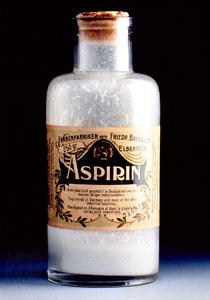
On this day in 1899, Bayer patents aspirin:

aspirinbottle

…the Imperial Patent Office in Berlin registers Aspirin, the brand name for acetylsalicylic acid, on behalf of the German pharmaceutical company Friedrich Bayer & Co.

Now the most common drug in household medicine cabinets, acetylsalicylic acid was originally made from a chemical found in the bark of willow trees. In its primitive form, the active ingredient, salicin, was used for centuries in folk medicine, beginning in ancient Greece when Hippocrates used it to relieve pain and fever. Known to doctors since the mid-19th century, it was used sparingly due to its unpleasant taste and tendency to damage the stomach.

In 1897, Bayer employee Felix Hoffman found a way to create a stable form of the drug that was easier and more pleasant to take. (Some evidence shows that Hoffman’s work was really done by a Jewish chemist, Arthur Eichengrun, whose contributions were covered up during the Nazi era.) After obtaining the patent rights, Bayer began distributing aspirin in powder form to physicians to give to their patients one gram at a time. The brand name came from “a” for acetyl, “spir” from the spirea plant (a source of salicin) and the suffix “in,” commonly used for medications. It quickly became the number-one drug worldwide….

Google-a-Day has a question about a punctuation reference: “In “Eats, Shoots and Leaves,” punctuation marks are compared to what highway safety device, because they keep words from banging together?”

Daily Bread for 3.5.13

Good morning.

Tuesday will bring snow to Whitewater, of about three to five inches during the day, with less than an inch additional this evening.

The city now has a Bicycle & Pedestrian Steering Committee meeting scheduled for 4:30 PM, and a Common Council meeting for 6:30 PM (Update: Canceled).

What does three feet of snowfall look like? It looks like this, from Connecticut:

On this day in 1946, Winston Churchill delivers his “Iron Curtain’ speech at Westminster College in Missouri (Churchill, himself, titled the address ‘Sinews of Peace’). His observation – wholly right – about Soviet intentions comes somehere near the middle of the speech:

….From Stettin in the Baltic to Trieste in the Adriatic, an iron curtain has descended across the Continent. Behind that line lie all the capitals of the ancient states of Central and Eastern Europe. Warsaw, Berlin, Prague, Vienna, Budapest, Belgrade, Bucharest and Sofia, all these famous cities and the populations around them lie in what I must call the Soviet sphere, and all are subject in one form or another, not only to Soviet influence but to a very high and, in many cases, increasing measure of control from Moscow. Athens alone — Greece with its immortal glories — is free to decide its future at an election under British, American and French observation. The Russian-dominated Polish Government has been encouraged to make enormous and wrongful inroads upon Germany, and mass expulsions of millions of Germans on a scale grievous and undreamed-of are now taking place. The Communist parties, which were very small in all these Eastern States of Europe, have been raised to pre-eminence and power far beyond their numbers and are seeking everywhere to obtain totalitarian control. Police governments are prevailing in nearly every case, and so far, except in Czechoslovakia, there is no true democracy. Turkey and Persia are both profoundly alarmed and disturbed at the claims which are being made upon them and at the pressure being exerted by the Moscow Government….

Google-a-Day asks about a Swiss mountain: “What mountain in Switzerland includes three types of glacial erosion, and resembles an ancient Egyptian structure with four specific sides?”

Daily Bread for 3.4.13

Good morning.

Monday will be cloudy with a high of thirty-one.

Whitewater’s Parks & Rec Board meets at 5 PM.

On this day in 1789, government under the U.S. Constitution begins:

The first session of the U.S. Congress is held in New York City as the U.S. Constitution takes effect. However, of the 22 senators and 59 representatives called to represent the 11 states who had ratified the document, only nine senators and 13 representatives showed up to begin negotiations for its amendment.

In 1786, defects in the Articles of Confederation became apparent, such as the lack of central authority over foreign and domestic commerce and the inability of Congress to levy taxes, leading Congress to endorse a plan to draft a new constitution. On September 17, 1787, at the conclusion of the Constitutional Convention in Philadelphia, the new U.S. Constitution, creating a strong federal government with an intricate system of checks and balances, was signed by 38 of 41 delegates to the convention.

As dictated by Article VII, the document would not become binding until it was ratified by nine of the 13 states. The Constitution was thus sent to the state legislatures, and beginning on December 7, five states–Delaware, Pennsylvania,New Jersey, Georgia, and Connecticut–ratified it in quick succession. However, other states, especially Massachusetts, opposed the document for its failure to reserve powers not delegated by the Constitution to the states and its lack of constitutional protection for such basic political rights as freedom of speech, religion, and the press, and the right to bear arms.

In February 1788, a compromise was reached in which Massachusetts and other states agreed to ratify the document with the assurance that amendments would immediately be adopted. The Constitution was thus narrowly ratified in Massachusetts, followed by Maryland and South Carolina. On June 21, 1788, New Hampshire became the ninth state to ratify the document, making it binding, and government under the U.S. Constitution was scheduled to begin on March 4, 1789.

On September 25, 1789, after several months of debate, the first Congress of the United States adopted 12 amendments to the U.S. Constitution–the Bill of Rights–and sent them to the states for ratification. This action led to the eventual ratification of the Constitution by the last of the 13 original colonies: North Carolina and Rhode Island.

From earlier this year, scenes of an ice shove along Lake Winnebago, topping ordinary snowfall in its unique character:

Recent Tweets, 2.24 to 3.2

Daily Bread for 3.3.13

Good morning.

Sunday in Whitewater brings sunny skies and a high of twenty-eight. We’ll have 11h 19m of sunlight, 12h 16m of daylight, and tomorrow will bring an additional two minutes.

In Friday’s Catblogging post, one saw a video of a backyard bobcat. If one, then perhaps two – here are two pugnacious urban bobcats, in someone’s yard. I’ll leave it to others to decide if the homeowner is lucky or unlucky for his feline visitors:

On this day in 1879, the U.S. Geological Survey is born:

Congress establishes the United States Geological Survey, an organization that played a pivotal role in the exploration and development of the West.

Although the rough geographical outlines of much of the American West were known by 1879, the government still had astonishingly little detailed knowledge of the land. Earlier federal exploratory missions under men like Ferdinand Hayden and John Wesley Powell had begun to fill in the map, yet much remained to be done. Congress decided to transform the earlier system of sporadic federal geological explorations into a permanent government agency, the United States Geological Survey (USGS).

From the beginning, the USGS focused its efforts on practical geographical and geological investigations that might spur western economic development. Since the vast majority of the nation’s public land was in the West, the USGS became one of the federal government’s most important tools for encouraging the exploitation of western natural resources. Congress appointed Clarence King, a brilliant young mining engineer and geologist, as the first director. King, who had previously done considerable work for western mining companies, viewed the USGS as a tool for aiding further mineral exploitation. As a result, the first major reports produced under King’s tenure concerned the economic geology of two important mining districts, Nevada‘s Comstock Lode and Colorado‘s Leadville silver district.

Daily Bread for 3.2.13

Good morning.

It’s a mostly sunny day with a high of twenty-four, and a north wind at 5 to 10 mph.

Born this day in 1904, Dr. Seuss:

On this day in 1904, Theodor Geisel, better known to the world as Dr. Seuss, the author and illustrator of such beloved children’s books as “The Cat in the Hat” and “Green Eggs and Ham,” is born in Springfield, Massachusetts. Geisel, who used his middle name (which was also his mother’s maiden name) as his pen name, wrote 48 books–including some for adults–that have sold well over 200 million copies and been translated into multiple languages. Dr. Seuss books are known for their whimsical rhymes and quirky characters, which have names like the Lorax and the Sneetches and live in places like Hooterville.

Geisel, who was born on March 2, 1904, in Springfield, Massachusetts, graduated from Dartmouth College, where he was editor of the school’s humor magazine, and studied at Oxford University. There he met Helen Palmer, his first wife and the person who encouraged him to become a professional illustrator. Back in America, Geisel worked as a cartoonist for a variety of magazines and in advertising.

The first children’s book that Geisel wrote and illustrated, “And to Think That I Saw It On Mulberry Street,” was rejected by over two dozen publishers before making it into print in 1937. Geisel’s first bestseller, “The Cat in the Hat,” was published in 1957. The story of a mischievous cat in a tall striped hat came about after his publisher asked him to produce a book using 220 new-reader vocabulary words that could serve as an entertaining alternative to the school reading primers children found boring.

Other Dr. Seuss classics include “Yertle the Turtle,” “If I Ran the Circus,” “Fox in Socks” and “One Fish, Two Fish, Red Fish, Blue Fish.”

Some Dr. Seuss books tackled serious themes. “The Butter Battle Book” (1984) was about the arms buildup and nuclear war threat during Ronald Reagan’s presidency. “Lorax” (1971) dealt with the environment.

Many Dr. Seuss books have been adapted for television and film, including “How the Grinch Stole Christmas!” and “Horton Hears a Who!” In 1990, Geisel published a book for adults titled “Oh, the Places You’ll Go” that became a hugely popular graduation gift for high school and college students.

Geisel, who lived and worked in an old observatory in La Jolla, California, known as “The Tower,” died September 24, 1991, at age 87.