Here’s the Friday open comments post.
Today’s suggested topic is downsizing government. If you could cut, what would you cut? Alternatively, what would you preserve, other cuts (if any) not withstanding? Would you expand anything?
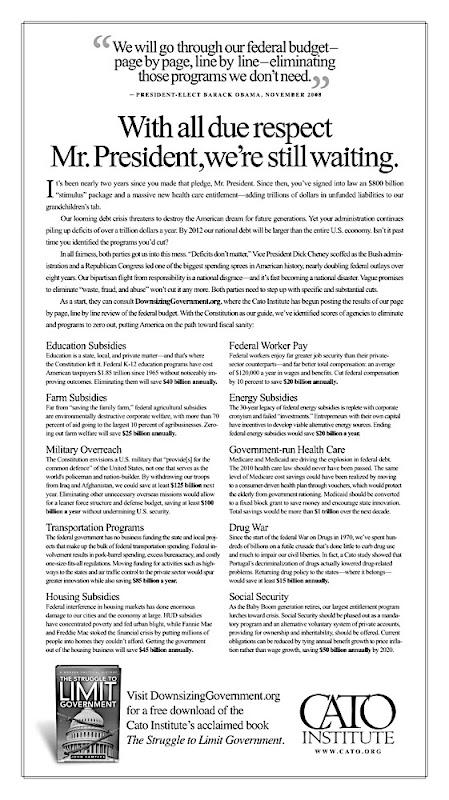
The Cato Institute has a fine new website, entitled DownsizingGovernment.org, offering a ‘department by department guide to cutting the federal budget.’
The focus today is on federal spending. (FREE WHITEWATER will focus on the City of Whitewater’s tax policy, its fiscal outlook, and municipal budget at a later time.)
Cuts represent far more than a savings in federal expenditures — they represent a reduction in meddlesome government, and a return to taxpayers of earnings (or alleviation of federal deficits from borrowing). Money returned and interest avoided will be better used in the hands of taxpayers than federal officials.
Consider just this one proposal, for a roughly 95% reduction in the size of the Department of Transportation, from Chris Edwards of Cato:
Most of the activities of the U.S. Department of Transportation are properly the responsibility of state and local governments and the private sector. There are few advantages in funding infrastructure such as highways and airports from Washington, but there are many disadvantages. Federal involvement results in political misallocation of resources, bureaucratic mismanagement, and costly one-size-fits-all regulations imposed on the states.
The Federal Highway Administration should be eliminated. Taxpayers and highway users would be better off if federal highway spending and gasoline taxes were ended. State governments could more efficiently plan their highway systems without federal intervention. The states should look to the private sector for help in funding and operating highways, and they ought to move forward with innovations such as expressways with electronic tolling.
The Federal Transit Administration should also be eliminated. Federal transit subsidies have caused local governments to make inefficient transportation choices. Federal aid favors rail systems, which are more expensive and less flexible than bus systems. The removal of federal subsidies and related regulations would spur local governments to discover more cost-effective transportation solutions, such as opening transit markets to private operators.
Air traffic control should be removed from the federal budget, and the ATC system should be set up as a stand-alone and self-funded agency or private company. Many nations have moved towards such a commercialized ATC structure, and the results have been very positive with regard to efficiency and safety.
Canada’s reform in the 1990s to create a private nonprofit ATC corporation is a good model for the United States to follow. U.S. ATC is currently overseen by the Federal Aviation Administration, which has serious funding problems and a poor record on implementing new technologies. Moving to a Canadian-style ATC system would help solve these problems and allow our aviation infrastructure to meet rising aviation demand.
Amtrak has provided second-rate rail service for decades, while consuming almost $40 billion in federal subsidies. It has a poor on-time record, and its infrastructure is in bad shape. As a government agency, it is hamstrung in its decisionmaking regarding routes, workforce polices, capital investment, and other aspects of business. Amtrak should be privatized to give it the management flexibility it needs to operate in a more efficient and competitive manner.
The table shows that federal taxpayers would save about $85 billion annually by closing down the agencies and programs listed. The department would retain its current activities regarding highway safety, aviation safety, and some other regulatory functions. Those functions could be reformed as well, but the most important thing is to end federal subsidies for transportation activities that would be better handled by the states and private sector. America should take heed of the market-based reforms being implemented abroad, and pursue similar solutions to its transportation challenges.
Department of Transportation
Proposed Spending Cuts
Program Spending in 2010
($ million)
Federal Highway Administration
Terminate entire agency $51,750
Federal Transit Administration
Terminate entire agency $15,476
Federal Aviation Administration
Air traffic control operations $7,299
Air traffic control capital grants $3,017
Airport grants $3,979
Passenger Rail
Amtrak $2,528
High-speed rail grants $339
Maritime Administration
Assistance to shipyards $104
Ocean freight differential $175
Title XI loans $108
Essential air service $53
Total proposed cuts $84,888
Total department outlays $90,944
Source: Estimated fiscal year outlays from the Budget of the U.S Government, FY2011.
The use of pseudonyms and anonymous postings are, of course, fine.
Although the comments template has a space for a name, email address, and website, those who want to leave a field blank can do so. Comments will be moderated, against profanity or trolls. Otherwise, have at it.
I’ll keep the post open through Sunday afternoon.
Have at it.