Saturday in Whitewater will be sunny with a high of 20. Sunrise is 7:25 and sunset is 4:34, for 9 hours, 9 minutes of daytime. The moon is a waxing crescent with 24.6 percent of its visible disk illuminated.
On this day in 1958, Sputnik 1, the first artificial Earth satellite, launched by the Soviet Union in 1957, falls to Earth from orbit.
For today, before going further over the next three days about an upcoming proposal before the Whitewater Common Council on Tuesday, a word about reliable measurements for Whitewater. Sound argumentation rests on a trustworthy foundation.
First, and foremost, what are conditions like truly like? How do people live and carry on each day? Not how a few who have wrung profit out of the city claim Whitewater is, but how ordinary residents living each day know Whitewater is? Will you believe what they tell you, or your own experience?
Second, good data and good reasoning carry the day. A few — too many, really — people in this town have traditionally used bad metrics in bad faith to win the day at the expense of general conditions all around us. They’ll mix and match any number of inapplicable measures or standards to prevent change. Those peddling in fear, uncertainty, and doubt use those techniques to their advantage, at the expense of market opportunities for others.
Ferocious opponents of progress, no matter how edgy and agitated, no matter how long-winded, are then and there simply blocking opportunity with a puffed-up display. Even the most furious Tasmanian Devil, it turns out, is no more than a creation of Warner Bros.
Those who stick to sound observation and sound data will serve Whitewater well.
Friday in Whitewater will be partly sunny with a high of 22. Sunrise is 7:25 and sunset is 4:33, for 9 hours, 8 minutes of daytime. The moon is a waxing crescent with 15.7 percent of its visible disk illuminated.
On this day in 1777, after victory at the Second Battle of Trenton the day before, American forces under Genera Washington then defeat British forces at the Battle of Princeton, helping boost Patriot morale.
There’s a story one sometimes hears, including in Whitewater, that there are only two forces shaping an economy: private and public. In this story, the private endeavors of individuals and businesses are defined as necessarily encouraging of general prosperity, and the public reach of government as necessarily restrictive of general prosperity.
While it’s a story, it’s also a false story, and sometimes no more than a self-serving lie.
Prosperity rests on the free interactions between individuals, businesses, and government. The relationship (of free action) precedes the result. That’s why libertarians (bona fide ones, who read more than superficially) are free-market men and women.
Government constrains, but not only government constrains. There are private men and private business, including those who proudly tout their ‘pro-business,’ ‘pro-growth’ outlook, but who stifle growth and inhibit the economic liberty of others.
They’re not the champions of positive change but its adversaries. They oppose competition.
How does this happen, that private men and incumbent businesses work against the economic liberty of others?
Here are a few ways (and residents of Whitewater will recognize them):
Control of government agencies and boards to favor cronies and limit alternatives. These private men don’t bother to count to 15,000, but instead stop at 4 of 7, simply enough to run a board or commission for their benefit and to the detriment rival businesses or individuals. This is regulatory or agency capture (shaping regulations their way, or controlling the whole agency and dismissing anyone who won’t go along with their selfish ambitions).
They’ll say this is what the people want, but they’ve not bothered to poll a community; they merely assert that they know the popular will. They’ll point to a few co-opted people as though a few were many. To gather these few, a special interest will rely on any claim imaginable, spreading fear, uncertainty, and doubt about potential rivals with better ideas and new approaches.
Control of a market by monopoly or oligopoly. We think of this approach as applicable only on a large scale, but it happens in small communities, too. One or a few private men will control an entire market and fight to keep new, rival businesses (especially ones with fresh ideas) from forming. They’ll buy resources and deny access to those who’d like to compete in a free market. Many are the one-horse towns where the old horse fights like hell to keep new horses from showing up, so to speak.
Whitewater has had both of these problems for many years. In Whitewater, specifically, It’s not government that has held people back, it’s scheming and selfish private men who think that they own the place and work to keep new enterprises from taking root.
When they talk ‘pro-business,’ they mean their businesses, their opportunities, their way. Indeed, they simply deny, at bottom, that there could be any other way than their businesses, their opportunities, their way.
Here’s a key technique: they’ll argue against any better opportunity for others in favor of an imagined perfect opportunity that they know won’t arrive. They’re like bakers who tell the hungry not to make their own bread but instead to wait for cake and caviar.
Again and again: Who owns Whitewater? Everyone and no one.
There’s no reason for residents in this town to deny themselves better opportunities for the sake of a few old men who insist that it must be their way or no way. The adversaries of free markets in Whitewater are private men who want to deny opportunity for others. No one in Whitewater lives at the pleasure of these aged schemers, no one here was born merely to deny himself or herself better life on an incumbent’s behalf.
Open the market to alternatives, and let people freely choose among them.
Thursday in Whitewater will be partly sunny with a high of 28. Sunrise is 7:25 and sunset is 4:32, for 9 hours, 7 minutes of daytime. The moon is a waxing crescent with 8.2 percent of its visible disk illuminated.
On this day in 1777, American forces under the command of General Washington repulse a British attack led by General Charles Cornwallis at the Second Battle of Trenton near Trenton, New Jersey:
After assaulting the American positions three times and being repulsed each time, Cornwallis decided to wait and finish the battle the next day. Washington moved his army around Cornwallis’s camp that night and attacked [Lieutenant Colonel Charles] Mawhood at Princeton the next day.
Somewhere in America, perhaps even in Whitewater, a grammarian is pondering whether nouns or adjectives are more important as parts of speech. And so, and so, in the expression the extraordinary ordinary, that person might wonder: does the noun ordinary matter more, or might the modifier extraordinary tell the crucial tale?
The public policy of Whitewater offers an answer.
Bringing the city into an ordinary development position, like other cities, is for Whitewater an act that should be ordinary, but requires instead extraordinary effort.
It’s in this way that Whitewater’s politics (and culture) are best understood. What should be easy is often hard, and what should be embraced often meets special-interest opposition.
Whitewater’s like a community where a few people have always eaten well, but some of those few have left others with less and worse, all the while insisting falsely that less and worse is somehow more and better.
If we’d had better policies before, one could say that this city for the last generation was meeting an ordinary development standard; as we had worse policies before, Whitewater is only now overcoming below-average standards.
We’re now on a proper diet after years of missed meals and poor nutrition. It’s simply that a few would like the community to believe that the past’s poor nutrition is preferable to the present’s proper diet.
For Whitewater, it’s extraordinary to be, at long last, ordinary in policy. It’s from the ordinary — the normal, and business-standard — that we can at last take advantage of the national and state growth that other communities have enjoyed.
Whitewater has waited long for ordinary, long for normal, long for business-standard.
There’s the answer to a grammarian pondering whether the noun or adjective of extraordinary ordinary is more important. For Whitewater, it’s extraordinary to be, at long last, ordinary in policy. It’s from the ordinary — the normal and business-standard — that we can at last take advantage of the national and state growth that other communities have enjoyed.
That’s a notable accomplishment.
A methodical, patient look at recent development projects, post by post, is overdue. Not so overdue as the projects themselves, of course, but that fault lies with the past.
Looking at these projects, of the last two years, is a good way to begin this year.
Wednesday in Whitewater will be sunny with a high of 71. Sunrise is 6:53, and sunset is 6:33, for 11 hours, 39 minutes of daytime. The moon is new, with none percent of its visible disk illuminated.
Whitewater will hold a Healthy Lakes Summit today at 5 PM.
On this day in 1980, Michael Myers becomes the first member of either chamber of Congress to be expelled since the Civil War.
Readers may recall that last week, Wausau Mayor Doug Diny removed “[a] drop box, located outside of City Hall, on Sunday and distributed a picture of himself doing it while wearing worker’s gloves and a hard hat. Diny is a conservative opponent to drop boxes. He insists he did nothing wrong.” See from FREE WHITEWATERPerformative Voting Disruption in Wausau.
The Wausau city clerk said the box was available outside of city hall “for residents to submit absentee ballots, payments, and other important city requests as was intended.”
Mayor Doug Diny removed the drop box on Sept. 22 without consulting with the clerk, who has the authority under a Wisconsin Supreme Court ruling legalizing drop boxes to make one available. They are not mandatory in the state.
Emphasis added. Wausau’s major is not a king1. He’s not even a duke, marquess, earl, viscount, or baron. The lawful authority over drop boxes was not his; he acted outside legal authority.
The law assigns the roles of public officials, and in a free society of limited government they do not (and should not) have more authority than the law allows.
A reminder to what’s left of Old Whitewater: this city did not have a mayor during your time, and if not a mayor then neither did Whitewater have a worthy and legitimate ‘unofficial mayor.’ When a few once declared someone an ‘unofficial mayor,’ the term was either a false & arrogant boast or an implicit insult against illegitimate overreaching. Those who thought the term praiseworthy confused praise with condemnation. ↩︎
Monday in Whitewater will be partly sunny with a high of 69. Sunrise is 6:44, and sunset is 6:49, for 12 hours, 5 minutes of daytime. The moon is a waning gibbous, with 63.7 percent of its visible disk illuminated.
Whitewater’s Urban Forestry Commission meets at 5:30 PM. The Whitewater School Board’s Policy Review Committee meets at 6 PM, and the full board in regular session at 7 PM.
Whitewater once again has a stand-alone supermarket, and like so many residents, this libertarian blogger is pleased to see ALDI in town. Note well: the public policy of recruiting a supermarket is not the matter of a single business, but of how local public officials have managed through public bodies (like the Whitewater Community Development Authority) under public laws and principles. However hard it has been, and remains, for Whitewater’s declining old guard to grasp, each of them (or any of us) is no less — but no more — than 1 of 15,000 in the city.1
Unquestionably right. The old Sentry closed in ’15, and Whitewater went years fumbling with old-guard CDA attempts to bring a dedicated supermarket. They accomplished nothing of the kind.
ALDI is in Whitewater because the city has a new municipal administration that brought ALDI here.
Larry Kachel indicated that the prior property owner [DLK related] had been in discussion with ALDI beginning in 2017, but the company had concluded that the traffic counts and population did not meet their minimum criteria. Kachel hastened to add that the late Jim Allen’s persistent efforts over many years to attract a store should also be recognized. Tom Howard, ALDI’s regional real estate developer, told the Banner that the city became a viable possibility for a store as a result of the success that the company has recently enjoyed with other stores in rural areas. Jon Kachel indicated that discussions have taken place with a variety of prospects regarding the property located between ALDI and Culver’s, but nothing has come together yet.
I’ll offer six remarks:
First, the City of Whitewater — through its taxpayers — had to spend $500,000 of public money to remediate — to clean up — the site of the prior private property owner, DLK Enterprises. In the language of a consultant’s assessment:
The existing structures on the property will be demolished and the site remediated, including the removal of asbestos and lead in the buildings. This cost is significant and potentially cost prohibitive for any new development.
I’m glad the City of Whitewater accepted this proposal, yet one should be clear about what this means: ordinary people had to pay to clean up the prior, local owner’s mess. The local business did not pay this money — ordinary people did. This municipal administration, under law, through the Community Development Authority and the Whitewater Common Council, had to pay this money up front to make the deal possible.
Second, It seems likely, if not certain, that the publicly-funded remediation has made the remaining area more suitable for sale. (The Brothers Kachel are free to thank the taxpayers of Whitewater at their earliest convenience.)
Third, and admittedly, the Banner‘s paragraph is a poor specimen on which to rely. There’s nothing quoted here; it’s a conversation or conversations related from one person to another, as though people were talking along a fence line. There isn’t even a claim to word-for-word accuracy: it’s an account of what someone “indicated,” not what someone said verbatim. It’s also told from a narrow perspective in which every reader should know the local people mentioned and in which the local men cited should be taken at face value3.
Fourth, the corporate real estate developer for ALDI, at least as recounted here, reasonably states the obvious about why ALDI would pick this city (once the property was cleaned up, of course). That statement says nothing about the many prior, fruitless local efforts to find a supermarket.
Sixth, equally puzzling is why anyone at the Whitewater Community Foundation’s Banner would look for answers from ALDI before seeking public documents from his or her own city. The foundational issue is about years’ long local policy to seek to a supermarket, and conduct at the Whitewater CDA across a decade’s time, not any given business arriving recently.
What portion of this libertarian blogger’s contention — ALDI is in Whitewater because the city has a new municipal administration that brought ALDI here — is accurate?
All of it, every last word.
I’m glad ALDI is here — one should be clear about how she’s here.
Denoted as a fraction, these aged men of the old guard would each look like this: 1/15,000 or 0.000067 ↩︎
The request, submitted and received under Wis. Stat. §§ 19.31–19.39, has more than one use. ↩︎
The Banner‘s author writes in his paragraph with a credulousness that suggests no awareness or no appreciation of the challenges to the modernization — normalization, truly — of local government over the last two years. ↩︎
Tuesday in Whitewater will be sunny with a high of 81. Sunrise is 6:30, and sunset is 7:11, for 12h 41m 02s of daytime. The moon is a waxing crescent with 43.1 percent of its visible disk illuminated.
Whitewater’s Public Works Committee meets at 5 PM, and her Community Involvement and Cable TV Commission also meets at 5 PM.
On this day in 1846, Elias Howe is granted a patent for the sewing machine.
Though Democrats face a formidable U.S. Senate map in 2024, they’re currently ahead in three key races.
In CBS News’ first poll of the race for Michigan’s open Senate seat, Democratic Rep. Elissa Slotkin is leading former GOP Rep. Mike Rogers by seven points. Meanwhile, Sens. Bob Casey of Pennsylvania and Tammy Baldwin of Wisconsin are ahead in their reelection bids by seven points and eight points, respectively.
Monday in Whitewater will be sunny with a high of 80. Sunrise is 6:29, and sunset is 7:13, for 12h 43m 53s of daytime. The moon is a waxing crescent with 32.9 percent of its visible disk illuminated.
What conditions should a local government body always meet? Two come to mind in all cases.
First, board members must not vote or deliberate on matters in which they have a conflict of interest. This should be evident to a person of average understanding, and yet, throughout the last decade, the Whitewater Community Development Authority was plagued with conflicts repeatedly. Someone so implicated who looks at this situation without personal contrition and insists that these conflicts do not matter is, and always will be, unsuited for public life.
At Planning, for example, the board chairman should ask all board members before a significant matter with competitive implications: does anyone on this board have a conflict that he or she should declare? Those who remain silent yet have material conflicts known or discovered are unfit to stay on that public body. (Note well: this question from a chairperson is for those for those on a board or commission.)
Second, public comment in Whitewater often comprises both ordinary residents and special interests advancing their economic gain (e.g., principals, operatives, catspaws, etc.). SeeThe Special-Interest Hierarchy of a Small Town and The Special-Interest Hierarchy of a Small Town (Adjacent Support). Almost all ordinary residents will have sincere reasons for supporting or opposing a policy; special interests will manipulate a few people now and again for the special interests’ own ends.
Boardmembers should consider of those who seek or oppose government action: cui bono? For whose benefit? In Whitewater’s case, is it for the community or for a few aged men who want to prevent competitive opportunity?
Is there such a thing as too much cheese? Producers across the US are betting billions of dollars that the answer is no. America’s per capita cheese consumption has more than doubled since the government began keeping track in 1975, to about 42 pounds a year—more than all the butter, ice cream and yogurt combined. Facilities for making cheese account for more than half of the $8 billion in US dairy-product projects slated to come online from 2023 to 2026, according to the International Dairy Foods Association.
Tuesday in Whitewater will be sunny with a high of 81. Sunrise is 6:00, and sunset is 7:58, for 13h 57m 38s of daytime. The moon is a waxing gibbous with 59.7 percent of its visible disk illuminated.
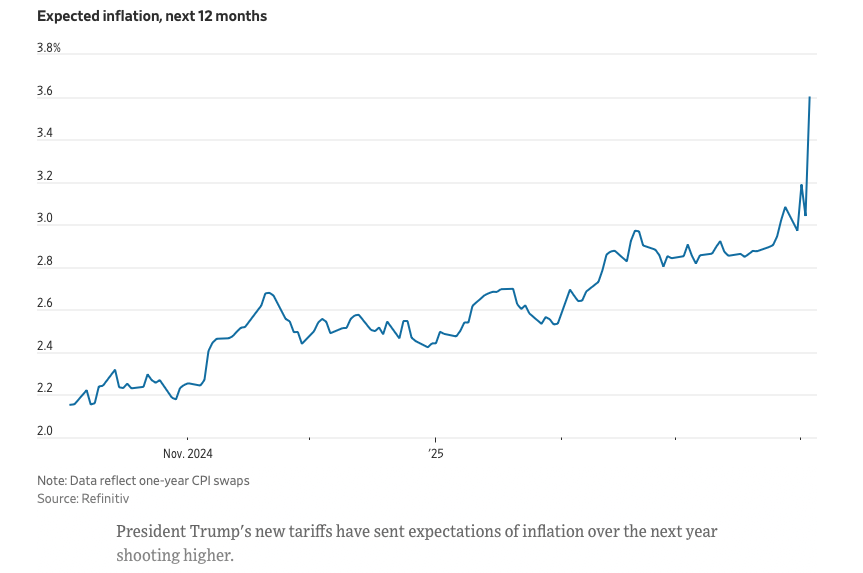
A key measure of wholesale inflation rose less than expected in July, opening the door further for the Federal Reserve to start lowering interest rates.
The producer price index, which measures selling prices that producers get for goods and services, increased 0.1% on the month, the Labor Department’s Bureau of Labor Statistics reported Tuesday. Excluding volatile food and energy components, the core PPI was flat.
Economists surveyed by Dow Jones had been looking for an increase of 0.2% on both the all-items and the core readings.
A further core measure that also excludes trade services showed a rise of 0.3%.
On a year-over-year basis, the headline PPI increased 2.2%, a sharp drop from the 2.7% reading in June.
Inflation is abating, and growth is up, and in these improving conditions residents of both big cities and also small towns (like Whitewater!) have a chance to avoid the economic mistakes of the past (and those who made them).
Some of Whitewater’s special-interest men (from the 2000s and 2010s) are like declining athletes who should have retired from the game years ago. They stayed too long, and now can’t hit, can’t field, can’t circle the bases. Overweight and underpowered. They want to blame everyone else for their below-average performance. One wonders: why pretend it’s a major-league game with these minor-league banjo-hitters stumbling up to the plate?
Thursday in Whitewater will be sunny with a high of 79. Sunrise is 5:40, and sunset is 8:22, for 14h 41m 27s of daytime. The moon is a waning gibbous with 77.8 percent of its visible disk illuminated.
The U.S. economy grew at a surprisingly robust 2.8 percent annualized rate in the second quarter, capping two years of solid expansion, despite some signs of softening.
Gross domestic product for the quarter ending in June was double the 1.4 percent reading in the previous quarter, but reflects a general cool-down from last year’s brisk pace, according to Commerce Department data released Thursday morning.
“Economic growth is solid, not too hot and not too cold,” said Chris Rupkey, chief economist at Fwdbonds, a financial research firm. “The soft patch we had at the beginning of the year has gone away and with it, the risks of a recession are dying on the vine.”
These impressive national growth numbers present Whitewater with a challenge:
Why would this beautiful town give time to the same tired, old-guard self-promoters who failed Whitewater in the 2010s?See about that time Whitewater’s Still Waiting for That Boom.
The enervated but agitated defenders of this city’s policymaking ‘tradition’ are simply the peddlers of excuses and lies.
Our next generation can — and already is — doing better for Whitewater.
Tuesday in Whitewater will see afternoon clouds and evening thunderstorms with a high of 85. Sunrise is 5:25 and sunset 8:17 for 14h 52m 53s of daytime. The moon is a waxing gibbous with 95.5 percent of its visible disk illuminated.
Whitewater’s Lakes Advisory Special Committee meets at 9 AM and the Common Council meets at 6:30 PM.
On this day in 1792, a lava dome collapses on Mount Unzen, near the city of Shimbara on the Japanese island of Kyushu, creating a deadly tsunami that kills nearly 15,000 people.
Witness conflicts of interest and hear self-serving claims long enough, and one risks becoming accustomed to them. The claims offered may be no better than a child’s connivances, yet repetition will cause hesitation even among reasonable and independent-minded people. FREE WHITEWATER published a few words on Monday about Whitewater’s new Common Council and Community Development Authority majorities. SeeOn a New Common Council & New Community Development Authority. Today, a few remarks will follow about specific contentions from holdovers of yesteryear’s CDA.
The video of the Whitewater CDA meeting from 5.16.24 is embedded above. In remarks below, I will refer to specific claims from that meeting, and from earlier public meetings.
A few points worth remembering:
1.Whitewater lacks adequate housing. This condition should be evident to everyone and anyone. See Video, CDA Meeting of 5.16.24@33:02.
2.Whitewater’s new CDA majority has proposed a residential development on South Moraine View Drive.See Video, CDA Meeting of 5.16.24@31:47 and professional reporting from WhitewaterWise, CDA recommends approval of 128-unit multifamily development on Moraine View Parkway. This proposal is well-located and would provide a needed boost to our housing supply.
3.Rents in Whitewater are high for many residents.
4. A former CDA chairman, a second-generation landlord, when arguing against these new opportunities for others, concedes his belief that the proposed developments will affect his financial condition:
He [a consultant] mentioned that it would have no effect on student housing. And he’s absolutely wrong.
It’s a candid admission: an acknowledgment that his view is particular, specific, and biased, impacting his interests.
These are not the views of an independent, unbiased analyst. It’s as though someone asked a Volkswagen salesman on commission which car to buy. (Be careful: someone may try to slip in some TruCoat.)
It is an implicit concession that rents will decline in conditions of steady demand and increased supply. With holdings in incumbent properties, this gentleman has a financial interest in preventing an increase in supply that might affect his bottom line.
5. He follows with a disingenuous assertion that he knows of no instance in which the city has provided financial assistance to a project like this.See Video, CDA Meeting of 5.16.24 @36:37.
The claim that there hasn’t been an effort to subsidize is disingenuous because policymakers (and self-interested men) can influence policy not merely through spending but through zoning. They can pay to make something happen, or they can argue against zoning regulations to limit competitors.
Later, when, as incumbents, they decided that they’d rather not have competition, they began to argue against others’ new properties. From 2014 seeDaily Union, Whitewater council eyes zoning for Campus Edge development, where the CDA chairman produced a parade of horribles against more development.
See alsoFREE WHITEWATER @ Boo! Scariest Things in Whitewater, 2014 (“So a new apartment building at Main & Prince is ‘too extreme’ in design for Whitewater? Well, I would guess that existing landlords must think so. [Update: For consumers, it’s a good thing, and a bad joke that anyone from the CDA would shill against it.]”)
Years later (they’re tenacious!) they similarly fought in 2018 against a project on Tratt Street. See Daily Union, Common council rezones annexed land.
That project has been quite helpful and attractive.
As with the 2014 effort, they argued up and down against more supply to meet demand.
6. Perhaps, as someone now contends, he’s simply an advocate of affordable single-family homes. No, he’s not. These gentlemen have argued against affordable homes in Whitewater. In 2022, they argued against smaller homes, insisting on larger ones instead.
Whitewater’s Common Council, by a vote of 5-2 at its 9.20.22 session, sensibly approved on first reading the creation of an R1-S zoning district for detached, single-family homes on smaller lots. A zoning change that offers some builders and buyers, even in limited areas, more options is, prima facie, the right decision.
So what a this lights on for us, lights off for you public policy? It’s this:
A tiny clique of landlords has for years addressed this issue opportunistically. These few wanted to liberalize Whitewater’s ordinances to permit more student housing. And so, and so, there were more student apartments in the center of town. Ah, but when competitors sought approval to build on Prince or Tratt Streets, an incumbent landlord (and sometime public official) used one claim after another under the city’s ordinances to prevent or restrict those competitive projects.
These are proud, private businessmen right up until the time they hold public offices and entreat public bodies to bend to their special-interest desires.
The larger homes these men advocated would have been out of reach for many residents.
It’s as though you told a struggling person that he should hold off buying tuna until he could afford caviar. A person taking that advice would go hungry waiting.
They opportunistically shift from one position to another while leaving residents without genuine, real options. Wait a bit is easier for men who already have than men and women who would like something affordable.
These gentlemen want the law liberalized when it liberalization suits their bottom line, but want the law restricted when restriction suits their bottom line. They could not be more obvious if they tried. (In my own case, the best policy would be fewer restrictions all the way down, but that’s not the point here. The point is that their views have shifted with their interests rather than the common good, and their interests are not the same as the city’s interests
7. Tax incremental funding comes up as an objection to this project. One should remember that the new CDA’s program here is to meet an existing need for affordable housing. A reminder: food, clothing, shelter. Any tax incremental fiancing now would meet a fundamental need. (I write this, by the way, as a long-standing critic of tax incremental financing; yet, this critic can see that some cases are more important than others, are more understandable than others.)
For years, these older men were involved in tax increment financing for Whitewater. They weren’t critics then; they’re raising doubts now they see competition. (These are not free-market men; they’re a few self-helping businessmen.)
Expressing optimism with perceived economic improvements, members of the Whitewater CDA recently discussed a number of the areas of the city designated as tax incremental financing (TIF) districts.
Officials briefly went over TIF districts 5 to 8 during a meeting Oct. 23. TIFS 5 and 7 are designated for mixed-use, a term denoting a blend of commercial and residential uses. TIFs 6 and 8, meanwhile, are earmarked for industrial use.
“We’re kind of getting out of the doldrums of this economy,” said CDA Chair Jeff Knight, expressing optimism of future development within the city.
Our current housing needs are, by far, greater than those of any tax incremental plan or other plan that a former CDA has ever advocated in this city.
If these few holdovers from another time would like to lecture others about tax incremental financing, they should first look to their past roles in tax incremental financing in this community.
Most important of all: it’s a city of 15,000 equal people, many of whom have good ideas for our future. A few older men who keep insisting ‘we’ve never done it that way’ or ‘that’s not our history’ only bolster the case for encouraging new officials, new voices, to advance a different way. We’ve not benefited from the public policy advice of the last generation. SeeA Candid Admission from the Whitewater CDA and Whitewater’s Still Waiting for That Boom.
It’s time — well past time — to blaze a new trail.
Monday in Whitewater will be cloudy with rain and a high of 75. Sunrise is 5:25 and sunset 8:17 for 14h 51m 06s of daytime. The moon is a waxing gibbous with 91.2 percent of its visible disk illuminated.
On this day in 1863, after the unsuccessful assault on Vicksburg the previous day, Union forces regroup in front of the city. The 1st Wisconsin Light Artillery and the 8th, 11th, 18th, and 23rd Wisconsin Infantry regiments joined the 14th and 17th Infantries to prepare for the next attack. While these arrangements took place at Vicksburg, the 4th Wisconsin Infantry fought in a skirmish in Cheneyville, Louisiana.
Whitewater now has a new Common Council majority and a new Community Development Authority majority. A few remarks today about these new majorities; remarks will follow tomorrow about specific contentions from a few holdovers from yesteryear’s CDA.
First, the obvious: this libertarian blogger is not, and has never claimed to be, a development man. And yet, and yet, a person need not be a development man to see the difference in quality between the self-serving claims of a conniving clique and the genuine accomplishments of residents and development employees. (One doesn’t have to be a watchmaker to see the difference between a fine timepiece and a cheap knockoff that’s scarcely right twice a day.)
Whitewater is a town of many talented people, of many sharp people, of many capable people. Thousands upon thousands, truly. This isn’t true because I believe it; I believe it because it’s true. Our advanced American civilization is far more than the product of a few — we are the work of millions across centuries. Whitewater, in the same way, is far more than the product of a few — we are the work of thousands across generations.
Whitewater, after all, has a Common Council (lit., ‘belonging to, open to, or affecting the whole of a community’) and Community Development Authority (lit., ‘the people of a district or country considered collectively; society’).
Whitewater does not have a Special Interests’ Council, or a Few Businessmen’s Development Authority. These are public bodies of — and for — the whole community, not simply platitudinous men, self-dealers, self-promoters, and their operatives, catspaws, scoundrels, or sycophants.
Whitewater now has sincere, independent majorities on her Common Council and Community Development Authority. They and I will not always agree, but I and others owe these officials the acknowledgment that whatever disagreements we may have, they are disagreements with capable and independent men and women.
Left, center, right, whatever: first, one must have men and women who exercise their independent judgment on behalf of not fifteen, but all fifteen thousand in this beautiful city.
For tomorrow, particular remarks on the CDA meetings of 4.18.24 and 5.16.24.
For today and always, best wishes and support to those sincere and principled officials acting on behalf of all of our city.
Friday in Whitewater will be sunny with a high of 52. Sunrise is 7:04 and sunset 7:02 for 11h 58m 32s of daytime. The moon is a waxing crescent with 33.4 percent of its visible disk illuminated.
Last April the Wisconsin Examiner published an examination of the way that Native American human remains have been retained by public institutions in Oshkosh long after the passage of a federal law that was intended to speed their repatriation to the tribes that once inhabited the area.
The article included some startling details that demonstrated the callousness of the institutions, especially the University of Wisconsin Oshkosh. But the university also managed to keep even more graphic information out of the story.
For example, readers did not learn that a Native American skull, collected in Oshkosh on the south bank of the Fox River, had been stolen in 1990 from an exhibit case on campus and “broken during the bungled burglary.” Nor did they read about the time that the remains of one individual went missing from an excavation where an assistant professor found 43 burials but apparently lost track of one “en route to the archaeology laboratory.”
The reason that these details, contained in inventory records that had been easily accessible at the campus library, were not included in my story was that during the course of my reporting university officials stepped in and placed the documents in a restricted area. I was in the midst of reviewing the documents when the university decided that they needed to be kept from the public on the basis of what turned out to be a completely bogus rationale.
Last month the university released a full set of the inventory records under prodding from the Winnebago County district attorney, whose investigation showed that UW Oshkosh had repeatedly and egregiously manipulated state law.
The DA’s investigation confirmed what I had asserted in a complaint filed in July, that UW Oshkosh had made a mockery of the state’s public records law, slow-walking responses, making up excuses for redacting information and misapplying doctrines like the attorney-client privilege. Among other things, I pointed out, UWO had withheld documents from me that it had released to another news organization and claimed that it had the right to keep from me a copy of an email that I myself had written.
(Emphasis added.)
Again and again: public officials in public institutions conducting public business aren’t entitled to private avenues of concealment. Officials who would like private protections can find those defenses just as soon as they return to private life.
Tuesday in Whitewater will be partly sunny with a high of 52. Sunrise is 6:21 and sunset 5:50 for 11h 29m 27s of daytime. The moon is a waning crescent with 29.2 percent of its visible disk illuminated.
There will be a session of the Whitewater Common Council tonight at 6:30 PM.
On this day in 1953, Joseph Stalin, mass murderer and longest-serving leader of the Soviet Union, dies at his Volynskoe dacha in Moscow after suffering a cerebral hemorrhage four days earlier.
A note and an agenda for today.
The note: I’ll hold a bit on a series about the school district, awaiting new developments. It’s not true — as a clever but mistaken resident once said — that this libertarian blogger comments hastily. Not at all. Some posts or series wait for the right time, and that time may come weeks or months after an event.
For the schools, more time will lead to a dispositive assessment.
Monday in Whitewater will be mostly sunny during the day, and rainy this evening, with a high of 64. Sunrise is 6:22 and sunset 5:49 for 11h 26m 33s of daytime. The moon is a waning crescent with 39.7 percent of its visible disk illuminated.
There will be Election Inspector Training today in Whitewater at 2:30 PM and 4:30 PM. Whitewater’s Lakes Advisory Committee meets at 5 PM, and the Equal Opportunities Commission also meets at 5 PM.
On this day in 1776, the Continental Army fortifies Dorchester Heights with cannon, leading the British troops to abandon the Siege of Boston.
Two quick reminders on local government, special interests, etc.:
Second, a good way to measure the strength of a position (considering its quality of being strong, its merit, and its desirability) is to ask: would one trade that position for another one?