Tuesday in Whitewater will see scattered afternoon thundershowers with a high of 72. Sunrise is 6:38 and sunset is 7:20 for 12 hours 42 minutes of daytime. The moon is a waxing gibbous with 97.7 percent of its visible disk illuminated.
Whitewater’s Aquatic Center Committee meets at 5:30 PM.
On this day in 1951, Remington Rand delivers the first UNIVAC I computer to the United States Census Bureau.
A UNIVAC I at the United States Census Bureau in 1951. Public Domain, Link
After a loud and intense Wisconsin Supreme Court race in ’25, this year’s race is neither loud nor intense:
In another sign this year’s Supreme Court race is flying under the radar for many Wisconsinites, the number of absentee ballots cast so far is around 112,000 behind the pace set in 2025.
As of Monday morning, the Wisconsin Elections Commission reported 146,583 absentee ballots had been returned in the matchup between liberal Wisconsin Appeals Court Judge Chris Taylor and conservative Wisconsin Appeals Court Judge Maria Lazar.
The returns are a fraction of what they were 12 months ago when former Republican Attorney General Brad Schimel was competing against now-Justice Susan Crawford in a race where ideological control of the bench was at stake. On March 24, 2025, the commission reported that 258,975 absentee ballots had been returned.
It’s notable that last year’s intensity, and Elon Musk’s involvement, didn’t change the outcome: WISGOP-backed candidate Brad Schimel still lagged Susan Crawford’s legitimate poll numbers throughout the race and in the final vote. See Bruce Murphy, Crawford Was Ahead Through Entire Election, Urban Milwaukee, April 7, 2025.
There’s a debate between Taylor and Lazar on Thursday, April 2 at 7 PM. The election ends five days later.
Invisible carbon in the air may explain some of the secrets of static electricity. From Van de Graaff generators to flying kites in thunderstorms, scientists have spent centuries playing with the strange effects of static electricity — yet the details of the phenomenon remain mysterious. Now experiments show that carbon molecules could play a key role in how oxides gain static charge. Is this the long-hidden mechanism behind static electricity or just another piece of a complex puzzle?
Monday in Whitewater will be sunny with a high of 75. Sunrise is 6:40 and sunset is 7:18 for 12 hours 38 minutes of daytime. The moon is a waxing gibbous with 93.5 percent of its visible disk illuminated.
Whitewater’s Plan & Architectural Review Commission meets at 6 PM and the Library Board at 6:30 PM.
On this day in 1867, the United States purchases Alaska from Russia for $7.2 million, about two cents per acre. (The U.S. Senate later ratifies a bilateral treaty with Russia in May of that year.)
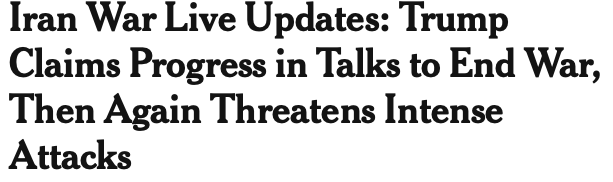
Consider an accurate headline describing the latest developments in the Iran War:
Check again soon, because in an hour or so the latest from Mr. Trump may be wholly different. Is the goal oil? Do we need oil? Should we need oil? Do we want regime change? Should we want regime change? Has the regime already been changed? Did we attack for ourselves or at the behest of a foreign power? Is the war won? Is the war intensifying? Is this even a war?
Admittedly, Trump is an extreme example of a problem with statements on topics national, statewide, or local: Is a claim justified merely in the making of it? He said it, so it must be true.1She claims it, and isn’t that all that matters?
A claim grounded like that would be the intellectual equivalent of a mayfly: buzzing, but only briefly. Few claims are self-authenticating, least of all the claims from Mar-a-Lago or whatever golf course Mr. Trump can find.
And yet, and yet, for so many of us, proof still matters beyond country clubs and golf courses.
It’s all 3-D chess, right? Has anyone considered that while a few talk about a three-dimensional version of chess, millions upon millions continue to play the traditional version of that ancient game? ↩︎
Sunday in Whitewater will be cloudy with a high of 62. Sunrise is 6:42 and sunset is 7:17 for 12 hours 35 minutes of daytime. The moon is a waxing gibbous with 87.2 percent of its visible disk illuminated.
On this day in 1974, farmers Yang Zhifa, his five brothers, and neighbor Wang Puzhi discover the Terracotta Army in Shaanxi province, China.
Alexander Shur reports that the Wisconsin Supreme Court race is pivotal for future election policy. That’s true:
Unlike the past two Wisconsin Supreme Court races, though, this contest won’t determine ideological control of the court. Liberals already hold a 4-3 majority, and the outcome will either preserve the liberal majority or expand it to 5-2 by replacing retiring conservative Justice Rebecca Bradley. As a result, the race has drawn significantly less attention and spending than the last two contests, which decided the court’s ideological balance.
Critically, the winning justice will also be a member of the court for the 2028 presidential election, when voting disputes often intensify and escalate to court challenges.
“There’s a lot of importance just because of the length of the term,” said UW-Madison political science professor Barry Burden, who noted that the Wisconsin Supreme Court in the past 10 years has weighed in on absentee voting rules, the legality of postponing elections because of the pandemic and President Donald Trump’s effort to overturn the results of the 2020 election.
The WISGOP — and it is the WISGOP that matters even in nonpartisan judicial races — suffers exhaustion. Same party leaders: too long, too dull, too old.
No one takes the boom out of Boomer like these men have.
Here’s a sharp-dressed Canadian gentleman with something to say:
Saturday in Whitewater will be sunny with a high of 47. Sunrise is 6:43 and sunset is 7:16 for 12 hours 33 minutes of daytime. The moon is a waxing gibbous with 78.8 percent of its visible disk illuminated.
On this day in 1910, Henri Fabre becomes the first person to fly a seaplane, the Fabre Hydravion, after taking off from water runway Étang le Barre, near Marseille.
The search is on for Chesney, a missing kangaroo. The kangaroo has been spotted by a drone hopping through the woods, but thus far, it has not returned to its home at the Sunshine Farm in Necedah, Wisconsin.
The safe return of this kangaroo, if accomplished, should include voluntary surrender to more responsible ownership in a proper sanctuary.
Scientists have filmed a sperm whale giving birth while other females worked together to support the mother and her newborn. A 19-year-old female named Rounder was surrounded by family members and others as she was about to give birth to her second calf off the coast of the Caribbean island of Dominica on 8 July 2023. Over nearly five-and-a-half hours, the scientists documented the group’s behavior, watching them from a boat and filming with drones and recording sounds beneath the waves.
Friday in Whitewater will be partly sunny with a high of 41. Sunrise is 6:45 and sunset is 7:15 for 12 hours 30 minutes of daytime. The moon is a waxing gibbous with 70 percent of its visible disk illuminated.
On this day in 1915, Typhoid Mary (Mary Mallon), the first healthy carrier of disease ever identified in the United States, is put in quarantine for the second time, where she would remain for the rest of her life.
A jury convicted a Wisconsin man of election fraud and identity theft for requesting the ballots of Republican state Assembly Speaker Robin Vos and Democratic Racine Mayor Cory Mason without their consent.
Jurors in Racine County on Tuesday found Harry Wait guilty of two misdemeanor election fraud charges and one felony identity theft charge following a two-day trial. He was acquitted of a second count of identity theft.
Wait leads a group that makes false election claims, including that Wisconsin’s elections are riddled with fraud and that President Donald Trump won the 2020 election. Trump lost Wisconsin in 2020 by about 21,000 votes.
Wait admitted in 2022 that he requested Vos’ and Mason’s ballots to try to prove that the state’s voter registration system is vulnerable to fraud. Wait told The Associated Press at the time that he wasn’t surprised he was charged.
“You got to expect to pay some costs sometimes when you are trying to work for the public good,” he said.
His efforts drew praise from Republican U.S. Sen. Ron Johnson in 2022, who called Wait a “white hat hacker.”
Of course Harry Wait is unrepentant, and Sen. Ron Johnson is supportive of him: years of burrowing into every dark, conspiratorial tunnel have left those two incapable of seeing much and seeing anything clearly.
The greater surprise would be if either man showed normal judgment and contrition.
Big Red basks in the sunlight as she tends to her nest and brand-new egg, laid on March 23. Red-tailed Hawk eggs are smooth and white, often with a buffy wash and sometimes heavily marked with blotches or speckles of brown or purple. (A red-tailed hawk pair has been nesting above Cornell University’s athletic fields since 2012. They have made use of two different light towers for their nest sites. In 2012, 2015, and 2018–2023 they used a tower near Fernow Hall, and in 2013, 2014, and 2016, they used the tower nearest Weill Hall. We installed cameras at both of these sites to get a better look at the intimate behavior of these well-known birds as they raise their young amid the bustle of a busy campus.)
Readers will want to check the Asociatia Felina SofistiCAT webpage regularly for 2027 competition details. See also Expedia flights from Milwaukee to Bucharest.
Tuesday, March 31 at 1:00 PM, there will be a showing of One, Two, Three @ Seniors in the Park, in the Starin Community Building:
Satire/Screwball Comedy
1 hour, 44 minutes (1961)
Our Second Annual April Fool’s Day Best Comedy Ever series continues with this Jimmy Cagney “tour de farce,” playing a frazzled Coca-Cola executive in West Berlin on the other side of the Iron Curtain in post war Germany. Stars Horst Buchholz, Pamela Tiffin, Arlene Francis, and Red Buttons.
Thursday in Whitewater will see scattered afternoon showers with a high of 63. Sunrise is 6:47 and sunset is 7:14 for 12 hours 27 minutes of daytime. The moon is a waxing gibbous with 58.7 percent of its visible disk illuminated.
On this day in 1982, the groundbreaking ceremony for the Vietnam Veterans Memorial takes place in Washington, D.C.
THERE’S SOMETHING HAPPENING here. What it is ain’t exactly clear. But at least some observers are seeing signs that the pivotal swing state of Wisconsin is shifting from purple to blue.
The upcoming April 7 election for a seat on the Wisconsin Supreme Court is shaping up to be a blowout win for the liberal contender, which would make it the third consecutive high-court contest to go the liberals’ way. This fall’s race to replace two-term Democratic Gov. Tony Evers seems to have a lopsided level of energy, with more than a half-dozen serious contenders on the Democratic side (to be narrowed to one in an August 11 primary), and just one serious contender among Republicans: Tom Tiffany, an acolyte of President Donald Trump currently serving in the U.S. House. And even given existing skewed electoral maps, the Dems have a fighting chance of flipping one or even two of the state’s eight congressional seats, for which Republicans now enjoy a six-to-two advantage.
TO GET A MORE NEUTRAL PERSPECTIVE, I spoke with Brandon Scholz, the former executive director of the Wisconsin Republican Party, who stopped being a Republican the day after the January 6th Capitol riot. Scholz, now an independent analyst and commentator, urged caution in attributing the legislature’s leadership exodus to concern over the upcoming election.
[…]
Scholz also believes that proclamations that Wisconsin is turning from purple to blue are premature. State voters re-elected Republican U.S. Senator Ron Johnson in 2022 and picked Trump for president in both 2016 and 2024. If liberal Court of Appeals Judge Chris Taylor handily beats conservative Court of Appeals Judge Maria Lazar in the state’s April 7 Supreme Court election, “that’s one box to check”; if Democrats gain control of the state Senate this fall, that’s another. Finally, if one of the multiple Democratic candidates for governor beats Tiffany, “who will have a Trump endorsement and the mythical MAGA vote, which never shows up”—well, if all that happens, he thinks “you could put that check mark into maybe they’re moving from purple to blue.”
This Never Trump libertarian shares Scholz’s assessment: it’s too soon to tell if Wisconsin will move from purple to blue. (I do agree with the assessment that the Taylor-Lazar court race is effectively over: Lazar’s campaign is cooked. She is an underfunded candidate who made the mistake of leading with an anti-abortion position. Lazar’s views are sincerely held, but bringing them front-and-center only reminded others of a position that wins some votes in Wisconsin at the expense of many more.)
Apparently, it is understood that it is impossible for a Republican to win a statewide race without Trump’s support. But it may also be that, in Wisconsin as elsewhere, winning with Trump’s support may prove to be equally difficult.
That’s it right there: a large coalition of opposition has both emerged and, crucially, solidified.
The administration did not expect the public to be repelled by DOGE. It did not expect outrage over the treatment of Kilmar Abrego Garcia. It did not expect Democrats to respond to threats of partisan gerrymandering with their own push to wring as many Democratic seats as possible out of so-called blue states. The administration certainly did not expect the mass mobilizations against the deployment of National Guard troops and the use of ICE and Customs and Border Protection as a roving paramilitary force. Minnesota in particular appears to have caught them entirely off guard — a tendency toward docility, it seems, is their base-line assumption about everyone they oppose.
A growing faction of concerned citizens living in suburban communities across the United States — places once known for political moderation or even conservatism — are increasingly positioned on the front lines of the anti-Trump resistance. More than a year into the Republican president’s second term, the so-called “soccer moms” are becoming bona fide activists taking to their well-manicured streets to fight Trump and his allies.
The leftward lurch could cost Republicans control of Congress for the president’s final two years in office. It could also reshape the Democratic Party by elevating a fresh crop of fiery progressive candidates emboldened to push back against the Trump administration more aggressively than the establishment may prefer.
It seems almost certain to this Never Trump libertarian blogger that the Democrats, the largest part of the coalition against Trump, will for their party choose “candidates emboldened to push back against the Trump administration more aggressively than the establishment may prefer.” The whole coalition, however, grows more hardened and more resistant to Trump each day.
It’s Trump who has earned — and intensified — this opposition. It is he who has made this opposition more implacable. As he is to blame for this many failures, so he is also responsible for an ever more hardened opposition.
Consumers could soon see the cost of everyday goods spike if the Middle East conflict drags on. The effective closure of the Strait of Hormuz is impacting supply chains for medicine, food, plastics and more. CNBC’s Garrett Downs breaks down what the conflict could mean for affordability in the run up to the midterms.
Those worried about affordability should reject the man who supports tariffs and war. Those who complain about affordability while supporting that same man advance an incoherent, self-defeating position.
Wednesday in Whitewater will be windy with a high of 68. Sunrise is 6:49 and sunset is 7:13 for 12 hours 24 minutes of daytime. The moon is a waxing crescent with 47.6 percent of its visible disk illuminated.
On this day in 1965, civil rights activists led by Martin Luther King Jr. successfully complete their march from Selma to the capitol in Montgomery, Alabama.
Wisconsin had an opportunity this year to adopt legislation against lawsuits designed to limit public participation, but the Wisconsin Senate declined to consider the legislation. Lawsuits like this are called strategic lawsuits against public participation (SLAPP) and are designed to limit discussion of public policy issues. Anti-SLAPP didn’t get a vote in the State Senate as WISGOP proponents of the legislation claim they were stymied by another WISGOP senator:
Rep. Jim Piwowarczyk (R-Hubertus), who coauthored the bill, said in an email to the Wisconsin Examiner that he was “very disappointed that one or two Republican senators would block a bill that would protect everyone’s First Amendment rights.” He said he identified a few senators opposed to allowing the bill to make it to the Senate floor, and made several attempts to contact them and address potential concerns.
“The vast majority of Republicans AND Democrats in the state Legislature supported this bill,” Piwowarczyk said.
[…]
The state Senate and Assembly have both adjourned their final regular floor sessions of the year. Work in the Capitol will be minimal for the remainder of the year as lawmakers turn their attention to running for reelection.
Free Press Action [a free-speech advocacy group] said it would also be advocating for the bill next year.
“SLAPP lawsuits are designed to punish and silence, not to win. Even when dismissed, they can cost defendants tens of thousands of dollars and years in court. When anti-SLAPP laws are enacted, targeted victims can defeat these speech-chilling attacks,” Arin Anderson, the Wisconsin civic media campaign manager for Free Press Action, said in a statement. “Passing this broadly supported bill would send a clear message: Wisconsin stands up for free speech, open debate and the right of people to hold the powerful accountable.”
When lawmakers return in January 2027, the makeup of both the state Assembly and Senate could be quite different, with Republican leaders and other incumbents retiring and Democratic lawmakers eyeing majorities.
Fly away, giant pigeon. Iván Argote’s “Dinosaur” watched over the High Line for over a year, fans gathered to say goodbye to the huge aluminum pigeon with a festive send off. [No report on where Argote’s sculpture will go next.]
Tuesday in Whitewater will be cloudy with a high of 50. Sunrise is 6:51 and sunset is 7:12 for 12 hours 21 minutes of daytime. The moon is a waxing crescent with 35.9 percent of its visible disk illuminated.
On this day in 1989, in Prince William Sound in Alaska, the Exxon Valdez spills 240,000 barrels (38,000 m3) of crude oil after running aground.
There are disparities both between national and Wisconsin party fundraising and within each. National trends are the mirror image of those in Wisconsin.
The RNC out-raised the DNC in February, $18.5 million to $10.3 million. And entering March, the RNC reported nearly seven times as much cash on hand, $109 million to $15.9 million.
The DNC has more outstanding debt, $17.4 million, than cash on hand, keyed to a $15 million loan the committee took out last October.
New federal fundraising data shows Wisconsin’s Democratic Party brought in nine times as much as the state’s Republican Party last month. At the same time, Democrats trounced Republicans on spending and ended with twice as much money in the bank ahead of the November midterm elections.
The figures come from the parties’ federal accounts, which are used to support candidates in U.S. Senate and U.S. House elections. The reports show the Democratic Party of Wisconsin raised around $1.5 million in February, while the Republican Party of Wisconsin brought in around $167,000.
There are several plausible explanations: (1) the national GOP is skilled at fundraising, (2) the national Democratic Party is not, (3) the WisDems are skilled at fundraising, and (4) the WISGOP is not.
Presidential candidates raised $2 billion and spent approximately $1.8 billion in the 24 months of the 2023-2024 election cycle, according to campaign finance reports filed with the Federal Election Commission that cover activity from January 1, 2023 through December 31, 2024. Congressional candidates collected approximately $3.8 billion and disbursed approximately $3.7 billion, political parties received $2.7 billion and spent $2.6 billion, and political action committees (PACs) raised approximately $15.7 billion and spent $15.5 billion in the 24-month period. Disbursements for independent expenditures reported in this period totaled $4.4 billion. Electioneering communications and communication costs reported to the Commission totaled $11.3 million and $39.7 million, respectively.
Of these billions, most came from non-party sources. Disparities in fundraising between the major parties tell us something about the prowess of party operatives in attracting funds, but tell far less about the total amount of money available to candidates in their respective races, nationally or in Wisconsin.
Monday in Whitewater will be sunny with a high of 43. Sunrise is 6:52 and sunset is 7:10 for 12 hours 18 minutes of daytime. The moon is a waxing crescent with 26 percent of its visible disk illuminated.
On this day in 1965, NASA launches Gemini 3, the United States’ first two-man space flight (crew: Gus Grissom and John Young).
This libertarian blogger has contended for minimal state regulation of data centers — local communities should decide what’s best for them, proposal by proposal. What municipalities should not do, however, is sign non-disclosure agreements (NDAs) with companies proposing data centers. If local communities are to decide for themselves, then residents need plentiful information about data center proposals. Microsoft now acknowledges that community need:
Microsoft announced last week it would stop signing nondisclosure agreements that keep its data center proposals secret, a move that received praise from open government advocates.
Less attention was paid to the other party to those NDAs: local governments.
“Hopefully, the industry follows,” said Wisconsin state Rep. Clint Moses, R-Menomonie, where the city signed an NDA, then put a proposed data center on hold. Microsoft “just realized that it’s not a successful formula when you come into a community under darkness.”
Moses said a bill he introduced to ban data center NDAs, which stalled in the Legislature, is still needed to prevent local governments from signing the agreements. If local officials sign them, “hopefully voters will remember it and hold them accountable,” he said.
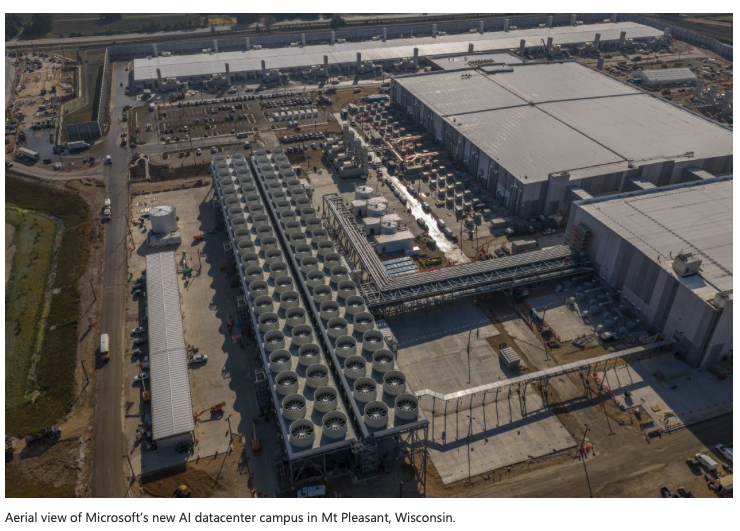
Microsoft did not sign NDAs in the Racine County communities of Mount Pleasant, where a multibillion-dollar data center complex is under construction, or in Caledonia, where it withdrew a data center proposal amid community opposition. But its announcement comes at a time of public backlash against data centers proposed in Wisconsin.
The company said its new position on NDAs is an effort toward transparency “as we continue to build trust with the communities around the world in which we operate, and that it would work with local governments to terminate current NDAs. Microsoft has one in Kenosha, where a data center is proposed.
Legislation banning NDAs with data center companies — or local governments — wouldn’t be necessary if each party understood that this level of secrecy is understandably and rightly objectionable to residents in these communities.
It would be far better if we lived in conditions where no company and no local government even considered the possibility of a non-disclosure agreement for a data center. We do not live in those conditions, although Microsoft’s announcement, if sincere, might move other companies to accept conditions of open and transparent government over these centers.
Sunday in Whitewater will be cloudy with a high of 57. Sunrise is 6:54 and sunset is 7:09 for 12 hours 15 minutes of daytime. The moon is a waxing crescent with 15.9 percent of its visible disk illuminated.
On this day in 1894, the Stanley Cup ice hockey competition is held for the first time, in Montreal, Canada (decades before the establishment of the NHL).
Haribo is one of the largest gummy candy manufacturers in the world, with its Wisconsin factory producing 60 million Goldbear gummies a day. Hershey, best known for chocolate, has expanded into pretzels and dipped fruit snacks. Ferrara, meanwhile, owns a range of chewy, hard and powder-based candy brands like Jelly Belly, Laffy Taffy and Fun Dip. But Haribo takes a different approach—focusing solely on gummy candy as its advantage. WSJ explores how Haribo uses local factories and regional flavors to grow its global presence. Chapters: 0:00 Haribo gummies 0:30 Gummy candy strategy 2:03 Factories 2:52 Decentralization and localization 5:07 What’s next?
NASA’s Hubble Space Telescope observed comet C/2025 K1 (ATLAS) fragmenting into multiple pieces, offering scientists a rare look at a comet breakup event and the forces driving it.