
Daily Bread
Daily Bread for 12.13.17
by JOHN ADAMS •
Good morning.
Midweek in Whitewater will see afternoon snow showers with a high of thirty-four. Sunrise is 7:17 AM and 4:21 PM, for 9h 03m 33s of daytime. The moon is a waning crescent with 18.8% of its visible disk illuminated. Today is the {tooltip}three hundred ninety-ninth day.{end-texte}Days since Trump’s election, with 11.9.16 as the first day.{end-tooltip}
Whitewater’s University Tech Park Board meets at 8 A.M.
On this day in 1864, the 3rd Wisconsin Light Artillery reaches the front lines of Savannah, Georgia.
Recommended for reading in full —
McKay Coppins writes The Alabama Election Is a Referendum on the GOP’s Future:
For all the national attention that’s been paid to the grisly particulars of Alabama’s special election over the past few weeks—the lurid details of the sexual-abuse accusations against Roy Moore; the performative shrieks of “Fake News!” from the candidate and his defenders—the true political consequences of the race will likely reach well beyond a single Senate race in 2017.
In fact, many Republicans in Washington believe the voters who are heading to the polls on Tuesday could end up playing a pivotal role in the fight for the soul of the GOP.
Republican leaders have been keeping an especially wary eye on Alabama ever since former White House chief strategist Steve Bannon announced his intention to recruit primary challengers for (virtually) every Republican senator up for reelection in 2018.
“There’s a time and season for everything,” Bannon said in a speech at the Values Voters Summit in October, “and right now it’s a season of war against the GOP establishment.”
(I’m neither a Republic nor a Democrat, and remain convinced that if there’s a metaphorical war to be fought it’s one against Trumpism, and those politicians and operatives who advance that autocratic, bigoted view. Still, better that a defective candidate like Moore lost, in an of itself: he was unfit.)
Aaron Blake assesses Winners and losers from the Alabama special election [full list in original article):
The race to replace Attorney General Jeff Sessions in the Senate featured votes spanning nearly four full months, with one bizarre turn after another, and ended Tuesday night with Democrat Doug Jones pulling off the upset over Republican Roy Moore, who faced allegations that he had sexually harassed and assaulted teenage girls while he was in his 30s.
Let’s break down the whole thing via winners and losers.
WINNERS
Democrats’ Senate majority hopesAt the start of the cycle, the math for Democrats winning the Senate majority in 2018 — even in a very good environment — appeared prohibitive. They had only two bona fide pickup opportunities, they needed three pickups, and they had to defend 10 swing and red states that President Trump won. The map was just brutal.
But since then, they’ve gotten the news they need to at least put the Senate in play. Potential takeovers in Arizona and Nevada look increasingly promising. An open seat has popped up in Tennessee, where last week Democrats landed popular former governor Phil Bredesen as a candidate, and now they’ve nabbed one of the three pickups they needed a year early in Alabama. The math is still tough, but it’s clearly within the realm of possibility now. And with Democrats claiming a double-digit lead on the generic ballot, things are very much looking up….
(I expected Moore to win; his defeat is a welcome surprise. As for the rest, one has no reason to relent, locally or elsewhere, until every last part of Trumpism meets its political ruin.)
Sara Hsu reports IMF Warnings Of China’s Financial Fragility Come As No Surprise:
The IMF warned, in its recent Financial Sector Assessment Report, of China’s financial fragility, pointing to high levels of corporate debt and funding through wealth management products. The report found growing risks within the banking system, particularly outside of the Big Four state-owned banks. Although China’s central bank brushed aside the warning tone of the report, these cautions should ring true with analysts who have been closely monitoring the debt pileup across multiple sectors.
The report and China’s response
The IMF report states, “the near-term prioritization of social stability appears to rely on credit expansion to continue financing firms even when they are not viable, and on stabilizing asset markets to prevent losses for households. Microprudential regulation and supervision will struggle to mitigate risks and deliver financial sector stability if the macroeconomic context—notably, monetary, fiscal, and development policies—is not supportive.” In other words, China’s attempt to stabilize the economy through the use of credit has created risks that cannot be resolved by imposing regulation alone; wider government policies must be supportive.
In response to the report, China’s central bank has stated that the IMF description did not entirely reflect the results of the stress tests, and that the banking system is well capitalized. This contradicts the IMF account that covered stress tests on 33 banks with RMB 171 trillion in total assets and RMB 20 trillion in off-balance sheet WMPs. The results of these tests found potentially vast under capitalization of joint stock and city commercial banks, given an economic shock. These banks have been responsible for much of the growth in the banking sector since 2011, the report states….
(State capitalism is failed capitalism.)
Jack Jenkins writes Nobody is laughing at the Religious Left in 2017:
There’s a well-worn joke that has circulated among religion writers for at least the past decade: every year, someone publishes a piece prophesying the “rise” of the Religious Left. And every year, the prediction turns out to be laughably overblown.
And then 2017 happened. These days, nobody’s laughing at the Religious Left.
Granted, the core catalyst for this shift was something few expected: the election of Donald Trump. His rise caught many by surprise, and sparked innumerable signal fires within activist spheres—a metaphorical call to arms against an enemy who threatens virtually every progressive cause at once….
To be fair, the Religious Left was never exactly napping. Aspects of the movement—which constitutes an amorphous group of interfaith activists that goes by many names and takes many forms—have operated since America’s founding, marching and praying in support of abolition, labor reform, and civil rights. Recent years have seen their public influence eclipsed by the rising influence of the Religious Right, however, even as they continued to fight for immigrants, gun violence prevention, and LGBTQ rights—often as a crucial component of larger progressive campaigns.
But Trump’s rise gave progressive people of faith a powerful reason to coalesce, forging unusual alliances while offering a moral counterweight to the president’s rhetoric and policies. The presence of religion among the “resistance,” broadly defined, was almost immediate: when a Republican member of the Electoral College in Texas declared in late 2016 he would not cast his ballot for Donald Trump, he cited his Catholic faith as a core driver of his decision….
In Captivity, Orangutans Unlock Greater Curiosity and Intelligence:
Alt-Right, America, Authoritarianism, Law, Liberty
Mycielski’s Complete Four-Page Guide to Surviving an Authoritarian Regime
by JOHN ADAMS •
European journalist Martin Mycielski has prepared a Complete Four-Page Guide to Surviving an Authoritarian Regime (“in graphic form, With love, your Eastern European friends.”) As he now sees the return of authoritarianism to his native Poland, we now see the beginning of it in America.
Here is Mycielski’s guide:
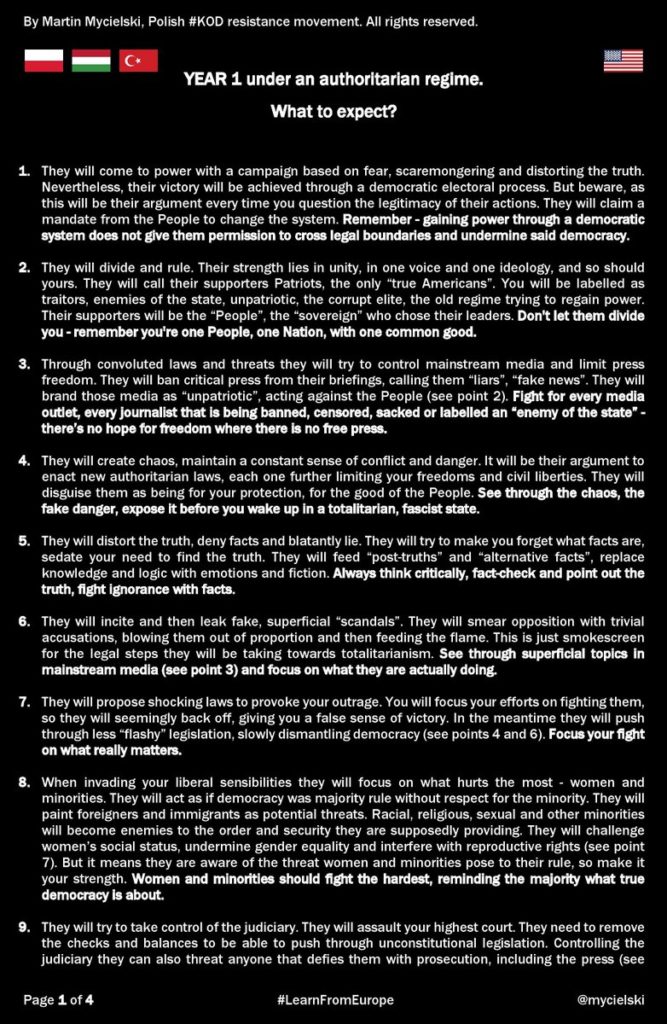
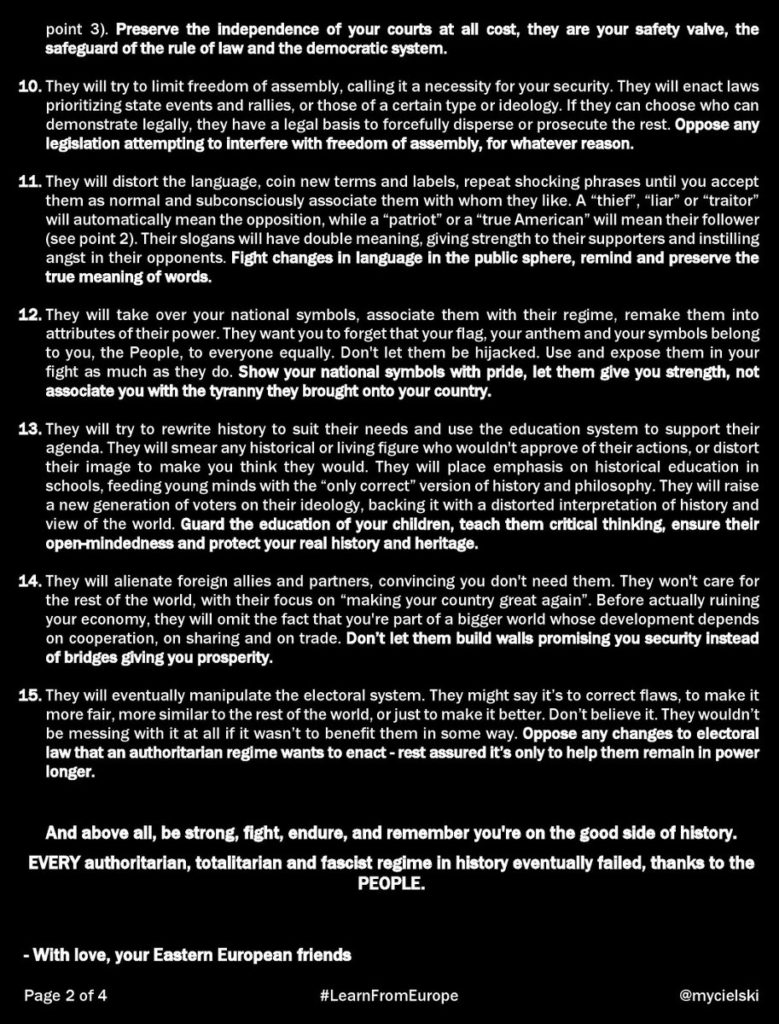

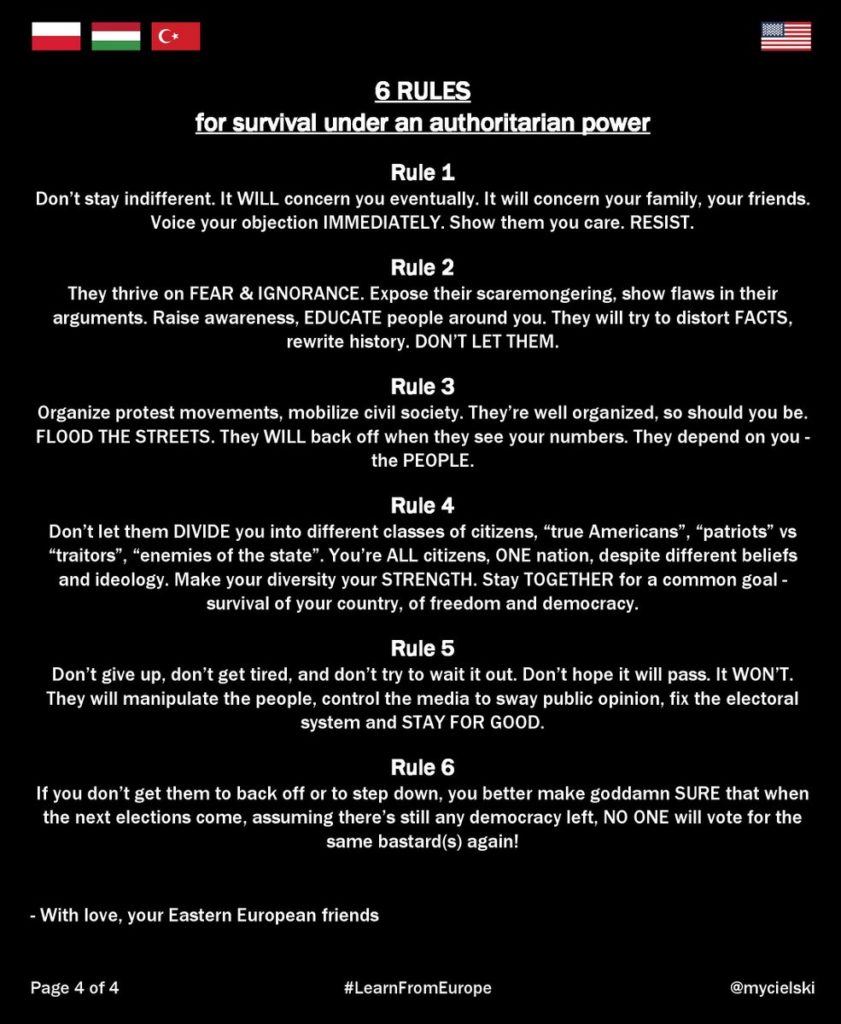
Daily Bread
Daily Bread for 12.12.17
by JOHN ADAMS •
Good morning.
Tuesday in Whitewater will be sunny with a high of twenty-two. Sunrise is 7:17 AM and sunset is 4:21 PM, for 9h 04m 07s of daytime. The moon is a waning crescent with 27% of its visible disk illuminated. Today is the {tooltip}three hundred ninety-eighth day.{end-texte}Days since Trump’s election, with 11.9.16 as the first day.{end-tooltip}
On this day in 1925, the first motel in the world, the Motel Inn (originally known as the Milestone Mo-Tel) opens in San Luis Obispo, California.
Recommended for reading in full —
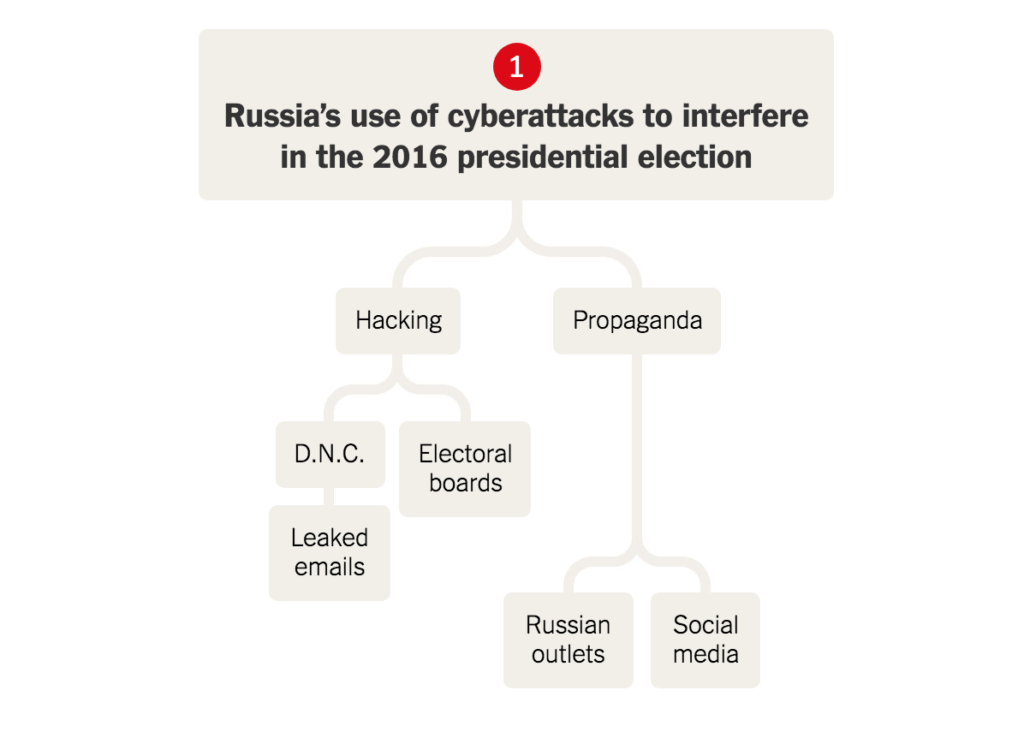
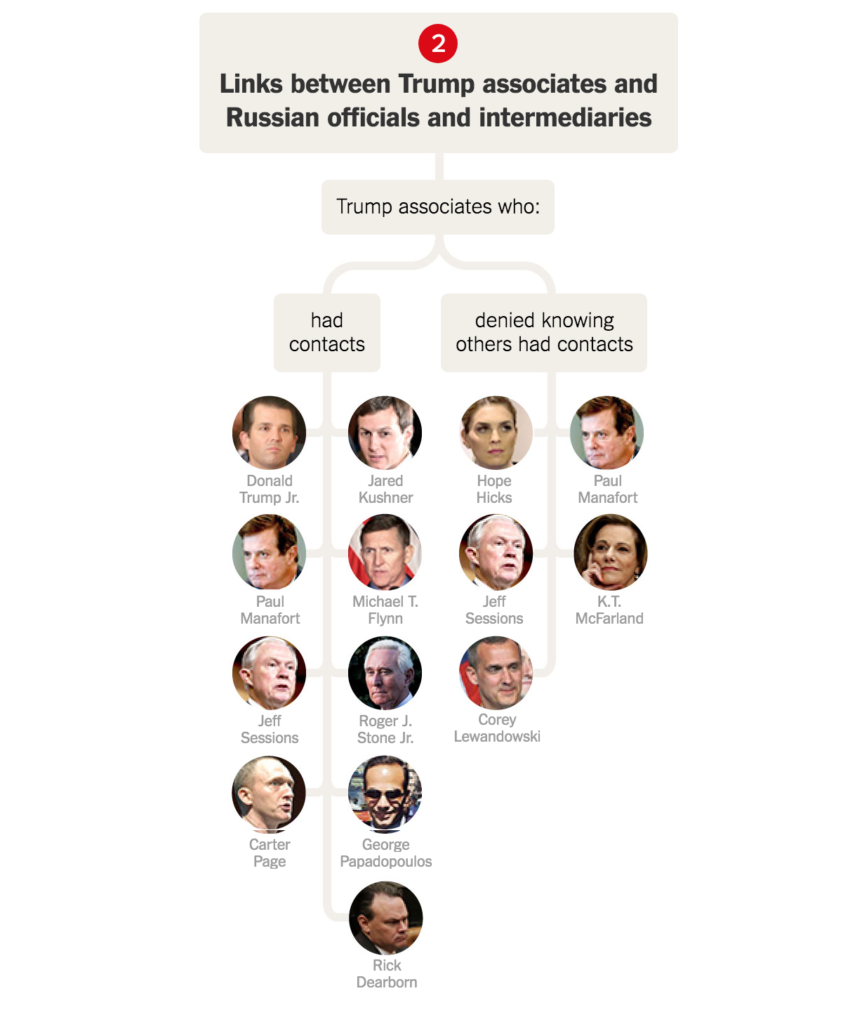
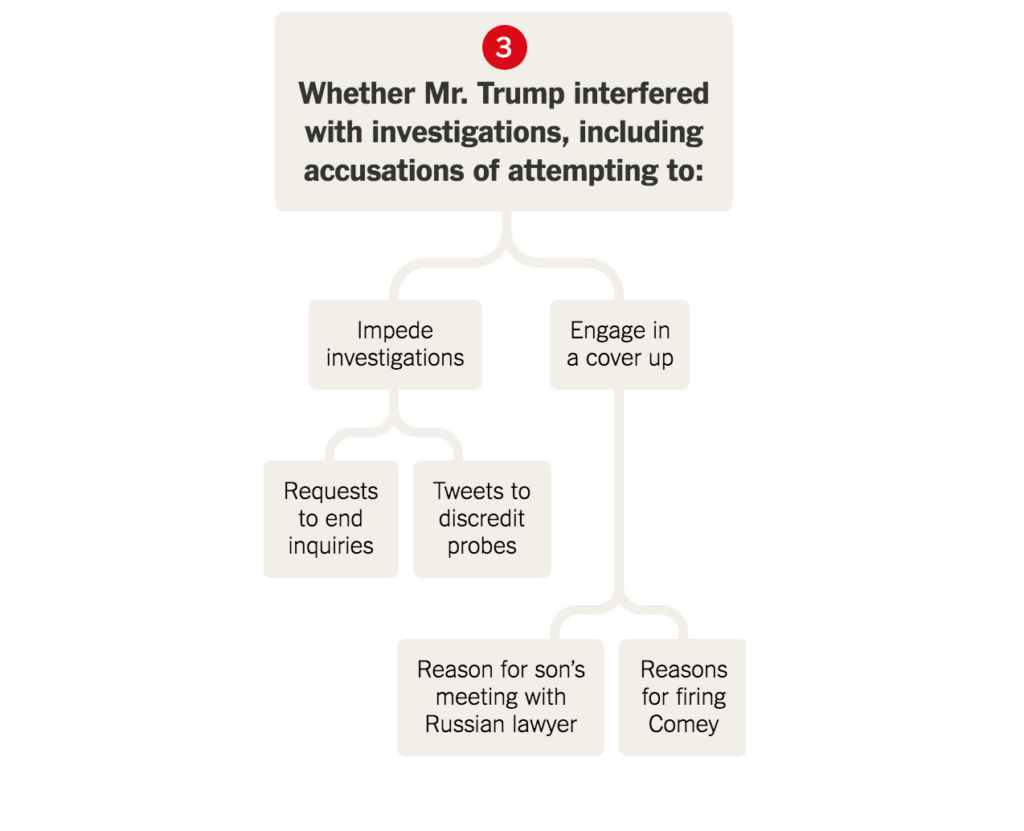
Karen Yourish asks Confused by all the news about Russia and the 2016 presidential election? We are here to help [illustrations include additional detail in text]:
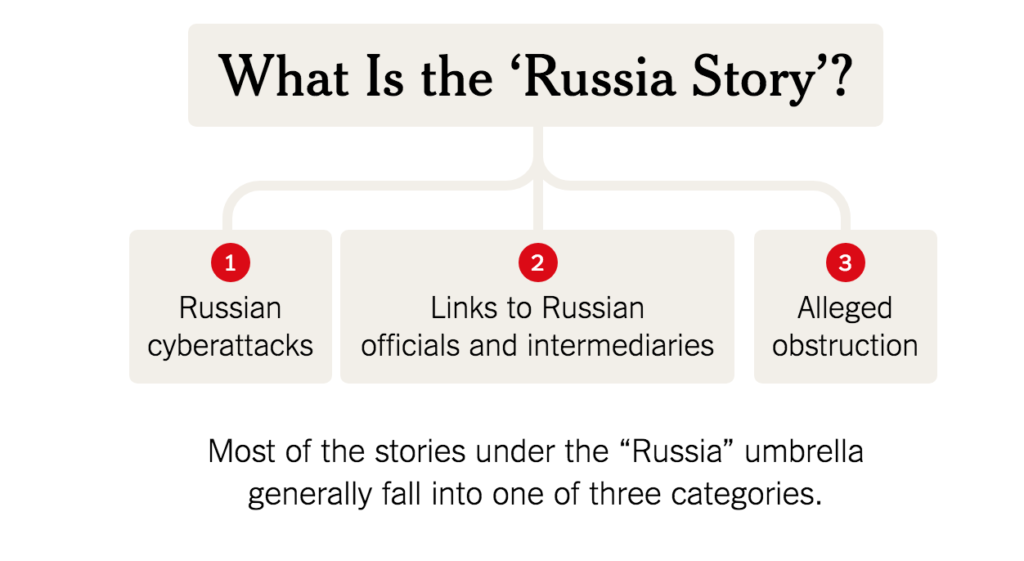
Jennifer Rubin writes Even without Roy Moore, the GOP is in a downward spiral:
The GOP has a bunch of problems, including these: Its signature bill is a dud, it is shedding voters and it is led by someone who, in the midst of a cultural revolution regarding sexual assault, is widely believed to be a serial sexual predator.
“A new USA TODAY/Suffolk University Poll finds just 32% support the GOP tax plan; 48% oppose it. That’s the lowest level of public support for any major piece of legislation enacted in the past three decades, including the Affordable Care Act …
Americans are skeptical of the fundamental arguments Republicans have made in selling the bill: A 53% majority of those surveyed predict their own families won’t pay lower taxes as a result of the measure, and an equal 53% say it won’t help the economy in a major way. … Overall, only 35% believe that the bill will boost the economy, and 31% that their own families’ tax bills will be lowered as a result. Nearly two-thirds, 64%, say the wealthy will get the most benefits; just 17% say the middle-class will.
Republicans, however, remain enthusiastic about the bill, supporting it by a wide margin, 71 percent to 12 percent.”
The poll also shows that while sentiment about the economy is very positive (56 percent), voters’ opinion of President Trump continues to deteriorate. (“Trump now has a favorable-unfavorable rating of 34%-58%, a net negative of 24 percentage points. His standing has worsened through the year, from a net negative of just 2 points in March and 15 points in June.”) The Republican Party as a whole has a dreadful favorable-unfavorable rating of 24 percent/61 percent; almost as bad as Congress overall (17 percent favorable to 64 percent unfavorable). Democrats do somewhat better (36 percent to 47 percent)….
Lena H. Sun and Alice Crites report New CDC head faces questions about financial conflicts of interest:
ATLANTA — After five months in office, President Trump’s new director of the Centers for Disease Control and Prevention has been unable to divest financial holdings that pose potential conflicts of interest, hindering her ability to fully perform her job.
Brenda Fitzgerald, 71, who served as the Georgia public health commissioner until her appointment to the CDC post in July, said she has divested from many stock holdings. But she and her husband are legally obligated to maintain other investments in cancer detection and health information technology, according to her ethics agreement, requiring Fitzgerald to pledge to avoid government business that might affect those interests. Fitzgerald provided The Post with a copy of her agreement.
Last week, Sen. Patty Murray (Wash.), the senior Democrat on the Senate committee that oversees CDC, wrote that Fitzgerald is raising questions about her ability to function effectively.
“I am concerned that you cannot perform the role of CDC director while being largely recused from matters pertaining to cancer and opioids, two of the most pervasive and urgent health challenges we face as a country,” Murray wrote….
Michael Gerson writes It’s America’s turn to ‘fight on the beaches’:
….From Churchill, we learn to resist pessimistic extrapolation. May 1940 was terrible, but not permanent. We learn the power of unreasonable optimism — the value of planning for revival in the midst of defeat. We see the possibility of leadership that can not only ride the tide but summon it.
Many of us view this example, not only with appreciation, but with longing. The problem of our time is not only arrogance without accomplishment or swagger without success. These are common enough in politics. Rather, it is the arrival of leadership that survives by feeding resentment, hatred and disorienting flux. Leadership urging us — at angry rallies, in ethnic stereotyping, through religious bigotry — to forget who we really are as a people. Leadership that has ceased to believe in the miracle at our country’s heart — the inclusive, unifying power of American ideals.
One needs a map when Searching for Copenhagen’s Hidden Giants:
City, Film
Film: Tuesday, December 12th, 12:30 PM @ Seniors in the Park: Almost Christmas
by JOHN ADAMS •

This Tuesday, December 12th at 12:30 PM, there will be a showing of Almost Christmas @ Seniors in the Park, in the Starin community building.
David E. Talbert directs the one hour, fifty-one minute film. During a family’s “first Christmas gathering since their mother passed away, Dad begs the family to suspend their differences and have a peaceful Christmas at home. Comedy, drama, laughs, and tears follow. A clever, fun, and inspirational Christmas tale, starring Danny Glover, Gladys Knight and Mo’Nique.”
The movie carries a PG-13 rating from the MPAA.
One can find more information about Almost Christmas at the Internet Movie Database.
Enjoy.
Music
Monday Music: Sleigh Ride
by JOHN ADAMS •
Daily Bread
Daily Bread for 12.11.17
by JOHN ADAMS •
Good morning.
Monday brings snow showers to Whitewater, with a high of thirty-five. Sunrise is 7:16 AM and sunset 4:20 PM, for 9h 04m 44s of daytime. The moon is a waning crescent with 36.6% of its visible disk illuminated. Today is the {tooltip}three hundred ninety-seventh day.{end-texte}Days since Trump’s election, with 11.9.16 as the first day.{end-tooltip}
Updated: The Whitewater Unified School Board is scheduled to meet at 6 P.M. Whitewater’s Planning Commission is scheduled to meet today at 6:30 P.M.
On this day in 1946, the United Nations establishes UNICEF, the United Nations Children’s Fund. On this day in 1901, the Morris Pratt Institute is incorporated: ” Morris Pratt gained incorporation for his school of spiritualism located in Whitewater, Wisconsin. Many people of this time embraced spiritualism to try to reach friends and family who had died in the Civil War. As a result, Whitewater became known as the “mecca of modern spiritualism.” Pratt built his institute in 1888, which was initially used as a meeting place for public seances. Pratt decided to turn his institution into an educational school for spiritualists, focusing on science, literature, morality, and communication, as well as spiritualistic instruction. The institute was closed for a few years during the Depression, and then in 1977 relocated to Waukesha…”
Recommended for reading in full —
Andrew Kaczynski reports on statements from Roy Moore in 2011: Getting rid of amendments after 10th would ‘eliminate many problems’:
Alabama Republican Senate nominee Roy Moore appeared on a conspiracy-driven radio show twice in 2011, where he told the hosts in an interview that getting rid of constitutional amendments after the Tenth Amendment would ‘eliminate many problems’ in the way the US government is structured….
In Moore’s June appearance, one of the hosts says he would like to see an amendment that would void all the amendments after the Tenth.
“That would eliminate many problems,” Moore replied. “You know people don’t understand how some of these amendments have completely tried to wreck the form of government that our forefathers intended.”
Moore cited the 17th Amendment, which calls for the direct election of senators by voters rather than state legislatures, as one he particularly found troublesome.
The host agreed with Moore, before turning his attention to the 14th Amendment, which was passed during the Reconstruction period following the Civil War and guaranteed citizenship and equal rights and protection to former slaves and has been used in landmark Supreme Court cases such as Brown v. Board of Education and Obergefell v. Hodges.
“People also don’t understand, and being from the South I bet you get it, the 14th Amendment was only approved at the point of the gun,” the host said.
“Yeah, it had very serious problems with its approval by the states,” Moore replied. “The danger in the 14th Amendment, which was to restrict, it has been a restriction on the states using the first Ten Amendments by and through the 14th Amendment. To restrict the states from doing something that the federal government was restricted from doing and allowing the federal government to do something which the first Ten Amendments prevented them from doing. If you understand the incorporation doctrine used by the courts and what it meant. You’d understand what I’m talking about.”
…Besides the 14th and 17th Amendments, amendments adopted after the Bill of Rights include the 13th Amendment, which abolished slavery, the 15th Amendment which prohibited the federal and state governments from denying citizens the right to vote based on that person’s “race, color, or previous condition of servitude,” and the 19th Amendment, which extended the right to vote to women….
Bella DePaulo writes I study liars. I’ve never seen one like President Trump:
I spent the first two decades of my career as a social scientist studying liars and their lies. I thought I had developed a sense of what to expect from them. Then along came President Trump. His lies are both more frequent and more malicious than ordinary people’s.
In research beginning in the mid-1990s, when I was a professor at the University of Virginia, my colleagues and I asked 77 college students and 70 people from the nearby community to keep diaries of all the lies they told every day for a week. They handed them in to us with no names attached. We calculated participants’ rates of lying and categorized each lie as either self-serving (told to advantage the liar or protect the liar from embarrassment, blame or other undesired outcomes) or kind (told to advantage, flatter or protect someone else)….
The sheer frequency of Trump’s lies appears to be having an effect, and it may not be the one he is going for. A Politico/Morning Consult poll from late October showed that only 35 percent of voters believed that Trump was honest, while 51 percent said he was not honest. (The others said they didn’t know or had no opinion.) Results of a Quinnipiac University poll from November were similar: Thirty-seven percent of voters thought Trump was honest, compared with 58 percent who thought he was not.
For fewer than 40 percent of American voters to see the president as honest is truly remarkable. Most humans, most of the time, believe other people. That’s our default setting. Usually, we need a reason to disbelieve….
Rebecca Ruiz explains Why Russia Tried to Cheat Its Way to Glory:
Russia’s two subversions, of global sports and American democracy, have more in common than you may think. Both involve intelligence agents, Russia’s will to win and the same cyberespionage team. Both have prompted millions of dollars of investigations and challenged public confidence — in the purity of sport and in the strength of democracy.
The two breaches are at the heart of how President Vladimir Putin has suggested he wants to reclaim Russia’s past: by weakening Western democracy and dominating world sports….
(See also Report Shows Vast Reach of Russian Doping: 1,000 Athletes, 30 Sports.)
Matthew DeFour reports Foxconn won $3 billion tax credit battle, but the public relations campaign continues:
….Foxconn’s public relations effort is being overseen by Platform Communications, a company owned by Walker campaign political adviser Keith Gilkes. A Platform spokeswoman declined to discuss the group’s communications strategy.
Foxconn provided a statement saying over the coming weeks and months, it will continue to engage with business leaders and the public as the company builds its campus in Racine County and grows an “extensive Wisconsin-based supply chain that will support this facility.”
Polls from Marquette Law School and Democratic-leaning Public Policy Polling suggested the deal isn’t wildly popular. The Marquette Poll was limited to southeastern Wisconsin but found 38 percent saying it was worth the $3 billion state investment and 48 percent saying it wasn’t. The PPP poll found statewide 41 percent opposed the Foxconn deal, 34 percent supported it and 26 percent weren’t sure….
These Robots Could Be Coming To An Airport Near You:
Daily Bread
Daily Bread for 12.10.17
by JOHN ADAMS •
Good morning.
Sunday in Whitewater will be partly cloudy with a high of thirty-four. Sunrise is 7:15 AM and sunset 4:20 PM, for 9h 05m 27s of daytime. The moon is a waning crescent with 47% of its visible disk illuminated. Today is the {tooltip}three hundred ninety-sixth day.{end-texte}Days since Trump’s election, with 11.9.16 as the first day.{end-tooltip}
On this day in 1864, Dr. Martin Luther King Jr. accepts the Nobel Peace Prize is Oslo, Norway. On this day in 1864, the 3rd Wisconsin Infantry reaches Savannah, Georgia: “The Wisconsin 3rd Infantry arrived at the front lines for the Battle of Savannah, Georgia. After marching from Atlanta under General William T. Sherman, Wisconsin troops assembled outside the coastal city of Savannah and laid siege to it.”
Recommended for reading in full —
Conservative Christian Peter Wehner writes Why I Can No Longer Call Myself an Evangelical Republican:
Just the other day I received a note from a friend of mine, a pastor, who told me he no longer uses the label “evangelical” to describe himself, even though he meets every element of its historical definition, “because the term is now so stained as to ruin my ability to be what evangelicalism was supposed to be.”
Another pastor who is a lifelong friend told me, “Evangelical is no longer a word we can use.” The reason, he explained, is that it’s become not a religious identification so much as a political one. A third person, who heads a Christian organization, told me the term evangelical “is now a tribal rather than a creedal description.” In October, the Princeton Evangelical Fellowship, a campus ministry for more than 80 years, changed its name to the Princeton Christian Fellowship. “We’re interested in being people who are defined by our faith and by our faith commitments and not by any sort of political agenda,” according to Bill Boyce, who has led the campus group for decades.
There are of course a great many honorable individuals in the Republican Party and the evangelical movement. Those who hold different views than I do lead exemplary lives. Yet I cannot help believing that the events of the past few years — and the past few weeks — have shown us that the Republican Party and the evangelical movement (or large parts of them, at least), have become what I once would have thought of as liberal caricatures….
In the latest example of this, a rising number of Republicans are attempting to delegitimize the special counsel’s investigation into whether there were links between Mr. Trump’s presidential campaign and Mr. Putin’s Russia because they quake at what he may find. Prominent evangelical leaders, rather than challenging the president to become a man of integrity, have become courtiers. What’s happening with Mr. Moore in Alabama — with the president, the Republican National Committee, the state party and many white evangelicals rallying around him — is a bridge too far for many of us. Where exactly is the bottom? And at what point do you pull back from associating yourself with a political party and a religious term you once took pride in but that are now doing harm to the things you treasure?
Institutional renewal and regeneration are possible, and I’m going to continue to push for them. But for now a solid majority of Republicans and self-described evangelicals are firmly aboard the Trump train, which is doing its utmost to give a seat of privilege to Mr. Moore. So for those of us who still think of ourselves as conservative and Christian, it’s enough already.
(Better for Wehner to preserve his fundamental religious and political principles than debase himself within Trumpism’s autocratic and perverse ideology.)
Rebecca Ruiz writes Report Shows Vast Reach of Russian Doping: 1,000 Athletes, 30 Sports:
LONDON — International sports’ antidoping watchdog on Friday laid out mountainous evidence that for years Russian officials orchestrated a doping program at the Olympics and other competitions that involved or benefited 1,000 athletes in 30 sports. The findings intensified pressure on the International Olympic Committee to reassess Russia’s medals from the 2014 Winter Olympics in Sochi and penalize the nation ahead of the 2018 Winter Games.
The evidence, published by the World Anti-Doping Agency, was the coda to a set of investigations led by the Canadian lawyer Richard McLaren, who issued a damning report in July that prompted more than 100 Russian athletes to be barred from the 2016 Summer Olympics in Rio de Janeiro.
The follow-up report outlined competitions that had been tainted by years of extraordinary preparations, ensuring Russia’s dominance at the 2012 Summer Olympics in London, the 2013 track and field world championships in Moscow and the 2014 Winter Olympics in Sochi — the “apex” of Russia’s cheating, the report said, because as the host of the event it controlled drug testing.
The subterfuge included using table salt and Nescafé instant–coffee granules to help conceal tainted urine and bypass controls, according to the inquiry. Some samples were clearly fraudulent: Urine provided by two female hockey players at the Sochi Games contained male DNA.
Yet Mr. McLaren suggested that the full extent of the cheating might never be known.
“It is impossible to know just how deep and how far back this conspiracy goes,” he said on Friday, calling the “immutable facts” of his report clear but far from comprehensive. “For years, international sports competitions have unknowingly been hijacked by the Russians”….
(Putin’s Russia, like the former Soviet Union, is a state of lies and corruption.)
Agence France-Press reports on Putin’s cult of personality:
“He is a super president and a super leader” – New “SuperPutin” exhibition opens in Moscow with the Russian leader portrayed in various heroic roles; from riding a bear to firing missiles in the colours of the Russian flag pic.twitter.com/LxQ9WZOxfD
— AFP news agency (@AFP) December 10, 2017
(Even – and especially – in the face of international censure, the Russian state – and these displays would not happen without the approval of the Russian state – bolsters its dictator. To critics of Putin, of course, this will all seem like parody, both inside and outside Russia.)
The New York Times reports from Inside Trump’s Hour-By-Hour Battle for Self-Preservation:
Before taking office, Mr. Trump told top aides to think of each presidential day as an episode in a television show in which he vanquishes rivals. People close to him estimate that Mr. Trump spends at least four hours a day, and sometimes as much as twice that, in front of a television, sometimes with the volume muted, marinating in the no-holds-barred wars of cable news and eager to fire back….
Mr. Kelly is trying, quietly and respectfully, to reduce the amount of free time the president has for fiery tweets by accelerating the start of his workday. Mr. Priebus also tried, with only modest success, to encourage Mr. Trump to arrive by 9 or 9:30 a.m….
(He may be the most powerful – but at least there is the advantage – that Trump is the laziest nativist in all America. Our situation would be far worse if he put in a full day’s work.)
NASA believes that the 2017 Geminids Will Be Dazzling:
Daily Bread
Daily Bread for 12.9.17
by JOHN ADAMS •
Good morning, Whitewater.
Saturday in town will be partly cloudy with a high of thirty-one. Sunrise is 7:14 AM and sunset 4:20 PM, for 9h 06m 13s of daytime. The moon is a waning gibbous with 56.9% of its visible disk illuminated. Today is the {tooltip}three hundred ninety-fifth day.{end-texte}Days since Trump’s election, with 11.9.16 as the first day.{end-tooltip}
On this day in 1844, Milwaukee’s first daily newspaper, The Daily Sentinel, begins publication. On this day in 1861, Wisconsin’s first heavy artillery troops muster in: “The 1st Wisconsin Heavy Artillery, Battery A mustered in on this day in 1861. It remained Wisconsin’s only heavy artillery battery until 1863. Its entire service was spent in Washington, D.C., defending against Confederate attacks on the capital.”
Recommended for reading in full —
Adam Goldman and Matt Apuzzo report F.B.I. Warned Hope Hicks About Emails From Russian Operatives:
WASHINGTON — F.B.I. officials warned one of President Trump’s top advisers, Hope Hicks, earlier this year about repeated attempts by Russian operatives to make contact with her during the presidential transition, according to people familiar with the events.
The Russian outreach efforts show that, even after American intelligence agencies publicly accused Moscow of trying to influence the outcome of last year’s presidential election, Russian operatives were undaunted in their efforts to establish contacts with Mr. Trump’s advisers.
There is no evidence that Ms. Hicks did anything improper. According to former officials, American intelligence and law enforcement agencies became alarmed by introductory emails that Ms. Hicks received from Russian government addresses in the weeks after Mr. Trump’s election.
After he took office, senior F.B.I. counterintelligence agents met with Ms. Hicks in the White House Situation Room at least twice, gave her the names of the Russians who had contacted her, and said that they were not who they claimed to be. The F.B.I. was concerned that the emails to Ms. Hicks may have been part of a Russian intelligence operation, and they urged Ms. Hicks to be cautious….
(The news is significant, among other reasons, because the meeting prevents Hicks from responding – truthfully – to Special Counsel Mueller’s team that she was unaware of the extent of Russian outreach efforts.)
Russell Berman has The 2018 Congressional Retirement Tracker:
If you want to see a political wave forming a year before an election, watch the retirements.
They’re often a leading indicator for which direction a party is headed, and so far, 2018 is shaping up ominously for Republicans. In the last few months, two GOP senators, Bob Corker of Tennessee and Jeff Flake of Arizona, and four Republican committee chairmen in the House have announced they won’t seek reelection next year. Several other veterans in competitive districts are also calling it quits, depriving the GOP of the advantage of incumbency in races that could determine control of the House in 2019. And more retirements are probably on the way between now and the end of the year, when lawmakers head home to discuss future plans with their families.
At the same time, a wave of allegations of sexual harassment and other inappropriate behavior has scrambled the retirement picture in both parties in recent weeks, and it’s forced several lawmakers to leave Congress early. Scandals have already taken down Democratic Senator Al Franken and long-serving Representative John Conyers among Democrats, as well as GOP Representatives Trent Franks and Tim Murphy. More could be on the way as new allegations come to light.
As for those getting out in 2018, President Trump’s low approval rating and Congress’s meager legislative output may be contributing to the decisions of some Republicans to retire, including moderate Representatives Ileana Ros-Lehtinen of Florida, Charlie Dent of Pennsylvania, Frank LoBiondo of New Jersey, and Dave Reichert of Washington state. But there are other factors at play. Unlike Democrats, Republicans have rules limiting the terms of their committee chairmen to ensure turnover and give younger members a chance to advance in the House. Congress isn’t as fun with less power, and all four of the retiring GOP committee leaders would be forced out of their roles and to the back bench in 2019….
Ariel Bogle asks Has the Google of South Korea Found a Way to Save Struggling News Outlets?:
Walk into the headquarters of South Korea’s biggest search engine, Naver, and you could be in Silicon Valley. Like Google and Facebook, the company has an affection for bean bags and primary colors. There are oversized toys in the shape of emoji from Naver’s messaging app, Line. A green wall is lined with ferns, and there’s an immaculately designed library.
Also like Google and Facebook, Naver has a tense relationship with journalists. Though the company produces no journalism itself, Naver’s desktop and mobile news portal is South Korea’s most popular news site. (The second is another local portal, Daum.) Naver hosts stories by various outlets, somewhat similar to news-aggregation apps like Apple News. In a country where around 83 percent of the population accesses news online, the company has outsize control over what Koreans read and see….
This hold that internet companies now have over digital advertising has left news outlets around the world in search of a sustainable business model. Some are doubling down on subscriptions; others rely on philanthropy. But Naver has an unusual model for working with Korean news publishers: The company directly pays 124 outlets as “Naver News in-link partners.” The outlets’ stories are published on Naver’s portal, making the site a one-stop source of articles and video and eliminating the need for readers to leave and visit the original news site. All the better for Naver’s own shopping platform and its own ads. (Another 500 or so news outlets are unpaid “search partners.” The site links to the publishers’ articles, much like Google News.) The total payout comes to more than $40 million per year.
For “in-link partners,” Naver’s model offers an alternative to relying on traffic from an aggregator like Google News, or schemes like Facebook’s Instant Articles that aim to share ad revenue. The partners have a negotiable relationship with the company that wants their work—a company that needs new content for readers each time they log on. Whether Naver’s compensation to publishers is sufficient, however, remains controversial. And like some of its fellow technology giants overseas, Naver’s news practices are under increasing scrutiny….
Barbara McQuade contends After Michael Flynn, Robert Mueller’s Next Targets Are in This Document:
The Statement of the Offense makes it clear that when Flynn spoke to Russia, he was not acting on his own as some rogue player. The Statement of Offense sets out a timeline indicating that Flynn’s conversations with Russian ambassador Sergey Kislyak were being discussed in real time with a “senior member of President-elect Trump’s Transition Team” and a “very senior member of the Presidential Transition Team.” The document notes that the “senior member” was with other transition officials at the Mar-A-Lago resort in Florida, where President-elect Trump was staying at the time. Some reports indicate that the “senior member” is Flynn’s former deputy K.T. McFarland and the “very senior member” is Trump’s son-in-law Jared Kushner.
Regardless, Flynn knows who they are and is prepared to testify about them, according to the plea agreement. This disclosure sheds new light on the reports that Kushner sought a back channel for communication with Russia during the transition. Flynn likely can confirm or refute this report and explain why any back channel for communicating with Russia might have been sought. (Kushner denied it was a “secret back channel” and said communications were to be about Syria)….
The Statement of Offense is not a document that Mueller is required to file. Why, then, did he file it? In part, no doubt, he wants to lock Flynn into what he will testify to if necessary at any trial. But if locking in Flynn’s statement was Mueller’s goal, he could do that by having Flynn testify under oath and in private before the grand jury. So why make it public? The “senior member” and “very senior member” of the transition team mentioned in the documents know who they are. Including this language in a public document sends a message to them that if they want to cooperate, now is the time, and perhaps, they, too, can get a good deal….
Trey Griffith is Stacking His Way to the Top:
When Trey Griffith found his first set of stacking cups, his life was changed forever. He began training himself to rack and stack cups at lightning speed, competing in tournaments around the globe. Trey’s father eventually took up stacking himself as an opportunity to bond and compete alongside his son. Today, at age 14, Trey is already the fastest stacker in the state of Texas. Now, he’s ready to take on the world.
Daily Bread
Daily Bread for 12.8.17
by JOHN ADAMS •
Good afternoon.
Friday in Whitewater will see a probability of evening snow showers, and an evening low of twenty-two. Sunrise is 7:13 AM and 4:20 PM, for 9h 07m 03s of daytime. The moon is a waning gibbous with 65.2% of its visible disk illuminated. Today is the {tooltip}three hundred ninety-fourth day.{end-texte}Days since Trump’s election, with 11.9.16 as the first day.{end-tooltip}
On this day in 1941, Congress declares war on Imperial Japan. On this day in 1864, the Wisconsin 2nd Cavalry is assigned to scout Memphis, Tennessee.
Recommended for reading in full —
The Poynter Institute releases a new study examining trust in the media:
The Poynter Institute released original public opinion research today that indicates overall trust and confidence in the media has increased since President Trump took office to the highest levels observed since the 2001 terrorist attacks, though the president’s war of words on the press appear to have exacerbated partisan divisions in attitudes toward the press.
Based on responses from 2,100 survey participants whose news consumption habits were tracked in November, Republicans have vastly more negative views of the press than do Democrats, and are more likely to support restrictions on press freedom. While Democrats with high political knowledge say they have the most faith in the press, Republicans with high political knowledge are the most distrustful of the media — more so than Republicans with low political knowledge.
Republicans and Trump supporters are also far more likely to endorse extreme claims about media fabrication, to describe journalists as an “enemy of the people,” and to support restrictions on press freedom….
Max Fisher, Eric Schmitt, Audrey Carlsen, and Malachy Browne ask Did American Missile Defense Fail in Saudi Arabia?:
The official story was clear: Saudi forces shot down a ballistic missile fired by Yemen’s Houthi rebel group last month at Saudi Arabia’s capital, Riyadh. It was a victory for the Saudis and for the United States, which supplied the Patriot missile defense system.
“Our system knocked the missile out of the air,” President Trump said the next day from Air Force One en route to Japan, one of the 14 countries that use the system. “That’s how good we are. Nobody makes what we make, and now we’re selling it all over the world.”
But an analysis of photos and videos of the strike posted to social media suggests that story may be wrong.
Instead, evidence analyzed by a research team of missile experts appears to show the missile’s warhead flew unimpeded over Saudi defenses and nearly hit its target, Riyadh’s airport. The warhead detonated so close to the domestic terminal that customers jumped out of their seats….
Rosalind S. Helderman and Tom Hamburger report Email pointed Trump campaign to WikiLeaks documents that were already public:
A 2016 email sent to candidate Donald Trump and top aides pointed the campaign to hacked documents from the Democratic National Committee that had already been made public by the group WikiLeaks a day earlier.
The email — sent the afternoon of Sept. 14, 2016 — noted that “Wikileaks has uploaded another (huge 678 mb) archive of files from the DNC” and included a link and a “decryption key,” according to a copy obtained by The Washington Post.
The writer, who said his name was Michael J. Erickson and described himself as the president of an aviation management company, sent the message to the then-Republican nominee as well as his eldest son, Donald Trump Jr., and other top advisers.
The day before, WikiLeaks had tweeted links to what the group said was 678.4 megabytes of DNC documents.
The full email — which was first described to CNN as being sent on Sept. 4, 10 days earlier — indicates that the writer may have simply been flagging information that was already widely available. CNN later corrected its story to note the email had been sent Sept. 14.
The message also noted that information from former secretary of state Colin Powell’s inbox was available “on DCLeaks.com.” That development, too, had been publicly reported earlier that day….
Frances Robles, Kenan Davis, Sheri Fink, and Sarah Almukhtar report Official Toll in Puerto Rico: 62. Actual Deaths May Be 1,052:
A review by The New York Times of daily mortality data from Puerto Rico’s vital statistics bureau indicates a significantly higher death toll after the hurricane than the government there has acknowledged.
The Times’s analysis found that in the 42 days after Hurricane Maria made landfall on Sept. 20 as a Category 4 storm, 1,052 more people than usual died across the island. The analysis compared the number of deaths for each day in 2017 with the average of the number of deaths for the same days in 2015 and 2016.
Officially, just 62 people died as a result of the storm that ravaged the island with nearly 150-mile-an-hour winds, cutting off power to 3.4 million Puerto Ricans. The last four fatalities were added to the death toll on Dec. 2.
“Before the hurricane, I had an average of 82 deaths daily. That changes from Sept. 20 to 30th. Now I have an average of 118 deaths daily,” Wanda Llovet, the director of the Demographic Registry in Puerto Rico, said in a mid-November interview. Since then, she said on Thursday, both figures have increased by one….
Here’s How NASA, SpaceX, and Blue Origin’s Monster Rockets Compare:
Babbittry, Culture, Development, Economy, Janesville, Local Government, Newspapers, Poverty, Press
‘Don’t worry about them – the rest of us feel great!‘
by JOHN ADAMS •
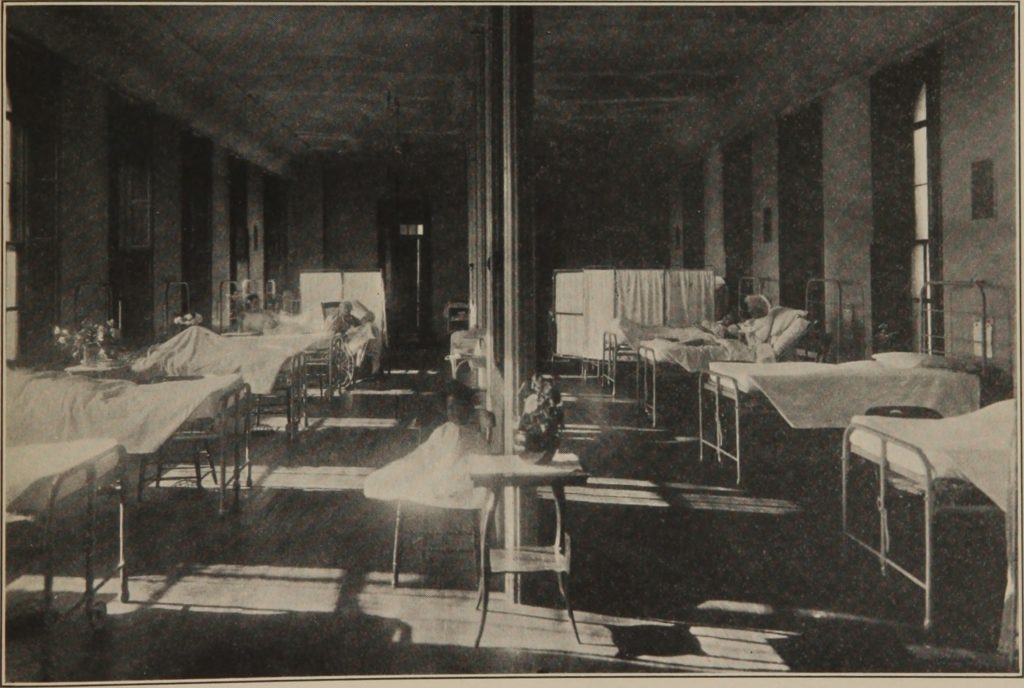
A doctor walks into a town of one-hundred people, and finds that half of them are pale, feverish, and vomiting blood. The physician calls out to a community leader, “Send for help, you have an epidemic on your hands.” The community leader replies, “Oh no, don’t worry about them – the rest of us feel great!”
There one sees the self-regard and self-promotion of some, while ignoring the condition of others.
Over at the Janesville Gazette, that paper’s editorialist feebly tries to divert attention from the fundamental problems of his community, as the Milwaukee Journal Sentinel reports them (and as cited at FW on Tuesday. See Contrast). First a portion of Rock County’s many struggles, then highlights from the Janesville editorialist’s reply —
Reporting from the Journal Sentinel (‘Wisconsin childhood trauma data explodes myth of ‘not in my small town’):
Of Wisconsin’s 72 counties, Rock County falls into the highest tier of overdose deaths, hospitalizations and emergency room visits linked to opioids and heroin, as ranked by state health authorities….
Once solidly middle-class Rock County today harbors the state’s highest scores for childhood trauma, the deepest plunge in income since the turn of the century, and one of the most extreme drug epidemics.
Of the state’s 72 counties, Rock County is home to the fourth-highest share of single-parent households (17.6%) behind Menominee, Milwaukee and Kenosha counties (28%, 23% and 18.4%, respectively). In the last 20 years, households in the county accepting FoodShare entitlements rose 310%. In the last 15 years, childhood poverty surged 150%, the second fastest increase in the state. The rate at which babies in the county are born with opioids, heroin or other addictive drugs in their bodies more than tripled from 2013 to 2016.
“Soon, we’ll have a whole generation of grade school kids who all have in common a parent who overdosed and died of heroin,” said Janesville police officer Justin Stubbendick. “It breaks my heart to think”….
Editorial reply from the Gazette (‘Our Views: Outsiders get the region’s story wrong again‘):
….This is the sort of one-dimensional portrayal of the region we’ve come to expect from outsiders (Mother Jones magazine did the same thing in 2009). It’s a cliché to characterize Janesville in a downward spiral since the closing of the GM plant nearly a decade ago. It’s a cliché, too, to dismiss the expansions of other manufacturers, the region’s surging tax base and downtown Janesville revitalization efforts.
To be sure, this region has many challenges—heroin being one of them—but these gloomy narratives emerge only by their authors ignoring positive developments….
W.W. Grainger on Janesville’s east side has hired hundreds of employees over the past two years and recently began in-house leadership training programs to help employees advance in the company.
Dollar General’s distribution warehouse has hired hundreds of workers, and while it doesn’t pay GM union levels, workers average $16 to $17 an hour to start, according to company hiring fliers.
Plastics company GOEX is in the process of expanding its warehousing and clean room facilities on the city’s north side to meet booming demand in markets it serves.
In southern Rock County, Pratt Industries opened a $52 million box plant this year.
Meanwhile, the state Department of Transportation remains committed to the Interstate 90/39 expansion project, even as the agency has shelved other Interstate projects (including in the Journal Sentinel’s own backyard). Officials have made I-90/39 a top priority because they recognize the corridor’s and this region’s economic importance….
We refuse to allow pockets of instability to define us. The Journal Sentinel piece is a reminder that we as a community must take responsibility for telling our own story, especially if outsiders seem bent on casting this region as a failure.
1. Outsiders! Many have written serious critiques of Janesville, including Pulitzer winner Amy Goldstein, but they’re mere outsiders to the editorialist. (At least he refrained from calling them rootless cosmopolitans.) These many and solid critiques are all from Americans: established, serious, thoughtful, relying on actual conditions of thousands of local residents.
So provincial is the Gazette that Milwaukee – part of the same state, not far at all from Janesville, is somehow a distant land. There’s wagon-circling, and then there’s this: a small-minded, xenophobic rejection of anything outside the county.
2. Parachuting! Easier said than being able to refute a single statistic JS reporter John Schmid offers. Truly, the Gazette‘s editorialist doesn’t refute any of the statsitics about Rock County’s troubled state – instead, he implores readers to look at the positive.
The supposedly positive (as the editorialist sees it) has not, and will not, compensate those who are now suffering for their actual hardships.
What does it profit a family to gain an interstate if it shall endure childhood poverty? What does it profit a family to gain a nearby warehouse if they struggle with addiction?
These supposed achievements have not brought widespread community uplift. They’ve brought, instead, leaders’ self-serving entreaties to accentuate the positive. (“Look, we have a box plant! Over here, pay attention!”)
Developments that allow a large underclass to grown within a city serve to distract from actual suffering to the benefit of aged leaders’ vanity and pride.
3. Refuse…to define us. These aged self-promoters – whose public lives have witnessed only community decline – have no power to define. Their refusals mean nothing – they’re too weak, too dense, too selfish to persuade anyone except a small number of that same ilk.
These few are not, even now, writing the story of their community. It’s written by men and women more thoughtful, more persuasive, more principled.
In any event, the future will write the history of the present. It will be harsh with the anything like the editorialist’s outlook.
That will prove true in small & beautiful, yet struggling, Whitewater, the city from which one daily views the world beyond.
Daily Bread
Daily Bread for 12.7.17
by JOHN ADAMS •
Good morning.
Thursday in Whitewater will be increasingly sunny with a high of twenty-seven. Sunrise is 7:12 AM and sunset 4:20 PM, for 9h 07m 58s of daytime. The moon is a waning gibbous with 78.4% of its visible disk illuminated. Today is the {tooltip}three hundred ninety-third day.{end-texte}Days since Trump’s election, with 11.9.16 as the first day.{end-tooltip}
Whitewater’s Community Development Authority is scheduled to meet at 5:30 PM, and her Landmarks Commission at 6 PM.
Seventy-six years ago, the Imperial Japanese Navy Air Service attacks the United States naval base at Pearl Harbor. Wisconsinite Russ Warriner was among the survivors that day:
Russ Warriner, a 25-year-old first class seaman on the USS Arizona, miraculously survived the Japanese attack on Pearl Harbor. The explosions ripped apart the Arizona and killed nearly all his mates. At the time of the attack, Warriner was on the sky control platform, where his job was to spot enemy ships and planes. The bomb that struck the Arizona sliced through the steel deck and exploded into a fuel tank. Fire flared for seven seconds before it ignited 1.7 million pounds of explosives held in the ship’s magazine. More than 1,000 sailors died instantly, including many on the lookout platform with Warriner. Warriner lost his balance and fell onto the platform. His hands swept through fiery magnesium remaining from incendiary bombs and were nearly burned off. He was knocked off the ship, pulled aboard a small motor boat, and eventually made his way to shore. Warriner was treated at Great Lakes Naval Base in Illinois, where plastic surgeons were able to repair his hands. Warriner settled in Wisconsin, married and raised two children. In the late 90s, Warriner was a retired piano tuner living in Beloit Township.
Recommended for reading in full —
Josh Gerstein reports Russian oligarch Deripaska drops libel suit against Associated Press:
A Russian oligarch whose business dealings have come under scrutiny by investigators probing Russian influence in the 2016 presidential election has dropped a libel suit against The Associated Press.
Lawyers for aluminum magnate Oleg Deripaska, who worked closely with indicted former Trump campaign chairman Paul Manafort several years ago, joined with the news service Tuesday in a joint court filing dismissing appeals of a judge’s decision in October tossing out the defamation lawsuit.
Deripaska’s suit, filed in May, alleged that an AP story published two months earlier falsely implied that Deripaska was paying Manafort for work aimed at advancing the goals of the Russian government and Russian president Vladimir Putin….
U.S. District Court Judge Ellen Huvelle dismissed the lawsuit, finding that the Russian businessman was “a limited purpose public figure” under U.S. libel law. That determination meant Deripaska needed to plausibly assert that the AP knew its story was false at the time it published it, something the judge found the complaint in the case failed to lay out….
Avi Selk reports Chirps, hums and phantom noises — how bizarre events in Cuba changed embassy workers’ brains:
They would sometimes wake in the night to hear a disembodied chirping somewhere in the room, or a strange, low hum, or the sound of scraping metal.
Sometimes they felt a phantom flutter of air pass by as they listened. Others in the room would often not notice a thing, the Associated Press reported, and the noises would cease if the person moved just a few feet away.
And then, usually within 24 hours of these bizarre events, bad things happened to those who heard the noises.
What exactly two dozen Americans experienced at the U.S. Embassy in Cuba — in incidents last year and then again in August — remains a mystery to science and the FBI. They have alternately been blamed on a high-tech sonic weapon or a mysterious disease, and have caused a diplomatic crisis because U.S. officials blame Cuba for the attacks….
Jennifer Rubin contends The anti-Trump Republicans can cripple the GOP:
So nearly 20 percent have checked out of the Trump GOP and 23 percent are leaning that way, for a total of 41 percent. This, of course, does not account for the loss of many voters who won’t even identify as Republican because of the Trump phenomenon….
Well, we’ve got a long way to go, and the collapse of the Trump presidency, if it comes, might either shatter the party or help unify it around Vice President Pence (although his proximity to Michael Flynn, Jared Kusher and, of course, Trump might be disqualifying for lots of voters). In any case, Trump enablers may dominate the GOP, but the rest of the party may choose to cripple the Trump GOP by leaving for greener pastures. The more the GOP regulars and Trump sycophants rail against the Never Trump contingent, the more likely the latter is to leave. And if Democrats play their cards right, they might even win some of these voters over.
(Even small defections from Trumpism might tip some Congressional contests. Well worth encouraging.)
Maura Judkis writes Behold, the latest wait-in-line, Instagram-your-purchase status food: Cheese tea:
We’ve nearly made it through 2017, a year that gave us the unicorn frappuccino, pea milk, the gummy bear juice cleanse, pumpkin spice deodorant, and its greatest (worst) gift, microwaveable mug cakes for one.
But just when you thought we were out of the woods, along comes 2017’s final salvo: cheese tea.
[Blue wine is a thing because your Instagram doesn’t have taste buds]
You are thinking: Those are two words that do not go together. Cheese! In tea! But we’re not talking Humboldt Fog or Camembert here. The cheese used in cheese tea is usually a cream cheese — sometimes sweet, sometimes salty — combined with condensed milk. It forms a tall, frothy head at the top of the beverage, sort of like whipped cream in a frappuccino. The teas are often matcha, oolong, jasmine and black, and you can customize them with fruits and other flavor infusions. They’re kind of like bubble tea, which has made its way into mall food courts across America.
(I’ve not yet tried it, but will search for some.)
Incredible Footage of the Deepstaria Jellyfish:
Culture, Education, University
UW-Whitewater’s Org Chart, 2017 Verison
by JOHN ADAMS •
UW-Whitewater has a 2017 organization chart, one I’ve embedded at the end of this post.
1. Big for Small. It’s not a big institution, but it is a big institution for a small town like Whitewater. There’s no institutional or organizational hierarchy in Whitewater half so large.
2. The key issues aren’t structural. Without question, UW-Whitewater’s biggest leadership challenges aren’t organizational, they’re cultural. Some university leaders’ challenges, however, likely have come, and still come, from confusing a small-town university with The Very Center of the Known Universe. A deep org chart reinforces the idea of a big organization.
In truth, Whitewater’s a small city, and nothing in it is truly big. The sadness of some – and the ruin of others – has come from refusing to accept that small and simple can be beautiful.
Few would contend that a person of average size should eat to morbid obesity, in the theory that more pounds make a better person.
3. Titles. Title inflation, in particular, is a UW System-wide practice, borrowing from corporations where a single simple designation no longer seems enough. UW-Whitewater’s not exceptional in this regard – on the contrary, it’s simply following the herd.
4. Rock, McHenry, and Lake. A university that wants to recruit from more prosperous Illinois counties now has to manage a truly struggling Rock County population, with uncertainty over how many of those students will integrate with Whitewater’s campus.
One might contend that a large organizational structure will help UW-Whitewater scale more easily, but that will only prove true if the leaders within the organization can manage different populations, including one for which they’ve shown little interest until they were recently compelled to do so.
It’s a large task, and for a leadership that hasn’t come to terms with past cultural errors, it’s especially large.
Those of us who ordinarily might have hoped for an evolving university as source of uplift have reason to expect a much longer wait.
Daily Bread
Daily Bread for 12.6.17
by JOHN ADAMS •
Good morning.
Midweek in Whitewater will be mostly sunny with a high of thirty-two. Sunrise is 7:11 AM and sunset 4:20 PM, for 9h 08m 57s of daytime. The moon is a waning gibbous with 87.2% of its visible disk illuminated. Today is the {tooltip}three hundred ninety-second day.{end-texte}Days since Trump’s election, with 11.9.16 as the first day.{end-tooltip}
Whitewater’s Public Works Committee is scheduled to meet at 6 PM.
On this day in 1865, the Thirteenth Amendment is ratified by the required number of states. On this day in 1864, the 30th Wisconsin Infantry arrives in Louisville, Kentucky.
Recommended for reading in full —
Callum Borchers reports Time’s Person of the Year isn’t Trump. It’s basically the opposite of Trump:
President Trump claimed in a tweet last month that Time magazine told him he would likely be named Person of the Year. But the magazine’s selection turned out to be, essentially, the opposite of Trump: The women and men speaking out about sexual misconduct.
Time dubbed these people “silence breakers” on a cover unveiled Wednesday, and some attributed their silence breaking to the president.
“I have real doubts about whether we’d be going through this if Hillary Clinton had won, because I think that President Trump’s election, in many ways, was a setback for women,” said NBC’s Megyn Kelly, the former Fox News host who last year accused former Fox chairman Roger Ailes of sexual harassment in a book. She added that “the overall message” of Trump’s victory “was that we don’t really matter.”
Trump, of course, won the presidency last fall, despite having been accused of groping and kissing women without consent — and bragging about getting away with such behavior on the infamous “Access Hollywood” tape published by The Washington Post….
Megan Twohey, Jodi Kantor, Susan Dominus, Jim Rutenberg, and Steve Eder report on
Weinstein’s Complicity Machine (“The producer Harvey Weinstein relied on powerful relationships across industries to provide him with cover as accusations of sexual misconduct piled up for decades”):
Harvey Weinsten built his complicity machine out of the witting, the unwitting and those in between. He commanded enablers, silencers and spies, warning others who discovered his secrets to say nothing. He courted those who could provide the money or prestige to enhance his reputation as well as his power to intimidate.
In the weeks and months before allegations of his methodical abuse of women were exposed in October, Mr. Weinstein, the Hollywood producer, pulled on all the levers of his carefully constructed apparatus.
He gathered ammunition, sometimes helped by the editor of The National Enquirer, who had dispatched reporters to find information that could undermine accusers. He turned to old allies, asking a partner in Creative Artists Agency, one of Hollywood’s premier talent shops, to broker a meeting with a C.A.A. client, Ronan Farrow, who was reporting on Mr. Weinstein. He tried to dispense favors: While seeking to stop the actress Rose McGowan from writing in a memoir that he had sexually assaulted her, he tried to arrange a $50,000 payment to her former manager and throw new business to a literary agent advising Ms. McGowan. The agent, Lacy Lynch, replied to him in an email: “No one understands smart, intellectual and commercial like HW.”
Mr. Weinstein’s final, failed round of manipulations shows how he operated for more than three decades: by trying to turn others into instruments or shields for his behavior, according to nearly 200 interviews, internal company records and previously undisclosed emails. Some aided his actions without realizing what he was doing. Many knew something or detected hints, though few understood the scale of his sexual misconduct. Almost everyone had incentives to look the other way or reasons to stay silent. Now, even as the tally of Mr. Weinstein’s alleged misdeeds is still emerging, so is a debate about collective failure and the apportioning of blame….
(Note for Whitewater: In institutions, organizations, corporations, and government, misconduct thrives on willing enablers, often men and woman who rationalize their role aiding misconduct in one way or another. Indeed, repeated abuse of individuals – discarding those injured in the name of some supposed, greater good – often requires carefully-placed help.)
Monika Bauerlein reports It’s a Perfect Storm for Destroying Journalism (“Economic threats or political attacks are bad enough by themselves. But together they are incredibly dangerous”):
We’ve known for a while that the news business is in trouble. Long before Google and Facebook started gobbling up advertising revenue, newsroom hiring froze and investigative teams were dissolved as corporate and hedge-fund owners sought ever fatter quarterly returns. Eric Klinenberg laid it all out in MoJo in 2007: As far back as the 1980s, he notes, corporate owners had begun to “buy up local newspapers, crush the competition, jack up ad rates, downsize the editorial staff (and, if required, break the union), then watch earnings soar.”
And we can fast-forward through the history of digital publishing in no time: Blogging (and layoffs), search engine optimization (and “rightsizing”), social-media optimization (and layoffs), pivot to video (did we mention layoffs?), rinse and repeat—and suddenly it’s late 2017, and here’s another round of, you guessed it, layoffs and revenue implosion. And the timing, at a moment when pursuing the truth about those in power feels like a matter of life and death for democracy, could not be worse….
(Note for Whitewater: Bloggers aren’t journalists, nor should they wish to be. The decline of local journalism has come about not merely for economic reasons, but lack of will: weak newspapers have led to even weaker imitations.)
Jonathan Berr writes The Kochs’ Investment In Time Doesn’t Make Much Business Sense:
It’s a good thing that Charles and David Koch don’t have to answer to shareholders because they would be livid over the billionaire brothers’ decision to invest $650 million in Meredith’s $2.8 billion acquisition of magazine publisher Time Inc.
Under the terms of the deal, the Kochs would become passive investors in the new company through preferred equity they will receive. Iowa-based Meredith has taken pains to note that the conservative-leaning Kochs would have no say over any editorial matters. I will believe it when I see it. Media mogul Rupert Murdoch has made similar promises but has repeatedly meddled in the editorial affairs of his various media properties, such as the New York Post.
But even if you accept the Kochs at their word, it’s hard to see the appeal of the Meredith-Time Inc. merger for any investors because Time Inc. has been a financial basket case for years. Before Time Warner spun off the corporate home of People, Sports Illustrated and Time magazines in 2013, revenue at Time Inc. had plunged in 22 out of the past 24 quarters. The company’s fortunes haven’t improved much since then. Total revenue barely budged from 2013 to 2016 and is expected to plunge in 2017 to $2.78 billion. To top it off, Time Inc. is saddled with more than $1.2 billion in debt from the Time Warner spin-off, an amount that Time Inc. itself has warned is “substantial”….
(There’s speculation that they have a political angle, but it may be instead, as Berr notes, that “[w]hether the Koch Brothers will get an expensive education in a sector they know little about remains to be seen.”)
So, Why Can’t You Put Pineapple in Jello?: