FREE WHITEWATER

Daily Bread for 9.13.16

Good morning, Whitewater.

Tuesday in the city will see thunderstorms this morning, then cloudy skies in the afternoon, with a high of seventy-five. Sunrise is 6:33 AM and sunset 7:06 PM, for 12h 32m 39s of daytime. The moon is a waxing gibbous with 86.1% of its visible disk illuminated.

On this day in 1862, Union soldiers discover Robert E. Lee’s Special Order 191, battle plans for a Maryland campaign:

Special Order 191 (series 1862) (the “Lost Dispatch,” and the “Lost Order“) was a general movement order issued by Confederate Army General Robert E. Lee in the Maryland Campaign of the American Civil War. A lost copy of this order was recovered in Frederick County, Maryland, by Union Army troops, and the subsequent military intelligence gained by the Union played an important role in the Battle of South Mountain and Battle of Antietam….

The order was drafted on or about September 9, 1862, during the Maryland Campaign. It gave details of the movements of the Army of Northern Virginia during the early days of its invasion of Maryland. Lee divided his army, which he planned to regroup later: according to the precise text Maj. Gen. Stonewall Jackson was to move his command to Martinsburg while McLaws’s command and Walker’s command “endeavored to capture Harpers Ferry.” Maj. Gen. James Longstreet was to move his command northward to Boonsborough. D. H. Hill‘s division was to act as rear guard on the march from Frederick.

Lee delineated the routes and roads to be taken and the timing for the investment of Harpers Ferry. Adjutant Robert H. Chiltonpenned copies of the letter and endorsed them in Lee’s name. Staff officers distributed the copies to various Confederate generals. Jackson in turn copied the document for one of his subordinates, Maj. Gen. D. H. Hill, who was to exercise independent command as the rear guard. Hill said the only copy he received was the one from Jackson.[1]

About noon [2] on September 13, Corporal Barton W. Mitchell of the 27th Indiana Volunteers, part of the Union XII Corps, discovered an envelope with three cigars wrapped in a piece of paper lying in the grass at a campground that Hill had just vacated. Mitchell realized the significance of the document and turned it in to Sergeant John M. Bloss. They went to Captain Peter Kopp, who sent it to regimental commander Colonel Silas Colgrove, who carried it to the corps headquarters. There, an aide to Brig. Gen. Alpheus S. Williams recognized the signature of R. H. Chilton, the assistant adjutant general who had signed the order. Williams’s aide, Colonel Samuel Pitman, recognized Chilton’s signature because Pitman frequently paid drafts drawn under Chilton’s signature before the war. Pitman worked for a Detroit bank during the period when Chilton was paymaster at a nearby army post.[3]Williams forwarded the dispatch to Maj. Gen. George B. McClellan, the commander of the Army of the Potomac. McClellan was overcome with glee at learning planned Confederate troop movements and reportedly exclaimed, “Now I know what to do!” He confided to a subordinate, “Here is a paper with which, if I cannot whip Bobby Lee, I will be willing to go home.”[4]

McClellan stopped Lee’s invasion at the subsequent Battle of Antietam, but many military historians believe he failed to fully exploit the strategic advantage of the intelligence because he was concerned about a possible trap (posited by Maj. Gen. Henry W. Halleck) or gross overestimation of the strength of Lee’s army.

JigZone has a puzzle of a flamingo for today:
Daily Bread for 9.12.16

Good morning, Whitewater.

Our week begins with sunny skies and a high of seventy-eight.  Sunrise is 6:32 AM and sunset 7:08 PM, for 12h 35m 31s of daytime.  The moon is a waxing gibbous with 78% of its visible disk illuminated.

A Whitewater’s Landmarks Commission subcommittee is scheduled to meet at 9:30 AM, the Community Development Authority at 5 PM, and the Planning Commission at 6:30 PM.

On this day in 1940, a French teenager discovers a cave with astonishing Upper Paleolithic art:

Lascaux (Lascaux Caves) … is the setting of a complex of caves in southwestern France famous for its Paleolithic cave paintings. The original caves are located near the village of Montignac, in the department of Dordogne. They contain some of the best-known Upper Paleolithic art. These paintings are estimated to be circa 17,300 years old.[citation needed] They primarily consist of images of large animals, most of which are known from fossil evidence to have lived in the area at the time. In 1979, Lascaux was added to the UNESCO World Heritage Sites list along with other prehistoric sites in the Vézère valley.[3]

….On September 12, 1940, the entrance to Lascaux Cave was discovered by 18-year-old Marcel Ravidat. Ravidat returned to the scene with three friends, Jacques Marsal, Georges Agnel, and Simon Coencas, and entered the cave via a long shaft. The teenagers discovered that the cave walls were covered with depictions of animals.[4][5] The cave complex was opened to the public in 1948.[6] By 1955, the carbon dioxide, heat, humidity, and other contaminants produced by 1,200 visitors per day had visibly damaged the paintings and introduced lichen on the walls. The cave was closed to the public in 1963 to preserve the art. After the cave was closed, the paintings were restored to their original state and were monitored daily. Rooms in the cave include the Hall of the Bulls, the Passageway, the Shaft, the Nave, the Apse, and the Chamber of Felines.

Lascaux II, a replica of the Great Hall of the Bulls and the Painted Gallery located 200 meters away from the original, was opened in 1983, so that visitors may view the painted scenes without harming the originals.[5] Reproductions of other Lascaux artwork can be seen at the Centre of Prehistoric Art at Le Thot, France.

On this day in 1892, three schools open at UW-Madison:

On this date the School of Economics, Political Science and History at UW-Madison opened under the leadership of Professor Richard T. Ely. [Source: University of Wisconsin-Madison]

It’s ships for the Monday JigZone puzzle:

Film: Tuesday, 12:30 PM @ Seniors in the Park, Concussion

This Tuesday, September 13th at 12:30 PM, there will be a showing of Concussion @ Seniors in the Park, in the Starin community building.

Concussion is about the research of pathologist Dr. Bennet Omalu concerning brain damage in football players who experience repeated concussions during play.

The film stars Will Smith, Alec Baldwin, Albert Brooks, with a run time of two hours, three minutes, and a PG-13 rating from the MPAA.

One can find more information about Concussion at the Internet Movie Database.

Enjoy.

Daily Bread for 9.11.16

Good morning, Whitewater.

Sunday in the city will be sunny with a high of seventy-four. Sunrise is 6:31 AM and sunset 7:10 PM, for 12h 38m 22s of daytime. The moon is a waxing gibbous with 69.3% of its visible disk illuminated.

Crater Lake National Park is always beautiful:

Today is the fifteenth anniversary of terrorist attacks in New York, Pennsylvania, and at the Pentagon.

In Wisconsin history on this day, auto racing begins, and a hospital is dedicated:

1903 – Auto racing debuts at The Milwaukee Mile

On this date William Jones of Chicago won a five-lap speed contest, setting the first track record with a 72 second, 50 mph lap in the process. The Milwaukee Mile was originally a private horse track, in existence since at least 1876, and is the oldest, continuously operating auto racing facility in the world. [Source: Wisconsin State Fair History of the Milwaukee Mile]

1912 – St. Mary’s Hospital Dedicated

On this date St. Mary’s Hospital in Madison was dedicated. Madison architect Ferdinand Kronenberg designed the 70-bed red brick facility which cost over $170,000 to complete. [Source: Bishops to Bootleggers: A Biographical Guide to Resurrection Cemetery, p.35]

The Origin of Dogs

How and when did wild wolves turn into domestic pets? Science tells us that humans were behind the domestication of what is now man’s best friend—but the timeline of the transformation has always been mysterious. In this video, Atlantic science writer Ed Yong explains the surprising origin of dogs in light of new research.

Via The Atlantic.

See, also, A New Origin Story for Dogs.

Daily Bread for 9.10.16

Good morning, Whitewater.

Saturday in town will be rainy in the morning, giving way to partly cloudy skies and a daytime high of seventy degrees. Sunrise is 6:30 AM and sunset 7:11 PM, for 12h 41m 14s of daytime. The moon is a waxing gibbous with 59.8% of its visible disk illuminated.

NASA this week launched the OSIRIS-REx probe to take a sample from an asteroid and return that sample for study. The launch used an Atlas V rocket from the United Launch Alliance:

On this day in 1813, Oliver Perry defeats a Royal Navy Squadron at the Battle of Lake Erie:

330px-portrait_of_oliver_hazard_perry_1818On September 10, 1813, Perry’s command fought a successful fleet action against a squadron of the Royal Navy in the Battle of Lake Erie. It was at the outset of this battle that Perry famously said, “If a victory is to be gained, I will gain it.”[21] Initially, the exchange of gunfire favored the British. Perry’s flagship, the USS Lawrence, was so severely disabled in the encounter that the British commander, Robert Heriot Barclay, thought that Perry would surrender it, and sent a small boat to request that the American vessel pull down its flag. Faithful to the words of his battle flag, “DON’T GIVE UP THE SHIP” (a paraphrase of the dying words of Captain James Lawrence, the ship’s namesake and Perry’s friend),[22][23] Perry, with Lawrence’s chaplain and purser as the remaining able crew, personally fired the final salvo,[24]and then had his men row him a half-mile (0.8 km) through heavy gunfire to transfer his command to USS Niagara.

Once aboard, Perry dispatched Niagara‘s commander, Captain Jesse Elliot, to bring the other schooners into closer action while he steered the Niagara toward the damaged British ships. Like Nelson’s Victory at Trafalgar, Niagara broke the opposing line. Perry’s force pounded Barclay’s ships until they could offer no effective resistance and surrendered. Although he had won the battle aboard Niagara, he received the British surrender on the deck of the recaptured Lawrence to allow the British to see the terrible price his men had paid.[21]

Perry’s battle report to General William Henry Harrison was famously brief: “We have met the enemy and they are ours; two ships, two brigs, one schooner and one sloop.”[22][C]

This was the first time in history that an entire British naval squadron had surrendered, and every captured ship was successfully returned to Presque Isle.[25][26]

Although the engagement was small compared to Napoleonic naval battles such as the Battle of Trafalgar, the victory had disproportionate strategic importance, opening Canada up to possible invasion, while simultaneously protecting the entire Ohio Valley.[3][27] The loss of the British squadron directly led to the critical Battle of the Thames, the rout of British forces by Harrison’s army, the death of Tecumseh, and the breakup of his Indian alliance.[26] Along with the Battle of Plattsburgh, it was one of only two significant fleet victories of the war.[3]

Friday Poll: Amtrak’s Seven-Month Response Time


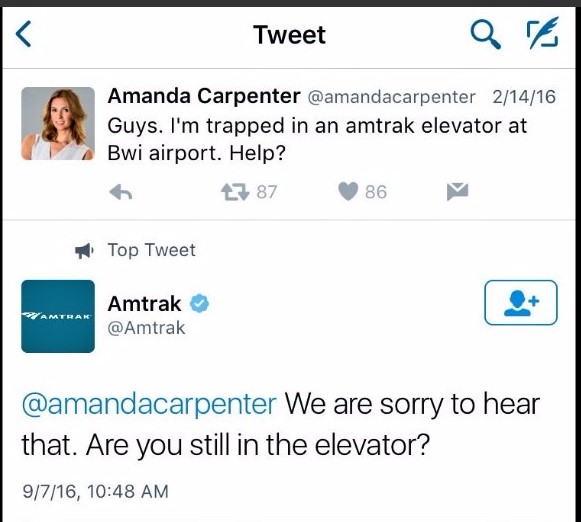
Amanda Carpenter, a sometime political operative and current CNN commentator, became stuck in an Amtrak station elevator in February, and she posted on Twitter at the time to describe her situstion. Seven months later, an Amtrak representative tweeted back to ask if she still needed help:

tweet

Carpenter obviously pushed the elevator’s help button also; her tweet was a way to hold Amtrak publicly accountable at the time.

So, was Amtrak surprisingly slow in its response, about as expected, or surprisingly fast in reply (where about expected and surprisingly fast are about your estimation of Amtrak’s abilities, not whether someone should be rescued promptly). Needless to say, the elevator should have been working properly so that passengers never risked being stuck inside.

Daily Bread for 9.9.16

Good morning, Whitewater.

Friday brings mostly cloudy skies and a high of eighty-two to Whitewater. Sunrise is 6:13 AM and sunset is 7:13 PM, for 12h 44m 05s of daytime. The moon is in its first quarter today.

On this day in 1965, Sandy Koufax achieved baseball perfection:

270px-sandy_koufaxSandy Koufax of the Los Angeles Dodgers pitched a perfect game in the National League against the Chicago Cubs at Dodger Stadium on September 9, 1965.[1] Koufax, by retiring 27 consecutive batters without allowing any to reach base, became the sixth pitcher of the modern era, eighth overall, to throw a perfect game. The game was Koufax’s fourth no-hitter, breaking Bob Feller‘s Major League record of three (and later broken by Nolan Ryan, in 1981). Koufax struck out 14 opposing batters, the most ever recorded in a perfect game, and matched only by San Francisco Giants pitcher, Matt Cain, on June 13, 2012. He also struck out at least one batter in all nine innings (Cain did not strike out a batter in the ninth in his perfect game), the only perfect game pitcher to do so to date.

The game was also notable for the high quality of the performance by the opposing pitcher, Bob Hendley of the Cubs. Hendley gave up only one hit (which did not figure into the scoring) and allowed only two baserunners. Both pitchers had no-hitters intact until the seventh inning. The only run that the Dodgers scored was unearned. The game holds the record for fewest base runners (both teams), with two; the next lowest total is four.[2]

Koufax’s perfect game is a memorable part of baseball lore. Jane Leavy‘s biography of Koufax is structured around a re-telling of the game. An article in Salon.com honoring Dodgers broadcaster Vin Scully focuses on his play-by-play call of the game for KFI radio.[3]This game was selected in a 1995 poll of members of the Society for American Baseball Research as the greatest game ever pitched.[4]

JigZone‘s daily puzzle is of colorful candy:

Unfunded Mandates 

Whitewater’s not the last place on earth where government should avoid unfunded mandates, but the last place is probably Rwanda, so that’s not much consolation for policymakers (and is no consolation for residents).

This is a full-time municipal administration of publicly-paid employees that shows almost no understanding of market conditions and burdens.

Each step like this reveals that full-time, publicly-paid managers don’t understand the relative disadvantage that costs impose on Whitewater. It’s always easier to explain away obligations that public employees don’t pay, or that their thin majority on Council doesn’t pay. 

The administration’s majority on Common Council can push expensive regulations onto the community, and the DU can dutifully write what a few insiders want it to write, but there’s a limit to their current posture.

Nothing human stays the same: organizations and communities either wax or wane. Each day of imposing new unfunded obligations, or insisting on new regulations, or proposing waste-importation schemes resting on exaggerations, lies, and evasions brings this city farther along the road to a near-permanent, comparative disadvantage.

But the city manager already has his job, and these costs aren’t coming out of his pocket, so why worry?

Daily Bread for 9.8.16

Good morning, Whitewater.

Thursday in town will see scattered thunderstorms in the morning, and partly cloudy skies in the afternoon, with a high of eighty-two.  Sunrise is 6:28 AM and sunset 7:15 PM, for 12h 46m 55s of daytime.  The moon is a waxing crescent with 40% of its visible disk illuminated.

On this day in 1966, the first episode of Star Trek airs on NBC:

NBC ordered 16 episodes of Star Trek, besides “Where No Man Has Gone Before“.[18] The first regular episode of Star Trek,The Man Trap,[23] aired on Thursday, September 8, 1966 from 8:30–9:30 as part of an NBC “sneak preview” block. Reviews were mixed; while The Philadelphia Inquirer and San Francisco Chronicle liked the new show, The New York Times and The Boston Globe were less favorable,[24] and Variety predicted that it “won’t work”, calling it “an incredible and dreary mess of confusion and complexities”.[25] Debuting against mostly reruns, Star Trek easily won its time slot with a 40.6 share.[26] The following week against all-new programming, however, the show fell to second (29.4 share) behind CBS. It ranked 33rd (out of 94 programs) over the next two weeks, then the following two episodes ranked 51st in the ratings.[27][28]

Star Treks first-season ratings would in earlier years likely have caused NBC to cancel the show. The network had pioneered research into viewers’demographic profiles in the early 1960s, however, and, by 1967, it and other networks increasingly considered such data when making decisions;[30]:115 for example, CBS temporarily cancelled Gunsmoke that year because it had too many older and too few younger viewers.[24] Although Roddenberry later claimed that NBC was unaware of Star Treks favorable demographics,[31] awareness of Star Treks “quality” audience is what likely caused the network to retain the show after the first and second seasons.[30]:115 NBC instead decided to order 10 more new episodes for the first season, and order a second season in March 1967.[18][32]

The Original Series was digitally remastered for a Blu-ray version in 2009.  Here’s how that first episode, from 1966, looks when compared with the remastered and CGI enhanced version –

JigZone‘s daily puzzle is of ivy & a lamp: