World’s Oldest #Cat Is 31 And Still Has Many Lives Left#Catshttps://t.co/94l7Fu5kB9 pic.twitter.com/lM7bFYRCUZ
— Oden (@Gjallarhornet) October 6, 2016
World’s Oldest #Cat Is 31 And Still Has Many Lives Left#Catshttps://t.co/94l7Fu5kB9 pic.twitter.com/lM7bFYRCUZ
— Oden (@Gjallarhornet) October 6, 2016
@erna_solberg med Pokémon under trontaledebatten på #Stortinget i går. Les hva hun sier om det selv, i @Klassekampen. pic.twitter.com/bJwoc1PRvQ
— Tom Henning Bratlie (@Jallapappa) October 5, 2016
So Norway’s Prime Minister, Erna Solberg, was caught playing Pokemon in that country’s parliament during a heated debate. What do you think?
Good morning, Whitewater.
The week in the city ends with cloudy skies and a high of sixty-four. Sunrise is 7 AM and sunset is 6:24 PM, for 11h 23m 37s of daytime. The moon is a waxing crescent with 33.3% of its visible disk illuminated.
Whitewater’s Landmarks Commission is scheduled to meets this morning at 10:30 AM.
On October 7th, 2007, journalist and human rights activist Anna Politkovskaya is murdered:
Anna Stepanovna Politkovskaya … née Mazepa; 30 August 1958 – 7 October 2006) was a Russian[1] journalist, writer, and human rights activist known for her opposition to the Second Chechen War and President of Russia Vladimir Putin.[3]
Politkovskaya made her reputation reporting from Chechnya.[4] Her post-1999 articles about conditions in Chechnya were turned into several books;[5] Russian readers’ main access to her investigations and publications was through Novaya Gazeta, a Russian newspaper known for its often-critical investigative coverage of Russian political and social affairs. From 2000 onwards, she received numerous international awards for her work. In 2004, she published a personal account, Putin’s Russia.[6]
On 7 October 2006, she was murdered in the elevator (lift) of her block of flats, an assassination that attracted international attention.[7][8][9] In June 2014 five men were sentenced to prison for the murder, but it is still unclear who ordered or paid for the contract killing.[10]
October 7th is Vladimir Putin’s birthday.
On this day in 1774, Wisconsin becomes part of Quebec:
On this date Britain passed the Quebec Act, making Wisconsin part of the province of Quebec. Enacted by George III, the act restored the French form of civil law to the region. The Thirteen Colonies considered the Quebec Act as one of the “Intolerable Acts,” as it nullified Western claims of the coast colonies by extending the boundaries of the province of Quebec to the Ohio River on the south and to the Mississippi River on the west. [Source: Avalon Project at the Yale Law School]
It’s a puzzle of acorns from JigZone this Friday:
Not just a competitor, but an off-string competitor. Impressive —
This post’s title is a play on the idea of six degrees, or connections, being a sufficient number to link two people, even those unknown to each other.
For today, I’m thinking about an academic degree, rather than a degree that describes a connection between people, and how that academic degree divides rather expresses a connection.
Old Whitewater has the lazy, entitled, lower-middle class habit of thinking that a university degree – in and of itself – is a worthy measure of a person’s learning or understanding. It’s a status-based culture, in which a few are sure that a formal education necessarily proves intellectual and informational superiority.
I’m from a paternal family that very much values formal education, and has for a very long time, but fortunately without the conceit that formal schooling necessarily implies some sort of superiority.
On the contrary, we would say that formal schooling is a human good, but one that establishes (if one is discerning) a burden, and a social obligation, but not an entitlement.
Part of that burden is continuing reading, study, and commitment to a cause, long after one has left school.
Use of a formal education as status distinction, the way an Englishman would use an aristocratic title, is beneath a discerning American. Education is a pursuit that should continue long after formal schooling ends. One should read literature in one’s field throughout one’s life, and learn things in new fields along one’s way.
(Occasionally, I have remarked on someone’s formal education, but only to make the point – however imperfectly – that much should be expected of someone who’s been formally schooled. It does not matter to me if others don’t think they’ve such an obligation, or underestimate the depth of that obligation; it’s a old truth apart from what they or I might think.)
It’s coldly disappointing how many times I’ve listened to some of Whitewater’s officials speak to others as though those speaking alone understood concepts that are, in fact, well known to most people. It’s a conceit, and a laughable one, to presume that there are only a few sharp people in a community. On the contrary, most people in most communities are very clever, and function well each day at complicated tasks.
Civilization would not – could not – have come so far if the overwhelming majority of people were not capable and clever.
If that stings someone’s sense of formal, educational entitlement, so be it. If one reads well, reasons well, and writes well, one may easily distinguish oneself. If one reads poorly, reasons poorly, and writes poorly, then one is a poor reflection on one’s school.
It does no good for someone to say he went there, or he did this and that, if years later no one can discern that he went anywhere or did anything much at all.
A formal education has so much to offer (far beyond money, by the way), but it should inspire one to offer much, rather than slothfully rest on a decades-old, formal experience.
The learning that leads to a degree should be only a beginning.
Good morning, Whitewater.
Thursday in town will bring a likelihood of thundershowers and a high of seventy-four. Sunrise is 6:59 AM and sunset is 6:25 PM, for 11h 26m 28s of daytime. The moon is a waxing crescent with 24.7% of its visible disk illuminated.
Whitewater’s Landmarks Commission meets at 6 PM, and there is a scheduled Fire Department Business Meeting at 7 PM.
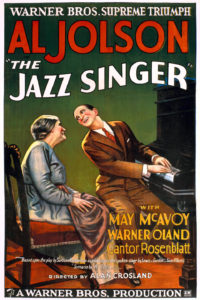
On this day in 1927, The Jazz Singer has its premiere in New York City:
The Jazz Singer is a 1927 American musical film. The first feature-length motion picture with synchronized sound, its release heralded the commercial ascendance of the “talkies” and the decline of the silent film era. Directed by Alan Crosland and produced by Warner Bros. with its Vitaphonesound-on-disc system, the film, featuring six songs performed by Al Jolson, is based on a play of the same name by Samson Raphaelson, adapted from one of his short stories “The Day of Atonement”.
The film depicts the fictional story of Jakie Rabinowitz, a young man who defies the traditions of his devout Jewish family. After singing popular tunes in a beer garden he is punished by his father, a cantor, prompting Jakie to run away from home. Some years later, now calling himself Jack Robin, he has become a talented jazz singer. He attempts to build a career as an entertainer but his professional ambitions ultimately come into conflict with the demands of his home and heritage.
Darryl F. Zanuck won the Special Academy Award for producing the film, and it was also nominated for Best Adapted Screenplay and Best Engineering Effects. In 1996, The Jazz Singer was selected for preservation in the National Film Registry of “culturally, historically or aesthetically significant” motion pictures. In 1998, the film was chosen in voting conducted by the American Film Institute as one of the best American films of all time, ranking at number ninety.
On this day in 1917, Fighting Bob defends free speech:
On this date Senator Robert La Follette gave what may have been the most famous speech of his Senate career when he responded to charges of treason with a three hour defense of free speech in wartime. La Follette had voted against a declaration of war as well as several iniatives seen as essential to the war effort by those that supported U.S. involvement in the first World War. His resistance was met with a petition to the Committee on Privileges and Elections that called for La Follette’s expulsion from the Senate. The charges were investigated, but La Follette was cleared of any wrong doing by the committee on January 16, 1919. [Source: United States Senate]
JigZone‘s puzzle of the day for Thursday is of a hammock:
There are a few moments from last night’s Common Council meeting that I’ll consider briefly today.
Budget. It’s fall, and so for Whitewater’s local government that means a proposed budget rollout, and Council sessions principally occupied with that subject through November.
On efficiency of government services, City Manager Clapper remarked that one can expect municipal services to cost more each year, in the way that Christmas presents for his children seem to cost more each year. The two are not analogous, of course: city work is a day-in, day-out provision of services, unlike holiday-season demand for retail toys. It’s an inapt comparison.
In any event, a successful, functioning market produces lower-cost, higher-quality goods and services year over year. America’s most competitive industries function this way, in goods or services (cheaper data storage, increased computing power, improved call quality, more advanced automobiles, etc.).
What City Manager Clapper is contending is that Whitewater’s local government will not, or cannot, meet the standards of the most productive private enterprises, but will look more like toymakers who rely on higher prices through seasonal demand.
It is, if nothing else, an honest admission.
There’s also something odd about reliance on efficiency comparisons to cities of similar size when some – but not all – of those cities receive vast sums of public money for infrastructure, operations, etc. It’s easy to claim local government functions at relatively lower cost when one’s city is awash in public money, to subsidize city government or to support a public university.
Our full-time staff might reply that they need some measure of state subsidy to function in a city that has a university that places infrastructure demands on local government.
Fair enough.
Would municipal officials live with the need for a subsidy while there is a university in town, or forgo the subsidy and ask UW-Whitewater to leave?
It’s a rhetorical question: if UW-Whitewater became UW-Palmyra, so to speak, this city’s economy would collapse. Crying about the need to maintain a university amounts to crocodile tears; the university gives more than she takes from Whitewater.
There’s also the question of Mr. Clapper’s search for revenue (fees, charges, surcharges, tipping fees for imported filth) to keep city government functioning at the ever-larger level he’d like (money for chosen businesses, running an aquatic center, spending big – millions – on infrastructure).
Over two million for the East Gateway project – do you feel two million better off? (Funny, then-councilmember Kidd wanted hundreds of thousands more for buried wires along the project site.)
If Mr. Clapper didn’t spend so much, and didn’t seek to acquire so much under city control, he wouldn’t need so much.
As for supposed revenue streams, there’s still a lingering, eighteen-month window to find a partner to deliver waste into Whitewater, in the absurd theory that the tipping fees would make Whitewater better off. Lynn Binnie helpfully turned out a majority for Clapper to continue along this path (Binnie, Kidd, Wellnitz, Grady).
There was no duress in any of this, of course – politicians choose freely, sometimes well, sometimes poorly. There are those who, no doubt, experience duress in life, but that unfortunate pressure doesn’t weigh on middle-aged men while sitting on Whitewater’s Common Council.
The Schools Presentation. The session last night began with a presentation from the Whitewater Schools’ new district administrator, Dr. Mark Elworthy, and Director of Business Services Nathan Jaeger.
It can’t be an easy time to arrive – Dr. Elworthy started this summer, with a construction referendum in the works, and a Board that went out of its way to mention at Dr. Elworthy’s introduction that he had been successful with prior referenda at other districts. One day, this district and her leaders (and other districts) will be able to lead with something other than the budget.
Honestly, I wish that had happened last night. There’s value in a PowerPoint for Council, but I think it would have been even more effective to listen to Dr. Elworthy alone, without a presentation, simply talking about what he wanted to accomplish (operational, capital, curricular, all of it).
Finally, there’s Business Director Jaeger’s reliance on a school construction survey from the spring to consider.
I’ll take two days next week first to discuss the survey and then to show, apart from the survey but relying on better information, that the referendum is likely to pass.
Lock Box. Better to place the matter – new ordinance, repeal of old, etc. – on an upcoming agenda. The friction over this issue shows that full-time municipal staff have a problem listening to merchants and appreciating their concerns. It also shows that full-time municipal staff think that it’s legitimate to circumvent those concerns through an ad hoc committee composed of obliging insiders.
All in all, we’re a small town, but never a dull one.
Good morning, Whitewater.
Midweek in town will be partly cloudy, with a one-third chance of thunderstorms, and a high of seventy-four. Sunrise is 6:58 AM and sunset is 6:27 PM, for 11h 29m 20s of daytime. The moon is a waxing crescent with 16.9% of its visible disk illuminated.
On this day in 1813, Harrison defeats Tecumseh and the British:
During the War of 1812, a combined British and Indian force is defeated by General William Harrison’s American army at the Battle of the Thames near Ontario, Canada. The leader of the Indian forces was Tecumseh, the Shawnee chief who organized intertribal resistance to the encroachment of white settlers on Indian lands. He was killed in the fighting.
Tecumseh was born in an Indian village in present-day Ohio and early on witnessed the devastation wrought on tribal lands by white settlers. He fought against U.S. forces in the American Revolution and later raided white settlements, often in conjunction with other tribes. He became a great orator and a leader of intertribal councils. He traveled widely, attempting to organize a united Indian front against the United States. When the War of 1812 erupted, he joined the British, and with a large Indian force he marched on U.S.-held Fort Detroit with British General Isaac Brock. In August 1812, the fort surrendered without a fight when it saw the British and Indian show of force.
Tecumseh then traveled south to rally other tribes to his cause and in 1813 joined British General Henry Procter in his invasion of Ohio. The British-Indian force besieged Fort Meigs, and Tecumseh intercepted and destroyed a Kentucky brigade sent to relieve the fort. After the U.S. victory at the Battle of Lake Erie in September 1813, Procter and Tecumseh were forced to retreat to Canada. Pursued by an American force led by the future president William Harrison, the British-Indian force was defeated at the Battle of the Thames River on October 5.
The battle gave control of the western theater to the United States in the War of 1812. Tecumseh’s death marked the end of Indian resistance east of the Mississippi River, and soon after most of the depleted tribes were forced west.
On this day in 1846, Wisconsin’s first constitutional convention meets:
On this date Wisconsin’s first state Constitutional Convention met in Madison. The Convention sat until December 16,1846. The Convention was attended by 103 Democrats and 18 Whigs. The proposed constitution failed when voters refused to accept several controversial issues: an anti-banking article, a homestead exemption (which gave $1000 exemption to any debtor), providing women with property rights, and black suffrage. The following convention, the Second Constitutional Convention of Wisconsin in 1847-48, produced and passed a constitution that Wisconsin still very much follows today. [Source: The Convention of 1846 edited Milo M. Quaife]
JigZone‘s Wednesday puzzle is of jasmine:
Good morning, Whitewater.
Tuesday in town will be partly cloudy with a high of seventy-four. Sunrise is 6:57 AM and sunset 6:29 PM, for 11h 32m 12s of daytime. The moon is a waxing crescent with 10.4% of its visible disk illuminated.
Common Council meets tonight at 6:30 PM.
Sputnik 1 … “Satellite-1”, or ??-1 [“PS-1″… “Elementary Satellite 1”])[3] was the first artificial Earth satellite. The Soviet Union launched it into an elliptical low Earth orbit on 4 October 1957. It was a 58 cm (23 in) diameter polished metal sphere, with four external radio antennae to broadcast radio pulses. It was visible all around the Earth and its radio pulses were detectable. This surprise success precipitated the American Sputnik crisis and triggered the Space Race, a part of the larger Cold War. The launch ushered in new political, military, technological, and scientific developments.[4][5]
Sputnik itself provided scientists with valuable information, even though it wasn’t equipped with sensors, by tracking and studying the satellite from Earth. The density of the upper atmosphere could be deduced from its drag on the orbit, and the propagation of its radio signals gave information about the ionosphere.
Sputnik 1 was launched during the International Geophysical Year from Site No.1/5, at the 5th Tyuratam range, in Kazakh SSR (now known as the Baikonur Cosmodrome). The satellite travelled at about 29,000 kilometres per hour (18,000 mph; 8,100 m/s), taking 96.2 minutes to complete each orbit. It transmitted on 20.005 and 40.002 MHz,[6] which were monitored by amateur radio operators throughout the world.[7] The signals continued for 21 days until the transmitter batteries ran out on 26 October 1957.[8] Sputnik 1 burned up on 4 January 1958, as it fell from orbit upon reentering Earth’s atmosphere, after travelling about 70 million km (43.5 million miles) and spending three months in orbit.[9]
JigZone‘s puzzle for Tuesday is of a chain and sprocket:
Good morning, Whitewater.
Morning fog gives way to partly cloudy skies and a high of seventy-one in town today. Sunrise is 6:55 AM and sunset 6:30 PM, for 11h 35m 04s of daytime. The moon is a waxing crescent with 5.3% of its visible disk illuminated.
Whitewater’s Lock Box Committee meets tonight at 6 PM.
On this day in 1990, East Germany becomes part of the Federal Republic of Germany, formally establishing the unification of the two states:
The German reunification (German: Deutsche Wiedervereinigung) was the process in 1990 in which the German Democratic Republic (GDR/East Germany) joined the Federal Republic of Germany (FRG/West Germany) to form the reunited nation of Germany, and when Berlin reunited into a single city, as provided by its then Grundgesetz constitution Article 23. The end of the unification process is officially referred to as German unity (German: Deutsche Einheit), celebrated on 3 October (German Unity Day) (German: Tag der deutschen Einheit).[1] Following German reunification, Berlin was once again designated as the capital of united Germany.
The East German regime started to falter in May 1989, when the removal of Hungary’s border fence with Austria opened a hole in the Iron Curtain. It caused an exodus of thousands of East Germans fleeing to West Germany and Austria via Hungary. The Peaceful Revolution, a series of protests by East Germans, led to the GDR’s first free elections on 18 March 1990, and to the negotiations between the GDR and FRG that culminated in a Unification Treaty.[1] Other negotiations between the GDR and FRG and the four occupying powers produced the so-called “Two Plus Four Treaty” (Treaty on the Final Settlement with Respect to Germany) granting full sovereignty to a unified German state, whose two parts had previously still been bound by a number of limitations stemming from their post-World War II status as occupied regions.
The united Germany is the enlarged continuation of the Federal Republic and not a successor state. As such, the Federal Republic of Germany retained all its memberships in international organizations including the European Community (later the European Union) and NATO, while relinquishing membership in the Warsaw Pact and other international organizations to which only East Germany belonged.
JigZone begins the week with a puzzle of a Golden Retriever: