Something light to begin the week —
Daily Bread
Daily Bread for 1.19.15
by JOHN ADAMS •
Good morning, Whitewater.
Happy King Day. We’ll have mild temperatures in Whitewater, with a high of thirty-six. Sunrise is 7:19 and sunset 4:51 PM, for 9h 31m 46s of daytime. The moon is a waning crescent, with just 1.5% of its visible disk illuminated.
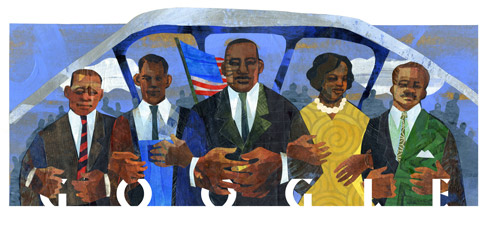
Google’s doodle for King Day links to useful information about his work and ongoing legacy.
On this day in 1937, industrialist and aviator Howard Hughes sets a transportation record for the time:
All landplane distance speed records were broken yesterday by Howard Hughes, millionaire sportsman pilot, who reached Newark Airport 7 hours 28 minutes and 25 seconds after he took off from Los Angeles, Calif. He was then forced to stay aloft until the runway at the field was clear and landed at 1:03 P. M. His average speed was 332 miles an hour for the 2,490 miles he traveled.
Grimy from the smoke of his exhaust stacks the lanky pilot climbed out of his cramped cockpit and grinned. In recounting his experiences on the flight he said that the skies were overcast all the way and he had to fly on top of the clouds. He saw the ground only twice west of the Ohio Valley, once at Winslow, Ariz. and again as he roared across the Mississippi River.
It was 2:14 o’clock in the morning and pitch dark when opened the throttle at the Union Air Depot at Burbank and released the 1,100 horsepower sealed in the fourteen cylinders of his supercharged Twin Row Wasp engine. The sleek gray and blue low-winged monoplane, designed and built under his own direction, staggered, accelerated and then literally vaulted into the air. Within a few seconds Hughes climbed into low-hanging clouds swung eastward and headed for the San Bernardino Pass.
At 14,000 feet, at which altitude he flew most of the way, he passed over the clouds, set his course and leveled off. He throttled his engine back until it was delivering only 375 horsepower and hunched himself over his instrument panel.
He was wearing a new type oxygen mask for high altitude flying. With nothing to see except the top of the cloud stratum he began experimenting with it. He finally adjusted it so that it fed too much air and not enough oxygen and he began to feel faint. Over the Sierras he had fears for a moment that his attempt might not be a success, but at last re-adjusted the mask so that the gas revived him.
On this day in 1939, in Fort Atkinson, a different kind of record:
1939 – Chicken Plucking World Record
On January 19, 1939 Ernest Hausen (1877 – 1955) of Ft. Atkinson set the world’s record for chicken plucking. [Source: Guiness Book of World’s Records, 1992]
Google-a-Day asks a question about geography:
What explorer first visited the U.S. river, which is the largest within its state, creating a natural boundary with Mexico?
City, Cycling, Development, Economy, Good Ideas, Health, Hip & Prosperous, Planning
In Support of the Complete Streets Initiative for Whitewater
by JOHN ADAMS •
This Tuesday, January 20th at 6:30 PM, Common Council will consider a Complete Streets ordinance (item O-3) for Whitewater. A Complete Streets program simply requires planners to consider bike and pedestrian travel, for example, when either building or reconstructing streets within our city.
(I listened closely to discussion of the idea at our 12.16.14 Common Council session; I look forward to the discussion on 1.20.15.)
It’s an excellent idea, and one that I fully support.
If we are to have planning – and this libertarian knows that one cannot build or reconstruct a road without planning – then it is the least to expect that planners should be forward-thinking, and look ahead to designs that consider “healthy, active living, reduce traffic congestion and fossil fuel use, and improve the safety and quality of life of residents of the City of Whitewater by providing safe, convenient and comfortable routes for walking, bicycling,” for example.
That’s what this idea requires – simply to look at more, to think beyond today (let alone yesterday, or decades ago) – and craft those possibilities into one’s future plans.
We cannot have growth and prosperity merely because we call for them, just as we cannot have good health merely because we say we are fit. Our future in these matters rests in our own hands – if we are to be a better place, then we will have to promote better ideas over worse ones.
We will have to do more than repeat tired platitudes that all is well, or that nothing needs to change.
Honest to goodness, this is a city of fifteen-thousand, not one or a few. There’s every right to advocate from one’s own experiences, but there’s something odd about believing that because a few people can’t imagine change, because they’re satisfied, that such a singular complacency should be a compelling policy argument.
This city is no insect in amber, to be placed as a paperweight on someone’s desk.
A Complete Streets perspective does not serve a few, but many – people of all ages, all backgrounds, all ideologies, all ethnic backgrounds – could and would benefit from more attention to biking and walking safely within the city. Unlike so many schemes that benefit only a few insiders’ friends, this mere expectation of planning with biking and walking in mind would benefit people from all parts of life.
Looking around, beyond the city, to successful and prosperous communities elsewhere, one sees that this is what they’re doing, to their own enrichment and betterment.
A proposal of this kind would place our city farther along the path to the hip, prosperous city she can be, and is destined to be.
It’s a discussion worth following closely, with best wishes to the proponents of a good idea for Whitewater.
Animation, Film
Sunday Animation: Haring
by JOHN ADAMS •
Haring from KLOMP! Animation on Vimeo.
Daily Bread
Daily Bread for 1.18.15
by JOHN ADAMS •
Good morning, Whitewater.
Sunday in town will be a day of decreasing clouds with a high of thirty-seven. Sunrise is 7:20 AM and sunset 4:50 PM, for 9h 29m 53s of daytime.
Friday’s FW poll asked if readers thought that a video of a supposed ghost in Blackburn, England seemed convincing. A majority of respondents (82.76%) said that they were unconvinced (‘you must be kidding’).
On this day in 1803, Pres. Jefferson requests $2,500 from Congress:
….President Thomas Jefferson sends a special confidential message to Congress asking for money to fund the journey of Lewis and Clark….
Jefferson directed Lewis to draw up an estimate of expenses. Basing his calculations on a party of one officer and 10 enlisted men—the number was deliberately kept small to avoid inspiring both congressional criticisms and Indian fears of invasion—Lewis carefully added up the costs for provisions, weapons, gunpowder, scientific instruments, and a large boat. The final tally came to $2,500. The largest item was $696, earmarked for gifts to Indians.
Following the advice of his secretary of the treasury, Albert Gallatin, Jefferson decided not to include the request in his general proposed annual budget, since it involved exploration outside of the nation’s own territory. Instead, on January 18, 1803, he sent a special secret message to Congress asking for the money, taking pains to stress that the proposed exploration would be an aid to American commerce. Jefferson noted that the Indians along the proposed route of exploration up the Missouri River “furnish a great supply of furs & pelts to the trade of another nation carried on in a high latitude.” If a route into this territory existed, “possibly with a single portage, from the Western ocean,” Jefferson suggested Americans might have a superior means of exploiting the fur trade. Though carefully couched in diplomatic language, Jefferson’s message to Congress was clear: a U.S. expedition might be able to steal the fur trade from the British and find the long hoped-for Northwest passage to the Pacific.
Despite some mild resistance from Federalists who never saw any point in spending money on the West, Jefferson’s carefully worded request prevailed, and Congress approved the $2,500 appropriation by a sizeable margin. It no doubt seemed trivial in comparison to the $9,375,000 they had approved a week earlier for the Louisiana Purchase, which brought much of the territory Jefferson was proposing to explore under American control….
On this day in 1908, tobacco goes up in smoke:
1908 – Fire Destroys Tobacco Warehouse
On this date fire devastated the tobacco warehouse of Julius Marqusee & Co. An estimated 4,000 cases of tobacco were destroyed. Losses were estimated at $250,000, Janesville’s largest property loss to that date. Three firemen suffered injuries fighting the blaze. [Source: Janesville Gazette]
Daily Bread
Daily Bread for 1.17.15
by JOHN ADAMS •
Good morning, Whitewater.
It’s only the seventeenth day of the year, but (at least so far) Saturday, January 17th will claim the title of warmest day of the year. The high temperature in town will be about forty-two, on a mostly cloudy day. Sunrise is 7:21 AM and sunset 4:49 PM, for 9h 28m 04s of daytime.

On this day in 1893, Hawaii loses her monarch:
…a group of American sugar planters under Sanford Ballard Dole overthrow Queen Liliuokalani, the Hawaiian monarch, and establish a new provincial government with Dole as president. The coup occurred with the foreknowledge of John L. Stevens, the U.S. minister to Hawaii, and 300 U.S. Marines from the U.S. cruiser Boston were called to Hawaii, allegedly to protect American lives….
President Grover Cleveland sent a new U.S. minister to Hawaii to restore Queen Liliuokalani to the throne under the 1887 constitution, but Dole refused to step aside and instead proclaimed the independent Republic of Hawaii. Cleveland was unwilling to overthrow the government by force, and his successor, President William McKinley, negotiated a treaty with the Republic of Hawaii in 1897. In 1898, the Spanish-American War broke out, and the strategic use of the naval base at Pearl Harbor during the war convinced Congress to approve formal annexation.
On this day in 1900, female cotton workers in Wisconsin go on strike:
1900 – Female Cotton Mill Workers Strike
On this date 100 female employees of the Monterey mill, affiliated with the Janesville Cotton Mills, went on strike for higher wages. According to local sources, a committee of four “good-looking young ladies” was appointed to negotiate with management. Doing piece work, the women earned only $40 a month. The company said the women “don’t know how good they’ve got it…because they are paid more than at other local cotton mills and as well as some men with families.” The women argued their monthly pay only averaged $20. Within three days, all the women were hired to work by tobacco warehouses. The Monterey mill was one of three Janesville cotton mills in operation at the turn of the century. [Source: Janesville Gazette]
Animals
Hamster Stocks Up
by JOHN ADAMS •
How a hamster packs his lunch —
Cats
Friday Catblogging: Still Landing on Her Feet
by JOHN ADAMS •
Here’s a feline who slips, but still lands right-side up. (The coat she’s wearing is a garment sometimes prescribed for animals to reduce their anxiety.) Coat notwithstanding, she sticks the landing.
Poll, Weird Tales
Friday Poll: The Blackburn Ghost
by JOHN ADAMS •
In England, an occasionally nutty place, there’s a tale about a ghost in Blackburn, and now there’s video of that supposed apparition.
I don’t think I’ve ever seen a video about ghosts quite like this one. The videographer proclaims that
This terrifying video shows the moment a ‘ghost’ appears on a deserted road – and CHASES after a car.
The petrifying three minute clip shows a car approach a mysterious white creature from behind as it walks along the road between Blackburn and Belmont in Lancashire.
The dread creature then turns and heads TOWARDS the vehicle as a passenger scream [sic] at the driver to reverse as fast as possible.
The horrified passenger can be heard yelling in Arabic: “Move the car backwards.
What do you think?
Daily Bread
Daily Bread for 1.16.15
by JOHN ADAMS •
Good morning, Whitewater.
Our Friday will be mostly cloudy but mild, with a high of twenty-six. Sunrise is 7:21 AM and sunset 4:47 PM, for 9h 26m 17s of daytime. The moon is a waning crescent with 20.5% of its visible disk illuminated.
On this day in 1991, Pres. George H.W. Bush tells the nation that Operation Desert Storm had begun. The next morning, the New York Times published news of the American-led campaign to drive the Iraqi Army from Kuwait:
WASHINGTON, Thursday, Jan. 17 — The United States and allied forces Wednesday night opened the long threatened war to drive President Saddam Hussein’s army from Kuwait, striking Baghdad and other targets in Iraq and Kuwait with waves of bombers and cruise missiles launched from naval vessels.
“The liberation of Kuwait has begun,” President Bush said in a three-sentence statement confirming the start of the attack that was read by his spokesman, Marlin Fitzwater, shortly after the raids began.
Later, in a televised address to the nation from the Oval Office a somber Mr. Bush said that after months of continuous diplomatic overtures had failed to produce movement by Iraq, the United States and its allies “have no choice but to force Saddam from Kuwait by force. We will not fail.”
Google-a-Day asks a geography question:
What area with nearly 2 million life forms was created to protect the wildlife of the country with the largest economy in Africa?
Daily Bread
Daily Bread for 1.15.15
by JOHN ADAMS •
Good morning, Whitewater.
Thursday in the Whippet City will be a mostly sunny day with a high of twenty-nine. Sunrise is 7:22 AM and sunset 4:46 PM, for 9h 24m 34s of daytime. The moon is a waning crescent with 29.3% of its visible disk illuminated.
On this day in 1967, the first Super Bowl ends just as it should have, Packers 35, Chiefs 10:
The First AFL-NFL World Championship Game in professional football, later known retroactively as Super Bowl I and referred to in some contemporary reports as the Supergame,[2] was played on January 15, 1967 at the Los Angeles Memorial Coliseum in Los Angeles, California. The National Football League (NFL) champion Green Bay Packers defeated the American Football League (AFL) champion Kansas City Chiefs by the score of 35–10.
Coming into this game, considerable animosity remained between the AFL and NFL, thus the teams representing the two rival leagues (Kansas City and Green Bay, respectively) felt pressure to win. The Chiefs posted an 11–2–1 record during the 1966 AFL season, and defeated the Buffalo Bills, 31–7, in the 1966 AFL Championship Game. The Packers finished the 1966 NFL season at 12–2, and defeated the Dallas Cowboys, 34–27, in the 1966 NFL Championship Game. Still, many sports writers and fans believed any team in the older NFL was vastly superior to any club in the upstart AFL, so expected Green Bay would blow out Kansas City.
The first half of Super Bowl I was competitive, as the Chiefs out-gained the Packers in total yards, 181–164, to come within 14–10 at halftime. But Green Bay safety Willie Wood’s 50-yard interception return early in the third quarter sparked the Packers to score 21 unanswered points in the second half. Green Bay quarterback Bart Starr, who completed 16 of 23 passes for 250 yards and two touchdowns, with 1 interception, was named MVP.
It is the only Super Bowl to have been simulcast in the United States by two networks: NBC had the rights to nationally televise AFL games, while CBS held the rights to broadcast NFL games; both networks were allowed to televise the game. The first Super Bowl’s entertainment largely consisted of college bands, instead of featuring popular singers and musicians as in more recent Super Bowls.
Google-a-Day asks a question about arthropods:
What type of arthropod appendage is comprised of a single series of segments attached end-to-end, rather than branching into two?
Animals, Science/Nature
How to Swim in Sand
by JOHN ADAMS •
It helps to be a sandfish or a shovel-nosed snake —
Politics
Even Smaller Government Can Be Intoxicating for the Vain
by JOHN ADAMS •
Many people who serve in government get up, go to work, do the best they can, and then go home again at the end of the day. That’s as work should be: simple, consistent, and humble.
It’s many, but not all, who live this way.
For a few in office, even a relatively small government (town, village, rural county, etc.) presents a daily struggle with vanity, self-serving pronouncements, and grandiose contentions.
That there are vast cities elsewhere does not prevent a proud person from falling victim to small-town vanity. Once ensnared in the minutiae of the near, the level-headed perspective of seeing and judging from afar means nothing to a person like that.
There may be many reasons that some people become small-town squires, and slip into a world self-promotion on a public tab.
I’ll suggest two reasons in this post.
First, even in a small town, local government may control millions in annual expenses and public property. That’s more than most people control privately, and more than they will likely ever control.
For self-promoters who seek office, the relatively greater scale of government compared against ordinary residents’ lives is a heady, intoxicating experience. A town may be small, but even then it will have a budget probably larger than most household budgets, and many business budgets.
The weak-minded get caught up with the idea of government-as-bigger-and-better, even in small places.
Second, people fall sway to self-promotion when they have nothing greater than themselves to promote. Conservatives, liberals, moderates, libertarians: if they arrive in government with a firm set of principles to advance, they’ve insulation from the warm, dangerously attractive glow of self-advancement.
If, by contrast, they arrive with views easily discarded for the sake of continuing participation in a small circle, they’re already susceptible of name-dropping, line-jumping, and self-serving.
Once they start down this path, they’re the office-seeking equivalent of nicotine fiends, and they just can’t get enough…
Anderson, Cartoons & Comics
Getting used to
by JOHN ADAMS •