University
UW-Whitewater Chancellor Richard Telfer Announces Retirement, Effective June 30th, 2015
by JOHN ADAMS •
The text of Chancellor Telfer’s announcement may be found at Important message from Chancellor Telfer, https://announcements.uww.edu/Announcement/Details/12115.
Music
Monday Music: Trailer for “The Blues Came Callin'”
by JOHN ADAMS •
Daily Bread
Daily Bread for 11.17.14
by JOHN ADAMS •
Good morning, Whitewater.
Monday will be partly cloudy with a high of seventeen degrees (corrected from an earlier entry mistakenly listing the high as seven degrees). Sunrise is 6:50 AM and sunset 4:29 PM, with 9h 39m 15s of daytime. The moon is a waning crescent with twenty-three percent of its disk illuminated.
On this day in 1777, Congress submits the Articles of Confederation to the states for ratification (having been adopted by Congress two days earlier):
The Articles of Confederation, formally the Articles of Confederation and perpetual Union, was a document signed amongst the 13 original colonies that established the United States of America as a confederation of sovereign states and served as its first constitution.[1] Its drafting by a committee appointed by the Second Continental Congress began on July 12, 1776, and an approved version was sent to the states for ratification in late 1777. The formal ratification by all 13 states was completed in early 1781. Even when not yet ratified, the Articles provided domestic and international legitimacy for the Continental Congress to direct the American Revolutionary War, conduct diplomacy with Europe and deal with territorial issues and Native American relations. Nevertheless, the weakness of the government created by the Articles became a matter of concern for key nationalists. On March 4, 1789, general government under the Articles was replaced with the federal government under the U.S. Constitution.[2][3] The new Constitution provided for a much stronger federal government with a chief executive (the president), courts, and taxing powers.
Google-a-Day asks a geography question:

On the flag of Angola, the symbol with a half circle shape is part of three symbols, collectively chosen to relate to the flag of what former county?
Nature, Photography
On Photographing the Milky Way
by JOHN ADAMS •
Former SpaceX engineer Ian Norman runs Lonely Speck, a site that teaches aspiring astrophotographers how to take pictures of the night sky. This splendid vignette reveals the art and passion behind his work, with stunning wide-field landscape shots of the Milky Way set against the deserts of Reno, Nevada. “It puts into perspective just how small and tiny and precious we are on our short time on this little rock, slowly spinning through space,” he says. “There’s nothing else like it.”
Via The Atlantic.
Animation, Film
Sunday Animation: Mean Teddies
by JOHN ADAMS •
While children sleep at night, their teddy bears defend them against imaginary monsters —
Mean Teddies from Tyler Novo on Vimeo.
Daily Bread
Daily Bread for 11.16.14
by JOHN ADAMS •
Good morning, Whitewater.
Sunday in town will be cloudy with a high of thirty-one. Sunrise is 6:49 AM and sunset 4:30 PM, for 9h 41m 19s of daytime.
Friday’s FW poll asked readers when they thought the city would first see at least one inch of accumulated snowfall. We’ve had more than an inch overnight, and of the total over an inch of that accumulated by midnight of Saturday, November 15th. Just over thirteen percent (13.04%) of respondents accurately predicted that the first inch of snow would accumulate sometime between November 14th and November 30th.
I love pumpkin pie, and this is that dessert’s season – from late October to just past Thanksgiving, pumpkin pie advances while fruit pies retreat from the menu. But what if the best pumpkin pie turns out to be butternut squash pie? Over at the New York Times, Melissa Clark nearly has me convinced:
See, also, The Trick to Great Pumpkin Pie: A Fresh Pumpkin Pie Recipe.
Daily Bread
Daily Bread for 11.15.14
by JOHN ADAMS •
Good morning, Whitewater.
We’ll have a sunny and cold Saturday, with a high of twenty-eight, giving way to snowy skies and a half inch of accumulation later this evening.
Whitewater has no tall buildings, but every big city in America does. In the wildly improbably chance that you’re in a skyscraper’s elevator when the cable fails, what’s the best technique for survival? Business Insider offers the answer:
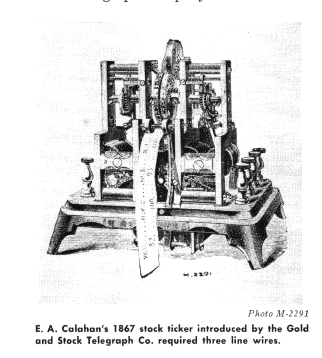
On this day in 1867, the stock ticker debuts in New York City:
Although telegraphic printing systems were first invented by Royal Earl House in 1846, early models were fragile, required hand-cranked power, frequently went out of necessary synchronization between sender and receiver, and did not become popular in widespread commercial use. David E. Hughes improved the printing telegraph design with clockwork weight power in 1856,[2] and his design was further improved and became viable for commercial use when George M. Phelps devised a resynchronization system in 1858.[3] The first stock price ticker system using a telegraphic printer was invented by Edward A. Calahan in 1863; he unveiled his device in New York City in 1867.[4][5] Early versions of stock tickers provided the first mechanical means of conveying stock prices (“quotes”), over a long distance over telegraph wiring. In its infancy, the ticker used the same symbols as Morse code as a medium for conveying messages. One of the earliest practical stock ticker machines, the Universal Stock Ticker developed by Thomas Edison in 1869, used alphanumeric characters with a printing speed of approximately one character per second.
Previously, stock prices had been hand-delivered via written or verbal messages. Since the useful time-span of individual quotes is very brief, they generally had not been sent long distances; aggregated summaries, typically for one day, were sent instead. The increase in speed provided by the ticker allowed for faster and more exact sales. Since the ticker ran continuously, updates to a stock’s price whenever the price changed became effective much faster and trading became a more time sensitive matter. For the first time, trades were being done in what is now thought of as near real-time.
By the 1880s, there were about a thousand stock tickers installed in the offices of New York bankers and brokers. In 1890, members of the exchange agreed to create the New York Quotation Co., buying up all other ticker companies to ensure accuracy of reporting of price and volume activity.[6]
On this day in 1867, a noted artist is born in Wisconsin:
On this date Georgia O’Keeffe was born in Sun Prairie. She studied at the Chicago Art Institute from 1904 to 1905. In 1907 she relocated to New York to study at the Arts Students League with William Chase. In 1926 she unveiled her now famous flower paintings. She received much of her artistic inspiration from her surroundings in New Mexico, where she settled permanently in 1946. O’Keeffe was awarded the Presidential Medal of Freedom in 1977. Georgia O’Keeffe died in 1986 in Santa Fe. [Source: Wisconsin Women: A Gifted Heritage]
Cats, Weather
Friday Catblogging: A Cat’s First Time on Snow
by JOHN ADAMS •

Via Cat Owner @ Imgur.
Poll, Weather
Friday Poll: Whitewater’s First Accumulated Snowfall of the 2014-2015 Season
by JOHN ADAMS •
What do you think – when will we see at least one inch of accumulation on the ground?
Daily Bread
Daily Bread for 11.14.14
by JOHN ADAMS •
Good morning, Whitewater.
Friday in town will be mostly cloudy with a high of twenty-eight. Sunrise is 6:46 AM, sunset 4:32 PM, for 9h 45m 35s of daytime today. The moon is a waning gibbous with 50.8% of its visible disk illuminated.
On November 14, 1851, Melville publishes a great novel, although it takes the world decades to see how great:
On this day in 1851, Moby-Dick, a novel by Herman Melville about the voyage of the whaling ship Pequod, is published by Harper & Brothers in New York. Moby-Dick is now considered a great classic of American literature and contains one of the most famous opening lines in fiction: “Call me Ishmael.” Initially, though, the book about Captain Ahab and his quest for a giant white whale was a flop.
Herman Melville was born in New York City in 1819 and as a young man spent time in the merchant marines, the U.S. Navy and on a whaling ship in the South Seas. In 1846, he published his first novel, Typee, a romantic adventure based on his experiences in Polynesia. The book was a success and a sequel, Omoo, was published in 1847. Three more novels followed, with mixed critical and commercial results. Melville’s sixth book, Moby-Dick, was first published in October 1851 in London, in three volumes titled The Whale, and then in the U.S. a month later. Melville had promised his publisher an adventure story similar to his popular earlier works, but instead, Moby-Dick was a tragic epic, influenced in part by Melville’s friend and Pittsfield, Massachusetts, neighbor, Nathaniel Hawthorne, whose novels include The Scarlet Letter.
After Moby-Dick’s disappointing reception, Melville continued to produce novels, short stories (Bartleby) and poetry, but writing wasn’t paying the bills so in 1865 he returned to New York to work as a customs inspector, a job he held for 20 years.
Melville died in 1891, largely forgotten by the literary world. By the 1920s, scholars had rediscovered his work, particularly Moby-Dick, which would eventually become a staple of high school reading lists across the United States. Billy Budd, Melville’s final novel, was published in 1924, 33 years after his death.
On this day in 1861, famed historian Frederick Jackson Turner is born:
On this date Frederick Jackson Turner was born in Portage. Turner spent most of his academic career at the University of Wisconsin. He published his first article in 1883, received his B.A. in 1884, then his M.A. in History in 1888. After a year of study at Johns Hopkins (Ph.D., 1890), he returned to join the History faculty at Wisconsin, where he taught for the next 21 years. He later taught at Harvard from 1910 to 1924 before retiring. In 1893, Turner presented his famous address, “The Significance of the Frontier in American History,” at the Chicago World’s Fair. Turner died in 1932.
Google-a-Day gives us a science question for Friday:
What element on the periodic table is named after the European capital where it was discovered in 1923?
Retail/Merchants
The Mercantile: A Short Film About a Montana Bakery
by JOHN ADAMS •
What it’s like – at least in part – to run a small shop —
Filmmaker Brian Bolster visited the outskirts of Glacier National Park to profile the owners of Polebridge Mercantile, a general store that first opened in 1914. Flannery Coats and Stuart Reiswig purchased the place five years ago, while looking for a place to marry and settle down. “I thought, oh wow,” Reiswig says. “How wonderful would it be to live up here in the wild and run the store, to get away from it all.”
While the couple no longer own the Mercantile—they sold it last May—Bolster’s film captures the rhythms and pleasures of running a small business in such a beautiful place. The tight shots of baked goods don’t hurt, either. (The huckleberry bearclaws look delicious.)
Via The Atlantic.
Daily Bread
Daily Bread for 11.13.14
by JOHN ADAMS •
Good morning, Whitewater.
Thursday in Whitewater will be mostly cloudy with a high of thirty. Sunrise is 6:45 AM and sunset 4:33 AM with 9h 47m 47s of daytime. The moon is a waning gibbous with just over sixty-percent of its visible disk illuminated.
Whitewater’s Police and Fire Commission is scheduled to meet tonight at 6:30 PM.
The European Space Agency’s successful landing of a probe onto a comet was a space-facing first:
Here’s the first image mosaic from #Philae on the surface of comet 67P rotated 90º CW & CCW #CometLanding #esa pic.twitter.com/NoAKwWdMiR
— Observing Space (@ObservingSpace) November 13, 2014
On this day in 1861, Gen. McClellan snubs president Lincoln:
After being named to the top army post, McClellan began openly associating with Democratic leaders in Congress and showing his disregard for the Republican administration. To his wife, McClellan wrote that Lincoln was “nothing more than a well-meaning baboon,” and Secretary of State William Seward was an “incompetent little puppy.”
Lincoln made frequent evening visits to McClellan’s house to discuss strategy. On November 13, Lincoln, Seward, and presidential secretary John Hay stopped by to see the general. McClellan was out, so the trio waited for his return. After an hour, McClellan came in and was told by a porter that the guests were waiting. McClellan headed for his room without a word, and only after Lincoln waited another half-hour was the group informed of McClellan’s retirement to bed. Hay felt that the president should have been greatly offended, but Lincoln replied that it was “better at this time not to be making points of etiquette and personal dignity.” Lincoln made no more visits to the general’s home. In March 1862, the president removed McClellan as general in chief of the army.
Lincoln later soundly defeated McClellan in the presidential election of 1864.
Google-a-Day asks a question about geography:
What structure on the South African coast has a range of 63 km and releases flashes every 30 seconds?
Anderson, Cartoons & Comics
See yourself
by JOHN ADAMS •