
“Apis Mellifera: Honey Bee” a high-speed short from Michael N Sutton / @MNS1974 on Vimeo.
Animation, Film
Sunday Animation: Girona
by JOHN ADAMS •
GIRONA from Pau Garcia Laita on Vimeo.
Daily Bread
Daily Bread for 7.13.14
by JOHN ADAMS •
Good morning, Whitewater.
Sunday in the Whippet City will be mostly sunny, with a high of eighty-one, and just a one-in-five chance of afternoon showers. Sunrise is 5:28 AM and sunset 8:33 PM. The moon is in a waning gibbous phase with ninety-seven percent of its visible disk illuminated.
They’ve had a season of widespread forest fires in Canada, and the effects of these fires are so clear that they may be seen from space —
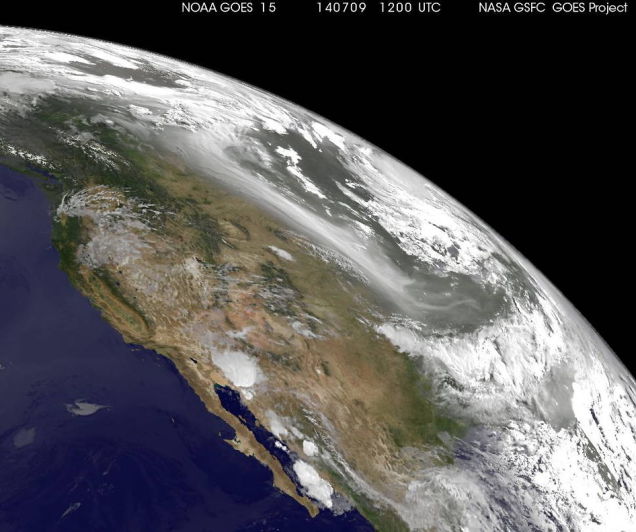
For more about the photograph and the fires, see Smoke From Canada’s Copious Wildfires As Seen From Space.
On this day in 1787, Congress under the Articles of Confederation passes the Northwest Ordinance:

The Northwest Ordinance (formally An Ordinance for the Government of the Territory of the United States, North-West of the River Ohio, and also known as the Freedom Ordinance or The Ordinance of 1787) was an act of the Congress of the Confederation of the United States, passed July 13, 1787. The primary effect of the ordinance was the creation of the Northwest Territory, the firstorganized territory of the United States, from lands south of the Great Lakes, north and west of the Ohio River, and east of the Mississippi River.
On August 7, 1789, President George Washington signed the Northwest Ordinance of 1789 into law after the newly created U.S. Congress reaffirmed the Ordinance with slight modifications under theConstitution. The Ordinance purported to be not merely legislation that could later be amended by Congress, but rather “the following articles shall be considered as Articles of compact between the original States and the people and states in the said territory, and forever remain unalterable, unless by common consent….”[1]
Arguably the single most important piece of legislation passed by members of the earlier Continental Congresses other than the Declaration of Independence, it established the precedent by which the federal government would be sovereign and expand westward across North America with the admission of new states, rather than with the expansion of existing states and their established sovereignty under the Articles of Confederation. It is the most important legislation that Congress has passed with regard to American public domain lands.[2]
Animation
Imaginary Animal Stunts
by JOHN ADAMS •
Daily Bread
Daily Bread for 7.12.14
by JOHN ADAMS •
Good morning, Whitewater.
We have a likelihood of late afternoon thunderstorms today, with a high of eighty-one.
If conventional race cars produce a powerful roar, then what’s the sound of an electric race car?
They sound like something from Star Wars:
On this day in 1984, Mondale chooses Ferraro:
Walter Mondale, the leading Democratic presidential candidate, announces that he has chosen Representative Geraldine Ferraro of New York as his running mate. Ferraro, a daughter of Italian immigrants, had previously gained notoriety as a vocal advocate of women’s rights in Congress.
Four days after Ferraro was named vice presidential candidate, Governor Mario Cuomo of New York opened the Democratic National Convention in San Francisco with an impassioned retort to Republican President Ronald Reagan’s contention that the United States was a “shining city on a hill.” Citing widespread poverty and racial strife, Cuomo derided President Reagan as oblivious to the needs and problems of many of America’s citizens. His enthusiastic keynote address inaugurated a convention that saw Ferraro become the first woman nominated by a major party for the vice presidency. However, Mondale, the former U.S. vice president under Jimmy Carter, proved a lackluster choice for the Democratic presidential nominee.
On November 6, President Reagan and Vice President George Bush defeated the Mondale-Ferraro ticket in the greatest Republican landslide in U.S. history. The Republicans carried every state but Minnesota–Mondale’s home state.
Ferraro left Congress in 1985. In 1992 and 1998, she made unsuccessful bids for a U.S. Senate seat. During President Bill Clinton’s administration, she was a permanent member on the United Nations Commission on Human Rights.
On this day in 1865, with the war won, Wisconsin regiments muster out of service to the Union:
1865 – (Civil War) 16th and 36th Infantry regiments muster out
The 16th and 36th Wisconsin Infantry regiments mustered out. The 16th had participated in the battles of Shiloh, Corinth, Jonesboro, Kennesaw Mountain, Atlanta, Sherman’s March to the Sea, and the siege of Savannah. It lost 399 men during service. The 36th had only mustered in March 23, 1864, and remained around the Washington, D.C., for the duration of its service. Its brief service included the Appomattox Campaign, Hatcher’s Run, and the surrender of General Robert E. Lee. It lost 342 men in a little over a year.
Food, Humor
Cutting a Pineapple with a Spoon
by JOHN ADAMS •
From YouTube’s Cut Dat Commentary Channel, here’s ‘detailed commentary on how to effortlessly cut a pineapple using a spoon’ —
Over at Digg, they’ve other favorites from the same series.
Enjoy.
Cats
Friday Catblogging: Online, Are Goats Replacing Cats?
by JOHN ADAMS •
It seems improbable, but at the Washington Post, Caitlin Dewey contends that Online, goats are the new cats. (No kidding!):
Let’s recap the sheer number of goats who have gone viral in recent months. There was Frostie, the sickly Australian snow goat who learned to walk with the help of a wheelchair. Then there was Gary, the GoPro-wearing muse/sidekick of comedian Jimbo Bazoobi, who somehow has nearly 730,000 fans on Facebook. (His schtick, not to oversimplify it, is basically just the goat.) Then there were the many fascinations of /r/goatparkour, a Reddit forum devoted to kids cavorting like deranged freerunners and the alleged “best thing online” — only rivaled, in truth, by “goat remixes,” a phenomenon that must be seen to be believed.

Miss Dewey cites the growing number of goat remixes, in which short clips of goats bleating are interspersed in music mideos, as in the example below:
I’ll place my bet on cats. Cats: the enduring Internet mascots.
Goats? I sense … mere fad.
Poll
Friday Poll: For New Bucks Arena, Should Public Money Be Used?
by JOHN ADAMS •
The Bucks have new owners (and a new coach, new star player), and they’d like a new arena.
Should public subsidies be used to build one?
Daily Bread
Daily Bread for 7.11.14
by JOHN ADAMS •
Good morning, Whitewater.
Friday in town will be partly sunny with a high of seventy-eight, and south winds of five to ten mph.
On this day in 1914, a baseball legend debuts in the majors:
On July 11, 1914, in his major league debut, George Herman “Babe” Ruth pitches seven strong innings to lead the Boston Red Sox over the Cleveland Indians, 4-3.
George Herman Ruth was born February 6, 1895, in Baltimore, Maryland, where his father worked as a saloon keeper on the waterfront. He was the first of eight children, but only he and a sister survived infancy. The young George, known as “Gig” (pronounced jij) to his family, was a magnet for trouble from an early age. At seven, his truancy from school led his parents to declare him incorrigible, and he was sent to an orphanage, St. Mary’s Industrial School for Boys. Ruth lived there until he was 19 in 1914, when he was signed as a pitcher by the Baltimore Orioles.
That same summer, Ruth was sold to the Boston Red Sox. His teammates called him “Babe” for his naiveté, but his talent was already maturing. In his debut game against the Indians, the 19-year-old Ruth gave up just five hits over the first six innings. In the seventh, the Indians managed two runs on three singles and a sacrifice and Ruth was relieved. His hitting prowess, however, was not on display that first night–he went 0 for 2 at the plate.
Ruth developed quickly as a pitcher and as a hitter. When the Red Sox made the World Series in 1916 and 1918, Ruth starred, setting a record with 29 2/3 consecutive scoreless innings in World Series play. His career record as a pitcher for the Red Sox was 89-46.
To the great dismay of Boston fans, Ruth’s contract was sold to the New York Yankees before the 1920 season by Red Sox owner Harry Frazee, so that Frazee could finance the musical No, No, Nanette. Ruth switched to the outfield with the Yankees, and hit more home runs than the entire Red Sox team in 10 of the next 12 seasons. “The Sultan of Swat” or “The Bambino,” as he was alternately known, was the greatest gate attraction in baseball until his retirement as a player in 1935. During his career with the New York Yankees, the team won four World Series and seven American League pennants. After getting rid of Ruth, the Red Sox did not win a World Series until 2004, an 85-year drought known to Red Sox fans as “the Curse of the Bambino.”
On this day in 1839, a Wisconsinite first receives a patent:
1839 – First patent issued to Wisconsin resident
On this day Ebenezar G. Whiting of Racine was issued patent #1232 for his improved plow, the first patent issued to someone from Wisconsin. Whiting’s improvements consisted of making the mold-board straight and flat which, when united in the center with the curvilinear part of the mold-board, would require less power to drag through the dirt. Whiting went on to serve as Vice President of the J.I. Case Plow Company and received another patent for a steel plow in 1876. [Source: United States Patent and Trademark Office]
Google-a-Day asks about a name:
The completion of what structure in 1971 altered the agricultural significance of the longest river of a country whose ancient name means “black land”?
Animals
Elephant rescued after fifty years of cruelty
by JOHN ADAMS •
Good Ideas, Science/Nature
The Makers of Things Present and Future
by JOHN ADAMS •
There’s a story at the Christian Science Monitor about makerspaces across America, like the one we have in town @ whitewatermakerspace.org, 1206 E Bluff Rd, Whitewater, WI 53190.
It’s a new-old idea, as Noelle Swan writes:
The ‘maker movement’ is heralded as a new industrial revolution – combining the spirit of the old shop class with modern tech in community ‘Do It Yourself’ spaces….
DETROIT — Think of the colorful Mt. Elliott Makerspace as a playroom where tools – such as soldering irons and electronics – are the toys.
A bank of Macs and PCs lines one wall where kids can research how to make things, learn to mix music with Garage Band, or build their own digital world with Minecraft. Windows behind the computers – a sort of bridge between the 20th and 21st centuries – offer a full view of a retired machinist’s woodworking shop. Bookshelves stuffed with remote-control cars, arts-and-crafts supplies, and beginning robotics kits flank a doorway leading to a bike shop. A pile of circuit boards and hard drives sits in a corner next to a disassembled electric wheelchair lying in wait for curious tinkerers….
We are a creative and inquisitive people; we have been this way from our beginnings.
I’ve been listening to Walter Isaacson’s Steve Jobs, and Jobs in his youth was part of a club (“Homebrew Computer Club”) of precocious builders and dreamers.
They, in their time had the power, as a younger generation now has the power, to build a more advanced and prosperous future.
The magazine Make offers page after page (in print or online) of clever projects: electronics, science kits, and crafts.
A recent episode of Whitewater Community Televison’s Park Bench Series recorded a discussion of microcontrollers, principally Arduino ones. (It’s a solid, informative discussion.)
(Those looking for a project with historical meaning might consider The Open Enigma Project, although I understand that it’s a pricier undertaking than many equally-fun and instructive projects.)
Here’s one from Make, for a Drawbot:
Those who work on these projects may not change the world tomorrow, but not so very long thereafter, really, they and others similarly inclined surely will.
Daily Bread
Daily Bread for 7.10.14
by JOHN ADAMS •
Good morning, Whitewater.
We have a pretty day ahead, with a high of seventy-seven and sunny skies. Sunrise today is 5:26 AM and sunset 8:34 PM. The moon is in a waxing gibbous phase with ninety-five percent of its visible disk illuminated.
On this day in 1940, and lasting for just over three months until a British victory over Germany, the Battle of Britain begins:
The Battle of Britain (German: Luftschlacht um England, literally “Air battle for England”) is the name given to the Second World War air campaign waged by the German Air Force (Luftwaffe) against the United Kingdom during the summer and autumn of 1940. The name is derived from a famous speech delivered by Prime MinisterWinston Churchill in the House of Commons: “… the Battle of France is over. I expect that the Battle of Britain is about to begin.”[16]
The Battle of Britain was the first major campaign to be fought entirely by air forces,[17] and was also the largest and most sustained aerial bombing campaign to that date. The German objective was to gain air superiority over the Royal Air Force (RAF), especially Fighter Command. From July 1940, coastal shipping convoys and shipping centres, such as Portsmouth, were the main targets; one month later, the Luftwaffe shifted its attacks to RAF airfields and infrastructure. As the battle progressed, the Luftwaffe also targeted aircraft factories and ground infrastructure. Eventually the Luftwaffe resorted to attacking areas of political significance and using terror bombing strategy.[nb 9]
By preventing Germany from gaining air superiority, the battle ended the threat that Hitler would launch Operation Sea Lion, an amphibious and airborne invasion of Britain. However, Germany continued bombing operations on Britain, known as The Blitz. The failure of Germany to achieve its objectives of destroying Britain’s air defences, or forcing Britain to negotiate an armistice or an outright surrender, is considered its first major defeat and a crucial turning point in the Second World War.[19]
On this day in 1832, during the Black Hawk War, Gen. Atkinson’s troops begin construction of a fort:
1832 – Fort Koshkonong Construction Begins
On this date General Henry Atkinson and his troops built Fort Koshkonong after being forced backwards from the bog area of the “trembling lands” in their pursuit of Black Hawk. The Fort, later known as Fort Atkinson, was described by Atkinson as “a stockade work flanked by four block houses for the security of our supplies and the accommodation of the sick.” It was also on this date that Atkinson discharged a large number of Volunteers from his army in order to decrease stress on a dwindling food supply and to make his force less cumbersome. One of the dismissed volunteers was future president, Abraham Lincoln, whose horse was stolen in Cold Spring, Wisconsin, and was forced to return to New Salem, Illinois by foot and canoe. [Sources: History Just Ahead: A Guide to Wisconsin’s Historical Markers edited by Sarah Davis McBride and Along the Black Hawk Trail by William F. Stark]
Google-a-Day asks a question about animals:
What is the source of the pressure that has caused coyotes, which were once essentially diurnal, to adjust to a more nocturnal behavior?
Animals
Dog-Turtle Dispute
by JOHN ADAMS •
Development, Local Government, Open Government, Planning
Shhh….Milton’s City Planning is a Big Secret
by JOHN ADAMS •
Over in Milton, with a ‘development professional’ for a mayor and a city administrator who’s quitting for a job where he can spend more time with his family, there’s a new municipal development:
MILTON—A proposed restaurant and convenience store at the corner of Sunnyside Drive and Highway 59 is “somewhat monumental” in that it kicks off the development along the new Highway 26/59 corridor, Milton Mayor Brett Frazier said Tuesday.
Both retail stores are “internationally known and well respected,” City Administrator Jerry Schuetz said. The end users cannot be released yet due to confidentiality agreements.
The plan commission on Tuesday unanimously approved the project’s memorandum of understanding with the Department of Transportation and the conceptual site plan.
See, subscription req’d, Milton moves forward with development on Sunnyside Drive, Highway 59.
A few simple points:
1. Confidentiality. Milton’s Plan Commission and the DOT – government entities – approved a plan about businesses the identities of which are a secret from the very public that these government bodies are by law required to serve?
That would be funny, if it were not perverse.
2. Not worth the pulp. The Gazette and Milton Courier have, apparently, offered no legal challenge to a claim of confidentiality in these public actions.
The Courier‘s scarcely a legitimate paper, but the Gazette still has those (unfounded) pretensions.
If they’ll not fight confidentiality in secret deals like this though legal challenge, these papers aren’t worth the pulp.
This is one reason why print’s in decline.
These papers will have to keep selling assets and retrenching until there are no more assets to sell and no more cutbacks to be made.
3. The Grandiose. I’m sure the residents of Milton are thrilled that they’re in store for a “somewhat monumental” deal for “internationally known and well respected” stores.
Oh, brother.
To whom are these political gentlemen speaking? One would have to think very little of the people of Milton (or very much of oneself) to speak to them in this patronizing way.
This Milton story describes a situation where a mediocre few treat an entire community of adult men and women as though they were children.
Government and the press can – and should – be better than this.