FREE WHITEWATER

Restaurant Review: China House


View Larger Map

China House, along West Main Street in Whitewater, sits in the city’s most visible retail district.  It’s a restaurant with both take-out service and eat-in seating.

It’s not an easy establishment to review, and part of the reason is that China House is really only one kind of establishment – a take-out restaurant.  The menu accurately describes China House as offering “TAKE OUT & EAT IN” fare, but the dining room is secondary.

If I were reviewing only the take-out service, I would have rated China House more than three of four stars: it offers a full menu of well-prepared Chinese cuisine.  There’s a rule that good restaurant have limited menus, but that guideline doesn’t apply to Chinese take-out: the menu is supposed to be large, as many of the items are easily and quickly prepared. 

That’s true with China House: you’ll find several selections from among each of the expected categories (Appetizers, Soup, Fried Rice, Chow Mein, Chop Suey, Lo Mein, Egg Foo Young, Moo Shu, Pork, Chicken, Beef, Seafood, House Specialities, Combination Plates, and Lunch Specialities).

There are, I’d guess, about one-hundred menu fifty items in all.

They’re well made, by this key requirement: there’s not too much sauce.  The easiest way to disguise a meal of meat and vegetables is with too much sauce, slathered over the ingredients to obscure underlying deficiencies.  At China House, meat and fish are tender and flavorful, and vegetables are soft without being limp.

That’s just as it should be.  Nothing overpowers, nothing conceals: one can taste each ingredient, in the proper combination of each. Portions are generous, too, by the way.

Near the kitchen window, to the right, there are all the take-out items one might like (extra sauces, chop sticks, napkins, plastic forks).  I don’t think you’ll need or benefit from extra sauces, but they’re there if you’d like.

My favorites – Beef with Broccoli and Moo Goo Gai Pan.

As a take-out place, it’s a good one.  As an eat-in restaurant, I’ll suggest plainly that the dining room, in design, furnishings, and atmosphere is simply an afterthought.  Although the menu proclaims both take-out and eat-in options, the eat-in experience is disappointing, in a plain and dining room with no table service.

But, really, I don’t think China House is an eat-in establishment, despite what the menu proclaims.  I’d guess most people see it as a take-out place,a and  so they don’t care about the dining room – for them it’s a waiting room.  Fair enough, I’d say.

There are two suggestions that would help China House.

First, why not start taking cards – they’ve a no credit/bank cards policy that’s silly.  Any merchant should be able to set up an account with something like Square, after all.  That card-processing company offers a “[a] card reader, simple pricing, and smarter business tools [that] make it easy for merchants to do what they love and get paid.”   Square can even process credit cards while attached to a merchant’s smart phone.

I brought cash for the occasion of my visits, but like others I’d rather not carry cash except for emergencies, as it’s easier to keep track of electronic transactions. 

Second, why not deliver?  Pizza shops do so easily; China House could do the same.

Still, as a take-out establishment, where food matters and atmosphere simply doesn’t, I like China House.

Recommended.

Enjoy.

LOCATION: 1128 W Main St, Whitewater, WI 53190. See, Google Map and directions embedded at the beginning of this review.
(262) 473-9788.

OPEN: Monday – Saturday 10:30 AM – 10:30 PM,  Sunday 10:30 AM – 10:00 PM.

PRICES: Meal & soda for under $10.

RESERVATIONS: Unnecessary.

DRINKS: Coffee, tea, juice, sodas.

SOUND: Light – no background music.

SERVICE: No table service.

VISITS: Two (both supper, as takeout and seated dining).

RATING: Recommended.

GoldStarGoldStarGoldStar

RATING SCALE: From one to four stars, representing
the full experience of food, atmosphere, service, and pricing.

INDEPENDENCE: This review is delivered without
financial or other connection to the establishment or its owner.  The
dining experience was that of an ordinary patron, without notice to
the staff or requests for special consideration.
Daily Bread for 9.25.13

Good morning.

We’ll have areas of fog in the morning, but thereafter sunny skies and a high of seventy.

On this day in 1957, Pres. Eisenhower orders federal soldiers to prevent obstruction of justice and assure lawful integration of Central High in Little Rock, Arkansas. On September 25, 1897, William Faulkner is born.

On this day in 1961, Wisconsin passes a law on seatbelts:

1961 – Law Requires Seatbelts in Wisconsin Cars
On this date Wisconsin Governor Gaylord Nelson signed into law a bill that required all 1962 cars sold in Wisconsin to be equipped with seat belts. [Source: Janesville Gazette]

Scientific American‘s trivia question asks about unfair labor. (Clicking on the question leads to its answer.)

How many people are forced to labor without wages worldwide?

Truths that the Whitewater Schools’ Composite Stats Don’t Show

WW

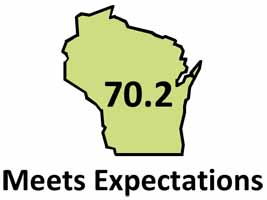
Wisconsin, like too much of America, now pushes at each turn for measurement, quantification, and numerical assessment of student performance. There should be measures – I merely have my doubts that displaying a top-line score describes meaningfully Wisconsin’s or Whitewater’s academic performance.

(Truly, the craze for measurement strikes me as half-clever person’s attempt to sound scientific and especially clever. It’s all over the country now, but when actual accomplishment among graduates proves lacking despite these scores upon scores, people will abandon confidence in these measurements. I believe in true scholastic achievement; cramming for – and later skimming over – these numbers won’t get America there.)

Looking deeper – and isn’t that the least one can expect of true scholastic accomplishments? – a few things about Whitewater (and nearby towns in the district) stand out.

(The Wisconsin Department of Public Instruction report card for Whitewater is available online, and it’s more detailed than a single score or single sheet per school.)

Whitewater’s Economy. We are an economically struggling community, where forty-four percent (44%) of Whitewater’s students are economically disadvantaged.

44%

That’s not a school district problem – it’s a community problem of the highest order.

We are the most prosperous and accomplished country on earth, but the American dream has not reached vast numbers of children in Whitewater. Until it does, arrogance, glad-handing, self-promotion, and crowing are disgraceful.

The champions of the status quo cannot win this argument; they’ll either try to conceal the truth or hope to change the subject as quickly as possible. Both tactics will prove fruitless: this is the genuine condition of the town in which they live.

I am confident that we can and will fix this problem in the years ahead. I am an optimist for a better future in Whitewater, for all her people. What’s been tried before has failed and will fail – a wholly different approach is needed: fewer big projects, fewer regulations, lower taxes, an emphasis on small businesses, and a shift to assistance for the needy that’s far less costly than the empty schemes of our self-important town squires.

Whitewater’s Increasing Diversity. What are the Whitewater Schools like?

They’re diverse and multicultural – there is no homogeneous student population. Just over sixty-seven percent (67.1%) of her students are white, almost twenty-six percent (25.9%) are Hispanic, three percent each Asian (3.2%) or black (3.3%), with under a percent (0.5%) being American Indian or Alaskan Native.

Whitewater’s looking more like America each day. That’s all to the good – America truly is exceptional and truly is admirable.

Comparing Schools. It’s almost too funny that even DPI urges readers that “[r]eport cards for different types of schools or districts should not be directly compared” but that a direct comparison between schools is the very thing one does by listing the top-line scores in bold font for each of our schools.

Lincoln Inquiry Charter School isn’t like the other schools in our district, but in displaying the data as a single number and picture for each school, one inevitably does exactly what DPI says should not be done. That school’s strengths and weakness won’t show properly in the same measure as conventional schools. Charter schools deserve a more specific (to their method) measurement.

There’s my point, from my initial paragraph, of course: it’s a none-too-clever approach to try to compare schools in such a simplistic way. It’s hardly the measure of a worthy education to do so.

Wisconsin shouldn’t be hawking reports on educational performance that fall below the standards of a suitably educated person.

There’s the only simple thing that DPI should be thinking about.

Daily Bread for 9.24.13

Good morning.

Tuesday brings a sunny day with a high near seventy to Whitewater, with winds of 5 to 10 mph.

Whitewater’s Urban Forestry Commission meets today at 4:30 PM, and her Bicycle & Pedestrian Master Plan Steering Committee at 6 PM.

On this day in 1789, America gets her first Supreme Court:

The Judiciary Act of 1789 is passed by Congress and signed by President George Washington, establishing the Supreme Court of the United States as a tribunal made up of six justices who were to serve on the court until death or retirement. That day, President Washington nominated John Jay to preside as chief justice, and John Rutledge, William Cushing, John Blair, Robert Harrison, and James Wilson to be associate justices. On September 26, all six appointments were confirmed by the U.S. Senate….

The U.S. Supreme Court grew into the most important judicial body in the world in terms of its central place in the American political order. According to the Constitution, the size of the court is set by Congress, and the number of justices varied during the 19th century before stabilizing in 1869 at nine. In times of constitutional crisis, the nation’s highest court has always played a definitive role in resolving, for better or worse, the great issues of the time.

Scientific American‘s trivia question asks about an inventor. (Clicking on the question leads to its answer.)

Who invented the hologram?

The question should really ask who was the first human to invent the hologram, as this one was designed even earlier, a long time ago, in a galaxy far, far away:

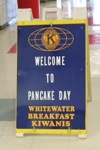
Whitewater’s Kiwanis Pancake Breakfast

20130923-104126.jpg

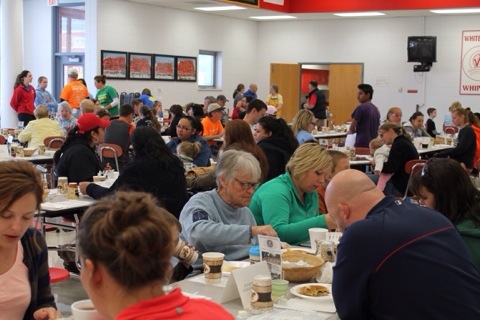
My youngest and I went to Sunday’s Kiwanis Pancake Breakfast at the high school.  We had a great time. 

Light, perfectly-prepared pancakes, the very size of a pan, with link sausages, syrup, butter, and one’s choice of coffee, juice, or water.  For a small price, one could order extra sausage, too, as we did. 

Once seated, we received the care and attention of countless volunteers, each making sure that we had all that we needed, that our drinks were replenished, and when we were finished removing our plates for us.  Row upon row of tables, and everyone attending receiving exemplary care.

A faraway monarch couldn’t have for himself conditions half so warm, so congenial, at any price. Better here than anywhere else, better this way of life than another.  

There we sat, and he happily and slowly ate his meal, leaning against me in the comfortable way that one’s small child will sometimes do.  One side resting against me, his free arm reaching lazily for another portion on the plate.  Nothing behind, and nothing ahead.

A beautiful Sunday meal.   

One writes and contends for this town, for its political future, as an expression of obligation and commitment and concern.  And yet, and yet – the most important moments in one’s life are not political, could not be political, and should not be political.   

We’ll be back again, of course, next time – we’re planning on it. 

20130923-104322.jpg

Daily Bread for 9.23.13

Downtown Whitewater’s Design Committee meets today at 8 AM.

On this day in 1952, then-Sen. Nixon delivers his Checkers speech:

Los Angeles, Sept. 23–Senator Richard M. Nixon, in a nation-wide television and radio broadcast tonight, defended his $18,235 “supplementary expenditures” fund as legally and morally beyond reproach.

He laid before the Republican National Committee and the American people the question of whether he should remain on the Republican party’s November election ticket as the candidate for Vice President.

Rising, near the end of his talk, from the desk at which he had sat, Senator Nixon urged his auditors to “wire and write” the Republican National Committee whether they thought his explanation of the circumstances surrounding the fund was adequate.

“I know that you wonder whether or not I am going to stay on the Republican ticket or resign,” he said. “I don’t believe that I ought to quit, because I’m not a quitter.”

Scientific American‘s trivia question asks about dancing. (Clicking on the question leads to its answer.)

Why do bees perform the waggle dance?

Here’s a video answer explaining the bees’ dance:

Daily Bread for 9.22.13

Good morning.

The first day of fall in Whitewater will be mostly sunny with a high of sixty-four. We’ll have northeast winds at 5 mph in the afternoon.

On this day in 1862, following the Battle of Antietam, the nature of the Civil War changes both formally and practically:

President Abraham Lincoln issues a preliminary Emancipation Proclamation, which sets a date for the freedom of more than 3 million black slaves in the United States and recasts the Civil War as a fight against slavery….

In July 1862, Lincoln informed his cabinet that he would issue an emancipation proclamation but that it would exempt the so-called border states, which had slaveholders but remained loyal to the Union. His cabinet persuaded him not to make the announcement until after a Union victory. Lincoln’s opportunity came following the Union win at the Battle of Antietam in September 1862. On September 22, the president announced that slaves in areas still in rebellion within 100 days would be free.

On January 1, 1863, Lincoln issued the final Emancipation Proclamation, which declared “that all persons held as slaves” within the rebel states “are, and henceforward shall be free.” The proclamation also called for the recruitment and establishment of black military units among the Union forces. An estimated 180,000 African Americans went on to serve in the army, while another 18,000 served in the navy.

After the Emancipation Proclamation, backing the Confederacy was seen as favoring slavery. It became impossible for anti-slavery nations such as Great Britain and France, who had been friendly to the Confederacy, to get involved on behalf of the South. The proclamation also unified and strengthened Lincoln’s party, the Republicans, helping them stay in power for the next two decades.

The proclamation was a presidential order and not a law passed by Congress, so Lincoln then pushed for an antislavery amendment to the U.S. Constitution to ensure its permanence. With the passage of the 13th Amendment in 1865, slavery was eliminated throughout America (although blacks would face another century of struggle before they truly began to gain equal rights).

Lincoln’s handwritten draft of the final Emancipation Proclamation was destroyed in the Chicago Fire of 1871. Today, the original official version of the document is housed in the National Archives in Washington, D.C.

Daily Bread for 9.21.13

Good morning.

Saturday, the last day of summer, will be mostly sunny with a high of sixty-two.

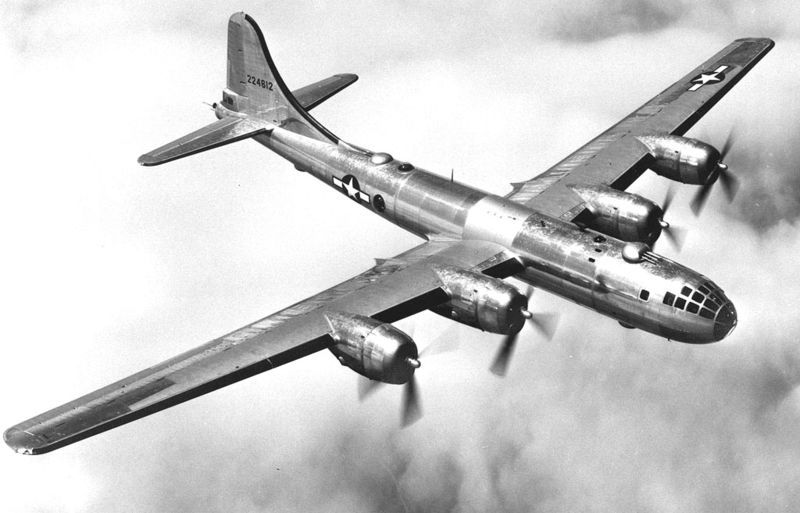
On this day in 1942, the B-29 bomber makes its maiden flight:

800px-B-29_in_flight

The B-29 Superfortress is a four-engine propeller-driven heavy bomber designed by Boeing that was flown primarily by the United States toward the end of World War II and during the Korean War. It was one of the largest aircraft to see service during World War II and a very advanced bomber for its time, with features such as a pressurized cabin, an electronic fire-control system, and remote-controlled machine-gun turrets. The name “Superfortress” was derived from that of its well-known predecessor, the B-17 Flying Fortress. Although designed as a high-altitude strategic bomber, and initially used in this role against the Empire of Japan, these attacks proved to be disappointing; as a result the B-29 became the primary aircraft used in the American firebombing campaign, and was used extensively in low-altitude night-time incendiary bombing missions. One of the B-29’s final roles during World War II was carrying out the atomic bomb attacks on Hiroshima and Nagasaki.

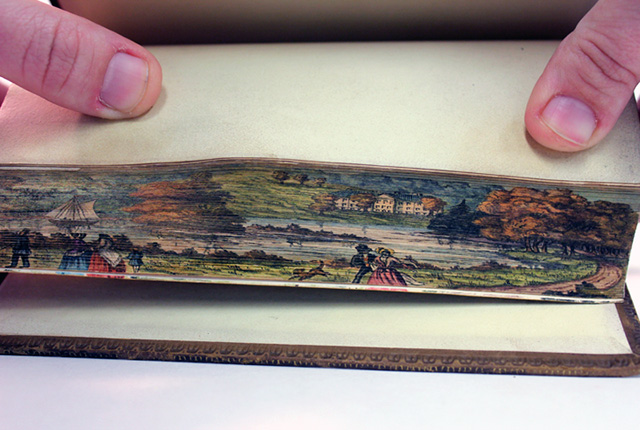
We’re rightly told not to judges books by their covers, but rather their contents. Still, what about a book’s edges, especially when they display fine and lovely art? Over at i09, Vince Miklós writes about Fore-Edge Paintings: The Secret Works of Art Hidden Inside Book Pages:

Sometimes the greatest artworks are hidden in plain sight. Case in point: the University of Iowa recently discovered a four-volume set of scientific books from 1837 contains hidden paintings on the edges of the pages, which only show up when you fan them part-way open. These “Fore-Edge Paintings” are everywhere, and they’re beautiful.

As Flavorwire explains, Fore-Edge Paintings go back to the 16th century, “when Italian artist Cesare Vecellio (cousin of Renaissance painter Titian) started using his books as a canvas in order to beautify them.” A bunch of them were posted by the University of Iowa and the Boston Public Library….

autumn-new

Autumn by Robert Mudie / Special Collections & University Archives at the University of Iowa

Small, detailed, and remarkably lovely.