
FREE WHITEWATER

About the Wisconsin Supreme Court Candidates

Someday, I’ll have to create a category called Could You Be More Obvious if You Tried™ or That’s No Way to Persuade in Print (Even if You Think It Is)™.

Consider these three descriptions of the candidates for Supreme Court Justice, on the ballot today:

Patience Roggensack [conservative]: “The incumbent, Patience Roggensack, is seeking her second ten year term on the Supreme Court bench. Before serving on the Supreme Court, Roggensack was an appelate [sic] court judge. On her website, Roggensack lists endorsements from about 100 former judges, including four former Supreme Court Justices.”

Vince Megna [liberal]: “a consumer rights attorney for the past 23 years, has suggested that he wants to represent “ordinary people on the Supreme Court” and believes that the justices should be honest about their political leaning. Megna is endorsed by a Milwaukee County judge and consumer rights advocates.”

Ed Fallone [moderate-liberal]: “a law professor at Marquette University, wants to be more representative of Wisconsin families. According to his campaign’s spokesperson, “leveling the playing field” for familes [sic] as opposed to special interests is why Fallone is running. Fallone is endorsed by former Wisconsin Senator Russ Feingold and two LGBT groups.”

Descriptions like these are a parody of how to describe the candidates fairly – it’s condescension to describe Fallone, in particular, as though he were simply the recipient of former Sen. Feingold’s endorsement and that of two LGBT groups.

Fallone has had a storied academic career at Marquette, and here’s his experience and background:

Legal Background
Associate Professor, Marquette University Law School
Expert in Constitutional Law, Corporate Law, and Criminal Law
Attorney, Gonzalez, Saggio & Harlan
Represented clients in complex corporate litigation
and shareholder lawsuits

Involved in the Community

President, Wisconsin Stem Cell Now
President’s Award, Community Shares of Greater Milwaukee 2010
Steering Committee, Catholic Charities Legal Services for Immigrants 2000-2005
President and Member of Board of Directors, Latino Community Center 2000-2003
Board of Trustees, Catholic Charities of the Archdiocese of Milwaukee 2000-2003
President, Wisconsin Hispanic Lawyers Association 1996-1997

Education and Family

J.D., magna cum laude, Boston University School of Law
B.A., summa cum laude, Boston University
Married, with two children

About Ed

For his entire career, Ed Fallone has been fighting to ensure all people have equal justice before the law. Ed is a law professor at Marquette Law School, teaching Constitutional, Corporate and Criminal Law. He is active in the State Bar, serving on the committee that drafted the state securities law and holding leadership positions. He led nonprofit organizations working to increase access to justice for immigrants and the “working poor,” and to provide anti-gang programs for at risk youth. He has been a practicing lawyer for almost 25 years in both federal and state courts.

Who’s endorsed him, by the way? It’s been far more than one former senator and two advocacy groups.

Here’s a more representative list:

Wisconsin AFL-CIO
Wisconsin Education Association Council
American Federation of Teachers – Wisconsin
American Federation of State, County, and Municipal Employees – Council 40
American Federation of State, County, and Municipal Employees – Council 48
American Federation of Teachers – Local 212
Madison Teachers Incorporated
Wisconsin Federation of Nurses and Health Professionals
Service Employees International Union.

State Senate Democratic Leader Chris Larson
State Senator Tim Carpenter
State Senator Dave Hansen
State Senator Nikkiya Harris
State Senator Bob Wirch
State Senator Jen Shilling
State Assembly Democratic Leader Peter Barca
State Representative Mandela Barnes
State Representative Evan Goyke
State Representative Fred Kessler
State Representative Cory Mason
State Representative Jon Richards
State Representative Mandy Wright
State Representative Jocasta Zamarripa
State Representative Dana Wachs

See, http://www.wispolitics.com/index.iml?Article=289730 and http://www.wispolitics.com/index.iml?Article=289637.

Make no mistake: I’m not a Democrat, and it’s fair to say that reading Fallone’s work over the years, I’ve had reason to disagree with some of his conclusions. But there’s no doubt – none at all – that he’s a well-qualified, mainstream candidate.

Ed Fallone has had a fine and distinguished professional practice and also academic career at Marquette Law.

Pretending otherwise is mistaken, and transparently & selectively so.
Daily Bread for 2.19.13

Good morning.

It’s a snowy election day in Whitewater. We’ll have light snow and flurries in the morning, with a high of eighteen. There will be 10h 45m of sunlight, and 11h 43m of daylight. Tomorrow will have two more minutes of light.

Polls are open today from 7 AM to 8 PM, with a Wisconsin Supreme Court race the leading contest on the ballot. Of the three candidates (Patience Roggensack, Ed Fallone, and Vince Megna) voters will choose two who’ll be on the April ballot.

On this day in 1847, a famous rescue, of a deeply troubled expedition:

….the first rescuers reach surviving members of the Donner Party, a group of California-bound emigrants stranded by snow in the Sierra Nevada Mountains.

In the summer of 1846, in the midst of a Western-bound fever sweeping the United States, 89 people–including 31 members of the Donner and Reed families–set out in a wagon train from Springfield, Illinois….After electing George Donner as their captain, the party departed Fort Bridger in mid-July. The shortcut was nothing of the sort: It set the Donner Party back nearly three weeks and cost them much-needed supplies. After suffering great hardships in the Wasatch Mountains, the Great Salt Lake Desert and along the Humboldt River, they finally reached the Sierra Nevada Mountains in early October….

Most of the group stayed near the lake–now known as Donner Lake–while the Donner family and others made camp six miles away at Alder Creek. Building makeshift tents out of their wagons and killing their oxen for food, they hoped for a thaw that never came. Fifteen of the stronger emigrants, later known as the Forlorn Hope, set out west on snowshoes for Sutter’s Fort near San Francisco on December 16. Three weeks later, after harsh weather and lack of supplies killed several of the expedition and forced the others to resort to cannibalism, seven survivors reached a Native American village….

Of the 89 original members of the Donner Party, only 45 reached California.

On 2.19.1868, a famous photographer is born near Whitewater:

Photographer Edward S. Curtis Born
On this date Edward Sheriff Curtis was born near Whitewater. As a young boy, he taught himself photography. His family eventually moved to the Puget Sound area of Washington state. He settled in Seattle and opened a photography studio in 1897.

A chance meeting on Mount Rainier resulted in Curtis being appointed official photographer on railroad magnate E.H. Harriman’s expedition to Alaska. Curtis also accompanied George Bird Grinnell, editor of Field and Stream magazine, to Montana in 1900 to observe the Blackfoot Sun Dance.

After this, Curtis strove to comprehensively document American Indians through photography, a project that continued for over 30 years. Working primarily with 6 x 8-inch reflex camera, he created over 40,000 sepia-toned images.

His work attracted national attention, most notably from Theodore Roosevelt and J. Pierpont Morgan, whose family contributed generously to his project. His monumental work, The North American Indian, was eventually printed in 20 volumes with associated portfolios. Curtis’ work included portraits, scenes of daily life, ceremonies, architecture and artifacts, and landscapes. His photographs have recently been put online by the Library of Congress.[Source: Dictionary of Wisconsin Biography, SHSW 1960, pg. 892]

Google-a-Day asks a question of logic and science: “Which form of logic did George Boole introduce in the 19th century?”

Monday Music: ‘James K. Polk’ by They Might Be Giants

You’ve probably been waiting, as so many others have, for a Presidents’ Day Song about James K. Polk. Your patience is rewarded: here’s They Might Be Giants with their original, definitely B-side song, ‘James K. Polk.’

As one can guess, it’s a tongue-in-cheek tribute, as Polk’s policies met with significant opposition (Lincoln and other Whigs, for example, opposed war with Mexico).

Enjoy.

Lyrics:

In 1844, the Democrats were split
The three nominees for the presidential candidate
Were Martin Van Buren, a former president and an abolitionist
James Buchanan, a moderate
Louis Cass, a general and expansionist
From Nashville came a dark horse riding up
He was James K. Polk, Napoleon of the Stump

Austere, severe, he held few people dear
His oratory filled his foes with fear
The factions soon agreed
He’s just the man we need
To bring about victory
Fulfill our manifest destiny
And annex the land the Mexicans command
And when the votes were cast the winner was
Mister James K. Polk, Napoleon of the Stump

In four short years he met his every goal
He seized the whole southwest from Mexico
Made sure the tarriffs fell
And made the English sell the Oregon territory
He built an independent treasury
Having done all this he sought no second term
But precious few have mourned the passing of
Mister James K. Polk, our eleventh president
Young Hickory, Napoleon of the Stump

Daily Bread for 2.18.13

Good morning.

Washington’s birthday holiday brings rain in the afternoon to Whitewater, and a high of 44.

Whitewater’s Irvin Young Library Board meets tonight at 6 PM.

Nature’s power ob display is evident from clear footage of a dash cam video of a meteor that exploded miles above Russia last week:

On this day in 1885, Twain published The Adventures of Huckleberry Finn:

Even in 1885, two decades after the Emancipation Proclamation and the end of the Civil WarThe Adventures of Huckleberry Finn landed with a splash. A month after its publication, a Concord, Massachusetts, library banned the book, calling its subject matter “tawdry” and its narrative voice “coarse” and “ignorant.” Other libraries followed suit, beginning a controversy that continued long after Twain’s death in 1910. In the 1950s, the book came under fire from African-American groups for being racist in its portrayal of black characters, despite the fact that it was seen by many as a strong criticism of racism and slavery. As recently as 1998, an Arizona parent sued her school district, claiming that making Twain’s novel required high school reading made already existing racial tensions even worse.

Aside from its controversial nature and its continuing popularity with young readers, The Adventures of Huckleberry Finn has been hailed by many serious literary critics as a masterpiece. No less a judge than Ernest Hemingway famously declared that the book marked the beginning of American literature: “There was nothing before. There has been nothing as good since.”

Google-a-Day asks a pop culture question: “Who scored the musical version of the movie that’s based on Patricia Resnick’s story?”

Scenes from Whitewater’s 2013 Polar Plunge® for Special Olympics

On February 16, 2013, Whitewater held her annual Polar Plunge® for Special Olympics. On a day with wind chills scarcely above zero, and water of only thirty-six degrees, hundreds of volunteers and donors raised tens of thousands for the Special Olympics of Wisconsin.

There’s no greater measure of a community than its charity. Below are scenes – necessarily capturing only a part – of a full and fine day for all Whitewater.

Special Olympics Polar Plunge® Whitewater 2013 from John Adams on Vimeo.

Recent Tweets, 2.10 to 2.16

Daily Bread for 2.17.13

Good morning.

We’ll have a mostly sunny day with a high of twenty-five.  Today brings 10h 39m of sunlight, 11h 37m of daylight, with a waxing crescent moon.

On 2.17.1972, Nixon goes to China:

Washington, Feb. 17 — President Nixon left for China today.

He is to reach Peking on Monday morning, China time (Sunday night, New York time), for a week’s stay on the mainland that is to include two conferences, with Chairman Mao Tse-tung and meetings with Premier Chou En-lai.

Addressing ‘Vice’ President Agnew, the leaders of Congress, members of his Cabinet and a large crowd assembled on the White House lawn this morning to bid him farewell, the President said in a brief statement that the United States and China must “find a way to see that we can have differences without being enemies in war.”

If We Can Make Progress

“If we can make progress toward that goal on this trip,” he declared, “the world will be a much safer world and the chance particularly for all of those young children over there to grow up in a world of peace will be infinitely greater.”

The trip produced several accords with Mao’s China, and was even the inspiration for an opera (from the composer, but most certainly not the blogger who lacks any of those talents, John Adams):

On 2.17.2002, a gold medal for a Wisconsinite:

2002 – Wisconsin Skater Takes Gold
On this date West Allis native Chris Witty won a gold medal in speed skating’s 1000 meter at the Salt Lake City Olympic Winter Games. She broke the world record with a time of 1:13.82, even though she was recovering from mononucleosis. Before Witty competed in ice staking, she was a professional bicyclist. [Source: US Olympic Team]

Google-a-Day asks a history question:  “Whose disciples founded Yellow Hats?”

Daily Bread for 2.16.13

Good morning.

Saturday in Whitewater will bring a slight chance of flurries, a high of eighteen, and partly sunny skies.

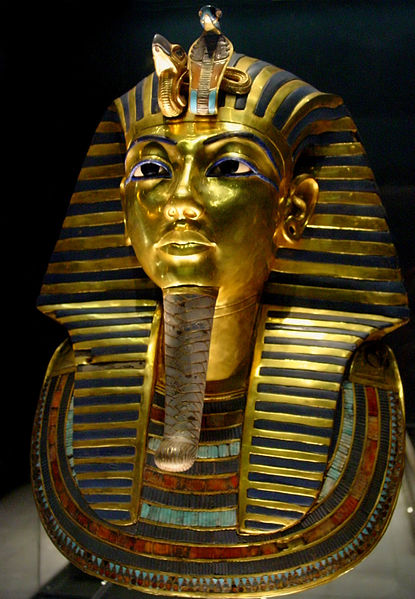
On this day in 1923, an archaeological wonder:

Tuthankhamun_Egyptian_Museum

[I]n Thebes, Egypt, English archaeologist Howard Carter enters the sealed burial chamber of the ancient Egyptian ruler King Tutankhamen….

When Carter arrived in Egypt in 1891, he became convinced there was at least one undiscovered tomb–that of the little known Tutankhamen, or King Tut, who lived around 1400 B.C. and died when he was still a teenager. Backed by a rich Brit, Lord Carnarvon, Carter searched for five years without success. In early 1922, Lord Carnarvon wanted to call off the search, but Carter convinced him to hold on one more year.

In November 1922, the wait paid off, when Carter’s team found steps hidden in the debris near the entrance of another tomb. The steps led to an ancient sealed doorway bearing the name Tutankhamen. When Carter and Lord Carnarvon entered the tomb’s interior chambers on November 26, they were thrilled to find it virtually intact, with its treasures untouched after more than 3,000 years. The men began exploring the four rooms of the tomb, and on February 16, 1923, under the watchful eyes of a number of important officials, Carter opened the door to the last chamber.

Inside lay a sarcophagus with three coffins nested inside one another. The last coffin, made of solid gold, contained the mummified body of King Tut. Among the riches found in the tomb–golden shrines, jewelry, statues, a chariot, weapons, clothing–the perfectly preserved mummy was the most valuable, as it was the first one ever to be discovered. Despite rumors that a curse would befall anyone who disturbed the tomb, its treasures were carefully catalogued, removed and included in a famous traveling exhibition called the “Treasures of Tutankhamen.” The exhibition’s permanent home is the Egyptian Museum in Cairo.

On 2.16.1943, the Nazis execute a Milwaukee native and leader of a small German resistance:

1943 – Mildred Harnack Guillotined in Berlin
On this date Mildred Harnack was guillotined in Berlin, Germany. Harnack was born in Milwaukee and studied and lectured at the University of Wisconsin. She and her husband, Arvid Harnack, were key members of a German resistance group which assisted German Jews and political dissidents, circulated illegal literature, met secretly with prisoners of war, and worked to document Nazi atrocities in Europe. Known by the Nazis as the “Red Orchestra,” Harnack’s companions were arrested, tortured, and tried for their activities. Mildred Harnack was guillotined in Berlin on the personal orders of Adolf Hitler. [Source: UW – Madison Archives and Records Management Services]

Google-a-Day aska a question about a patron of the arts: “What was the name of the 8000-acre estate inherited by the art patron who commissioned ‘Lobster Telephone’?”

Friday Poll: Cruise from Hell Compensation Package

All America’s been watching the return and disembarkation of the Carnival Cruise ship Triumph, after days without power, in conditions of filth, for about four-thousand passengers and crew.

The line has offered a compensation package for those so distressed these last few days:

As a third tug boat was dispatched to assist in towing Carnival Triumph to port in Mobile, Alabama, Carnival Cruise Lines announced further compensation for passengers affected and the cancellation of 12 additional voyages.

USD$500 per person will be added to the current compensation package that includes a full refund of the cruise along with transportation, expenses and reimbursement of all shipboard purchases during the voyage (excluding casino charges, art and gift shop purchases).

Passengers will also receive a future cruise credit to the amount paid for this voyage.

Is that compensation enough?

I’ll say no: they’d do better to offer far more (ten or twenty times that amount), across the board, to produce a greater goodwill among the general public. They might also offer an especially large package as settlement of any and all claims, but that should be done individually, passenger by passenger, rather than as part of an offer to all passengers.

What do you think?