
Cats
Friday Catblogging: One Really Excited Cat
by JOHN ADAMS •
stereo skifcha from Denis Borisovich on Vimeo.
Film, Poll
Friday Poll: 2013 Oscar Pick
by JOHN ADAMS •
The Academy Awards are Sunday, February 24th beginning at 6 PM CT.
There are nine films in contention for best picture. (The nominees and links to info about them appear at the bottom of this post.)
So what do you think: Which film do you think will win? Which film would you like to win?
I’ve haven’t seen all these films, but I’ll guess that the contest is between Argo and Lincoln for winner (relying on accounts of the horse race), and I’d think that either one of those films would be worthy of winning (considering past winners).
Daily Bread
Daily Bread for 2.22.13
by JOHN ADAMS •
Good morning.
Friday brings snow, mixed with freezing drizzle in the morning, a high of thirty-one, with snow accumulation during the day of around an inch.
On 2.22.1980, against all expectations, America defeats the Soviet Union in hockey at the Winter Olympic Games, 4-3 (later those games to win the gold medal):
Lake Placid, N.Y., Feb. 22 — In one of the most startling and dramatic upsets in Olympic history, the underdog United States hockey team, composed in great part of collegians, defeated the defending champion Soviet squad by 4-3 tonight.
The victory brought a congratulatory phone call to the dressing room from President Carter and set off fireworks over this tiny Adirondack village. The triumph also put the Americans in a commanding position to take the gold medal in the XIII Olympic Winter Games, which will end Sunday.
On this day in 1950, a Wisconsin politician’s accusations lead to a Red-scare committee:
1950 – McCarthy Committee Formed to Investigate Red Scare
On this date, at the suggestion of Senate Majority Leader Scott Lucas, the five-member Tyding Committee was created. This group was a subcommittee of the Foreign Relations Committee and was charged with the sole purpose of investigating Wisconsin Senator Joseph McCarthy’s accusations of communist activities. [Source: Fox Valley Turning Points]
Google-a-Day asks a film and pop culture question: “The Oscar nominated movie released in 2011 that received a “fresh” rating of less than 50% on “Rotten Tomatoes,” was based on a book by what author?”
Science/Nature
Permafrost, yes permafrost, in ninety seconds
by JOHN ADAMS •
City, Politics
Wholly Unsolicited Political Advice for the Republicans and Democrats of Whitewater
by JOHN ADAMS •
Here’s the last post in my promised February political survey for Whitewater. I’m a libertarian and a Libertarian (that is, both in ideology and party membership), and so one can guess that I view the two major parties through that perspective. Still, I’ll offer my thoughts on what Republicans and Democrats can do to strengthen their respective positions in the city.
First, the state of things, over-simplified and bluntly expressed:
Republicans walk around town like they own the place (although they don’t). Democrats walk around town as though the sidewalks were made of eggshells (although they aren’t). Neither party approaches conditions as they truly are; both are squandering opportunities.
For Democrats.
1. Call yourselves Democrats. Someone once said that the only political party in Whitewater is Incumbency. That was then, this is now: Gov. Walker has transformed the local into the statewide. He’s Wisconsinized our politics. Although I disagree with much of his direction, I admire – sincerely – his ideological clarity.
Far as I’ve heard, Gov. Walker doesn’t call himself a ‘compassionate conservative,’ etc. He calls himself a conservative. Good for him.
Democrats, moderates, liberals, progressives? Say what you are.
2. What do you believe, locally? All America knows – broadly – where Democrats stand on national issues. Where do Whitewater’s Democrats stand on local issues? Here I mean issues of local, municipal policy. One knows where the state party stands – where does the local party stand?
Residents could guess, but while they’re guessing, you’re missing a clearer message for concern over not winning, or criticism, or whatever.
It’s politics, not knitting: follow the example of those across the state who are plain in their local advocacy. Acting locally and thinking globally is an ineffective inversion of the progressive call to action.
Note: The ‘Move to Amend’ campaign is an exception, I’d say. I well know some will contend it’s a bipartisan affair, but it’s an initiative of the left, and many others see it that way. (I think it’s truly an anti-speech initiative, but credit where credit is due: it’s a far plainer expression of opinion than much of what’s offered locally. My best guess is that it will win on the April ballot by a good margin.)
3. Who are your political leaders in the city? Many in Whitewater would have trouble naming even one official of the local Democrats. It doesn’t matter that I can – you’re not looking for the libertarian blogger vote: you’re looking for votes, generally.
4. Beware the risks of your waxing numbers. Political trends in the city favor your party, but it’s a slow process, and along the way you may find that otherwise persuadable voters will conclude you’re tepid, timid, and unwilling to speak out.
For the GOP.
1. Figure out where you live. It’s a college town that Pres. Obama carried with 61% of the vote. He carried every precinct in the city. Republicans can win here, but not by (a) assuming victory is owed to them, (b) relying on the last generation’s overdone responses, (c) whining about students, followed an extra helping of (d) whining about students.
You’re free to express whatever you want, but if you want to win here, you’ll need more Jack Kemp and less Rick Santorum.
It was a Democrat, then-Sen. George Mitchell, who offered some of the best advice I’ve ever heard, while he was was speaking on that chamber’s floor. Frustrated over the disarray among his Democratic majority, he asked his fellow liberals: “Do you want to make a statement, or do you want to make a law?”
If you want the statement, keep going as you are. If you’re interested in making local policy a decade from now, you’ll need to revise your approach.
2. Promote a new generation of messengers. If a party has an assured (long-standing) majority, it doesn’t need to worry so much about day-to-day spokespeople. Republicans in Brookfield don’t need a front-and-center spokesperson. Whitewater’s Republicans need something along those lines.
Sharp, witty, sophisticated – you’ve many people in the city like that – find some to speak frequently on behalf of your party. Go smart, youthful, articulate, attractive: there are most certainly Republicans like that in the city now.
3. Stop thinking that you can win in Whitewater with a ham-handed message. Once you promote the messengers, you’ll need a powerful and elegant message.
4. Take nothing for granted. Yes, yes, you’ve won in the past. Few people care: all politics is on the margin, focusing on today and tomorrow. You’ll need to stop assuming that everything you say is obvious.
Gov. Romney didn’t win that way, and you won’t either.
No one expects that five or ten years from now Whitewater will be a predominantly libertarian city. No matter, it will be a place markedly different from today. If the major parties of 2013 want to shape profoundly that new city, they’ve both work yet ahead.
Best wishes, truly, to all concerned.
City, Politics
Politics in Whitewater, Wisconsin: Recent Races
by JOHN ADAMS •
I posted yesterday about the Wisconsin Supreme Court primary. Here’s a post about recent general election results that illustrate the evolution of politics in the city.
Overview. For a while, I’ve contended that the left and right (such as they are here) have had an approximate balance, where the right does well in primaries, and the left carries the city in statewide or national races. See, along this line, Why Whitewater Isn’t a Progressive City; Why Whitewater’s ‘Conservatives’ Hold the City Tenuously from November 2010.
More recently, I’ve begun to think that the city (but not the state) is slowly turning blue more completely and decisively. See, The (Red) State, the (Blue) City.
Simply put, Whitewater’s Republican voters underperform the state’s GOP turnout, not just in general elections, but now in primary elections, by meaningful amounts. It’s not just the case that the GOP does less well locally when large numbers of college-age voters turn out. Even in a low intensity primary, as was Tuesday’s, the left-right margin in the city is far closer than statewide.
The 2.19.13 Supreme Court Primary:
Here are the most recent results:
Within Whitewater, considering results from Walworth and Jefferson counties, Roggensack received (unofficially) 292 votes to 242 for Fallone (W 187, J 14) and Megna (W 40,J 1) combined.
In the City of Whitewater, the margin between left and right (and that’s what it truly is, left v. right) was 54.7% as against 45.3%.
That’s more than a 9-point swing each for left and right, or over 18 points closer in Whitewater than in all Wisconsin.
The 2012 November General Election:
Obama statewide — 1,613,950 or 53.4%
Obama in Whitewater — 4,310 or 61%.
Baldwin statewide — 1,544,274 or 52.9%
Baldwin in Whitewater — 3,950 or 57.9%.
Jorgensen for the 43rd Assembly race (Whitewater vote) — 3,828 or 56.7%.
Jorgensen in the 43rd (whole district margin) — 58-42%.
(Jorgensen’s an exception to the contention that Whitewater Republicans underperform state or district Republicans – but not by much. Wynn also ran while a resident of the city, something not present in any of the other races, needless to say.)
(Margins derived from the two-party vote.)
See, Walworth County and Jefferson County results.
The 6.5.12 Recall Vote:
….without campus being in session, Whitewater still chose Barrett over Walker, by about 1,988 to 1,460. There may be some adjustment to these totals, from Jefferson and Walworth Counties, but that’s a greater margin than I would have expected. (Walworth County – now with a much better, much needed election details pdf – and Jefferson County results are online. Walworth County chose Walker 26,201 to 14,330; Jefferson County went for Walker 22,461 to 14,678.)
Barrett carried each of the precincts in the city, in either county. Whitewater’s progressives have typically done better in bigger elections, not as well in smaller, spring elections.
Some results of note:
1. Obama carried every precinct in the city, and Baldwin and Jorgensen each carried every precinct but one. Obama and Baldwin both did far better in Whitewater by two-party vote than they did statewide.
2. Walker did very well statewide in 2012 (better than 2010), but still didn’t carry Whitewater. That’s not because he didn’t run an effective campaign – he most certainly did. It’s because his effective campaign didn’t depend on the GOP in Whitewater, and losing the city to Barrett had no adverse consequence whatever for his effort against the June 2012 recall vote.
3. Results like this aren’t the results of a conservative town, of which there are many in Wisconsin, any of which would deliver far more for the GOP than Whitewater does.
Next: Wholly Unsolicited Political Advice for the Republicans and Democrats of Whitewater.
Anderson, Cartoons & Comics
The (Political) Limits of Insurance
by JOHN ADAMS •

Daily Bread
Daily Bread for 2.21.13
by JOHN ADAMS •
Good morning.
It’s a cloudy Thursday ahead, with a high of about twenty-five. There’s a good chance of snow later this evening. Today brings 10h 51m of sunlight, and 11h 47m of daylight, with a waxing gibbous moon (there somewhere, behind the clouds).
Common Council meets tonight at 6:30 PM.
On this day in 1885, a dedication of a world-famous monument:
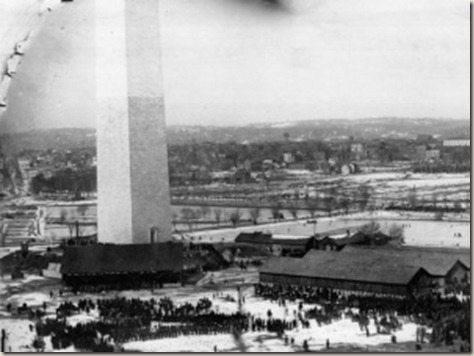
The Washington Monument, built in honor of America’s revolutionary hero and first president, is dedicated in Washington, D.C.
The 555-foot-high marble obelisk was first proposed in 1783, and Pierre L’Enfant left room for it in his designs for the new U.S. capital. After George Washington‘s death in 1799, plans for a memorial for the “father of the country” were discussed, but none were adopted until 1832–the centennial of Washington’s birth. Architect Robert Mills’ hollow Egyptian obelisk design was accepted for the monument, and on July 4, 1848, the cornerstone was laid. Work on the project was interrupted by political quarreling in the 1850s, and construction ceased entirely during theAmerican Civil War. Finally, in 1876, Congress, inspired by the American centennial, passed legislation appropriating $200,000 for completion of the monument.
In February 1885, the Washington Monument was formally dedicated, and three years later it was opened to the public, who were permitted to climb to the top of the monument by stairs or elevator. The monument was the tallest structure in the world when completed and remains today, by District of Columbia law, the tallest building in the nation’s capital.
In our state’s history, in on 2.21.1918, a sound rejection of efforts to stifle political dissent:
1918 – Denunciation of LaFollette rejected by Assembly
On this day, a move to denounce Sen. Robert LaFollette and the nine Wisconsin congressmen who refused to support World War I failed in the State Assembly, by a vote of 76-15. Calling LaFollette “disloyal,” the amendment’s originator, Democrat John F. Donnelly, insisted that LaFollette’s position did not reflect “the sentiment of the people of Wisconsin. We should not lack the courage to condemn his actions.” Reflecting the majority opinion, Assemblyman Charles F. Hart retorted that “The Wisconsin State Legislature went on record by passing a resolution telling the President that the people of this state did not want war. Now we are condemning them for doing that which we asked them to do.” [Source: Capital Times 2/21/1918, p.1]
Google-a-Day asks a question of geography (and local folklore): “Which landmark pictured on Segovia’s coat of arms is believed by local legend to have been built by the devil?”
Elections
Politics in Whitewater, Wisconsin: The February Supreme Court Primary
by JOHN ADAMS •
Across Wisconsin on Tuesday, voters narrowed the Wisconsin Supreme Court field (Justice Patience Roggensack, Prof. Ed Fallone, and Atty. Vince Megna) from three candidates down to two. April will see a contest between Roggensack and Fallone.
Look at these results, and one sees something about the political future of the city.
Justice Roggensack did well, and received about 64% of the vote statewide, to about 36% for her two challengers (one moderate-liberal, the other liberal).
That statewide total for Roggensack is the mark by which the candidates’ showings locally should be measured: across all the state, she received more than 6 in 10 votes from a light turnout.
Roggensack also received a majority from among yesterday’s City of Whitewater voters.
Yet, for it all, the City of Whitewater’s results show that citywide, the conservative, incumbent justice underperformed her statewide total
Within Whitewater, considering results from Walworth and Jefferson counties, Roggensack received (unofficially) 292 votes to 242 for Fallone (W 187, J 14) and Megna (W 40,J 1) combined.
In the City of Whitewater, the margin betwen left and right (and that’s what it truly is, left v. right) was 54.7% as against 45.3%.
That’s more than a 9-point swing each for left and right, or over 18 points closer in Whitewater than in all Wisconsin.
It was a good day for the right statewide, but not as good in Whitewater, even with a low-interest, low-turnout primary that might have favored a conservative candidate. In other parts of the state, conservatives were able to do far better, and outperform even Roggensack’s solid statewide average.
Conservatives do well in Wisconsin (often an understatement), but conservatives within the city don’t perform at those same high levels.
It’s a college town, surely, but reduced margins – over time – take a toll.
Tomorrow: Looking at the last few general elections in Whitewater, and what both right and left could do to boost their prospects here.
Food, Restaurant, Review
Restaurant Review: Whitewater’s Lakefront Pub
by JOHN ADAMS •
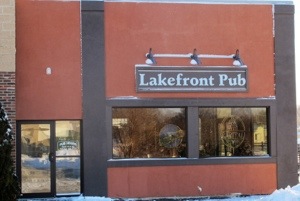
Whitewater, Wisconsin is a college town with a plentiful selection of bars, but a suitable pub with good food, a wide selection of beers, and a congenial atmosphere is always hard to find. Those in, or visiting, Whitewater would find that experience at the Lakefront Pub, named for its location along Cravath Lake in downtown Whitewater.
The Lakefront Pub offers a tavern’s menu, and more: a full bar, burgers, chicken and fish sandwiches, several full entrées, appetizers of all kinds, but salads, too. Patrons will find excellent draft beers, mixed drinks of their choice, and a generous wine selection for a pub. (Where sometimes there are practically no wine selections at a tavern, and definitely nothing worth considering, you’ll find suitable offerings at the Lakefront Pub.)
Walk in, and one discovers a full bar, with seating for fifteen at the bar, about ten interior tables, and I’d guess a dozen patio tables overlooking Cravath for warmer-weather dining. Seating is comfortable: you’ll find yourself with ample space between tables for a more causal experience.
It’s a sharp and attractive bar, too. Dark wood as one would expect, but impressive in a room that’s been designed with care. The lighting is conventional, low without being too dark, with fixtures that complement an antiqued, attractive industrial ductwork.
The logo of the establishment, a small red fish skeleton, appears on the mirrors by the bar, and on the tables of the pub. It says something – something good – that the proprietor (Christ Christon) thought about the establishment as a brand, with a definite look and feel. One can see that thought and care went into the design.
American pubs don’t offer food if they don’t offer burgers: a good pint and a burger are the foundation on which the experience rests. The burgers are large, prepared as you’d like them, with an accompanying side (pub chips), or an alternative for an additional charge. I found my burger properly cooked, suitably juicy without being underdone, and in a generous portion.
The pub chips are fine, but I’d recommend sweet potato fries for a slight, additional charge. They’re a personal favorite, at any establishment: they’re a sweeter accompaniment, their texture is softer, and so closer to a burger’s.
I’ll mention, in particular, a selection of a salmon sandwich on my second visit, while my companion selected a salad. Although salmon’s an easy fish to prepare (especially as a sandwich), fish is always a good test of a menu: one goes wrong with fish very quickly. In my experience, the salmon was (to use an expression that should summarize one’s experience of pub fare) tasty.
Here’s what made the sandwich yet better: while taking my order, our server mentioned that the salmon was prepared with a particularly spicy sauce. She asked if I’d like it that way. That’s the right practice: one may prepare as one wishes. If the patron knows that there’s something particular about the preparation of the meal, he can accept or decline the unique preparation.
A meal’s not a quiz – one shouldn’t be guessing, or be stumped by what one finds.
That’s a confident kitchen: one can have the sandwich with or without spices. Here one sees not just a friendly, but an attentive, waitress: aware of the offerings and offering an alternative to patrons.
A pub only has salads, needless to say, if it has a larger kitchen nearby, and that’s true of the Lakeront Pub: it shares a full kitchen with the Whitewater Street Restaurant.
Both of my experiences with dining companions (dinner, lunch) saw those with me pleased in their selections (salad, chicken wrap, fish).
I was curious, though, how the experience might seem to a patron dining alone. So I made a third visit, and chose to eat at a table, rather than the bar (as a sole patron typically would). It’s hard to tell, but the reaction of the staff suggested that they don’t have many patrons who order dinner, and then sit by themselves at a table while dining.
They were friendly and attentive, though, and that’s what underlay my curiosity: how friendly was the pub to just one diner? It may seem odd to those who are adventuresome, but sometimes a pub will intimidate someone not familiar with the atmosphere. (Longtime readers can guess that worrying about these things is not a concern of mine, but it is for some people.)
Diners may be reassured: the Lakefront Pub is a friendly place, and the experience will prove comfortable and enjoyable whether with a group or on your own.
Easily recommended.
Enjoy.
LOCATION: 111 W. Whitewater Street, Whitewater, WI 53190 (262) 473-2920 See, Google Maps.
OPEN: Daily, with grill available until 10 PM.
PRICES: Burger, sides, and a pint available for about $13.
RESERVATIONS: Unnecessary.
DRINKS & WINE: Full bar, with wide selection of imported and domestic beer, plentiful choices on tap, conktails, and wine.
SOUND: Music at a moderate level – conversation at one’s table is comfortable.
SERVICE: Friendly, attentive, casually-attired (as one would expect for a pub).
VISITS: Three for this review, two with dining companions (lunch, dinner), and one without (dinner).
RATING: Recommended.

RATING SCALE: From one to four stars, representing the full experience of food, atmosphere, service, and pricing.
INDEPENDENCE: This review is delivered without financial or other connection to the establishment or its owner. The dining experience was that of an ordinary patron, without notice to the staff or requests for special consideration.
Daily Bread
Daily Bread for 2.20.13
by JOHN ADAMS •
Good morning.
It’s a sunny but chilly Wednesday in the Whippet City, with clear skies and a high of sixteen. Wind chill measures will be between -5 and -15.
One could imagine a pod of dolphins miles long, stretching across a vast expanse of water, but that’s not necessary. Imagination not required: there’s video of just such an amazing sight. KTLA in Los Angeles has footage of thousands of dolphins swimming near San Diego [updated with alternative video]:
On this day in 1962, John Glenn, later a U.S. Senator from Ohio, is the first American to orbit the Earth:

From Cape Canaveral, Florida, John Hershel Glenn Jr. is successfully launched into space aboard the Friendship 7 spacecraft on the first orbital flight by an American astronaut.
Glenn, a lieutenant colonel in the U.S. Marine Corps, was among the seven men chosen by the National Aeronautics and Space Administration (NASA) in 1959 to become America’s first astronauts. A decorated pilot, he flew nearly 150 combat missions during World War II and the Korean War. In 1957, he made the first nonstop supersonic flight across the United States, flying from Los Angeles toNew York in three hours and 23 minutes.
Glenn was preceded in space by two Americans, Alan B. Shepard Jr. and Virgil I. “Gus” Grissom, and two Soviets, Yuri A. Gagarin and Gherman S. Titov. In April 1961, Gagarin was the first man in space, and his spacecraft Vostok 1 made a full orbit before returning to Earth. Less than one month later, Shepard was launched into space aboard Freedom 7 on a suborbital flight. In July, Grissom made another brief suborbital flight aboard Liberty Bell 7. In August, with the Americans still having failed to make an orbital flight, the Russians sprinted further ahead in thespace race when Titov spent more than 25 hours in space aboard Vostok 2,making 17 orbits. As a technological power, the United States was looking very much second-rate compared with its Cold War adversary. If the Americans wanted to dispel this notion, they needed a multi-orbital flight before another Soviet space advance arrived.
It was with this responsibility in mind that John Glenn lifted off from the launch pad at Cape Canaveral at 9:47 a.m. on February 20, 1962. Some 100,000 spectators watched on the ground nearby and millions more saw it on television. After separating from its launching rocket, the bell-shaped Friendship 7 capsule entered into an orbit around Earth at a speed of about 17,500 miles per hour. Smoothing into orbit, Glenn radioed back, “Capsule is turning around. Oh, that view is tremendous.”
During Friendship 7‘s first orbit, Glenn noticed what he described as small, glowing fireflies drifting by the capsule’s tiny window. It was some time later that NASA mission control determined that the sparks were crystallized water vapor released by the capsule’s air-conditioning system. Before the end of the first orbit, a more serious problem occurred when Friendship 7‘s automatic control system began to malfunction, sending the capsule into erratic movements. At the end of the orbit, Glenn switched to manual control and regained command of the craft.
Toward the end of Glenn’s third and last orbit, mission control received a mechanical signal from the spacecraft indicating that the heat shield on the base of the capsule was possibly loose. Traveling at its immense speed, the capsule would be incinerated if the shield failed to absorb and dissipate the extremely high reentry temperatures. It was decided that the craft’s retrorockets, usually jettisoned before reentry, would be left on in order to better secure the heat shield. Less than a minute later, Friendship 7 slammed into Earth’s atmosphere.
During Glenn’s fiery descent back to Earth, the straps holding the retrorockets gave way and flapped violently by his window as a shroud of ions caused by excessive friction enveloped the spacecraft, causing Glenn to lose radio contact with mission control. As mission control anxiously waited for the resumption of radio transmissions that would indicate Glenn’s survival, he watched flaming chunks of retrorocket fly by his window. After four minutes of radio silence, Glenn’s voice crackled through loudspeakers at mission control, and Friendship 7splashed down safely in the Atlantic Ocean. He was picked up by the USS destroyer Noa, and his first words upon stepping out of the capsule and onto the deck of the Noa were, “It was hot in there.” He had spent nearly five hours in space.
Glenn was hailed as a national hero, and on February 23 President John F. Kennedy visited him at Cape Canaveral. He later addressed Congress and was given a ticker-tape parade in New York City.
Google-a-Day presents a science question: “What Swedish taxonomist created binomial nomenclature?”
Business, Film, Good Ideas
The Innovator
by JOHN ADAMS •
The Innovator from Cineastas on Vimeo.
Mike Friton is a freelance shoemaker, weaver, paper sculptor and innovator with over 30 years of experience at Nike. His innovations are responsible for many elements of athletic footwear that people wear today. Each of his crafts informs one another and he is constantly exploring the fringes of his field. Mike’s work is a great example of how non-traditional methods of exploring one’s craft can lead to unique end results.
History, Science/Nature
Happy Birthday, Copernicus
by JOHN ADAMS •
Google celebrates Nicolaus Copernicus’s 540th birthday today with a Google Doodle illustrating the heliocentric universe:

Unlike the doodle above, the one on their main search page is animated.
They’ve also a link to search for Copernicus’s scientific accomplishments and investigations of the natural order.