
Public Meetings
Downtown Whitewater
by JOHN ADAMS •
Daily Bread
Daily Bread for 2.11.13
by JOHN ADAMS •
Good morning.
Snow showers and flurries, with no expected accumulation, and a high of thirty-three start our week.
Downtown Whitewater’s board meets today at 8 AM, and Whitewater’s Planning Commission later today at 6 PM.
On this day in 1861, Lincoln leaves for Washington:
On a cold, rainy morning, Lincoln boarded a two-car private train loaded with his family’s belongings, which he himself had packed and bound. His wife, Mary Lincoln, was in St. Louis on a shopping trip, and joined him later in Indiana. It was a somber occasion. Lincoln was leaving his home and heading into the maw of national crisis.
Since he had been elected, seven Southern states had seceded from the Union. Lincoln knew that his actions upon entering office would likely lead to civil war.
He spoke to a crowd before departing: “Here I have lived a quarter of a century, and have passed from a young man to an old man. Here my children have been born, and one is buried. I now leave, not knowing when, or whether ever, I may return, with a task before me greater than that which rested upon Washington. Without the assistance of that Divine Being… I cannot succeed. With that assistance, I cannot fail… To His care commending you, as I hope in your prayers you will commend me, I bid you an affectionate farewell.”
A bystander reported that the president-elect’s “breast heaved with emotion and he could scarcely command his feelings.” Indeed, Lincoln’s words were prophetic—a funeral train carried him back to Springfield just over four years later.
It’s an understatement to say that 2.11.1842 was a low point in Wisconsin’s legislative history:
1842 – Shooting in the Legislature
On this date the Territorial Legislature of Wisconsin met in Madison, only to be interrupted by the shooting of one member by another. The legislature was debating the appointment of Enos S. Baker for sheriff of Grant County when Charles Arndt made a sarcastic remark about Baker’s colleague, James Vineyard. After an uproar, adjournment was declared and when Arndt approached Vineyard’s desk, a fight broke out during which Vineyard drew his revolver and shot Arndt. [Source: Badger Saints and Sinners by Fred L. Holmes]
Google-a-Day offers a history question: “What nation was the source of the missiles found aboard the Yemen-bound unflagged freighter intercepted by the Spanish SPS Navarra on December 9, 2002?”
Recent Tweets, 2.3 to 2.9
by JOHN ADAMS •
Tom Ricks: Will Hagel withdraw? I’d say 50-50 #weakpick http://t.co/gUJa1Xt5
— John Adams (@DailyAdams) February 8, 2013
Ten Things the Latest CBO Report Tells Us about Federal Finances #badnews http://t.co/FiJNGKHJ
— John Adams (@DailyAdams) February 8, 2013
The Achilles Heel of the Drone Memo: who verifies legitimate targets? | Volokh Conspiracy http://t.co/qVPIosRn
— John Adams (@DailyAdams) February 8, 2013
Wi-Fi “as free as air”—the totally false story that refuses to die http://t.co/hy3z08ZT
— John Adams (@DailyAdams) February 8, 2013
Advice for Crony Capitalists: Press Release Tips for the WEDC | FREE WHITEWATER http://t.co/8oSbQwwT
— John Adams (@DailyAdams) February 7, 2013
Hope springs eternal: Will Cutting Saturday Service Kill the Post Office? – Esquire http://t.co/QZYh8rX0 #snailmail
— John Adams (@DailyAdams) February 7, 2013
The next Xbox: Always online, no second-hand games, 50GB Blu-ray discs and new Kinect | Edge Online http://t.co/o1sUOgDl
— John Adams (@DailyAdams) February 7, 2013
In Wisconsin: The best crony-capitalist quasi-public agency taxpayer money can buy http://t.co/so2S6mni
— John Adams (@DailyAdams) February 6, 2013
Spill on Aisle 5: Former Target Store Manager to Oversee Nation's Nuclear Security http://t.co/ULoKpqOa
— John Adams (@DailyAdams) February 6, 2013
Obama’s dicey license to kill #drones http://t.co/yIkH98B3
— John Adams (@DailyAdams) February 6, 2013
The Sad Reality of BlackBerry 10: Not Even Canada Really Wants It http://t.co/IJ9YWy8U
— John Adams (@DailyAdams) February 6, 2013
Anything Goes – Obama Targeted Killing Document: If We Do It, It's Not Illegal http://t.co/4gi1Ax6p
— John Adams (@DailyAdams) February 5, 2013
WI Governor Turns to Public Pensions for Business Subsidies #cronycapitalism http://t.co/5vZeJPHg
— John Adams (@DailyAdams) February 4, 2013
Dutch pilot locked out cockpit while co-pilot slept #badairline http://t.co/jmS1bdqz
— John Adams (@DailyAdams) February 4, 2013
Ravens!
— John Adams (@DailyAdams) February 4, 2013
“@feeonline: Time for some competition in the New Orleans energy industry, eh?”
— John Adams (@DailyAdams) February 4, 2013
Only a matter of time: The Monkey Uprising Has Begun in Saudi Arabia – Atlantic Wire http://t.co/qUzYD6mW
— John Adams (@DailyAdams) February 3, 2013
A Guide to Super Bowl Party Small Talk – Atlantic Wire http://t.co/MYclfL5u
— John Adams (@DailyAdams) February 3, 2013
Cartoons & Comics
Sunday Morning Cartoon: Valentine’s Day Promos, Then and Now
by JOHN ADAMS •
1954, Theater Trailer:
2009, Cartoon Network Promo:
Daily Bread
Daily Bread for 2.10.13
by JOHN ADAMS •
Good morning.
Sunday brings rain or freezing rain, with a high of forty today.
On this day in 1763, it’s the end of the French and Indian War:
The Seven Years’ War, a global conflict known in America as the French and Indian War, ends with the signing of the Treaty of Paris by France, Great Britain, and Spain.
In the early 1750s, France’s expansion into the Ohio River valley repeatedly brought the country into armed conflict with the British colonies. In 1756, the British formally declared war against France.
In the first year of the war, the British suffered a series of defeats at the hands of the French and their broad network of Native American alliances. However, in 1757, British Prime Minister William Pitt (the older) recognized the potential of imperial expansion that would come out of victory against the French and borrowed heavily to fund an expanded war effort. Pitt financed Prussia’s struggle against France and her allies in Europe and reimbursed the colonies for the raising of armies in North America. By 1760, the French had been expelled from Canada, and by 1763 all of France’s allies in Europe had either made a separate peace with Prussia or had been defeated. In addition, Spanish attempts to aid France in the Americas had failed, and France also suffered defeats against British forces in India.
The Seven Years’ War ended with the signing of the treaties of Hubertusburg and Paris in February 1763. In the Treaty of Paris, France lost all claims to Canada and gave Louisiana to Spain, while Britain received Spanish Florida, Upper Canada, and various French holdings overseas. The treaty ensured the colonial and maritime supremacy of Britain and strengthened the 13 American colonies by removing their European rivals to the north and the south.
The end of that war brings a change to Wisconsin:
1763 – Treaty of Paris Cedes Wisconsin to England
On this date the Treaty of Paris ceded formerly French-controlled land, including the Wisconsin region, to England. [Source: Avalon Project at Yale University]
Google-a-Day asks about a book proposal’s original title: “When Maurice Sendak first pitched the idea for the book that would eventually become “Where The Wild Things Are”, what was the title?”
Daily Bread
Daily Bread for 2.9.13
by JOHN ADAMS •
Good morning.
A partly sunny Saturday, with a high of thirty-one, lies ahead.
So Monopoly now has a cat playing-piece, and the Daily Show’s Jon Stewart thinks it should have been the robot. There’s still room for an obvious compromise:
At approximately 8:12 p.m. Eastern time, Sunday, February 9, 1964, The Ed Sullivan Show returned from a commercial (for Anacin pain reliever), and there was Ed Sullivan standing before a restless crowd. He tried to begin his next introduction, but then stopped and extended his arms in the universal sign for “Settle Down.” “Quiet!” he said with mock gravity, and the noise died down just a little. Then he resumed: “Here’s a very amusing magician we saw in Europe and signed last summer….Let’s have a nice hand for him—Fred Kaps!”
For the record, Fred Kaps proceeded to be quite charming and funny over the next five minutes. In fact, Fred Kaps is revered to this day by magicians around the world as the only three-time Fédération Internationale des Sociétés Magiques Grand Prix winner. But Fred Kaps had the horrific bad luck on this day in 1964 to be the guest that followed the Beatles on Ed Sullivan—possibly the hardest act to follow in the history of show business.
It is estimated that 73 million Americans were watching that night as the Beatles made their live U.S. television debut. Roughly eight minutes before Fred Kaps took the stage, Sullivan gave his now-famous intro, “Ladies and gentlemen…the Beatles!” and after a few seconds of rapturous cheering from the audience, the band kicked into “All My Lovin’.” Fifty seconds in, the first audience-reaction shot of the performance shows a teenage girl beaming and possibly hyperventilating. Two minutes later, Paul is singing another pretty, mid-tempo number: “Til There Was You,” from the Broadway musical Music Man. There’s screaming at the end of every phrase in the lyrics, of course, but to view the broadcast today, it seems driven more by anticipation than by the relatively low-key performance itself. And then came “She Loves You,” and the place seems to explode. What followed was perhaps the most important two minutes and 16 seconds of music ever broadcast on American television—a sequence that still sends chills down the spine almost half a century later.
On this day in 1870, a dream of Wisconsin naturalist Increase Lapham comes true:
1870 – National Weather Service Authorized
On this date President Ulysses S. Grant signed a joint resolution authorizing a National Weather Service, which had long been a dream of Milwaukee scientist Increase Lapham. Lapham, 19th-century Wisconsin’s premier natural scientist, proposed a national weather service after he mapped data contributed over telegraph lines in the UpperMidwest and realized that weather might be predicted in advance. He was concerned about avoiding potential disasters to Great Lakes shipping and Wisconsin farming, and his proposal was approved by Congress and authorized on this date. [Source: History Just Ahead: A Guide to Wisconsin’s Historical Markers, edited by Sarah Davis McBride]
Google-a-Day asks a question of geography and art: “In what European capital can you view the city’s first nude statue by Sir Richard Westmacott erected in 1822?”
Film, Hip & Prosperous, New Whitewater
The Whitewater Premiere of Heavy Hands: Sunday, 2.10.13 @ 7 PM
by JOHN ADAMS •
Supporters of independent filmmaking helped fund Sean Williamson’s Heavy Hands through Kickstarter.
His film will have a local premiere on Sunday, February 10th at 7 P.M. Following a December showing in Milwaukee, the film will be screened at here in Sommers Theater at UW-Whitewater.
Heavy Hands tells the story of “anti-hero Jimmy Lee as he deals with the ramifications of a careless and selfish act. Set in a cold and dangerous country climate, Heavy Hands is funny, sad and sexy.”
Film critic Matt Wild, writing at the AV Club, offers praise for Williamson’s work:
Though only an hour long, Heavy Hands tells its story at a leisurely pace, finding time for picturesque respites and unexpected cameos from the The Royal Tenenbaums’ Kumar Pallana and Milwaukee’s own Mark Borchardt and Frankie Latina. (Milwaukee groups Jaill, Hello Death, Hot Coffin, and Altos provide the soundtrack.) The film’s cinematography—handheld and mostly utilitarian—owes a debt to the earlier work of Jim Jarmusch, though a few scenes, like Jimmy’s fateful camping trip and a walk through a haunted house, are surprisingly lyrical. But it’s the film’s experimental, avant-garde bent that leaves the greatest impression. Heavy Hands may bill itself as cowpoke crime drama full of bleak landscapes and tortured souls, but, like all good experimental films, it’s really about the power of film—honest-to-God film—itself.
An extended trailer appears immediately below:
Cats
Friday Catblogging: Monopoly
by JOHN ADAMS •

Update 2.8.13: Jon Stewart (inexplicably) wanted the robot:
Stay for the whole video, and you’ll hear what he has to say (hilariously) about the Post Office… more >>
Poll
Friday Poll: Asteroids
by JOHN ADAMS •
On 2.15.13, an asteroid the size of an office building will pass very close to the Earth. It’s a close encounter of a kind that happens only rarely:
It will be the nearest recorded brush with a space rock so large, NASA scientists said Thursday.
(The Washington Post/NASA) – A chunk of rock about half the length of a football field — travelling at almost 5 miles per second — will pass about 17,200 miles from Earth on Friday.
The good news: There’s no chance of an impact. At its closest, asteroid 2012 DA14 will pass about 17,000 miles above Earth.
The bad news: A million other potentially dangerous — and unknown — city-killing space rocks are out there, and one of them could be on a collision course with Earth. Critics say NASA and other space agencies are not doing enough to scan for these threats.
“It’s like Mother Nature sending a warning shot across our bow,” said Don Yeomans, who tracks asteroids for the Jet Propulsion Laboratory in Pasadena, Calif.
So, Asteroids: Big Problem or Not Worth Worrying Over?
I’m in the Not Worth Worrying Over category, as I think we’ve the time and will develop the technology to manage these risks.
What do you think?
Daily Bread
Daily Bread for 2.8.13
by JOHN ADAMS •
Good morning.
Whitewater’s work week ends with decreasing clouds turning into a mostly sunny day, with a high of twenty-six. We’ll have 10h 16m of sunlight and 11h 14m of daylight. Tomorrow will bring two minutes more light.
Next week, an asteroid the size of an office building will pass very close the Earth. It’s a close encounter of a kind that happens only rarely:
It will be the nearest recorded brush with a space rock so large, NASA scientists said Thursday.
(The Washington Post/NASA) – A chunk of rock about half the length of a football field — travelling at almost 5 miles per second — will pass about 17,200 miles from Earth on Friday.
The good news: There’s no chance of an impact. At its closest, asteroid 2012 DA14 will pass about 17,000 miles above Earth.
The bad news: A million other potentially dangerous — and unknown — city-killing space rocks are out there, and one of them could be on a collision course with Earth. Critics say NASA and other space agencies are not doing enough to scan for these threats.
“It’s like Mother Nature sending a warning shot across our bow,” said Don Yeomans, who tracks asteroids for the Jet Propulsion Laboratory in Pasadena, Calif.
On this day in 1918, a military newspaper resumes publication:
…the United States Army resumes publication of the military newsletter Stars and Stripes.
Begun as a newsletter for Union soldiers during the American Civil War, Stars and Stripes was published weekly during World War I from February 8, 1918, until June 13, 1919. The newspaper was distributed to American soldiers dispersed across the Western Front to keep them unified and informed about the overall war effort and America’s part in it, as well as supply them with news from the home front.
The front page of the newspaper’s first World War I issue featured A Message from Our Chief, a short valedictory from General John J. Pershing, commander in chief of the American Expeditionary Force (AEF):
“The paper, written by the men in the service, should speak the thoughts of the new American army and the American people from whom the army has been drawn. It is your paper. Good luck to it.”
The World War I-era Stars and Stripes was largely the creation of Second Lieutenant Guy T. Viskniskki, an AEF press officer and former censor at the American Field Test Headquarters in Neufchateau, France. Featuring news articles, sports news, poetry, letters to the editor and cartoons, among other content, the eight-page weekly publication was printed on presses that had been borrowed from Paris newspapers. Viskniskki’s staff was made up mostly of enlisted men and featured prominent journalists like Harold Ross, future co-founder of The New Yorker magazine, Alexander Woollcott, a former drama critic for The New York Times, and Grantland Rice, who went onto become known as the dean of American sports writers. At its peak during the war, Stars and Stripes reached a circulation of 526,000.
On this day in 1858, a Wisconsin Congressman picks a fight:
1858 – Wisconsin Congressman Starts Fight in Legislature
Just before the Civil War, the issue of slavery tore apart the U.S. Congress. On February 8, 1858, Wisconsin Rep. John Potter (considered a backwoods hooligan by Southern aristocrats) leaped into a fight on the House floor. When Potter embarrassed a pro-slavery brawler by pulling off his wig, the gallery shouted that he’d taken a Southern scalp. Potter emerged from the melee covered in blood and marked by slave owners as an enemy.Two years later, on April 5, 1860, he accused Virginia Rep. Roger Pryor of falsifying the Congressional record. Pryor, feeling his character impugned, challenged Potter to a duel. According to Southern custom, a person challenged had the right to choose weapons.
Potter replied that he would only fight with “Bowie knives in a closed room,” and his Southern challenger beat a hasty retreat. Republican supporters around the nation sent Potter Bowie knives as a tribute, including this six-foot-long one. [Source: Badger Saints and Sinners by Fred L. Holmes]
Google-a-Day poses a question of pop culture: “The main character in the Broadway production of “Jersey Boys” was the lead singer for a band that celebrated their first commercial release in what year?”
Anderson, Cartoons & Comics
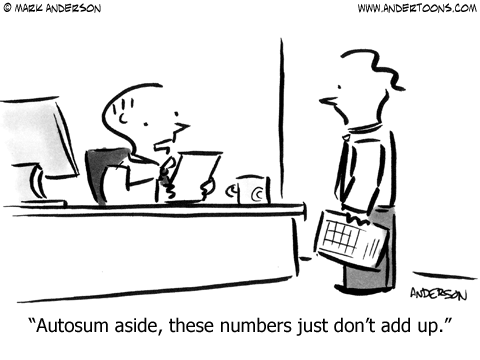
A Numbers Problem
by JOHN ADAMS •
CDA, City, Corporate Welfare, Government Spending, Press Release, State Government
Press Release Tips for the WEDC
by JOHN ADAMS •
Let’s assume you’re a troubled, controversial public-private hybrid agency in Wisconsin, like the Wisconsin Economic Development Corporation. While spending vast sums of public money, you decide to issue a press release announcing taxpayers’ your largesse.
You must know – and hope residents of a small city don’t know — that you’re politically toxic, across the whole political spectrum. For goodness’ sake, a conservative online newspaper from the nationwide Franklin Center is mocking your so-called ‘corporation,’ with lyrics from rap songs:
“Come get money with me, if you curious to see
how it feels to be with a P-I-M-P
Roll in the Benz with me, you could watch TV
From the backseat of my V, I’m a P-I-M-P …
If ever you needed someone, I’m the one you should call
I’ll be there to pick you up, if ever you should fall
If you got problems, I can solve’em, they big or they small”
That’s a damned big PR problem.
So if you’re the WEDC, what should you – in your news release – do or say?
1. Don’t publish the release on the Web, while using the past tense, before the actual ceremony even takes place.
During the Governor’s visit to the Whitewater Innovation Center, the CDA presented Date Check Pro and Got Apps, two area entrepreneurs, the first grants from the fund. The CDA provide both with a $10,000 grant to assist the companies in their business development. Click here to read their stories.
Why shouldn’t you do that? Because a blogger might notice on 2.6.13 that you’d released these words ahead of schedule, might prepare a post in reply that same day, and then follow up on 2.7.13 to ridicule your cheesy, canned press release.
2. When the local university chancellor thanks your organization in that cheesy, canned press release, make sure he gets your name right.
So when he thanks “the Wisconsin Economic Development Council,” you might want to remind him that you’re the Wisconsin Economic Development Corporation.
Remember? You’re suposed to have this sounding like a private deal, and use words like corporation and CEO whenever possible. Yeah, it’s really public money, but can’t you at least try to fool people with a consistent use of deceptive terms?
Someone who holds you so close should at least know your name.
3. Ask those you’re quoting to speak matter-of-factly about their own neighbors.
So, if the city manager you’re quoting says that “[w]e are fortunate in Whitewater to have such a proactive, visionary CDA,’ you might want to remind him that ‘visionary,’ sounds absurd from one local person to another.
Visionary? That’s Jonas Salk, or Dr. King, or maybe even a famous science-fiction writer, like Jules Verne. It’s over-the-top and overdone when used to describe one agency to another in the same small city, in the same state.
It sounds silly, and you just never know if someone might point that out, perhaps even on the Web. One way or another, regardless, you can be sure that any normal people reading that flowery description will be thinking it’s silly.
Whitewater, or Wisconsin, or any American city will always deserve better than these clumsy and awkward attempts to hawk crony capitalism.
Next time, you might want to do better.
Daily Bread
Daily Bread for 2.7.13
by JOHN ADAMS •
Good morning.
It’s a day of a wintry mix, and about two to four inches of snow, ahead for Whitewater. Not a bad term ‘wintry mix’ – it’s a quick way of saying sleet, snow, cold rain, all together. Better as a term, of course, than an experience.
The Landmarks Commission is now listed for a meeting tonight at 6 PM, but the weather may yet change their schedule.
On this day in 1984, U.S. astronauts take the first untethered spacewalk:
Houston, Feb. 7 — In a spectacle of bravery and beauty, two American astronauts flew out, up and away from the space shuttle Challenger today. Free of any lifeline and propelled into the dark void by tiny jets, they became, in effect, the first human satellites.
The successful test of the propulsion backpacks – a wireless high-wire act 170 miles above the earth – was an important step toward future operations to repair and service orbiting satellites and to assemble and maintain large space stations.
A second test by the same two space fliers, Capt. Bruce McCandless 2d of the Navy and Lieut. Col. Robert L. Stewart of the Army, is scheduled for Thursday morning. They are to practice grappling a large object rotating at the end of the shuttle’s mechanical arm, a dress rehearsal for a mission in April to repair a crippled scientific satellite.
On 2.7.1867, a famous Wisconsin author is born:
1867 – Laura Ingalls Wilder born
Wisconsin’s most famous children’s author, Laura Ingalls Wilder, was born this day near Pepin. Although her family moved away a year later, it subsequently returned in 1870 and remained until 1874. It is this period that is immortalized in her first book, Little House in the Big Woods. [Source: Dictionary of Wisconsin History]
Google-a-Day aska about a famous author: “Though he created one of the most popular, classic works in the English language, who died in 1400 and was buried in Poet’s Corner, but never made a living as a writer?”