FREE WHITEWATER

Engagement and Engagement-Engagement

Sometimes, as a matter of emphasis, people repeat a word – so a big tree becomes a big-big tree, and something sweet becomes sweet-sweet. The repetition of the adjective suggests an exceptional thing – more intense or more significant.

In this way, there might be both engagement and engagement-engagement. In this first situation, there’s some involvement in an issue or discussion; in the second situation, there’s ongoing involvement beyond the moment.

One can offer a guess about Whitewater, from the presence of a same-ten-person problem for government participation: a controversy might led to engagement with government on an issue, but it may not lead to engagement-engagement (that is, longterm, consistent involvement).

The best indicator of whether someone will respond to government action is whether he or she has responded consistently in the past. That man or woman has a track record; declarations of ongoing action from others who have not engaged consistently are merely promissory.

Daily Bread for 7.27.20

Good morning.

Monday in Whitewater will be partly cloudy with a high of eighty-one.  Sunrise is 5:42 AM and sunset 8:20 PM, for 14h 37m 26s of daytime.  The moon is in its first quarter with 49.5% of its visible disk illuminated.


 Whitewater’s Urban Forestry Commission meets visual conferencing at 4:30 PM, and the Whitewater Unified School Board meets via audiovisual conferencing at 7 PM.

 On this day in 1940, The animated short A Wild Hare is released, introducing the character of Bugs Bunny.

Recommended for reading in full —

 Ron Brownstein writes Trump’s Portland Offensive Fits a Long Pattern:

Trump’s alarms about “angry mobs” and “violent mayhem” in Democratic cities might allow him to recapture some Republican-leaning white suburbanites and energize his rural and small-town support, analysts in both parties told me. But as I’ve written before, his belligerent tone simultaneously risks hardening the opposition he’s facing from the many suburban voters who feel that he’s exposing them to more danger—both in his response to the policing protests and his unrelenting push to reopen the economy despite the coronavirus’s resurgence. In last week’s national Quinnipiac University poll, just over seven in 10 white voters holding at least a four-year college degree disapproved of Trump’s handling of both race relations and the outbreak.

The larger political implication of these battles is to deepen the sense that the nation is hardening into antagonistic camps separated by an imaginary border that circles all of the major population centers, dividing the metropolitan core within from the less densely settled places beyond.

Trump is determined to widen that trench. He is trying to rally red America by portraying blue cities as a threat, and then positioning himself as the human wall against them. Until now, Trump has advanced that divisive vision through rhetoric denouncing cities and through policies that cost them money and influence, such as eliminating the federal deduction for state and local taxes, trying to block Justice Department grants for cities that don’t fully cooperate with federal immigration authorities, and his renewed efforts to strip undocumented immigrants from the census.

The Washington Post editorial board writes Schools are moving toward closing for the fall. That is not their fault:

The White House has made it unmistakably clear that it wants schools to open this year with full in-person instruction, and that nothing — least of all the science — should stand in the way. But the actual decisions on whether to allow children back into the classroom are thankfully being made not by a president hellbent on making a political point, but by school officials who are listening to public health experts and consulting with members of their communities. Many of them are coming to the reluctant conclusion that the failure to contain the novel coronavirus — something that actually is the responsibility of President Trump’s administration — makes it unwise to return children to the classroom.

….

 If Mr. Trump wanted to take constructive action to get children back in the classroom, he would put in place the testing and other safeguards needed to control the virus rather than just browbeating the Centers for Disease Control and Prevention into becoming a cheerleader for his political agenda or trotting out his education secretary with absurd theories of how children actually block the virus.

Plant-based meats: More global food giants now developing plant protein alternatives:

more >>

Daily Bread for 7.26.20

Good morning.

Sunday in Whitewater will be partly cloudy with a high of eighty-nine.  Sunrise is 5:41 AM and sunset 8:21 PM, for 14h 39m 29s of daytime.  The moon is a waxing crescent with 38.2% of its visible disk illuminated.


 On this day in 1775, the office that would later become the United States Post Office Department is established by the Second Continental Congress.

Recommended for reading in full —

 David A. Fahrenthold, Joshua Partlow, and Jonathan O’Connell report Spin, deride, attack: How Trump’s handling of Trump University presaged his presidency:

The judge was out to get him, he said. So was that prosecutor in New York, whom he called a dopey loser on a witch hunt. So were his critics, who he said were all liars. Even some of his own underlings had failed him — bad people, it turned out. He said he didn’t know them.

Now, he was trying to attack his way out, breaking all the unwritten rules about the way a man of his position should behave. The secret to his tactic: “I don’t care” about breaking the rules, Trump said at a news conference. “Why antagonize? Because I don’t care.”

That was 2016. He was talking about a real estate school called Trump University.

Trump University, which shut down in 2011 after multiple investigations and student complaints, was treated as a joke by many of Trump’s political opponents — much as they treated Trump Steaks or Trump Vodka. But to those who knew the school well, it wasn’t a joke.

The saga of Trump University showed how far Trump would go to deny, rather than fix, a problem, they said — a tactic they have now seen him reuse as president many times, including now, in the face of a worsening pandemic. For months, President Trump promised something wonderful but extremely unlikely — that the virus would soon disappear.

John Cassidy writes America Is a Country Besieged by Its Own President:

On Wednesday, Tom Ridge, a veteran Republican who served as the governor of Pennsylvania and as the first Secretary of Homeland Security, said that the agency wasn’t established “to be the President’s personal militia.” Ridge added, “Had I been governor even now, I would welcome the opportunity to work with any federal agency to reduce crime or lawlessness in any of the cities. But . . . it would be a cold day in hell before I would consent to a unilateral, uninvited intervention into one of my cities.”

In Chicago, Mayor Lori Lightfoot said that the city would gladly accept federal assistance in fighting crime, but she also issued a warning. “We welcome actual partnership, but we do not welcome dictatorship,” she said. “We do not welcome authoritarianism, and we do not welcome the unconstitutional arrests and detainments of our residents, and that is something I will not tolerate.”

These developments suggest that America as a whole isn’t failing—not yet, anyway. But its system of government, its stated values, and its claims to greatness are all under siege by a President who lacks the moral compass, self-doubt, and respect for historical norms that would restrain another leader.

Why One Man Is Walking Around the World With His Dog:

more >>

Daily Bread for 7.25.20

Good morning.

Saturday in Whitewater will be partly sunny with a high of eighty-eight.  Sunrise is 5:40 AM and sunset 8:22 PM, for 14h 41m 31s of daytime.  The moon is a waxing crescent with 27.4% of its visible disk illuminated.


 On this day in 1999, Robin Yount becomes the first player inducted to the Baseball Hall of Fame in a Brewer’s jersey.

Recommended for reading in full —

Luke Nozicka, Bryan Lowry, and Cortlynn Stark report Barr’s claim of 200 arrests in Kansas City is debunked (‘KC arrests Barr wrongly cited were made months earlier, led to no new federal charges’):

When U.S. Attorney General William Barr announced Wednesday the expansion of federal anti-crime initiatives, he baffled officials in Kansas City with a single statement.

“Just to give you an idea of what’s possible, the FBI went in very strong into Kansas City and within two weeks we’ve had 200 arrests,” Barr said of apprehensions made as part of a new effort called Operation Legend.

But after inquiries from The Star and pushback from local officials, a senior Justice Department official clarified Barr’s comments, saying the 200 figure included state and FBI arrests in joint operations dating back to December as part of another operation, Relentless Pursuit.

Barr’s false claim, livestreamed by the White House, raised questions about the Justice Department’s trustworthiness. And the point Barr apparently was illustrating only grew shakier Thursday as officials in Kansas City clarified further that the arrests that did occur resulted in no new federal charges — with the exception of one case announced earlier this week.

 Dan Alexander and Michela Tinera report How Donald Trump moved millions from his campaign donors to his private business:

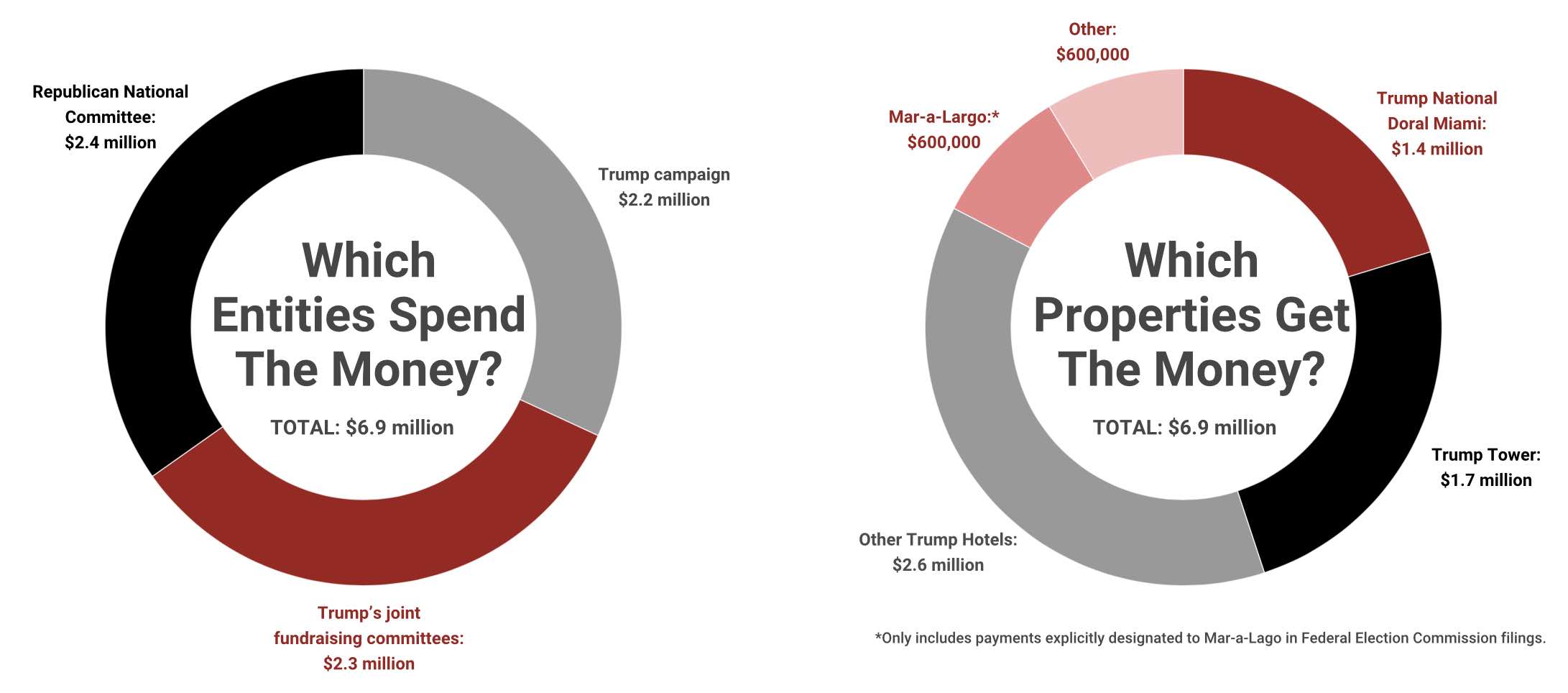
Donald Trump has not given a dime to his reelection campaign, opting instead to fund the entire effort with his donors’ money. His business, meanwhile, has continued to charge the campaign for things like food, lodging and rent. The result is that $2.2 million of contributions from other people has turned into $2.2 million of revenue for Trump.

And that’s just counting the money flowing directly through the president’s campaign. His reelection apparatus also includes two joint fundraising committees, which work with the Republican Party to raise money for Trump. Since he took office, those entities—named Trump Victory and the Trump Make America Great Again Committee—have funneled another $2.3 million into the president’s private business, according to a review of Federal Election Commission records. Then there’s the Republican National Committee, which has spent an additional $2.4 million at Trump properties. Add it all up, and the president, working in concert with the party he leads, has helped push $6.9 million into his businesses since taking office.

It’s a meaningful sum, even for a large business. Consider the payments to Trump National Doral, the president’s golf resort in Miami. In 2017, Trump’s first year leading the country, revenues at Doral dropped from $88 million to $75 million, dragging profits (measured as earnings before interest, taxes, depreciation and amortization) down from $12.4 million to just $4.3 million. The next year, the RNC, which had spent just $3,000 at the property in 2017, upped its expenditures to $603,000. That helped give a slight boost to the business, which recorded 2018 profits of $9.7 million, according to a spokesperson for the Trump Organization.

Video from Space – Weekly Highlights for the Week of July 19, 2020:

more >>

Daily Bread for 7.24.20

Good morning.

Friday in Whitewater will be partly sunny with a high of eighty-four.  Sunrise is 5:39 AM and sunset 8:23 PM, for 14h 43m 30s of daytime.  The moon is a waxing crescent with 17.5% of its visible disk illuminated.


 On this day in 1969, Apollo 11 splashes down safely in the Pacific Ocean.

Recommended for reading in full —

Anne Applebaum writes The president is deploying the kind of performative authoritarianism that Vladimir Putin pioneered:

The very idea seems, on the face of it, sheer madness. In Portland, Oregon, federal security officers dressed for combat—wearing jungle-camouflage uniforms with unclear markings, carrying heavy weapons, using batons and tear gas—are patrolling the streets, making random arrests, throwing people into unmarked vans. The officers do not come from institutions that specialize in political crowd control. Instead, they come from Customs and Border Protection, Immigration and Customs Enforcement, the Transportation Security Administration, and the Coast Guard. These are people with experience patrolling the border, frisking airline passengers, and deporting undocumented immigrants—exactly the wrong sort of experience needed to carry out the delicate task of policing an angry political protest.

….

Students of modern dictatorship will find these tactics wearily familiar. Russian President Vladimir Putin, whom Trump admires, has deployed performative authoritarianism, alongside other tools, in order to keep himself in power for many years now. In 2014, during a political crisis in Ukraine, he created an elaborate media narrative that equated Ukrainian democracy protesters with 1940s fascists. Russian state television showed scenes of violence over and over again—scenes that Putin himself had helped create, first by encouraging the former Ukrainian president to shoot at demonstrators, and then by invading the country. He sent troops in unmarked uniforms—the infamous “little green men”—into Crimea and eventually eastern Ukraine to “dominate” the situation, to use Trump’s own word for his tactics in Portland. Or at least that was the way it was meant to look on TV.

Lt. Gen. (retired) Mark Hertling writes I helped build a police force in Iraq. We refused to dress them in camo:

We were rapidly expanding our recruiting and training of future Iraqi police officers so we could put thousands in the cities quickly, but the interior minister — the Baghdad official charged with growing the nascent police force — couldn’t get us the large number of uniforms we needed for those we were graduating. The minister asked if we would accept camouflage outfits instead of police uniforms for the graduates, and he asked if we would also accept unmarked pickup trucks for service as police cruisers.

“Tell him, ‘Hell, no,’” the MP commander told me emphatically. When I asked why, he explained the history of the blue police uniform, as well as the psychological role that a uniform plays in law enforcement. The traditional “blues” started with the London “bobbies” of the early 1800s, whose uniforms were designed to distinguish the British police force from the British military. Our nation’s first organized police, in New York, continued this tradition in the 1850s, numerous other American cities followed suit, and now most nations associate the police officer with blue uniforms.

Myriad studies have shown interesting results: For example, some research shows citizens adjust behaviors when someone wearing a police uniform is nearby; others show that police uniforms are most likely to “induce feelings of safety” when compared to other uniforms or civilian clothes, and those wearing a blue uniform receive a high rate of cooperation when asked to perform a task. Wearing camouflage uniforms, our division MP commander said, would send the wrong message, especially in a society where neither the U.S. nor the Iraqi military was yet trusted by the population.

How CBS News covered the Apollo 11 splashdown:

more >>

Donald Trump’s Niece on Her Bestselling Family Account

After the Trump family went to court to stop the book—and lost—it was published last week and has reportedly sold a million copies. This memoir/psychological dissection, “Too Much and Never Enough: How My Family Created the World’s Most Dangerous Man,” is a harrowing account of a man and a clan shaped by ego, rivalry, the pursuit of wealth, and profound pathology.

Mary Trump’s depiction of her uncle as a broken human being—broken by his father, Fred, a ruthless patriarch with sociopathic traits—is more explanatory than revelatory. She doesn’t show us a Trump we haven’t already seen. But she explains how and why he became a person more concerned about his TV ratings than the deaths of 140,000 fellow Americans.


The Whitewater Unified School District’s Proposed Fall Instructional Plans

Last night (7.22), the Whitewater Unified School District held a virtual meeting to describe a fall instructional proposal to be presented to the district’s school board on 7.27.20. The meeting was interrupted, and so the district published today (7.23) a video describing the proposal. Embedded above is that video presentation. (There was an earlier, recorded parent focus group on 7.8.20, about which I have posted. See Whitewater Schools’ Community Focus Group, 7.8.20)

Generally, the proposal calls for primarily virtual instruction from September 1 to 29, with limited face-to-face instruction (including orientation before the school year begins).  (Video, beginning at 9:10.) There would be re-evaluation thereafter, with the hope of increasing face-to-face instruction time. All students would be provided during this time a Chromebook model varying by grade level, with technology support.

There are choices before the board about food service, with three options running from in-classroom meals, and meals for virtual learners. (Video, 20:40.)

There’s an effort – still in planning – for after-school childcare options. (Video, 24:10.)

A tiered athletic plan has begun already, one that extends into the period of this proposal. (Video 30:55.)

A few remarks —

. 1. Uncertainty Calls for Caution. It’s an understatement to say that these are difficult times, and a public health threat is made worse for Whitewater by existing economic problems. This small community has, among its residents, different populations, with different daily occupations, living close to each other. For the community to fare well during a pandemic, a cautious approach is justified. It’s reason, not fear, that recommends this approach. A rushed return would not evince strength, but instead weakness.

. 2. Provison of Food. Which food-service model of the three the district recommends matters less than that adequate nutrition is issued in safe condition. It’s also necessary, as the plan provides, that virtual learners receive their school meals. That accomplishment alone would be a gain to the community — public schools in Whitewater play a critical role in assuring children are properly fed.

3. The School Board. While a cautious approach (like this one) is rational, whether this school board will embrace that approach in the face of pressure is a bet a sensible person would be reluctant to wager. These board members have not had to make a decision this important during their tenures. 

 4. Open Government. It’s regrettable that the community presentation last night was interrupted, but the best approach is always to review a video (or document) fully oneself. The recording from today gives residents an opportunity to do so. 

Daily Bread for 7.23.20

Good morning.

Thursday in Whitewater will be partly cloudy with a high of seventy-six.  Sunrise is 5:38 AM and sunset 8:24 PM, for 14h 45m 27s of daytime.  The moon is a waxing crescent with 9.6% of its visible disk illuminated.


Whitewater’s Community Development Authority meets via audiovisual conferencing at 5:30 PM.

 On this day in 1903, Ford Motor Company sells its first car.

Recommended for reading in full —

Quinta Jurecic and Benjamin Wittes write Nothing Can Justify the Attack on Portland:

So why is the Trump administration sending into American cities officers who aren’t appropriately trained for the mission, are acting on legal authority that will require litigation to defend, and are being deployed to address a problem that the federal government could address by means far less provocative and in a fashion far less likely to escalate disorder?

The answer is unfortunately obvious. Having given up on controlling the pandemic that has now killed more than 140,000 Americans, and faced with dimming reelection prospects, Trump is doing his best to substantiate the tough-guy vision of the presidency that has always appealed to him. During earlier stages of his administration, he played out this fantasy along the southern border of the United States by deploying troops to the American Southwest and warning about “caravans” of travelers illegally entering the country. Now, as officers typically tasked with enforcing the border have been deployed into Portland, Trump’s apocalyptic warnings about the need for a brutal response to any perceived threat have also moved from the edge of the country into American cities.

Josh Barro writes The Economy Won’t Be Recovering Anytime Soon:

Real-time data from the Opportunity Insights Economic Tracker, sponsored by Harvard and Brown universities and the Bill & Melinda Gates Foundation, shows that consumer spending remains far above the levels from March and April but stopped rising in mid-June and remains below last year’s levels. The recent retrenchment has been national — consumer-spending growth has stalled not just in COVID hot spots like Texas and Arizona but also in states like New York that are performing much better. That suggests consumers are looking at the big picture rather than reacting to outbreaks in their own area. And the grim outlook for schools’ reopening in the fall will serve as a further drain on the economy, making it tough for parents to resume normal work schedules.

The “V-shaped recovery” that Trump economic adviser Larry Kudlow forecast as recently as July 8 is not in the cards. A double-dip recession is possible, but the most probable outcome right now looks like treading water, with the fast recovery of the late spring turning into a long, slow slog. Fewer jobs will be created, and many businesses will find themselves unable to stay afloat until conditions improve. Exactly how rough the economic recovery will be depends on many variables, but three will be key: the extent and persistence of COVID outbreaks, whether and how robustly Congress extends additional economic aid to workers and businesses, and whether and when an effective vaccine is widely distributed.

COVID19 – The big questions 6 months on:

more >>

Whitewater, Wisconsin’s Temporary Mask Ordinance: 7 Points

Updated evening of 7.22.20 with meeting video. (The discussion on Whitewater’s mask ordinance runs from 31:09 to 3:37:50.)

At last night’s meeting of the Whitewater Common Council, the seven-member council voted unanimously for a temporary mask ordinance, taking effect 8.1.20 and running through 12.31.20, requiring masks in parts of buildings open to the public, and for a few outdoor venues (farmers’ markets, for example, held on Tuesdays and Saturdays). The council waived a second reading of the ordinance. At the request of the Whitewater Unified School District’s new administrator the ordinance will apply to K12 public schools within the city.

A few remarks —

. 1. Science. There is ample evidence that masks are useful to limit the spread of the novel coronavirus. Arguments to the contrary often rely on distortions of data from America and abroad, and false analogies that rely on no data at all. Much – too much – credence has been given to these unfounded counterarguments.

. 2. Liberty Arguments. As I mentioned yesterday, there is a libertarian case – grounded in science, relying on personal responsibility – for wearing a mask. (See About That Proposed, Temporary Mask Ordinance for Whitewater, Wisconsin citing A Libertarian Case for Masks.) One would have preferred (obviously) that an ordinance was not necessary, but here one faces a pandemic that – by its spread – inhibits free association among people. Those who argue that a limited requirement for masks (with exceptions) for a limited time (a pandemic) is an infringement on liberty should consider that the far greater infringement on liberty will come if this pandemic is not stopped before free association among people becomes impossible. The sick and dead do not gather freely in the marketplace; illness and mortality confines them to hospitals and morgues.

3. Widespread Failure of Teaching and Government. If we haven’t taught well – and as a society we haven’t as misinformation easily spreads – we have not elected well, either. At the federal level particularly, we face a flood of lies, misinformation, and selfishness that has made this pandemic vastly worse than it might have been. The most advanced society in all the world has been reduced to the condition of an under-developed, contagion-stricken nation. It’s only through the efforts of thousands of private doctors, healthcare workers, and sensible state and local officials that our situation is not worse. 

4. Public K12 Application. As passed, the ordinance will apply – by not exempting – public K12 buildings within the city. That answers a question for the district, as long as the school board does not request an exemption in an amended municipal ordinance.

This is easily one of the most significant applications of the ordinances, and it makes sense to me.

If a mask requirement is to have value for Whitewater, it will need to apply to large publicly-accessible buildings within the city, including the public schools located here. If the Whitewater School Board retreats on this point, and if the City of Whitewater thereafter relents, the reach of mask requirement will be significantly narrower. Requirements for public buildings in Whitewater – if they’re genuine in their effort to protect public health – shouldn’t have exemptions for densely-populated public facilities. To do otherwise would make an ordinance merely ornamental.

Oddly, a local newspaper story, at the time of this writing,  doesn’t expressly mention this reach. A local website at which the council president describes himself as a staff writer also describes this application only by implication: “Exceptions include….Private K-12 schools, childcare or youth facilities that have a comprehensive safety plan in place.”

5. ‘Communication.’  This ordinance would have sparked less controversy if the case for it had been better made in advance. Instead, the only item in the agenda about the ordinance was the draft itself. Honest to goodness: it was treated beforehand like a hot potato left on a table, to see if it would grow cool enough to touch. It shouldn’t have been presented that way. Most people don’t spend time reading ordinance drafts. Proponents should have shown more work to the public: to have enough confidence in their case to present it with summaries and explanations (e.g., what will this require? and what won’t the draft require?).

Much work will now have to be done in a short time. Preparations should have been more advanced & more public (as part of a proposal).

6. Emails. During the discussion, the council president mentioned that he received something near one-hundred emails about this matter. That might seem like a lot, but it’s not a large number compared to nearby towns with controversial issues. Nearby cities smaller than Whitewater have received more public comments (or attendance) for notable issues they’ve faced. There’s much less engagement in Whitewater than is good for the community, and that the community leaders are willing to admit. 

7. Three Minutes’ Time. If a community has trouble with engagement, it does no good for the council president to ask that commenters not repeat themselves. If commenters’ have three minutes’ time to speak, and they stay on topic, they should be encouraged to use that time however they speak. Perhaps they will repeat themselves, or others: what harm is that compared to the participatory gain? Three minutes – even multiplied by many people – is hardly an imposition on the council’s time. If Sec. Clinton could offer eight hours of testimony under questioning over an eleven-hour span during the Benghazi hearings, others should take her example under their own easier circumstances without that kind of cautionary remark to residents. This isn’t a small point: simply let people talk as they wish.

The mask ordinance is a necessary expedient; implementation and compliance will yet tell the tale.