FREE WHITEWATER

Preliminary Remarks on a 12.15.15 Meeting

WGTB logo PNG 112x89 Post 51 in a series. When Green Turns Brown is an examination of a small town’s digester-energy project, in which Whitewater, Wisconsin would import other cities’ waste, claiming that the result would be both profitable and green.

I’ve had lots of questions about the 12.15.15 Common Council meeting in Whitewater, that discussed waste importation, and a broader wastewater plant upgrade (I’ve now emailed everyone back – thanks much for your inquiries).

I watched the discussion on 12.15, and have reviewed it yet again since then. The full discussion is filled with some very solid assessments from residents and Council, and more than a few inadequate, almost evasive remarks from the municipal administration.  There’s a lot there, both very sound and equally disappointing.

One can categorize the discussion by the three groups that spoke: (1) members of the municipal administration & vendor representatives, (2) residents, and (3) members of Common Council.

On Council, there were excellent questions from many, but one could not overlook that Stephanie Goettl showed a command of the whole project, touching on issues that I’ve not considered or addressed in this more narrowly-focused series. I’m sure that we’d have different opinions on some other subjects, but intelligent, thorough, and focused is always admirable.

Briefly, I’ll say that parts of the discussion, from some members of Council and from two residents (Jeff Knight, Larry Kachel) showed the unmistakable clarity that comes from fundamentals, applied to the project generally and to waste importation (as the particular focus of this series). There’s much to admire in that, truly.  I believe – and do so because it’s so evidently true – that we’re a fortunate town of many talented people with much to offer.

For the municipal administration (that is, city employees and the vendors on whom they’ve relied), it was a tellingly disappointing showing. If one had doubts about waste importation before, there’s more reason to doubt after listening to Messrs. Clapper and Reel, and the vendor representatives.  Candidly, some of the remarks from the city manager and wastewater superintendent call into question whether they grasp key aspects of the project and its consequences.

There’s much to consider, and there yet lingers the possibility that this city’s full-time staff will keep pushing for a waste-importation project with an unfounded, ill-considered enthusiasm.

I’ve notes to review, additional information recently received to consider, and as always more to read. One should, and can afford to be, diligent and methodical.

Here’s the video recording of the 12.15.15 meeting, with most of the evening’s discussion revolving around the wastewater treatment plant –

Common Council Meeting 12/15/2015 from Whitewater Community TV on Vimeo.
 

WHEN GREEN TURNS BROWN: Mondays @ 10 AM, here on FREE WHITEWATER.

New Words About Food

At the New York Times, Julia Moskin writes about The Top New Food Words of 2105. Here are two from her article:

CUISINOMANE (n.) The new official Canadian French word for “foodie,” as determined by the Office québécois de la langue française. This agency is tasked with maintaining French as a living language in Quebec, and is particularly reluctant to adopt words from English. “Cuisinomane” follows the same form as “balletomane” and “bibliomane,” meaning a person who is an obsessive fan of a certain art form….

HANGRY (adj.) The state of being so hungry that you become angry or irritable. (The state itself is not new, of course, but used to be described as “having low blood sugar.”) Added to the online Oxford English Dictionary in 2015.

I’d offer that no one needs an agency to designate official words, but at least cuisinomane has an elegant ring to it; hangry works well because it’s origins as a combination are easily grasped.

For Ms. Moskin’s full list, see ‘Hangry’? Want a Slice of ‘Piecaken’? The Top New Food Words for 2015 @ New York Times.

Daily Bread for 12.17.15

Good morning, Whitewater.

Thursday will be cloudy in the morning, sunny in the afternoon, and will bring a high temperature of thirty-four to Whitewater.  Sunrise is 7:20 and sunset 4:22 for 9h 02m 09s of daytime.  The moon is a waxing crescent with 37.4% of its visible disk illuminated.

It’s Ludwig van Beethoven’s 245th year (he was baptized on this day in 1770), and Google has a doodle in commemoration:


On this day in 1864, a Wisconsinite leads the Union to victory in Texas:

1864 – (Civil War) General C.C. Washburn Takes Texas Port
The Wisconsin State Journal reported on December 17, 1863, that General C.C. Washburn of Wisconsin had led a successful attack on Port Cavalla, Texas, giving Union forces control of Matagorda Bay.

Here’s the Thursday game from Puzzability:

This Week’s Game — December 14-18
Trimming the Tree
We’re adding the decorations to our Christmas tree this week. Each day, we started with a word or phrase, added the eight letters in ORNAMENT, and rearranged the remaining letters to get a new phrase. Both pieces are described in each day’s clue, with the shorter one first.
Example:
Feral; aged personification of the coldest season
Answer:
Wild; Old Man Winter
What to Submit:
Submit both pieces, with the shorter one first (as “Wild; Old Man Winter” in the example), for your answer.
Thursday, December 17
Charles Bronson vigilante film; variety program with the theme song “Everybody Loves Somebody”

At UW-Whitewater, Far More Championship Rings Than Actual Athletes & Coaches

I wrote yesterday of Beverly Kopper’s remark that Richard Telfer’s only weakness was not having enough rings for all his championships.  Needless to say, Richard Telfer had no championships at UW-Whitewater: he wasn’t a coach or athlete.  When I first read Kopper’s remark months ago, it wouldn’t have occurred to me that non-athletes were – literally – building ring collections.

What a disappointment it is to read a Gannett Media investigative report that reveals that our local campus has spent over one-hundred thousand dollars on far more championship rings than the total of all her championship athletes and coaches.   See, from 12.11.15,  UW school pays $112,000 for sports rings @ Gannett Wisconsin Media Investigative Team.

Reporter Keegan Kyle reveals that over two years, UW-Whitewater ordered 376 rings, but had only 230 rostered athletes on those teams.  Even accounting for understandably deserving coaches of those teams, that’s far too many rings.  (Irony of ironies, the only program that ordered fewer rings than rostered athletes was then-Coach Fader’s national runner-up program in 2014: just 4 rings for 25 on the roster.  Honest to goodness, Fader did the right thing in that instance, too.)

American schools are the envy – rightly – of all the world.

They are the envy of the world because they have high standards for achievement, properly accounted to those who have, in fact, achieved.

There’s something both sad and unjustified about Richard Telfer, then-chancellor of a Division III school composed of scholar-athletes, receiving (or UW-Whitewater doling out) championship rings for non-competitors. That some others may do this is an unsatisfying excuse: there’s no good reason to emulate the poor practices of others.

It’s not a violation of NCAA rules, but then it’s embarrassing in a more fundamental way: it’s a misunderstanding about the unique and precious accomplishments of athletes on the playing field, and the coaches who guide them there.

That’s something the former chancellor and I have in common, actually – neither one of us are national championship athletes, and so neither of us deserves a championship ring, let alone many.

Rings should be for players and coaches. The rest of us should be contented supporting those programs, and enjoying their successes, without receiving so singular a symbol of achievement.

Daily Bread for 12.16.15

Good morning, Whitewater.

Today in Whitewater light morning rain gives way to partly cloudy skies and a high of forty-eight. Sunrise is 7:19 and sunset 4:22, for 9h 02m 28s of daytime. The moon is a waxing crescent with 26.8% of its visible disk illuminated.

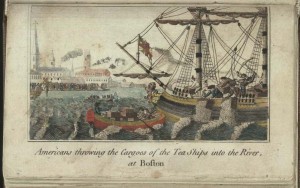
On this day in 1773, Patriots display their feelings for the Tea Act of 5.10.1773:

While Samuel Adams tried to reassert control of the meeting [of protestors], people poured out of the Old South Meeting House to prepare to take action. In some cases, this involved donning what may have been elaborately prepared Mohawk costumes.[61] While disguising their individual faces was imperative, because of the illegality of their protest, dressing as Mohawk warriors was a very specific and symbolic choice. It showed that the Sons of Liberty identified with America, over their official status as subjects of Great Britain.[62]

Boston_Tea_Party-CooperThat evening, a group of 30 to 130 men, some dressed in the Mohawk warrior disguises, boarded the three vessels and, over the course of three hours, dumped all 342 chests of tea into the water.[63] The precise location of the Griffin’s Wharf site of the Tea Party has been subject to prolonged uncertainty; a comprehensive study[64] places it near the foot of Hutchinson Street (today’s Pearl Street)….

Whether or not Samuel Adams helped plan the Boston Tea Party is disputed, but he immediately worked to publicize and defend it.[65] He argued that the Tea Party was not the act of a lawless mob, but was instead a principled protest and the only remaining option the people had to defend their constitutional rights.[66]

By “constitution” he referred to the idea that all governments have a constitution, written or not, and that the constitution of Great Britain could be interpreted as banning the levying of taxes without representation. For example, the Bill of Rights of 1689 established that long-term taxes could not be levied without Parliament, and other precedents said that Parliament must actually represent the people it ruled over, in order to “count.”

On this day in 1864, Wisconsinites win a victory over the Confederacy:

1864 – (Civil War) Battle of Nashville, Tennessee

The 8th, 14th, 24th, 33rd, 44th, and 45th Wisconsin Infantry regiments and the 6th Wisconsin Light Artillery were engaged in the Battle of Nashville, Tennessee. By the end of the day, 6,000 Confederate troops were killed, wounded or missing and Union forces had largely destroyed the Confederate ability to wage war in the region.

Here’s the midweek game in Puzzability‘s Trimming the Tree series:

This Week’s Game — December 14-18
Trimming the Tree
We’re adding the decorations to our Christmas tree this week. Each day, we started with a word or phrase, added the eight letters in ORNAMENT, and rearranged the remaining letters to get a new phrase. Both pieces are described in each day’s clue, with the shorter one first.
Example:
Feral; aged personification of the coldest season
Answer:
Wild; Old Man Winter
What to Submit:
Submit both pieces, with the shorter one first (as “Wild; Old Man Winter” in the example), for your answer.
Wednesday, December 16
Military shoulder decorations; Oscar winner for acting in Reds

The Former Chancellor’s Only Weakness

Months ago, as then-Chancellor Richard Telfer was preparing for retirement, then-Provost Beverly Kopper thought about his career, and spotted only one weakness:

Chancellor Richard Telfer has only one weakness, according to Beverly Kopper, provost at UW-Whitewater.

This weakness isn’t being a bad listener or not being able to do his job.  His weakness is only having 10 fingers.

“Not nearly enough to wear his championship rings,” Kopper said. “An avid supporter of student athletes, since [Telfer] became chancellor, UW-Whitewater Intercollegiate and Club Sports teams have won 22 national championships.”

See, Thirty Years and One Goodbye: University Honors Chancellor Richard Telfer’s Career, http://royalpurplenews.com/thirty-years-and-one-goodbye-university-honors-chancellor-richard-telfers-career/.

I’m tempted to say at least two weaknesses, one of them being a fawning successor whose reflections are obtuse.

Obtuse for two reasons, one lighter, one weightier. The lighter of the two is the implication that a university chancellor in a D3 environment actually earns any championship rings at all. Honest to goodness that’s ridiculous.

Athletes and coaches win championship rings – no one else actually wins anything (regardless of what one takes or receives).

Those who competed so well, and those who coached them to national victories, won those many UW-Whitewater championships – not administrators, administrators’ friends, town notables, etc.

Athletes and coaches.

There’s another way, weightier by far, in which Beverly Kopper’s observation is obtuse: the Telfer Administration squandered millions on an Innovation Center, then still millions more in WEDC money, saw a marked rise in sexual assault complaints at UW-Whitewater, a federal investigation into those complaints, chose a budget-reduction method that emphasized top-down solutions over freely-selected buyouts, saw statewide criticism for use of student informants on campus, and more than once pushed flimsy claims or studies unworthy of serious scholarship.

Many of these problems yet linger.

Those whose families have for so many generations on this continent respected academic accomplishment – and who can easily see that there are many talented students and professors at UW-Whitewater – would likely find the Telfer Administration’s deficiencies serious (and unworthy of a campus that deserved far better).

Only a light person, or one who though her audience was light, would ignore weightier matters for silly and false remarks about Telfer’s only supposed weakness.

As it turns out, however, Kopper’s remark about rings raises a more literal concern.

I’ll post about that, tomorrow.

Daily Bread for 12.15.15

Good morning, Whitewater.

Tuesday in town will be cloudy with a high of forty-two.  Sunrise is 7:18 and sunset 4:21, for 9h 02m 51s.  The moon’s a waxing crescent with 17.9% of its visible disk illuminated.

Whitewater’s Common Council meets tonight at 6:30 PM.

On this day in 1791, ten amendments to the Constitution become law:

On June 8, 1789 Representative James Madison introduced a series of thirty-nine amendments to the constitution in the House of Representatives. Among his recommendations Madison proposed opening up the Constitution and inserting specific rights limiting the power of Congress in Article One, Section 9. Seven of these limitations would become part of the ten ratified Bill of Rights amendments. Ultimately, on September 25, 1789, Congress approved twelve articles of amendment to the Constitution and submitted them to the states for ratification. Contrary to Madison’s original proposal that the articles be incorporated into the main body of the Constitution, they were proposed as supplemental additions (codicils) to it. Articles Three–Twelve were ratified as additions to the Constitution December 15, 1791, and became Amendments One–Ten of the Constitution. Article Two became part of the Constitution May 7, 1992 as the Twenty-seventh Amendment.[1] Article One is technically still pending before the states.

Originally the Bill of Rights applied only to the federal government. The door for their application upon state governments was opened in the 1860s, following ratification of the Fourteenth Amendment. Since the early 20th century both federal and state courts have used the Fourteenth Amendment to apply portions of the Bill of Rights to state and local governments. The process is known as incorporation.[2]

On 12.15.1847, Wisconsin convenes her second constitutional convention:

On this date the first draft of the Wisconsin Constitution was rejected in 1846. As a result, Wisconsin representatives met again to draft a new constitution in 1847. New delegates were invited, and only five delegates attended both conventions. The second convention used the failed 1846 constitution as a springboard for their own, but left out controversial issues such as banking and property rights for women that the first constitution attempted to address. The second constitution included a proposal to let the people of Wisconsin vote on a referendum designed to approve black suffrage. [Source: Attainment of Statehood by Milo M. Quaife]

Here’s the Tuesday game from this week’s Trimming the Tree Puzzability series:

This Week’s Game — December 14-18
Trimming the Tree
We’re adding the decorations to our Christmas tree this week. Each day, we started with a word or phrase, added the eight letters in ORNAMENT, and rearranged the remaining letters to get a new phrase. Both pieces are described in each day’s clue, with the shorter one first.
Example:
Feral; aged personification of the coldest season
Answer:
Wild; Old Man Winter
What to Submit:
Submit both pieces, with the shorter one first (as “Wild; Old Man Winter” in the example), for your answer.
Tuesday, December 15
Brand that used to make Chinese food swing … American; current New York Knicks star


Coach Timothy Fader, Vindicated

Coach Timothy Fader, a nationally-recognized coach who was dismissed from his position as head wrestling coach at UW-Whitewater, is now the head wrestling coach at UW-Eau Claire.

As Whitewater’s current chancellor likes to be clear, I will be, too:

Coach Fader would never have been hired elsewhere in the UW System if there had been any legitimate basis for his non-renewal at UW-Whitewater.  Never.

There’s his complete vindication – a fine coach, a responsible man, unfairly dismissed from a program he ably led to national prominence.

I’ve never met Coach Fader, and have never had any contact with him, but from the very day that then-Chancellor Telfer suspended Coach Fader, people in Whitewater and far beyond, including coaches in competitive programs outside Wisconsin, began to write to me expressing surprise, frustration, and contempt for the decision to suspend, and later effectively to dismiss, Timothy Fader.

Some of those who wrote were athletically-oriented, others were knowledgeable about how to manage sexual assault complaints. Many were prominent in their fields, and offered me contacts to additional information about how matters like this should be handled.

In the months that followed, I wrote about Coach Fader’s dismissal, subsequent accounts of it, and the UW-Whitewater administration’s shifting, contradictory explanations on the matter.

Careful review makes clear that Richard Telfer over-reacted, exhibited (not for the first or last time) inferior management skills, placed reputational concerns over fairness to an individual, and that his athletic director, Amy Edmonds, was equally incompetent in her own role.

I’m ordinarily inclined to hope principally for success for UW-Whitewater’s athletes and coaches.

One can and nevertheless sometimes should expand one’s well-wishes, and this is such an occasion – to wish the very best for Timothy Fader and those now under his guidance.

A Working Thesis

WGTB logo PNG 112x89 Post 50 in a series. When Green Turns Brown is an examination of a small town’s digester-energy project, in which Whitewater, Wisconsin would import other cities’ waste, claiming that the result would be both profitable and green.

This is the fiftieth post in this series, with many more to come, along with a standalone website to launch, related social media to support that website, and thereafter a written and video account of waste-hauling projects like the one Whitewater is undertaking.

A reader asked me over the weekend if I had a working thesis, or theme, after these posts. Well, I do, and a commenter’s remarks on a post from November (Questions on the 9.17.15 Remarks on Waste Importation) are a fair description of what a working perspective looks alike. Here’s Sue, commenting on a WGTB post from 11.17.15:

This idea won’t get better. It’s just pretending to say that other cities are rushing to do this. It’s a plan for down and outers. Towns do this because they have quit on themselves. It’s an idea for suckers, that’s all. A successful community of people who cared about their futures would never laugh the way the people in this room do. A successful community of people who cared about their families and property would not have thought the glowing children quip was funny. They wouldn’t hire the kind of person who thought that was funny. If someone showed a successful community the video no one would hire someone who said these things. Part of what you’re doing is showing people who care that they’ve settled for politicians who aren’t up to it.

That’s about right, to my mind. What’s been said at length about this project, from municipal officials, from the vendors hired, and in my research and travels to other cities (more on that later in the series) supports Sue’s comment.

That’s what makes a series, book, and video documentary about this project valuable: it’s not just about Whitewater (much as I love the town), but about Whitewater when compared with other places. One should have the goal of encouraging a place one loves to adopt the sound practices of others; yet in the end, people choose freely, sometimes well, sometimes poorly.

Writing is sometimes commentary, but more often chronicle.

WHEN GREEN TURNS BROWN: Mondays @ 10 AM, here on FREE WHITEWATER.