FREE WHITEWATER

Daily Bread for 3.8.14

Good morning.

We will have gradual clearing in the Whippet City today, with a high of twenty-seven. Sunrise on Saturday is 6:19 AM and sunset 5:53 PM. The moon is in its first quarter.

Friday’s poll results are in: there’s very little support (only 15.79%) for living in a giant hamster wheel.

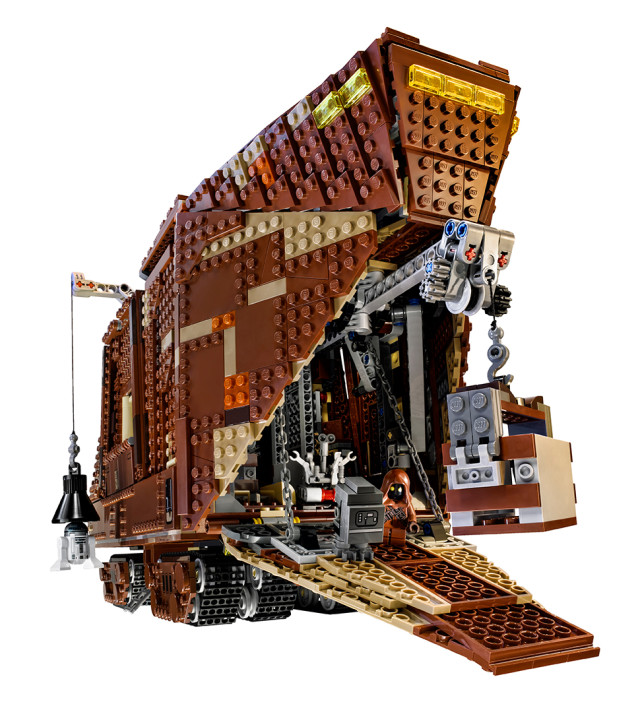
Lego has a new, large model of a Star Wars sand crawler: Behold the New 3,296-piece Lego Star Wars Sandcrawler!

It looks truly impressive. The model’s due to hit stores in May.
o265xuokytsw56s1uq06

b8rusgoc5sw30n4gzvik

On this day in 1983, Pres. Reagan again refers to the Soviets as an evil empire:

Speaking to a convention of the National Association of Evangelicals in Florida on this day in 1983, President Ronald Reagan publicly refers to the Soviet Union as an evil empire for the second time in his career. He had first used the phrase in a 1982 speech at the British House of Commons. Some considered Reagan’s use of the Star Wars film-inspired terminology to be brilliant democratic rhetoric. Others, including many within the international diplomatic community, denounced it as irresponsible bombast.

He was right – they slaughtered millions and oppressed hundreds of millions more. Even the slightest of Soviet actions would have been violations of human rights in any civilized nation.

On this day in 1862, a soon-to-be-notable Wisconsin unit readies in Kenosha:

1862 – (Civil War) 1st Wisconsin Cavalry Mustered In
The 1st Wisconsin Cavalry mustered in at Camp Harvey, Kenosha, and left for for St. Louis, Missouri, a week later. It would go on to fight in the Battle of Chickamauga in 1863 and in the Atlanta Campaign the following year. It also helped capture Confederate President Jefferson Davis on May 10, 1865. The 1st Cavalry lost about half its men in three years: six officers and 67 enlisted men were killed in combat and seven officers and 321 enlisted men died from disease.

More than a Garbage Chute

chute

The great advantage of a garbage chute is that it takes trash from one place, and carries it off under force of gravity to another. For high-rise apartment dwellers, it’s quite the time-saver.

A local municipal administration, needless to say, should be more than a tunnel through which flimsy proposals drop from vendor to local city council.

Department heads who escort representatives of other cities or big corporations into town, and listen to them say damn near anything (or nothing, really) before our common council exercise no diligence or oversight.

A man who drops trash from the thirty-third floor of a building into a garbage chute does not, after all, assume any responsibility for how the chute is constructed – he just drops it down and walks away.

Common Council should not be, along the same lines, just a dumpster at the bottom, passively receiving any junk that someone flings into the chute.

Make no mistake – this municipal administration and particularly current city manager are vastly preferable to the prior administration and manager. Our present city manager is better educated, more articulate, more affable, and all without the last administration’s tendency to exaggerate accomplishments to the point of repeated (but laughable) small-town mendacity.

Although I’m not looking for the occasion (and I am sure neither is he), it seems clear to me that one could sit at table with City Manager Clapper for a productive and congenial conversation.

Whitewater’s city government, and her thousands of residents, can meet the genuine and competitive standards of all America (and friendly countries beyond with whom we trade and exchange information). The city’s department leaders should be expected to do so, too.

There is no Whitewater political exceptionalism (it’s just a conceit), but there certainly is an exceptionalism and greatness to our country and those places that share fundamental principles with us.

When a vendor or outside interest visits Council, to pitch something, it should not be allowed to say anything, no matter how vacuous or one-sided, without reply.

One should be prepared to say to under-prepared or over-promising presenters:

Go home now, but feel free to come back when you’re prepared to meet the proper standards that all Americans – including surely the residents of Whitewater, Wisconsin – deserve.

Friday Catblogging: When Franz Dreamed of Cat Firebombers

cat-bomb

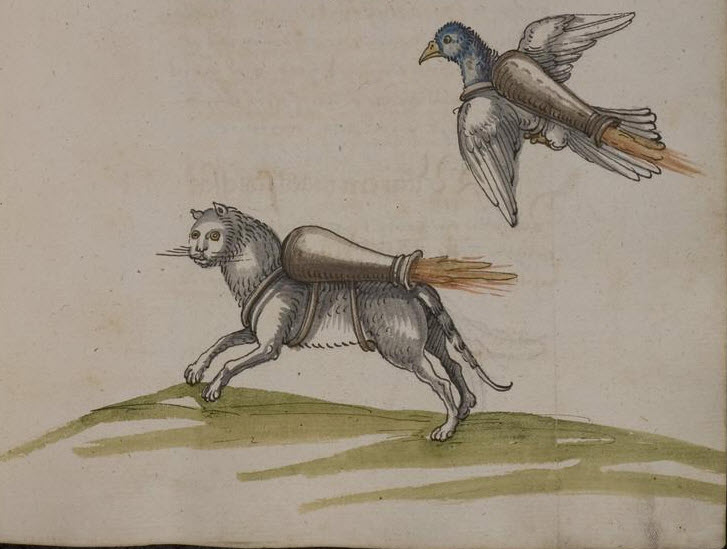
In the 1500s, Germany military tactician Franz Helm of Cologne pondered whether cats (or doves) with fire strapped to their backs might usefully wreak havoc on enemy cities.

Here’s a translation of part of Helm’s plan:

Create a small sack like a fire-arrow … if you would like to get at a town or castle, seek to obtain a cat from that place. And bind the sack to the back of the cat, ignite it, let it glow well and thereafter let the cat go, so it runs to the nearest castle or town, and out of fear it thinks to hide itself where it ends up in barn hay or straw it will be ignited.

There’s no word on whether Helm was drinking when he penned these words, and if so, how much he was drinking.

See, Cat Firebombs Featured in 500-Year-Old German War Manual @ LiveScience.

Friday Poll: Life in a Giant Hamster Wheel

Today’s poll question: would you live in a giant hamster wheel for ten days?


As performance art, two men are living in a giant hamster wheel for ten days:

Think it’s tough living with a roommate? These two fellows are sharing a house that spins like a hamster wheel—one on the inside and one on the outside—forcing them to coordinate their daily routine.

Ward Shelley and Alex Schweder’s In Orbit is a performance art piece examining the social effects of architecture. For ten days, they are spending 24 hours a day in their spinning “house”—although I wonder how the bathroom situation works. All of the furniture is attached to the wheel itself, and the two have to operate in tandem in order to access a different piece of furniture. The shape of the house affects not just the boundaries but also the relationship between the two dwellers.

(The performance is called In Orbit, and derives from the idea of a rotating space wheel, but it looks like a hamster wheel, too.)

If I have the time someday, I’d try it. I’m just not sure I’d last ten days…

How ’bout you?

Daily Bread for 3.7.14

Good morning.

We’ll have a slight chance (20%) of afternoon rain, with a high of thirty-nine.

On this day in 1811, a great naturalist (to be) is born:

1811 – Increase Allen Lapham Born
A pioneer naturalist and noted author, Increase Allen Lapham was instrumental in establishing the Milwaukee public high school program. He was one of the founders of Milwaukee Female Seminary in 1848 and served as president of the State Historical Society from 1862 to 1871. Lapham came to Milwaukee in 1836 to serve as chief engineer and secretary for the Rock River Canal Company.

He was one of the first authors and map makers in Wisconsin. Among approximately 80 titles in his bibliography, most notable was his Antiquities of Wisconsin, the first book length investigation of Wisconsin’s Indian mounds. Lapham also served as chief geologist for Wisconsin from 1873 to 1875. He founded many educational, civic, and scientific organizations in Wisconsin. You can see many of his writings, letters, maps, and drawings, at Turning Points in Wisconsin Historyby typing “Lapham” into the search box. [Source:Dictionary of Wisconsin Biography, SHSW 1960, pg. 221]

Puzzability‘s opera-themed series ends with Friday’s game:

This Week’s Game — March 3-7
Opera Boxes
What opera, doc? For each day this week, we’ll give a three-by-three letter grid in which we’ve hidden the title of an opera. Each has 10 or more letters and any number of words. To find the title, start at any letter and move from letter to letter by traveling to any adjacent letter—across, up and down, or diagonally. You may come back to a letter you’ve used previously, but may not stay in the same spot twice in a row. You will not always need all nine letters in the grid.
Example:
BOV/RTA/EIL
Answer:
Il Trovatore
What to Submit:
Submit the opera’s title (as “Il Trovatore” in the example) for your answer.
Friday, March 7
ANI/OEG/ZYU

An Empty Answer

On Tuesday night, Trane (a part of Ingersoll Rand) presented to Council about supposed energy efficiency projects for Whitewater.  As it turns out, some of these projects weren’t even about energy efficiency but were additional items in a $1,924,749 project list. (See, previously, Whitewater’s a Small Town, for Goodness’ Sake – It Should Be Run Like One.)

A presentation like this is not a matter of mere showmanship, but reveals the thoroughness of preparation from both the vendor and the municipal administration, and the seriousness of those who are seeking millions in public – not private – money.

Below, I have embedded a portion of the presentation to Council.  (I will update with a link to the full video when it’s available online.)  Following it is my transcription of the excerpt, and my remarks on the clip.

Video:

An Empty Answer from John Adams on Vimeo.

Transcript:

Trane Representative 1:  So, that is part of the cost of doing a performance contact and having this comprehensive process: the measurement, verification, and commissioning, construction management, all of that is bundled in.  

Councilmember Binnie: So the 5% is construction management?

Trane Representative 1: Yep.

Councilmember Binnie: And the 7% is what?

Trane Representative 1:  General conditions.

Councilmember Binnie: Which means what?

Trane Representative 1:  Todd can probably explain that a little better than I can [softly laughs].

Trane Representative 2 [Todd]:  That involves everything from, umm, getting the project set up, umm, manning the job, getting the project ready, the dumpsters, cleaning everything up, all the general conditions on a project.  Umm, you come in and put the roof on but you gotta tear the roof out, clean everything up, handle the dumpsters to get everything removed.

Councilmember Binnie: I guess I would normally think that that would be included in the contract price, as opposed to being a separate price.  So, when you’re bidding this, you’re not asking the contractor to do those sorts of things?

Trane Representative 2:  On occasion not, on occasion yes we ask for it for it to be broken out.  Sometimes there’s efficiencies if you’re doing multiple things in a building to have one contractor handle it rather than every contractor handle them all, so it’s on a case by case basis.

Remarks:

1.  Empty Answer.  Trane Representative 1 can’t answer Councimember Binnie’s questions, and Trane Representative 2 gives only a generic answer (the laughable ‘on occasion not, on occasion yes.’)  Which occasion does Trane Representative 2 think this is, and why?  

That’s the answer the city deserved from Trane on Tuesday, and deserves at a future meeting, rather than their vacuous reply delivered in substandard usage.  

2.  How the local press fails.  Community papers and would-be news and sports sites fail our politics because they don’t share exchanges like this with their readers. They omit mediocre answers from vendors, for example, so residents don’t see how sloppy, or lightweight, these contract proposals are.  

Councilmember Binnie asks concise, pertinent questions, and the vendor representatives — who expect millions from Whitewater — can’t or won’t give him direct, responsive answers.  Their replies are just vacuous, canned talking points.  (Not just talking points, even, but second-tier, obvious ones.)  

His questions ably demonstrate fundamental inadequacies and hollowness with this proposal.  

Trane’s representative’s answers show a disrespect to this city and her residents: either they think lightweight work is good enough for them, or is good enough for us.  

3.  A final question.

Does Whitewater deserve better than this vendor’s efforts so far?

Yep.

Daily Bread for 3.6.14

Good morning.

Thursday will be a mostly sunny day with a high of twenty-eight. Sunrise today is 6:22 AM and sunset is 5:51 PM. The moon is a waxing crescent with 32% of its visible disk illuminated.

Whitewater’s Landmarks Commission meets tonight at 6 PM.

On this day in 1899, Bayer patents aspirin:

…the Imperial Patent Office in Berlin registers Aspirin, the brand name for acetylsalicylic acid, on behalf of the German pharmaceutical company Friedrich Bayer & Co.

Now the most common drug in household medicine cabinets, acetylsalicylic acid was originally made from a chemical found in the bark of willow trees. In its primitive form, the active ingredient, salicin, was used for centuries in folk medicine, beginning in ancient Greece when Hippocrates used it to relieve pain and fever. Known to doctors since the mid-19thcentury, it was used sparingly due to its unpleasant taste and tendency to damage the stomach.

In 1897, Bayer employee Felix Hoffman found a way to create a stable form of the drug that was easier and more pleasant to take. (Some evidence shows that Hoffman’s work was really done by a Jewish chemist, Arthur Eichengrun, whose contributions were covered up during the Nazi era.) After obtaining the patent rights, Bayer began distributing aspirin in powder form to physicians to give to their patients one gram at a time. The brand name came from “a” for acetyl, “spir” from the spirea plant (a source of salicin) and the suffix “in,” commonly used for medications. It quickly became the number-one drug worldwide….

Here’s the Thursday Puzzability game:

This Week’s Game — March 3-7
Opera Boxes
What opera, doc? For each day this week, we’ll give a three-by-three letter grid in which we’ve hidden the title of an opera. Each has 10 or more letters and any number of words. To find the title, start at any letter and move from letter to letter by traveling to any adjacent letter—across, up and down, or diagonally. You may come back to a letter you’ve used previously, but may not stay in the same spot twice in a row. You will not always need all nine letters in the grid.
Example:
BOV/RTA/EIL
Answer:
Il Trovatore
What to Submit:
Submit the opera’s title (as “Il Trovatore” in the example) for your answer.
Thursday, March 6

XOU/INC/KHA

Whitewater’s a Small Town, for Goodness’ Sake – It Should Be Run Like One

Last night, at Council, Trane presented a proposal for supposed energy conservation improvements in Whitewater’s public buildings.

Total proposed project cost: $1,924,749.

It was a galling presentation – some of the items were not about energy savings, at all.  Of others, it was work that city staff could do now, or do when necessary (rather than when Trane wants, much sooner, to make a buck on taxpayers.)  

Whitewater, with a population of about fifteen thousand, is a small Midwestern town.  Places like this are imagined to be – and should be – simply run.  

There’s a role for consultants and outside vendors, but it should be a limited one. 

If this municipal administration cannot make simple things happen without ‘comprehensive’ proposals for vendor contracts, then perhaps Trane should run the municipal entire administration.  We’d have fewer middlemen that way.

When one hears a department head from this city insist that if Trane doesn’t get all it wants now, the city will have to find another contractor next year, one feels obligated to ask:

Do you think you’re working at NASA?  

Here’s an offer of assistance, without charge or expectation: No one who works at 312 W. Whitewater Street works for NASA.  

Nor are we are a flush private corporation, but a city of diverse residents, most of whom need not pay for work that white-collar bureaucrats think might be a good idea, etc., etc. Those who wish to enrich Trane should, with their own money, invest in that large, eager-to-sell-to-municipalities enterprise.

They shouldn’t ask ordinary residents to foot the bill for superfluous work.

Council was right to hold off approving this over-stuffed idea; when it comes back, a line-by-line justification will be in order.

Daily Bread for 3.5.14

Good morning.

Ash Wednesday in Whitewater will see snow and a high of twenty-one.

The Landmarks Commission meets tonight Thursday at 6 PM.

On this day in 1946, Winston Churchill delivered his ‘Iron Curtain’ speech at Westminster College in Missouri. (Churchill, himself, titled the speech as ‘Sinews of Peace.’) Here’s how the New York Times began its reporting of that address:

Fulton, Mo., March 5 – A fraternal association between the British Empire and the United States was advocated here today by Winston Churchill to stem “the expansive and proselytizing tendencies” of the Soviet Union.

Introduced by President Truman at Westminster College, Great Britain’s wartime Prime Minister asserted that a mere balance of power in the world today would be too narrow a margin and would only offer “temptations to a trial of strength.”

On the contrary, he added that the English-speaking peoples must maintain an overwhelming preponderance of power on their side until “the highroads of the future will be clear, not only for our time but for a century to come.”

From that speech, an excerpt:

….A shadow has fallen upon the scenes so lately light by the Allied victory. Nobody knows what Soviet Russia and its Communist international organization intends to do in the immediate future, or what are the limits, if any, to their expansive and proselytizing tendencies. I have a strong admiration and regard for the valiant Russian people and for my wartime comrade, Marshall Stalin. There is deep sympathy and goodwill in Britain — and I doubt not here also — towards the peoples of all the Russias and a resolve to persevere through many differences and rebuffs in establishing lasting friendships. We understand the Russian need to be secure on her western frontiers by the removal of all possibility of German aggression. We welcome Russia to her rightful place among the leading nations of the world. We welcome her flag upon the seas. Above all, we welcome, or should welcome, constant, frequent and growing contacts between the Russian people and our own people on both sides of the Atlantic. It is my duty however, for I am sure you would wish me to state the facts as I see them to you. It is my duty to place before you certain facts about the present position in Europe.

From Stettin in the Baltic to Trieste in the Adriatic an iron curtain has descended across the Continent. Behind that line lie all the capitals of the ancient states of Central and Eastern Europe. Warsaw, Berlin, Prague, Vienna, Budapest, Belgrade, Bucharest and Sofia, all these famous cities and the populations around them lie in what I must call the Soviet sphere, and all are subject in one form or another, not only to Soviet influence but to a very high and, in some cases, increasing measure of control from Moscow. Athens alone — Greece with its immortal glories — is free to decide its future at an election under British, American and French observation. The Russian-dominated Polish Government has been encouraged to make enormous and wrongful inroads upon Germany, and mass expulsions of millions of Germans on a scale grievous and undreamed-of are now taking place. The Communist parties, which were very small in all these Eastern States of Europe, have been raised to pre-eminence and power far beyond their numbers and are seeking everywhere to obtain totalitarian control. Police governments are prevailing in nearly every case, and so far, except in Czechoslovakia, there is no true democracy….

Here’s Puzzability’s game for Wednesday:

This Week’s Game — March 3-7
Opera Boxes
What opera, doc? For each day this week, we’ll give a three-by-three letter grid in which we’ve hidden the title of an opera. Each has 10 or more letters and any number of words. To find the title, start at any letter and move from letter to letter by traveling to any adjacent letter—across, up and down, or diagonally. You may come back to a letter you’ve used previously, but may not stay in the same spot twice in a row. You will not always need all nine letters in the grid.
Example:
BOV/RTA/EIL
Answer:
Il Trovatore
What to Submit:
Submit the opera’s title (as “Il Trovatore” in the example) for your answer.
Wednesday, March 5
JRW/TAV/KIL