FREE WHITEWATER

Whitewater’s Kiwanis Pancake Breakfast

20130923-104126.jpg

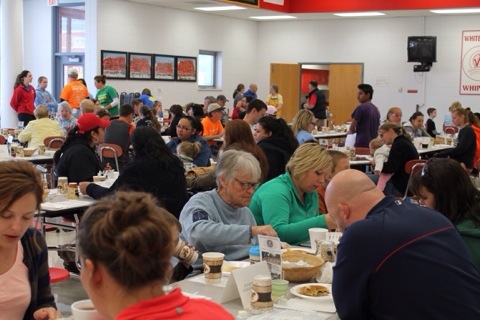
My youngest and I went to Sunday’s Kiwanis Pancake Breakfast at the high school.  We had a great time. 

Light, perfectly-prepared pancakes, the very size of a pan, with link sausages, syrup, butter, and one’s choice of coffee, juice, or water.  For a small price, one could order extra sausage, too, as we did. 

Once seated, we received the care and attention of countless volunteers, each making sure that we had all that we needed, that our drinks were replenished, and when we were finished removing our plates for us.  Row upon row of tables, and everyone attending receiving exemplary care.

A faraway monarch couldn’t have for himself conditions half so warm, so congenial, at any price. Better here than anywhere else, better this way of life than another.  

There we sat, and he happily and slowly ate his meal, leaning against me in the comfortable way that one’s small child will sometimes do.  One side resting against me, his free arm reaching lazily for another portion on the plate.  Nothing behind, and nothing ahead.

A beautiful Sunday meal.   

One writes and contends for this town, for its political future, as an expression of obligation and commitment and concern.  And yet, and yet – the most important moments in one’s life are not political, could not be political, and should not be political.   

We’ll be back again, of course, next time – we’re planning on it. 
20130923-104322.jpg

Daily Bread for 9.23.13

Downtown Whitewater’s Design Committee meets today at 8 AM.

On this day in 1952, then-Sen. Nixon delivers his Checkers speech:

Los Angeles, Sept. 23–Senator Richard M. Nixon, in a nation-wide television and radio broadcast tonight, defended his $18,235 “supplementary expenditures” fund as legally and morally beyond reproach.

He laid before the Republican National Committee and the American people the question of whether he should remain on the Republican party’s November election ticket as the candidate for Vice President.

Rising, near the end of his talk, from the desk at which he had sat, Senator Nixon urged his auditors to “wire and write” the Republican National Committee whether they thought his explanation of the circumstances surrounding the fund was adequate.

“I know that you wonder whether or not I am going to stay on the Republican ticket or resign,” he said. “I don’t believe that I ought to quit, because I’m not a quitter.”

Scientific American‘s trivia question asks about dancing. (Clicking on the question leads to its answer.)

Why do bees perform the waggle dance?

Here’s a video answer explaining the bees’ dance:

Daily Bread for 9.22.13

Good morning.

The first day of fall in Whitewater will be mostly sunny with a high of sixty-four. We’ll have northeast winds at 5 mph in the afternoon.

On this day in 1862, following the Battle of Antietam, the nature of the Civil War changes both formally and practically:

President Abraham Lincoln issues a preliminary Emancipation Proclamation, which sets a date for the freedom of more than 3 million black slaves in the United States and recasts the Civil War as a fight against slavery….

In July 1862, Lincoln informed his cabinet that he would issue an emancipation proclamation but that it would exempt the so-called border states, which had slaveholders but remained loyal to the Union. His cabinet persuaded him not to make the announcement until after a Union victory. Lincoln’s opportunity came following the Union win at the Battle of Antietam in September 1862. On September 22, the president announced that slaves in areas still in rebellion within 100 days would be free.

On January 1, 1863, Lincoln issued the final Emancipation Proclamation, which declared “that all persons held as slaves” within the rebel states “are, and henceforward shall be free.” The proclamation also called for the recruitment and establishment of black military units among the Union forces. An estimated 180,000 African Americans went on to serve in the army, while another 18,000 served in the navy.

After the Emancipation Proclamation, backing the Confederacy was seen as favoring slavery. It became impossible for anti-slavery nations such as Great Britain and France, who had been friendly to the Confederacy, to get involved on behalf of the South. The proclamation also unified and strengthened Lincoln’s party, the Republicans, helping them stay in power for the next two decades.

The proclamation was a presidential order and not a law passed by Congress, so Lincoln then pushed for an antislavery amendment to the U.S. Constitution to ensure its permanence. With the passage of the 13th Amendment in 1865, slavery was eliminated throughout America (although blacks would face another century of struggle before they truly began to gain equal rights).

Lincoln’s handwritten draft of the final Emancipation Proclamation was destroyed in the Chicago Fire of 1871. Today, the original official version of the document is housed in the National Archives in Washington, D.C.

Daily Bread for 9.21.13

Good morning.

Saturday, the last day of summer, will be mostly sunny with a high of sixty-two.

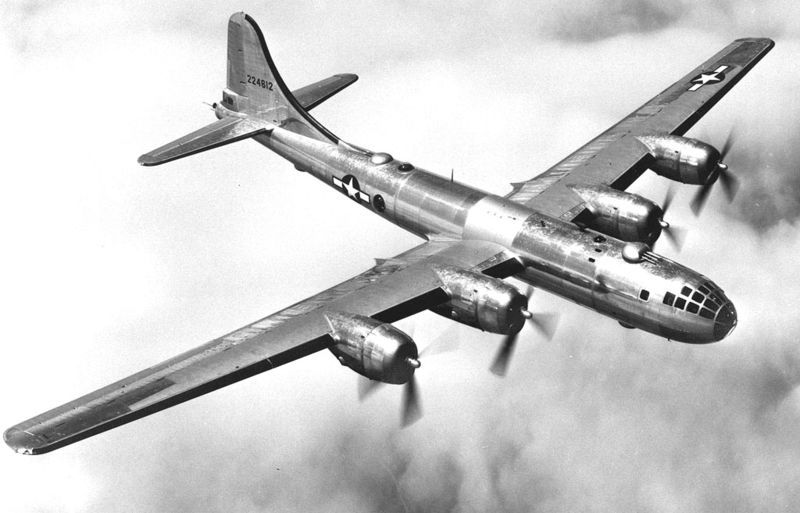
On this day in 1942, the B-29 bomber makes its maiden flight:

800px-B-29_in_flight

The B-29 Superfortress is a four-engine propeller-driven heavy bomber designed by Boeing that was flown primarily by the United States toward the end of World War II and during the Korean War. It was one of the largest aircraft to see service during World War II and a very advanced bomber for its time, with features such as a pressurized cabin, an electronic fire-control system, and remote-controlled machine-gun turrets. The name “Superfortress” was derived from that of its well-known predecessor, the B-17 Flying Fortress. Although designed as a high-altitude strategic bomber, and initially used in this role against the Empire of Japan, these attacks proved to be disappointing; as a result the B-29 became the primary aircraft used in the American firebombing campaign, and was used extensively in low-altitude night-time incendiary bombing missions. One of the B-29’s final roles during World War II was carrying out the atomic bomb attacks on Hiroshima and Nagasaki.

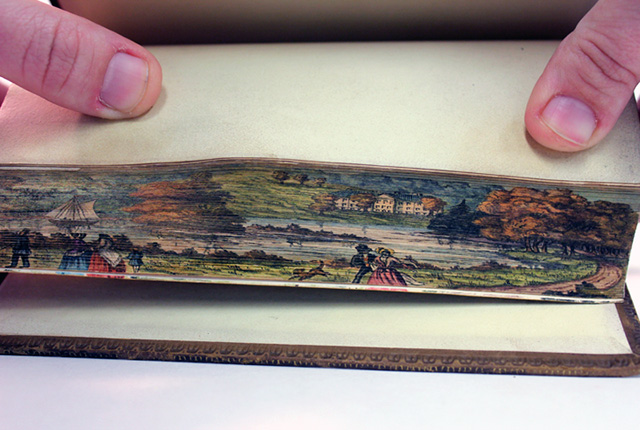
We’re rightly told not to judges books by their covers, but rather their contents. Still, what about a book’s edges, especially when they display fine and lovely art? Over at i09, Vince Miklós writes about Fore-Edge Paintings: The Secret Works of Art Hidden Inside Book Pages:

Sometimes the greatest artworks are hidden in plain sight. Case in point: the University of Iowa recently discovered a four-volume set of scientific books from 1837 contains hidden paintings on the edges of the pages, which only show up when you fan them part-way open. These “Fore-Edge Paintings” are everywhere, and they’re beautiful.

As Flavorwire explains, Fore-Edge Paintings go back to the 16th century, “when Italian artist Cesare Vecellio (cousin of Renaissance painter Titian) started using his books as a canvas in order to beautify them.” A bunch of them were posted by the University of Iowa and the Boston Public Library….

autumn-new

Autumn by Robert Mudie / Special Collections & University Archives at the University of Iowa

Small, detailed, and remarkably lovely.

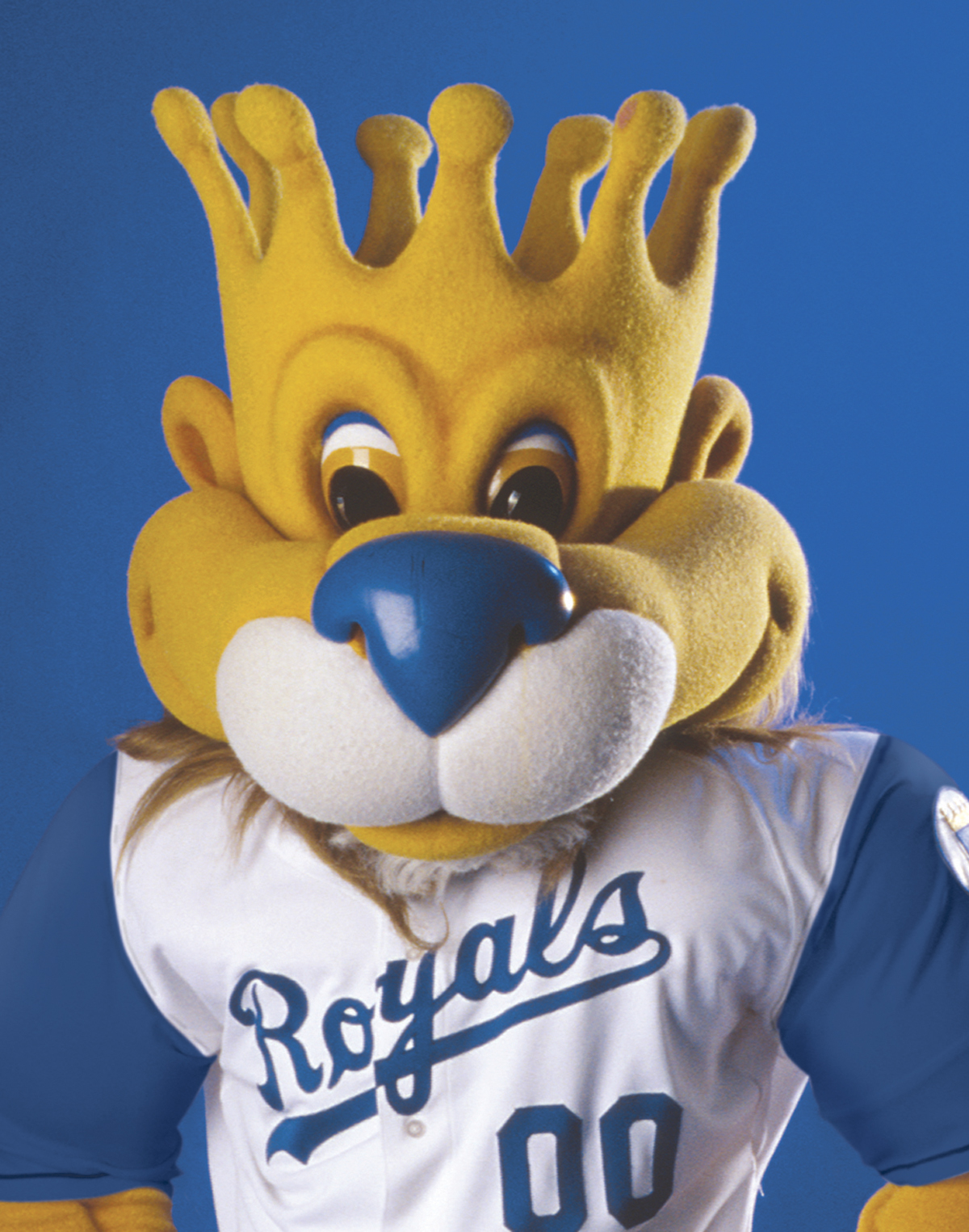
Friday Poll: Hot Dog-Hurling Mascot

Sluggerrr

At a Kansas City Royals baseball game, the team mascot, Sluggerrr, threw a hot dog in the stands, hitting a spectator. The spectator sued for injuries when his retina became detached after the hot dog hit him in the eye. A lower court ruled that the fan assumed the risk of such injuries when he purchased a ticket (since oddly-named mascots sometimes throw things, and that’s just part of the experience). The fan’s now appealed to the Missouri Supreme Court.

So, should Sluggerrr (and his team, the Kansas City Royals) be liable for the hot-dog-as-projectile stunt? I’ll say no – part of baseball is tossing toys or promotions or other items into the stands. Hot dogs? Close enough.

What you think?


Daily Bread for 9.20.13

Good morning.

Friday presents a one-third chance of morning showers then a mostly cloudy day with a high of seventy-two. We have a waning gibbous moon with 98% of its visible disk illuminated.

Of the moon, using the Lunar Reconnaissance Orbiter, NASA’s created a detailed, striking animation of the lunar surface:

On this day in 1881, America sees her third president within one year’s time:

…Chester Arthur is inaugurated, becoming the third person to serve as president in that year.

The year 1881 began with Republican Rutherford B. Hayes in office. Hayes served out his first and only term and officially turned over the reins of government to James A. Garfield, who happened to be a close friend of his, in March 1881. Just four months into his term, on July 2, Garfield was shot by a crazed assassin named Charles Guiteau. Guiteau claimed to have killed Garfield because he refused to grant Guiteau a political appointment. Garfield sustained wounds to his back and abdomen and struggled to recover throughout the summer. Though it appeared he would pull through in early September, the autopsy report revealed that the internal bullet wound contributed to an aneurism that ultimately killed Garfield on September 19.

The next day, Vice President Chester Arthur was sworn in as president. Strangely, Garfield’s assassin wrote to the new president from jail, taking credit for vaulting Arthur into the White House. According to President Hayes, Arthur’s administration was best known for “liquor, snobbery and worse.” He served only one term from 1881 to 1885.

This was the second time in American history that three men served as president in one year; a similar situation occurred in 1841, when Martin Van Buren, William Henry Harrison and John Tyler all held the office.

Scientific American‘s trivia question asks about a quantity. (Clicking on the question leads to its answer.)

How many gigabytes make up a terabyte?

Daily Bread for 9.19.13

Good morning.

Thursday’s forecast calls for thunderstorms and a high of eighty-seven.

On September 19, 1959, during a visit to the United States, Soviet Premier Khrushchev has a fit because he couldn’t visit Disneyland:

In one of the more surreal moments in the history of the Cold War, Soviet leader Nikita Khrushchev explodes with anger when he learns that he cannot visit Disneyland. The incident marked the climax of Khrushchev’s day in Los Angeles, one that was marked by both frivolity and tension.

Khrushchev arrived in the United States on September 15 for an extended visit and a summit meeting with President Dwight D. Eisenhower. The Soviet leader indicated a desire to see Hollywood and a visit was arranged. On September 19, Khrushchev and his wife arrived in Los Angeles. The day began pleasantly enough, with a tour of the Twentieth Century Fox Studios in Hollywood. The Soviet premier was taken on to the sound stage for the movie “Can-Can” and was immediately surrounded by the cast of the film, including Shirley MacLaine and Juliet Prowse. MacLaine greeted Khrushchev in broken Russian and then attempted to engage the premier in an impromptu dance. Khrushchev jovially begged off and then stood by while the cast members performed a number from the film. Frank Sinatra was brought in to serve as an unofficial master of ceremonies for the visit, and he later lunched with an obviously delighted Khrushchev.

Things began to unravel when Twentieth Century Fox President Spyros P. Skouras introduced Khrushchev at Los Angeles Town Hall. Almost immediately, Skouras, who was an ardent anticommunist, irritated Khrushchev by referring to the premier’s famous statement that Russia would “bury” capitalism. Skouras declared that Los Angeles was not particularly interested in “burying” anyone, but would meet the challenge if posed. Khrushchev’s famous temper quickly flared. He charged that Skouras’s remarks were part of a campaign to heckle him during his trip to America. The plan, Khrushchev suggested, was to needle him, “rub” America’s strength in his face, and make him “a little shaky in the knees.” Addressing Skouras directly, Khrushchev stated, “If you want to go on with the arms race, very well. We accept that challenge. As for the output of rockets–well, they are on the assembly line. This is a most serious question. It is one of life or death, ladies and gentlemen. One of war and peace.”

Khrushchev’s anger increased when he learned that he would not be allowed to visit Disneyland. Government authorities feared that the crowds would pose a safety hazard for the premier. Khrushchev, still fuming about the debate with Skouras, exploded. “And I say, I would very much like to go and see Disneyland. But then, we cannot guarantee your security, they say. Then what must I do? Commit suicide? What is it? Is there an epidemic of cholera there or something? Or have gangsters taken hold of the place that can destroy me?” Khrushchev left Los Angeles the next morning.

If Khrushchev wanted to see something like Disneyland, then he should have permitted a society that had creative and economic wherewithal like America’s.

Scientific American‘s trivia question asks about scientific achievement. (Clicking on the question leads to its answer.)

The first American woman to win an unshared Nobel Prize did so in what year?