FREE WHITEWATER

Waste Digesters and the Ledge Guardians

Nearly one-hundred fifty miles from Whitewater, in Maribel, Wisconsin and surrounding communities, hundreds of residents are organized and committed against a large, commercial waste digester in their area.

They’ve an impressive website on behalf of their dedicated efforts: Ledge Guardianswww.ledgeguardians.com.

There are sound arguments against waste digesters, against how they really work, what they bring into a community, what they spew out into a community, against their empty claims of economic benefit, how the contents of them are described dishonestly, and how those out-of-town interests pushing them never live nearby (but expect others to do so).

A specific proposal for Whitewater, one from which Whitewater’s Community Development Authority rightly turend away, was among the worst projects ever advanced for our city.

One wishes the Ledge Guardians ongoing support to keep their community safe, clean, prosperous, open, and honest.

Daily Bread for 10.8.12

Good morning.

Whitewater’s Columbus Day will be breezy, with a high of fifty-seven.

This evening, Whitewater’s Planning Commission meets at 6 PM, and the Library Board meets at 6:30 PM.

In honor of Columbus Day, the History Channel offers 10 Things You May Not Know About Christopher Columbus. Number 9 is particularly unexpected:

9. Even in death, Columbus continued to cross the Atlantic.

Following his death in 1506, Columbus was buried in Valladolid, Spain, and then moved to Seville. At the request of his daughter-in-law, the bodies of Columbus and his son Diego were shipped across the Atlantic to Hispaniola and interred in a Santo Domingo cathedral. When the French captured the island in 1795, the Spanish dug up remains thought to be those of the explorer and moved them to Cuba before returning them to Seville after the Spanish-American War in 1898. However, a box with human remains and the explorer’s name was discovered inside the Santo Domingo cathedral in 1877. Did the Spaniards exhume the wrong body? DNA testing in 2006 found evidence that at least some of the remains in Seville are those of Columbus. The Dominican Republic has refused to let the other remains be tested. It could be possible that, aptly, pieces of Columbus are both in the New World and the Old World.

Daily Bread for 10.7.12

Good morning.

Sunday will be a day of decreasing clouds, a high of forty-nine, and northwest winds from 5 to 10 MPH.

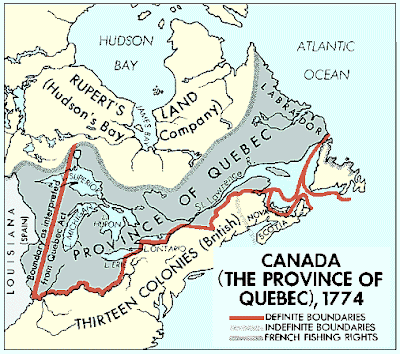
On this day in 1774, Wisconsinites all became a bit more French:

1774 – Wisconsin Becomes Part of Quebec

On this date Britain passed the Quebec Act, making Wisconsin part of the province of Quebec. Enacted by George III, the act restored the French form of civil law to the region. The Thirteen Colonies considered the Quebec Act as one of the “Intolerable Acts,” as it nullified Western claims of the coast colonies by extending the boundaries of the province of Quebec to the Ohio River on the south and to the Mississippi River on the west. [Source: Avalon Project at the Yale Law School]


Puzzle-lovers will enjoy the Smithsonian’s Great American History Puzzle:

George Washington’s spies used invisible ink during the Revolution. Abraham Lincoln’s young cryptanalysts cracked the Confederacy’s “Vicksburg Square” cipher during the Civil War. The United States entered World War I after Britain decoded an encrypted message from the Germans inviting Mexico to wage war on America—the so-called “Zimmermann Telegram.” In World War II, the Marines’ Navajo “code-talkers” were crucial to victories in the Pacific theater.

Because puzzle-solvers and code breakers have long been heroes of American history, we present the Smithsonian Great American History Puzzle. The puzzle is a month-long contest conceived by the puzzle master and “Jeopardy!” champion Ken Jennings. The first person to correctly follow all the clues, avoid all the red herrings and uncover all the secrets will win the grand prize: a free trip to Washington, D.C. and a “Secrets of the Smithsonian” tour (created by Smithsonian Journeys and valued at $10,000) behind the scenes of the world’s largest museum and research complex.

Daily Bread for 10.6.12

Good morning.

Saturday in Whitewater will be mostly sunny and windy, with a high of sixty-three.

On this day in 1866, America saw the first robbery of a moving train:

On this day in 1866, the Reno gang carries out the first robbery of a moving train in the U.S., making off with over $10,000 from an Ohio & Mississippi train in Jackson County, Indiana. Prior to this innovation in crime, holdups had taken place only on trains sitting at stations or freight yards….

As for the Reno gang, which consisted of the four Reno brothers and their associates, their reign came to an end in 1868 when they all were finally captured after committing a series of train robberies and other criminal offenses. In December of that year, a mob stormed the Indiana jail where the bandits were being held and meted out vigilante justice, hanging brothers Frank, Simeon and William Reno (their brother John had been caught earlier and was already serving time in a different prison) and fellow gang member Charlie Anderson.

In Wisconsin history, in 1917 Sen. La Follette delivered a Senate-floor defense of free speech:

1917 – Robert La Follette Supports Free Speech in Wartime
On this date Senator Robert La Follette gave what may have been the most famous speech of his Senate career when he responded to charges of treason with a three hour defense of free speech in wartime. La Follette had votedagainst a declaration of war as well as several initiatives seen as essential to the war effort by those that supported U.S. involvement in the first World War. His resistance was met with a petition to the Committee on Privileges and Elections that called for La Follette’s expulsion from the Senate. The charges were investigated, but La Follette was cleared of any wrong doing by the committee on January 16, 1919. [Source: United States Senate]

Google’s daily puzzle asks about English monarchical intrigue: “The first king to rule the House of Lancaster chose a wife who became unpopular with the people. For what crime was she convicted?”

The Local Press as a Bad Habit

If local officials (whether elected or appointed) want to be successful, they’ll have to set higher standards for themselves than our local press sets for them.

Successful leaders have been, are, and will always be those who set a better standard for themselves. There’s no partisan ideology in this – the same applies to those of left, right, and center.

I grew up enjoying newspapers, and look fondly on some even now.

We’ve two local dailies nearby, although none from within the city. It’s undeniable, to my eyes, that those papers have covered government officials poorly. For me that means that they’ve not really reported on local politics at all, but instead have fawned over elected politicians and appointed managers. It’s no surprise to any long-time reader that I feel this way.

And yet, and yet – the problem isn’t how I feel, but the damage that sycophantic coverage does to officials, themselves: mediocre coverage creates mediocre leaders, and mediocre leaders produce mediocre work. It encourages them to do less and try less, to settle for shoddy arguments and flimsy claims. Worse, it plays to the vanities of weak-minded officials: they eagerly lap the syrupy concoctions that toadying reporters too gladly serve.

A newspaper story should have some better use than as a page in an official’s scrapbook.

As a rule, local press analysis is poor, the scourcing that newspapers claim is their advantage is non-existent or laughably inadequate, and their quality of composition is wanting.

Coverage of major political initiatives, of policies supposedly worth vast sums, receives no careful review and assessment, but only the most cursory and unthinking acceptance.

It’s not true that this is the best newspapers can do.

Thousands of residents throughout our city, and millions of Americans across this continent, easily meet a higher standard each day than the flimsy coverage our politics receives in the traditional, local press. Americans are among the hardest-working and most competitive peoples in all the world. We are at the forefront of humanity’s accomplishments in science, technology, industry, and art.

Those accomplishments are not the works of a few, but the achievements of over three-hundred million of us, cooperating in countless transactions each day.

Why would any elected or appointed official set aside America’s high standards for the low standards of a local press?

Everyone is free to choose for himself or herself, but not all choices are equally beneficial. Looking outward to the best practices across America (and beyond) is our only sensible, productive, and prosperous approach.

No one in should settle for anything less.

Friday Poll: When’s a Good Time for Stores to Begin Selling Christmas Decorations?

I saw that our local Walmart had a section with Christmas decorations for sale. It’s probably the same with other Walmart stores, and similar retailers. So, today’s question: When’s a good time, in your view, to begin selling Christmas decorations? The question’s not about what should be permissible (I’d say anytime, after all), but what seems fitting to you, as a shopper.

In my case, I’ll answer that November seems a good beginning, after Halloween, and when Christmas is about six weeks away.

What do you think?


Daily Bread for 10.5.12

Good morning.

Whitewater’s week ends with a mostly sunny day, and a high of fifty-three.

On this day in 1947, Pres. Truman delivered the first televised address from the White House:

President Harry Truman (1884-1972) makes the first-ever televised presidential address from the White House, asking Americans to cut back on their use of grain in order to help starving Europeans. At the time of Truman’s food-conservation speech, Europe was still recovering from World War II and suffering from famine. Truman, the 33rd commander in chief, worried that if the U.S. didn’t provide food aid, his administration’s Marshall Plan for European economic recovery would fall apart. He asked farmers and distillers to reduce grain use and requested that the public voluntarily forgo meat on Tuesdays, eggs and poultry on Thursdays and save a slice of bread each day. The food program was short-lived, as ultimately the Marshall Plan succeeded in helping to spur economic revitalization and growth in Europe.

On this day in 1846, Wisconsin’s first state constitutional convention met:

1846 – First State Constitutional Convention Meets
On this date Wisconsin’s first state Constitutional Convention met in Madison. The Convention sat until December 16,1846. The Convention was attended by 103 Democrats and 18 Whigs. The proposed constitution failed when voters refused to accept several controversial issues: an anti-banking article, a homestead exemption (which gave $1000 exemption to any debtor), providing women with property rights, and black suffrage. The following convention, the Second Constituitional Convention of Wisconsin in 1847-48, produced and passed a constitution that Wisconsin still very much follows today. [Source:The Convention of 1846 edited Milo M. Quaife]

For today’s daily puzzle from Google, some chemistry: “What is produced when the element discovered by Joseph Priestly reacts with the metal manufactured by his “mad” brother-in-law?”