Often, going fishing consists of more talking than actually catching anything. In this short documentary A Fishing Trip on the Gunnison, three members of the conservation organization Trout Unlimited discuss the impacts of irrigation on the beautiful Gunnison River in Colorado. The organization that works with farmers, ranchers, and conservationists to find ways to preserve Colorado waterways.
Ted Yoder covers Everybody Wants to Rule the World on a dulcimer. Quite something –
Sunday in town will become increasingly sunny with a high of seventy-nine. Sunrise is 6:24 AM and sunset 7:22 PM, for 12h 58m 15s of daytime. The moon is a waxing crescent with 9.1% of its visible disk illuminated.
Friday’s FW poll asked whether readers thought that Vladimir Putin was, in fact, ignorant of the hacking of a major American political party’s servers. Most respondents thought that he was lying (84%), but 16% thought he was ignorant of the hacking’s perpetrators.
In 1884, Eastman patented the first film in roll form to prove practicable; he had been tinkering at home to develop it. In 1888, he perfected the Kodak camera, the first camera designed. Eastman was progressive for his era. He promoted Florence McAnaney to be head of the personnel department, one of the first women to hold an executive position in a major U.S. company.
Saturday in town will be mostly sunny with a high of seventy-seven. Sunrise is 6:23 AM and sunset is 7:24 PM, for 13h 01m 05s of daytime. The moon is a waxing crescent with 4.5% of its visible disk illuminated.
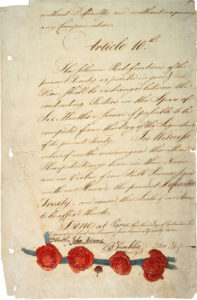
On this day in 1783, representatives of America and Britain sign the Treaty of Paris, formally ending the Revolutionary War:
The Treaty of Paris, signed in Paris by representatives of King George III of Great Britain and representatives of theUnited States of America on September 3, 1783, ended the American Revolutionary War. Britain acknowledged the United States to be sovereign and independent. The treaty set the boundaries between the British Empire and the new country, on lines “exceedingly generous” to the United States.[2] Details included fishing rights and restoration of property and prisoners of war.
This treaty, along with the separate peace treaties between Great Britain and the nations that supported the American cause—France, Spain, and the Dutch Republic—are known collectively as the Peace of Paris.[3][4]
….Historians have often commented that the treaty was very generous to the United States in terms of greatly enlarged boundaries. Historians such as Alvord, Harlow, and Ritcheson have emphasized that British generosity was based on a statesmanlike vision of close economic ties between Britain and the United States. The concession of the vast trans-Appalachian region was designed to facilitate the growth of the American population and create lucrative markets for British merchants, without any military or administrative costs to Britain.[14] The point was the United States would become a major trading partner. As the French foreign ministerVergennes later put it, “The English buy peace rather than make it”.[15] Vermont was included within the boundaries because the state of New York insisted that Vermont was a part of New York, although Vermont was then under a government that considered Vermont not to be a part of the United States.[16]
On this date famed Green Bay Packer coach, Vince Lombardi, died at the age of 57. Lombardi played college football at Fordham, where he was one of the legendary “Seven Blocks of Granite.” Lombardi served as coach and general manager for the Green Bay Packers from 1959 to 1967. He directed the team to five NFL championships in seven years (1961-62 and 1965-67). His 1966 and 1967 teams also made history by winning the first two Super Bowls.
Russian President Vladimir Putin claims he has no idea who hacked the Democratic Party’s email server. (“But I want to tell you again, I don’t know anything about it, and on a state level Russia has never done this.”) Do you believe him?
Is Putin simply ignorant of the matter, or do you think he’s lying?
Friday in town will be partly cloudy with a high of seventy-five. Sunrise is 6:22 AM and sunset is 7:25 PM, for 13h 03m 53s of daytime. The moon is a waxing crescent with 1.3% of its visible disk illuminated.
The Great Fire of London was a major conflagration that swept through the central parts of the English city of London from Sunday, 2 September to Wednesday, 5 September 1666.[1] The fire gutted the medieval City of London inside the old Roman city wall. It threatened but did not reach the aristocratic district of Westminster, Charles II‘s Palace of Whitehall, and most of the suburban slums.[2] It consumed 13,200 houses, 87 parish churches, St Paul’s Cathedral, and most of the buildings of the City authorities. It is estimated to have destroyed the homes of 70,000 of the City’s 80,000 inhabitants.[3] The death toll is unknown but traditionally thought to have been small, as only six verified deaths were recorded. This reasoning has recently been challenged on the grounds that the deaths of poor and middle-class people were not recorded, while the heat of the fire may have cremated many victims, leaving no recognisable remains. A melted piece of pottery on display at the Museum of London found by archaeologists in Pudding Lane, where the fire started, shows that the temperature reached 1250 °C.[4]
The Great Fire started at the bakery of Thomas Farriner (or Farynor) on Pudding Lane shortly after midnight on Sunday, 2 September and spread rapidly west across the City of London. The major firefighting technique of the time was to create firebreaks by means of demolition; this, however, was critically delayed owing to the indecisiveness of Lord Mayor of London Sir Thomas Bloodworth. By the time that large-scale demolitions were ordered on Sunday night, the wind had already fanned the bakery fire into a firestorm which defeated such measures. The fire pushed north on Monday into the heart of the City. Order in the streets broke down as rumours arose of suspicious foreigners setting fires. The fears of the homeless focused on the French and Dutch, England’s enemies in the ongoing Second Anglo-Dutch War; these substantial immigrant groups became victims of lynchings and street violence. On Tuesday, the fire spread over most of the City, destroying St Paul’s Cathedral and leaping the River Fleet to threaten Charles II’s court at Whitehall, while coordinated firefighting efforts were simultaneously mobilising. The battle to quench the fire is considered to have been won by two factors: the strong east winds died down, and the Tower of London garrison used gunpowder to create effective firebreaks to halt further spread eastward.
The social and economic problems created by the disaster were overwhelming. Evacuation from London and resettlement elsewhere were strongly encouraged by Charles II, who feared a London rebellion amongst the dispossessed refugees. Despite numerous radical proposals, London was reconstructed on essentially the same street plan used before the fire.[5]
A new month begins in Whitewater with morning clouds, giving way to afternoon sunshine, with a daytime high of seventy-one. Sunrise is 6:21 AM and sunset 7:27 PM, for 13h 06m 41s of daytime. The moon is new today, with no part of its visible disk illuminated.
A new school year begins in our public district. Best wishes for a year of exploration and adventure.
Whitewater’s Landmarks Commission meets tonight at 6 PM, and there will be a Fire Department Business Meeting at 6:30 PM.
On this day in 1972, Fischer defeats Spassky:
The World Chess Championship 1972 was a match for the World Chess Championship between challenger Bobby Fischer of the United States and defending champion Boris Spassky of the Soviet Union. The match took place in the Laugardalshöll arena in Reykjavík, Iceland, and has been dubbed the Match of the Century. Fischer became the first American born in the United States to win the world title, and the second American overall (Wilhelm Steinitz, the first world champion, became a naturalized American citizen in 1888). Fischer’s win also ended, for a short time, 24 years of Soviet domination of the World Championship.
The first game was played on July 11, 1972. The last game (the 21st) began on August 31, was adjourned after 40 moves, and Spassky resigned the next day without resuming play. Fischer won the match 12½–8½, becoming the eleventh undisputed World Champion.
JigZone has flowers as its theme for today’s puzzle:
The latest Marquette Law School poll results are out, and here are a few key findings from the 8.25.16 to 8.28.16 poll (the full results will be available online later this afternoon).
Clinton-Trump, Among LV:
Among likely voters in WI, Clinton 45%, Trump 42%, with 10% supporting neither. #mulawpoll
Our month ends on a day of partly cloudy skies with a high of seventy-eight. Sunrise is 6:19 AM and sunset 7:29 PM, for 13h 09m 29s of daytime. We’ve a new moon, with just .9% of its visible disk illuminated.
Marquette Law publishes a new Wisconsin poll this afternoon. I’ll have highlights when they’re available.
Thomas Edison receives a patent for his movie camera, the Kinetograph. Edison had developed the camera and its viewer in the early 1890s and staged several demonstrations.
The camera was based on photographic principles discovered by still-photograph pioneers Joseph Nicephone Niepce and Louis Daguerre of France. In 1877, inventor Edward Muybridge developed a primitive form of motion pictures when Leland Stanford, governor of California, invited him to develop photo studies of animals in motion. Muybridge developed an ingenious system for photographing sequential motion, setting up 24 cameras attached to trip wires stretched across a racetrack. As the horse tripped each wire, the shutters snapped. The resulting series of photos could be projected as something resembling a motion picture. This breakthrough in the early 1870s inspired another student of animal motion, Etienne Jules Marey of France, to develop in 1882 a rotating camera rather like a rifle, where different pictures were taken in a rapid sequence by a rotating cartridge.
Unlike these earlier cameras, Edison’s Kinetoscope and Kinetograph used celluloid film, invented by George Eastman in 1889. In February 1893, Edison built a small movie studio that could be rotated to capture the best available sunlight. He showed the first demonstration of his films—featuring three of his workers pretending to be blacksmiths—in May 1893.
It’s a seahorse puzzle from JigZone for Wednesday: