FREE WHITEWATER

Daily Bread for 3.28.18

Good morning.

Wednesday in Whitewater will be partly sunny with a high of fifty-seven. Sunrise is 6:42 AM and sunset 7:17 PM, for 12h 34m 57s of daytime. The moon is a waxing gibbous with 89.3% of its visible disk illuminated. Today is the {tooltip}five hundred third day.{end-texte}Days since Trump’s election, with 11.9.16 as the first day.{end-tooltip}

Whitewater’s Parks & Recreation Board meets at 5:30 PM.

On this day in 1898, the United States Supreme Court, in United States v. Wong Kim Ark, rules that

A child born in the United States, of parents of Chinese descent, who, at the time of his birth, are subjects of the Emperor of China, but have a permanent domicil and residence in the United States, and are there carrying on business, and are not employed in any diplomatic or official capacity under the Emperor of China, becomes at the time of his birth a citizen of the United States, by virtue of the first clause of the Fourteenth Amendment of the Constitution,

All person born or naturalized in the United States, and subject to the jurisdiction thereof, are citizens of the United States and of the State wherein they reside.

On this day in 1933, a national group posthumously honors  C. Latham Sholes:

On this date a group of women paid thanks to the inventor of the typewriter, Milwaukee’s C. Latham Sholes, in a national radio program. Amelia Earhart, Anna Boettinger (Franklin Roosevelt’s daugher), Mrs. Robert E. Speer, the president of the National Young Women’s Christian Association, all participated in the program. [Source: Badger Saints and Sinners by Fred Holmes, p. 316-328]

Recommended for reading in full —

➤ David A. Graham sees  A Cabinet of Conspicuous Corruption (“Wasteful spending of taxpayer dollars by several secretaries follows a tone set by the president”):

For spring cleaning this year, President Trump is looking at his Cabinet. The Associated Press reported Monday that Veterans Affairs Secretary David Shulkin is near to being removed. When Trump fired H.R. McMaster as national-security adviser, that torpedoed a plan to dismiss McMaster, Shulkin, and Ben Carson, the secretary of housing and urban development, at once, according to Politico’s Eliana Johnson.

Shulkin and Carson face the same problem: dubious use of taxpayer dollars in their duties as secretaries. They can console themselves knowing that they’re in good company. Interior Secretary Ryan Zinke, EPA Administrator Scott Pruitt, Treasury Secretary Steven Mnuchin have been caught in extravagant expenditures, too. Less heartening is the sixth example, Tom Price, who was unceremoniously forced out as secretary of health and human services in September 2017.

This extravagant spending around public displays of status—call it, with apologies to Thorstein Veblen, conspicuous corruption—has become a trademark of the Trump administration. There are so many cases of huge spending of taxpayer dollars by Cabinet secretaries that it’s easy to lose track of them all—or simply to become desensitized—so here’s a few of the lowlights [summary follows in article].

➤ The Committee to Investigate Russia writes that  NRA Admits Accepting Foreign Funds:

The National Rifle Association (NRA) is admitting it does receive funds from foreign sources but claims it does not spend that money on U.S. elections, an assertion that is difficult for outsiders to evaluate.

NPR:

Pressure on the organization has also been increased by a McClatchy report which suggested that the FBI had been investigating whether a top Russian banker with Kremlin ties illegally funneled money to the NRA to aid President Trump’s campaign for president. The Federal Election Commission has also opened a preliminary investigation into this question.

The NRA is not required to be transparent about how money moves between its various political entities, and this leaves questions unanswered about how these foreign funds were ultimately spent.

In the context of ongoing investigations, Sen. Ron Wyden, the top Democrat on the Senate Finance Committee, wrote to the National Rifle Association earlier this month asking, “Can you categorically state that your organizations have never, wittingly or unwittingly, received any contributions from individuals or entities acting as conduits for foreign entities or interests?”

The NRA said that in fact they do receive foreign money, but not for election purposes.

(…)

The NRA’s response was not sufficient for Wyden. In a letter dated March 27, the senator demanded that the organization provide a detailed accounting of how foreign funds were used over the past three years, whether they were targeted at particular American audiences, and what its measured impact was.

Wyden also demanded to know whether any Russian nationals or foreign individuals had been members of the NRA’s donor programs, and whether the NRA received any money from sanctioned individuals.

(…)

The NRA has a variety of accounts, and the NRA Political Victory Fund is their official political action committee and must report all of its spending to the Federal Election Commission.

It also has other accounts that require less transparency, and do not report spending to the FEC — and in those funds, the NRA told Wyden, they “receive funds from foreign persons only for purposes not connected to elections, as permitted by federal law.”

However, the NRA acknowledges that money moves between those accounts: “transfers between accounts are made as permitted by law,” the NRA’s general counsel wrote.

➤ Joshua Matz contends Trump is running on animus autopilot:

President Trump is hard at work making animus the law of the land. Justice Department lawyers revealed his latest effort Friday night, announcing a revised plan to exclude nearly all transgender soldiers from the armed forces.

As many commentators have observed, the reasoning offered to support Trump’s policy is riddled with empirical errors and anti-trans stereotypes. It comes nowhere close to disproving the comprehensive study in 2016 that recommended allowing transgender people to serve openly. Like so many other missives from this White House, it makes only a token effort to conceal the disdain and disgust that underlie it.

Trump’s original “transgender ban” was blocked by four federal courts. After two of those rulings were affirmed on appeal, the administration decided against seeking Supreme Court review. It’s therefore safe to assume that Trump’s latest order will not go into effect unless it survives constitutional challenges.

And in thinking about that litigation, it’s hard to escape a feeling of deja vu. A little more than 14 months into Trump’s presidency, a pattern has emerged in cases challenging some of his most despicable decisions [list of steps in Trump’s pattern follows in article].

➤ Rhonda Garelick contends Stormy Daniels’s Boring Interview Was Actually Brilliant (“Once again, she proves she’s a worthy adversary for Trump”)

In fact, Stormy was entirely credible in every way. Calm, clear-eyed, and direct, she telegraphed competence and clarity of purpose. She answered questions quickly and without hesitation, never averting her gaze, lowering her eyes, or even pausing. Her words were simple and devoid of rhetorical flourishes. When asked, for example, whether she understood the $130,000 she’d accepted was “hush money,” Daniels’s firm “yes” flew from her mouth nearly before Cooper could finish his question. She offered this kind of swift, emphatic, and monosyllabic response several times.

Everything about this interview screamed legitimacy. 60 Minutes is the 50-year-old doyenne of broadcast journalism, a network show watched by grandparents and Trump supporters (and apparently even Trump himself). This was Stormy’s chance to take her case to the widest American public, to clear her name and tell her truth, even at the risk of being penalized for breaching her non-disclosure agreement (and possibly even at risk to her personal safety).

(I saw this interview last night. Trump’s conduct toward Daniels isn’t the worst of his offenses, but I agree that in her matter-of-fact presentation, Daniels did well for herself, all things considered.)

➤ NASA ScienceCasts describes Earth’s Magnetosphere:

Foxconn as Alchemy: Magic Multipliers

The Foxconn plant isn’t even built yet, but the Walker Admin and its allies (including a few local apologists for corporate welfare in Whitewater) now resort to fantastic, magical claims about how much economic development will come from nearly four billion in taxpayer subsidies.

So magical, so fantastic, that they now claim an 18-1 multiplier (yes, really):

A fully built Foxconn Technology Group plant would add $51.5 billion to Wisconsin’s gross domestic product over the 15 years the state pays incentives to the company, a new analysis by the Metropolitan Milwaukee Association of Commerce concludes.

That would equate to $18 of economic impact for every $1 spent by the state, the business group, which worked to help attract Foxconn, said.

Averaged over the 15 years, the MMAC’s estimate amounts to an additional $3.4 billion annually in state gross domestic product from Foxconn. That would tack another 1% onto Wisconsin’s current GDP of about $313 billion.

A few remarks:

A Laughable Return. The MMAC analysis assumes a return that, in a first-world market, is both speculative (Foxconn doesn’t guarantee this) and too-good-to-be-true. One public dollar in corporate subsidies gets you 18? Did Bernie Madoff even promise a return like that?

Data Foxconn Itself Doesn’t Use. The MMAC analysis uses a 13,000 figure for Foxconn direct employment – Foxconn itself has never guaranteed that number, or anything like it. It’s all couched as ‘up to,’ ‘as many as,’ or ‘the potential to.’

Wisconsin won’t break even on Foxconn plant deal for over two decades sets the story straight:

And that’s still assuming that Foxconn actually creates the 13,000 jobs it claimed it might create, at the average wage — just shy of $54,000 — it promised to create them at. In fact, the plant is only expected to start with 3,000 jobs; the 13,000 figure is the maximum potential positions it could eventually offer. If the factory offers closer to 3,000 positions, the report notes, “the breakeven point would be well past 2044-45.”

The authors of the report even seem somewhat skeptical of the best-case scenario happening. Foxconn is already investing heavily in automation, and there’s no guarantee it won’t do the same thing in Wisconsin. Nor is there any guarantee that Foxconn will remain such a manufacturing powerhouse. (Its current success relies heavily on the success of the iPhone.)

A Self-Interested Study. MMAC isn’t an independent organization – it’s a group that “worked to help attract Foxconn.”

Fat Cats Are The New Alchemists. In 2009, Alan Reynolds rightly criticized, in Faith-Based Economics, wildly generous multipliers that Democrats used to justify big publicly-financed capital projects. It’s the GOP that now controls Wisconsin and federal spending, and they’re using the same bad arguments that Reynolds criticized in ’09:

Such reasoning lay behind the infamous “multiplier,” which the late Harry Johnson described as an “inexhaustibly versatile mechanical toy.” Because people employed in burying and digging up bottles will supposedly employ other people by spending their paychecks, the initial increase in government spending was thought to have a multiple effect on total spending. And that, said Keynes, will lead to an “increase in employment and hence in real income.” But checks received for producing nothing are not real income. Real income per worker depends on real output per worker – incentives to produce, not incentives to spend.

If there is no multiplier effect, the multiplier is one – a billion dollars of government spending adds a billion to national income, but no more. Keynes offered a hypothetical example suggesting the multiplier could be ten if people promptly spent 90 percent of added income on consumer goods. That is how he came to imagine that “public works even of doubtful utility may pay for themselves over and over again at a time of severe unemployment if only from the diminished cost of relief expenditure.”

Recent research finds multipliers to be very small at best, if not negative. In 2002, the IMF published “The Effectiveness of Fiscal Policy in Stimulating Economic Activity – a Review of the Literature” [link added] by Richard Hemming, Michael Kell, and Selma Mahfouz. They found that “short-term multipliers average around a half for taxes and one for spending, with only modest variation across countries and models.”

These MMAC  claims are political, not economic. It’s a confidence game, to dupe hopeful but gullible people into supporting incumbent politicians.

Here in Town. Whitewater’s had its own local version of this hucksterism for years, indeed about a generation. Flacks for fly-by-night tech ideas, nutty capital spending projects, and outside developers are just tricking ordinary residents into believing a string of false promises.

Instead of reasonable spending on behalf of good, local businesses and cooperative initiatives, one hears nothing but sales pitches for fancy-sounding tech fantasies and out-of-area developers looking to cash in their tax credits.

The city’s still struggling with this chapter in her history, much to the detriment of her residents.

PreviouslyFoxconn Destroys Single-Family Homes10 Key Articles About FoxconnFoxconn Devours Tens of Millions from State’s Road Repair Budget, and The Man Behind the Foxconn Project.

Daily Bread for 3.27.18

Good morning.

Tuesday in Whitewater will see a morning  shower and a high of fifty-two. Sunrise is 6:43 AM and sunset 7:15 PM, for 12h 32m 01s of daytime. The moon is a waxing gibbous with 80.2% of its visible disk illuminated. Today is the {tooltip}five hundred second day.{end-texte}Days since Trump’s election, with 11.9.16 as the first day.{end-tooltip}


On this day in 1794, Congress passes and Pres. Washington then signs an Act to Provide a Naval Armament of “six frigates at a total cost of $688,888.82. These ships were the first ships of what eventually became the present-day United States Navy.”

On this day in 1920, the nation’s first tank company is established in Janesville:

On this date Janesville was chosen as home base for the National Guard’s first tank company in the United States, the 32nd. When activated for duty during WWII, the unit was called Company A, 192nd Tank Battalion. This company fought in the Philippines during World War II. Many of the ninty-nine Janesville men who became prisoners of war and were tortured during the infamous Bataan Death March, were affiliated with this tank company.

Recommended for reading in full —

➤ Michael Gerson contends We are not ‘globalists.’ We’re Americans:

At one haunted moment in American history — early in 1939, not long after Kristallnacht — Sen. Robert Wagner (D-N.Y.) and Rep. Edith Nourse Rogers (R-Mass.) introduced a bill that would have allowed 20,000 unaccompanied Jewish refugee children into the United States. Opponents argued that Congress should focus on the welfare of American children and that German refugees were a Trojan horse. “Twenty thousand charming children,” said President Franklin D. Roosevelt’s cousin, “would all too soon grow up into 20,000 ugly adults.”

The legislation died in committee. And most of the children, presumably, did not grow up at all. At the time, some 80 percent of Americans opposed increasing the quota of European refugees.

Six years later, journalist Marguerite Higgins was among the first to enter the Dachau death camp as it was being liberated by the 42nd Infantry. She found the main yard empty. But then “a jangled barrage of ‘Are you Americans?’ in about 16 languages came from the barracks 200 yards from the gate. An affirmative nod caused pandemonium. Tattered, emaciated men, weeping, yelling and shouting ‘Long live America!’ swept toward the gate in a mob. Those who could not walk limped or crawled.”

An extraordinary group of leaders — politicians, military commanders, diplomats — defined a practical and moral role for America in the global defense of free governments and institutions. “In natural abilities and experience,” writes historian Paul Johnson , “in clarity of mind and in magnanimity, they were probably the finest group of American leaders since the Founding Fathers.” Harry S. Truman lent his defiant moral sensibilities to the enterprise. Dwight D. Eisenhower matched humility with power. John F. Kennedy gave poetry to the struggle. “For it is the fate of this generation,” he said, “to live with a struggle we did not start, in a world we did not make. .?.?. And while no nation ever faced such a challenge, no nation has ever been more ready to seize the burden and the glory of freedom.”

This is what some now dismiss as “globalism” — the combination of America’s founding purpose with unavoidable international responsibilities. The postwar preeminence of the United States has been sustainable, not only because of our military power but also because the global order we shaped is not a zero-sum game. Both America and our allies benefit from American security commitments in Europe and East Asia. Both America and our trading partners can benefit from relatively free global markets.

➤ Ari Berman writes GOP Declares War on the Courts After Rulings That Threaten Its Majorities (“In crucial swing states, Republicans are trying to nullify court orders they don’t like”):

On Thursday, a judge ruled that Wisconsin Gov. Scott Walker must hold special elections this spring to fill two vacant state legislative seats that some Republicans fear could flip to the Democrats. But instead of scheduling new elections, Wisconsin Republicans came up with a different plan: They would convene a special legislative session to change the law governing special elections so they wouldn’t have to hold them before November.

Walker had a “plain and positive duty” to hold the elections, Dane County Circuit Court Judge Josann Reynolds, who was appointed by Walker in 2014, ruled on Thursday. She instructed Walker to issue an order within a week scheduling the elections.

But the next day, Walker threw his support behind the plan to change the election law. “It would be senseless to waste taxpayer money on special elections just weeks before voters go to the polls when the Legislature has concluded its business,” Walker said in a statement. “This is why I support, and will sign, the Senate and Assembly plan to clarify special election law.”

Democrats immediately denounced the move, saying Republicans were going to extraordinary lengths to avoid holding an election for two legislative seats previously held by Republicans that have been vacant since December. “Even for Republicans in Wisconsin, this would be a stunning action to keep citizens from exercising their right to vote,” said former Attorney General Eric Holder, who leads a Democratic group that sued Walker on behalf of Wisconsin voters in the two districts. “They appear to be afraid of the voters of Wisconsin.”

Wisconsin Republicans’ refusal to follow the court’s order is part of a broader trend among Republicans at the state level to nullify legal rulings they don’t like and attack judges who rule contrary to their positions.

➤ David Frum writes Trump’s Legal Threats Backfire (“The president is used to getting his way by bluster and intimidation, but the strategy that once worked for him is now working against him”):

Minutes after the Stormy Daniels interview on 60 Minutes, Team Trump fired off a heavy-breathing lawyer’s letter, bristling with phrases like “cease and desist” and “retract and apologize.”

This is exactly the approach by which Donald Trump inadvertently made millions for Michael Wolff. Having so spectacularly backfired the first time, why do it again? The short answer is: Team Trump knows nothing else.

Back when he was a private businessman, Trump learned how to use law as a weapon. The lesson he took from that is that if your pockets are deep enough—and your conscience dull enough—it doesn’t matter that you are wrong. The other party will go broke before you will lose.

A heavy-breathing lawyer’s letter from Team Trump does not frighten a Stormy Daniels. She can release it to The New York Times and watch it dominate the next day’s news cycle. With news domination come economic opportunities for her—and unremitting political damage for the presidency.

(Trump’s too small-minded to see that he now has more to lose than Daniels and other counter-parties.)

➤ Jay Michaelson contends Stormy Daniels’ Legal Strategy Strongly Suggests She Has Photos of Donald Trump (“The hush money and the alleged affair aren’t confidential anymore—she told ‘60 Minutes’ everything—so what is the fight about? Look at the fine print”):

If Daniels has retained copies of pictures or texts, then she is in clear violation of the central parts of the confidentiality agreement. Not only does the agreement explicitly forbid her from keeping copies of images or texts, it actually defines them as Trump’s – oh, sorry, David Dennison’s – personal, copyrighted property.

Incidentally, that, too, is quite unusual. Normally, that kind of provision appears in a consultancy or employment agreement. Here, however, it’s been grafted into a confidentiality agreement. If that DVD has pictures of Trump, it is literally Trump’s copyrighted property.

Unless, of course, the agreement is null and void.

Now the pieces come together. Avenatti wants to void the agreement because that way, Daniels can keep that DVD, or, if you want to be cynical about it, auction it off to the highest bidder.

That DVD could be the stained blue dress of this whole scandal: proof positive that the affair took place, that the coverup took place, and that Cohen and Trump are liars.

Then again, it might just be a blank DVD in a safe.

(Like many plaintiffs’ lawyers, Michael Avanetti is theatrical, flamboyant, but Michaelson’s description of Avanetti’s underlying strategy is plausibile: condidentiality has long ago evaporated with countless press accounts, but evidence of specific conduct may yet await disclosure if a court deems the agreement void.)

➤ James Gorman describes The Amazing Metabolism of Hummingbirds:

Hummingbirds have long intrigued scientists. Their wings can beat 80 times a second. Their hearts can beat more than 1,000 times a minute. They live on nectar and can pack on 40 percent of their body weight in fat for migration.

But sometimes they are so lean that they live close to caloric bankruptcy. At such times, some hummingbirds could starve to death while they sleep because they’re not getting to eat every half-hour or so. Instead they enter a state of torpor, with heartbeat and body temperature turned way down to diminish the need for food.

Kenneth C. Welch Jr. at the University of Toronto, Scarborough has studied the metabolisms of hummingbirds for more than a decade. His most recent research with Derrick J. E. Groom, in his lab, and other colleagues is on the size and energy efficiency in hummingbirds. By using data on oxygen consumption and wing beats to get an idea of how much energy hummingbirds take in and how much work they put out, the scientists found that during strenuous hovering flight, bigger hummingbirds are more efficient energy users than smaller ones.

A National Study on Big-City Economic Development

What’s the relationship, if any, between economic development and inclusion? A study from the Brookings Institution (Metro Monitor 2018) suggests that for large metropolitan areas, there may be one. (I’ll not try to fit these data into a local container. That’s why there’s no ‘The Scene from Whitewater Wisconsin’ logo attached to this post.)

Here’s a summary of the report’s findings on the relationship between economic development and inclusion:

Over the 10 years from 2006 to 2016, however, changes in inclusion track more closely with changes in growth and prosperity than changes in growth or prosperity track with each other, as the charts in Figure 1 depict [link to Figure 1].

Over this longer term, progress on inclusion seems to stand out even despite the unevenness noted above. Of the 38 metro areas that achieved above-average performance on growth from 2006 to 2016, 28 also achieved above-average performance on inclusion. Twenty-five (25) of the 38 also performed above average on prosperity. Of the 45 metro areas that achieved above-average performance on prosperity during that period, 32 also achieved above-average performance on inclusion. Twenty-five (25) of the 45 also performed above average on growth.

This admittedly wonkish analysis thus points to a simple insight that should guide regional economic development efforts: although it may be elusive from year to year, in the long run, inclusion may provide the key to true economic success.

See the full study, METRO MONITOR: An index of inclusive economic growth in the 100 largest U.S. metropolitan areas.

These large areas don’t, needless to say, center on small towns like Whitewater. The study data cannot – at least reasonably & honestly – be manipulated to infer conclusions about Whitewater.

The study’s three defined measures, however, might apply to different places, of different sizes.

Here’s how the authors define growth, prosperity, and inclusion:

Growth indicators measure change in the size of a metropolitan area economy and the economy’s level of entrepreneurial activity. Growth creates new opportunities for individuals and can help a metropolitan economy become more efficient. Entrepreneurship plays a critical role in growth, creating new jobs and new output; entrepreneurial activity can also indicate investors’ confidence in future growth and prosperity.[1]

Prosperity indicators capture changes in the average wealth and income produced by an economy. When a metropolitan area grows by increasing the productivity of its workers, through innovation or by upgrading workers’ skills, for example, the value of those workers’ labor rises. As the value of labor rises, so can wages. Increases in productivity and wages are what ultimately improve living standards for workers and families.

Inclusion indicators measure how the benefits of growth and prosperity in a metropolitan economy—specifically, changes in employment and income—are distributed among individuals. Inclusive growth enables more people to invest in their skills and to purchase more goods and services. Thus, inclusive growth can increase human capital and raise aggregate demand, boosting prosperity and growth.

Thinking about these three measures, it’s fair to ask: despite so very much government-generated crowing, and so many proud headlines and subject lines, how much has Whitewater really achieved in amount of growth, prosperity, and inclusion?

Film: Tuesday, March 27th, 12:30 PM @ Seniors in the Park, The Darkest Hour

This Tuesday, March 27th at 12:30 PM, there will be a showing of The Darkest Hour @ Seniors in the Park, in the Starin community building.

Joe Wright directs the two-hour, five-minute film. The Darkest Hour recounts the early days of World War II, as the fate of Western Europe hangs on the newly-appointed British Prime Minister Winston Churchill, who must decide whether to negotiate with Adolf Hitler, or fight on against incredible odds.

Gary Oldman won Best Leading Actor at the 2018 Academy Awards for his portrayal of Churchill. The cast also includes Kristin Scott Thomas, Ben Mendelsohn, and Lily James.  The movie carries a rating of PG-13 from the MPAA.

One can find more information about The Darkest Hour at the Internet Movie Database.

Enjoy.

Monday Music: So, What’s Ragtime?

The pianist and scholar Terry Waldo takes you through the history and styles of Ragtime in this Jazz Academy video! Find out what made Ragtime a truly unique American art form, and how it came to influence Jazz.

Daily Bread for 3.26.18

Good morning.

Monday in Whitewater will see an afternoon shower with a high of fifty-one. Sunrise is 6:45 AM and sunset 7:14 PM, for 12h 29m 07s of daytime. The moon is a waxing gibbous with 71.6% of its visible disk illuminated. Today is the {tooltip}five hundred first day.{end-texte}Days since Trump’s election, with 11.9.16 as the first day.{end-tooltip}

Whitewater’s Urban Forestry Commission meets at 4:30 PM.

On this day in 1945, the United States is victorious, after weeks of intense fighting, at the Battle of Iwo Jima.

On this day in 1881, a famous Wisconsin mascot passes away: “On this date Old Abe, famous Civil War mascot, died from injuries sustained during a fire at the State Capitol. Old Abe was the mascot for Company C, an Eau Claire infantry unit that was part of the Wisconsin 8th Regiment. During the Capitol fire of 1881, smoke engulfed Old Abe’s cage. One of his feathers survived and is in the Wisconsin Historical Museum. [Source: Wisconsin Lore and Legends, pg. 51]”

Recommended for reading in full —

➤ Craig Timberg and Tom Hamburger report Former Cambridge Analytica workers say firm sent foreigners to advise U.S. campaigns:

 Cambridge Analytica assigned dozens of non-U.S. citizens to provide campaign strategy and messaging advice to ­Republican candidates in 2014, according to three former workers for the data firm, even as an attorney warned executives to abide by U.S. laws limiting foreign involvement in elections.

The assignments came amid efforts to present the newly created company as “an American brand” that would appeal to U.S. political clients even though its parent, SCL Group, was based in London, according to former Cambridge Analytica research director Christopher Wylie.

Wylie, who emerged this month as a whistleblower, provided The Washington Post with documents that describe a program across several U.S. states to win campaigns for Republicans using psychological profiling to reach voters with individually tailored messages. The documents include previously unreported details about the program, which was called “Project Ripon” for the Wisconsin town where the Republican Party was born in 1854.

➤ Margaret Hartmann reports After Losing Pennsylvania Gerrymandering Battle, GOP Representative Costello Won’t Seek Reelection:

After the Pennsylvania Supreme Court issued a new map to replace the gerrymandered version that favored the GOP, U.S. Representative Ryan Costello was among the handful of Republicans who called forthe judges to be impeached. A month later, with even the Republican majority leader of the state House criticizing the impeachment effort, Costello has decided to withdraw from the midterm race instead.

Costello, who was first elected in 2014, was already facing a difficult reelection campaign before the new congressional map shifted his district from being an area where Hillary Clinton won by one point to one she would have taken by ten points. However, Costello denied that he was retiring from Congress because he was afraid of losing. In addition to considerations for his young family, he cited the “political environment” for his decision.

➤ Michael S. Schmidt and Maggie Haberman report At a Crucial Juncture, Trump’s Legal Defense Is Largely a One-Man Operation:

Working for a president is usually seen as a dream job. But leading white-collar lawyers in Washington and New York have repeatedly spurned overtures to take over the defense of Mr. Trump, a mercurial client who often ignores his advisers’ guidance. In some cases, lawyers’ firms have blocked any talks, fearing a backlash that would hurt business.

Joseph diGenova, a longtime Washington lawyer who has pushed theories on Fox News that the F.B.I. made up evidence against Mr. Trump, left the team on Sunday. He had been hired last Monday, three days before the head of the president’s personal legal team, John Dowd, quit after determining that the president was not listening to his advice. Mr. Trump had also considered hiring Mr. diGenova’s wife, Victoria Toensing, but she will also not join the team.

That leaves the president with just one personal lawyer who is working full time on the special counsel’s investigation as Mr. Trump is facing one of the most significant decisions related to it: whether to sit for an interview.

➤ Eliot A. Cohen makes A Modest Plea for Patriotic History (“If Americans were more familiar with the complex heroes of their past, they would be better equipped to recognize people of good character today”):

It is telling that those who speak loudest about Making America Great Again tend to refer to themselves as nationalists rather than patriots. George Orwell took the measure of contemporary nationalism in a 1945 essay on the subject. Nationalism, he noted, is “the habit of assuming that human beings can be classified like insects.” Patriotism, on the other hand, is “devotion to a particular place and a particular way of life, which one believes to be the best in the world.” The United States could do with more patriots and fewer nationalists.

One of the ways to grow patriots is through engagement with the past. Self-described white nationalists do not need to know anything—in fact, it is easier if they do not. It is not surprising that the chief American nationalist these days has proudly noted that he has not read a book for half a century. To understand and truly appreciate one’s own requires knowledge; to cruise the world inflaming your supporters, looking for trade fights with allies and murmuring soft words for dictators, on the other hand, ignorance does the job quite nicely.

Unsurprisingly, the events of the last two years have evoked a resurgence of interest in civic education, and particularly historical education. This is a good thing. Amid all the dismal statistics about American kids being unable to describe what is in the Bill of Rights, from which country the US won its independence, and whether Benjamin Franklin was president, there is good news. Even the usually wary Thomas B. Fordham Institute cheered the revamping of the Advanced Placement US History program by the College Board in 2014. At a grass-roots level there are a lot of teachers, school boards, and anxious parents who realize that the kids need to learn about who Americans are, how to think critically, and how democracy works.

This Map Shows [Just Perhaps] Where We’ll Live On Mars:

Daily Bread for 3.25.18

Good morning.

Palm Sunday in Whitewater will be mostly sunny with a high of forty-three. Sunrise is 6:47 AM and sunset 7:13 PM, for 12h 26m 12s of daytime. The moon is a waxing gibbous with 59% of its visible disk illuminated. Today is the {tooltip}five hundredth day.{end-texte}Days since Trump’s election, with 11.9.16 as the first day.{end-tooltip}

On this day in 1911, the Triangle Shirtwaist Factory Fire claims 146:

the deadliest industrial disaster in the history of the city, and one of the deadliest in US history. The fire caused the deaths of 146 garment workers – 123 women and 23 men[1] – who died from the fire, smoke inhalation, or falling or jumping to their deaths. Most of the victims were recent Italian and Jewish immigrant women aged 16 to 23;[2][3][4] of the victims whose ages are known, the oldest victim was 43-year-old Providenza Panno, and the youngest were 14-year-olds Kate Leone and “Sara” Rosaria Maltese.[5]

The factory was located on the eighth, ninth and tenth floors of the Asch Building, at 23–29 Washington Place in the Greenwich Village neighborhood of Manhattan. The 1901 building still stands today and is known as the Brown Building. It is part of and owned by New York University.[6]

Because the owners had locked the doors to the stairwells and exits – a then-common practice to prevent workers from taking unauthorized breaks and to reduce theft[7] – many of the workers who could not escape from the burning building jumped from the high windows. The fire led to legislation requiring improved factory safety standards and helped spur the growth of the International Ladies’ Garment Workers’ Union (ILGWU), which fought for better working conditions for sweatshop workers.

The building has been designated a National Historic Landmark and a New York City landmark.[8]

Recommended for reading in full —

➤ Jennifer Rubin writes They came, they marched, they inspired:

By the hundreds of thousands, they came. They gave impassioned and articulate speeches. The shared their experiences in Chicago, South Los Angeles and Florida. They gave one TV interview after another, displaying remarkable poise and heart-breaking sincerity. Adults decades older watched with awe. These are teenagers. How did these kids learn to do  this? 

The sense of amazement among adults, including jaded members of the media, was palpable — both because supposedly sophisticated adults had not pulled off this kind of change in attitudes about guns in the decades they’d been trying and because the teenagers shredded the talking points, the lies, the cynicism and the indifference that we’ve become accustomed to in our politics.

If this was a movie, you’d think it was inauthentic. However, it may be our image of our fellow Americans and teenagers that has been wildly inaccurate and unfairly negative. Too many of us have bought into the notion that teenagers are passive, addicted to their phones and lacking civic awareness. Too many have been guilted into accepting that “real Americans” are the Trump voters, and that the rest of us are pretenders, pawns of “elites.” The crowd reminded us of the country’s enormous geographic, racial, gender and age diversity. (Plenty of teachers, parents and grandparents turned out.) And in the case of guns, these people are far more representative of the views of the country than the proverbial guy in the Rust Belt diner.

➤ DigitalGlobe released satellite imagery confirming the huge size of the 3.24.18 March for Our Lives gathering in Washington, D.C.:

➤ Peter Beinart writes John Bolton and the Normalization of Fringe Conservatism (“Donald Trump’s incoming national-security adviser has provided support for anti-Muslim voices on the right”):

What Bolton has done, again and again, is to elevate the anti-Muslim bigotry of others. In 2010, he wrote the forward to Pamela Geller and Robert Spencer’s book, The Post-American Presidency: The Obama Administration’s War on America. Bolton’s forward begins with the words, “Barack Obama is our first post-American president.” But he leaves the meaning of those words vague. It is Geller and Spencer who declare that “Barack Hussein Obama” is pursuing the “implementation of a soft sharia: the quiet and piecemeal implementation of Islamic laws that subjugate non-Muslims.”

In 2010 and 2011, Bolton spoke at rallies against the “Ground Zero” mosque sponsored by Geller and Spencer’s organization, Stop Islamization of America. But Bolton has not echoed Geller’s wilder and uglier theories: among them that Obama is Malcolm X’s love child or that Muslims practice bestiality. He’s never said, as Spencer has, that “there is no distinction in the American Muslim community between peaceful Muslims and jihadists.”

Similarly, Bolton in 2012 defended Michelle Bachmann’s inquiry into whether former Hillary Clinton aide Huma Abedin was an agent of the Muslim Brotherhood. “What is wrong with raising the question?” he declared on Gaffney’s radio show. (John McCain, by contrast, called Bachmann’s inquiries “specious and degrading.”) But, as far as I know, Bolton never questioned Abedin’s loyalty himself. As in his push for Gaffney’s reinstatement at CPAC, Bolton doesn’t preach hatred of Muslims. He just aids those who do.

Once upon a time, the American right made room for conservative Muslims. Now it makes room for people who want to deny them equal rights. And John Bolton, America’s next national-security adviser, is part of the reason why.

➤ Norman J. Ornstein contends This major challenge to local news has gone almost unnoticed:

The proposed merger would be by far the largest in the history of local TV, adding up to 42 stations — including in New York City, Los Angeles, Chicago, Philadelphia, Dallas, Denver and other top-20 markets — to the Sinclair empire. These would join the 173 stations Sinclair already owns, including outlets in other big cities such as Baltimore, Minneapolis, Seattle, St. Louis and the District, plus stations in key electoral states such as Ohio, Pennsylvania and Wisconsin.

Congress limits a single broadcaster to covering 39 percent of the country, but due to an arcane rule adopted before cable and satellite became the dominant way that Americans receive broadcast TV, ultra-high-frequency stations get counted at only 50 percent of their coverage. Sinclair, which owns many UHF stations, would have ended up covering a staggering 72 percent of the national audience if approved as initially proposed — an action that would be hotly disputed by many in Congress who believe this would breach the law. Adding to the problem are Sinclair’s numerous “sidecar” agreements, a controversial industry arrangement that allows companies to bypass ownership limitations by outsourcing management, as well as much content, to another station in the same market.

In theory, media outlets owned by megaconglomerates will not necessarily ignore local interests. The real question is whether owners interfere in the content of the outlets, either to promote and protect business interests or to tilt news coverage in a slanted, ideological direction. Sinclair has frequently been accused of the latter, via “must-run” programming mandates that tilt heavily toward the right — including recent promotional inserts requiring its anchors to lament “false news.” The company maintains that such segments make up only a tiny fraction of programming and provide “a viewpoint that often gets lost in the typical national broadcast media dialogue.” But they directly contravene the localism principle at the core of the Communications Act.

The Sinclair merger has been opposed by a slew of individuals, media companies, members of Congress, state attorneys general, and newspapers and other media outlets. Importantly, these objectors range across the ideological spectrum from conservative cable news networks to liberal public interest organizations.

➤ Here’s The Bodega Bringing the Beats in Brooklyn:

Geovanny Valdez goes from bodega owner by day to DJ Jova by night. With over 40,000 listeners tuning in to Relambia FM, the Latin radio station he started for the residents of East Brooklyn, New York, Valdez churns out an eclectic mix of urban music, romantic ballads, merengue, and classic oldies. But this show isn’t just about the jams, it’s a chance to give a voice to his community.(It seems reasonable, by contrast, to contend that dogs need only be groomed more simply for them to be clean and happy.)

Daily Bread for 3.24.18

Good morning.

Saturday in Whitewater will be cloudy with a high of thirty-nine. Sunrise is 6:49 AM and sunset 7:12 PM, for 12h 23m 17s of daytime. The moon is a waxing crescent with 48.2% of its visible disk illuminated. Today is the {tooltip}four hundred ninety-ninth day.{end-texte}Days since Trump’s election, with 11.9.16 as the first day.{end-tooltip}

On this day in 1965, the Ranger 9 probe reaches the moon:

Ranger 9 was a Lunar probe, launched in 1965 by NASA. It was designed to achieve a lunar impact trajectory and to transmit high-resolution photographs of the lunar surface during the final minutes of flight up to impact. The spacecraft carried six television vidicon cameras – two wide-angle (channel F, cameras A and B) and four narrow-angle (channel P) – to accomplish these objectives. The cameras were arranged in two separate chains, or channels, each self-contained with separate power supplies, timers, and transmitters so as to afford the greatest reliability and probability of obtaining high-quality television pictures. These images were broadcast live on television to millions of viewers across the United States.[1] No other experiments were carried on the spacecraft.[2]

Recommended for reading in full —

➤ Steven Erlanger and Gerry Mullany report ‘The Whole World Should Be Concerned’: U.S. Allies React to Bolton’s Appointment:

BRUSSELS — John Bolton’s appointment as national security adviser seems to many around the world to represent President Trump unbound, and they are trying to puzzle out what exactly that means.

A fiercely intelligent man with deeply conservative, nationalistic and aggressive views about American foreign policy, Mr. Bolton may bring more consistency and predictability to President Trump’s foreign policy, many suggest. But others worry that his hawkish views on Iran and North Korea, among others, may goad Mr. Trump into seeking military solutions to diplomatic problems.

But some also wonder whether Mr. Bolton, who has played the outsider even when serving as a senior American diplomat in the State Department and at the United Nations, will be able to adjust to a high-pressure job where he must be less public, less strident and more of a mediator of differing policy views.

And it is an open question whether he will be able to manage his relationship with Mr. Trump, who seems to tire quickly of anyone outside his own family who tries to guide or restrict his behavior, his public statements or his instincts.

➤ Michael Kranish and Karen DeYoung report Kushner Companies confirms meeting with Qatar on financing:

Jared Kushner’s father met with Qatar’s finance minister three months after President Trump’s inauguration, a New York City session at which funding for a financially troubled real estate project was discussed, the company acknowledged Sunday.

However, Charles Kushner said he turned down possible funding to avoid questions of a conflict of interest for his son, who had run the family company until he became Trump’s senior adviser. The elder Kushner said that the Qataris had asked for the meeting, and that he told them he couldn’t accept sovereign funds.

“I was invited to a meeting,” he said in a statement to The Washington Post. “Before the meeting, Kushner Companies had decided that it was not going to accept sovereign wealth fund investments. We informed the Qatar representatives of our decision and they agreed. Even if they were there ready to wire the money, we would not have taken it.”

The company said Kushner agreed to the meeting as a courtesy.

A spokesman for the Qatari Embassy in Washington said his government had no comment.

➤ Eric Levitz reports Ben Carson Might Be Next on Trump’s Chopping Block:

When Ben Carson first took the reins of American public housing — a system plagued by a $49 billion repairs backlog, in which entire complexes regularly lack heat and hot water in the winter — his greatest concern was that its tenants might be too comfortable in their lodgings. “Compassion,” Carson argued, meant not giving people “a comfortable setting that would make somebody want to say: ‘I’ll just stay here. They will take care of me.’”

But Carson took a decidedly different view of the value of creature comforts when it came to his own accommodations – opting to spend $31,000 on a dining-room set for his office, even though he was only authorized to spend $5,000. When news of this profligacy first broke, the Housing secretary said that he was unaware that “the table had been purchased” — but nonetheless felt the price was not “too steep,” and thus, he did “not intend to return it.” Days later, he claimed that as soon as he learned of the table’s exorbitant cost, he tried to cancel the purchase. Then, he pinned responsibility for the entire affair on his wife — until internal emails revealed that Carson had personally participated in the selection of the table. The Housing secretary proceeded to insist that he’d spent $31,000 of taxpayer money on a piece of furniture for the sake of “safety” — according to Carson, the office’s existing furniture had caused people to be “stuck by nails, and a chair had collapsed with someone sitting in it.”

Finally, during an appearance before the Senate Thursday, Carson “took responsibility” for the ordeal — while stipulating that he believed Jesus would have approved of his response to the episode, as it had been modeled on Christ’s advice in his Sermon on the Mount, which Carson summarized as “don’t worry about what people are saying about you, and do the right thing.”

(One would have to be utterly self-serving – or utterly dense – to think that the Sermon on the Mount applies to the purchase of federal office furniture. For that matter, there’s no worthy exegisis of Christ’s words that merely  reduces to Caron’s description of them. It’s like summarizing War and Peace as ‘a bunch of Europeans were fighting and stuff.’ )

➤ Anne Applebaum writes First Russia unleashed a nerve agent. Now it’s unleashing its lie machine:

Maybe he was a drug addict; maybe he was suicidal. Maybe his British handlers decided to get rid of him; maybe it was his mother-in-law. Ever since Sergei Skripal, a former Russian spy, was poisoned in a provincial English town, Russian state media and Russian officials have worked overtime to provide explanations.

The British government identified the poison as Novichok, a substance made only in Russia. A spokesman for the Russian foreign ministry spokesman parried the claim by insisting that the Czechs, the Slovaks and the Swedes had it, too. And, of course, the British themselves.

One Russian journalist opined that the assassination attempt was a rival’s ploy to undermine Russian President Vladi­mir Putin; another blamed a Ukraine attempt “to frame Russia.” The Russian foreign minister declared the whole story was an attempt to “distract from Brexit.”

The conspiracy theories came so thick and fast that some had to be retracted. One Russian scientist admitted that the Soviet Union had created Novichok; the interview was removed from the Internet because it contradicted the foreign ministry spokesman, who claims Novichok never existed. So far, the British foreign office has tallied 21 separate explanations for the assassination attempt, with more presumably on the way.

No one was surprised by this barrage of contradictory claims: This was exactly how the Russian media and Russian authorities responded after Russian-backed troops in eastern Ukraine shot down a Malaysian passenger plane in 2014, killing everyone on board. Those explanations were just as varied and far-fetched (the Ukrainians were trying to shoot down Putin and missed; the plane took off from Amsterdam with dead bodies on board), and they had the same aim: to pollute the conversation and make the truth seem unknowable.

➤ Ponder The Weird World of Competitive Dog Grooming:

For competitive groomers, dogs are more than pets—they’re living canvases. These dedicated hobbyists spend months sculpting, coiffing, and dyeing their canines into vibrant works of art, ranging from recreations of Michael Jackson to Disney characters to lions. Rebecca Stern’s whimsical short documentary Well Groomed follows creative groomers as they intricately style their dogs to compete for Best in Show. But this is no Christopher Guest movie; Stern’s film is earnest proof of creativity’s variegated forms.

“It was surprising to find out how vast the world of competitive dog grooming is,” Stern told The Atlantic. “Like a lot of people, I’d only really seen the Westminster Dog Show and had assumed the breeding was what made the coats that shiny. I was so wrong. A lot goes into dog grooming, and there’s an entire world of people passionate about making our furry friends look their best. In fact, they’ve staked their livelihoods on it.”

For more information, including Well Groomed’s future as a feature film, visit the website.

(It seems reasonable, by contrast, to contend that dogs need only be groomed more simply for them to be clean and happy.)

‘Stable and yet it cannot stand still’

Jurist Roscoe Pound once famously observed that “the law must remain stable yet it cannot stand still.” What is true of the law is true of communities – including Whitewater.

Among some (but not all) of the few who have held sway in this town for the last generation, changes are unwelcome, and change itself to produce greater stability must seem paradoxical.

No matter, this is the city’s direction, all around us, reflected not in the wishes of a few, but the countless free and voluntarily transactions of thousands of residents each day.

A quick follow-up on open government, along these lines. Whitewater’s latest school board meeting, from 3.19.18, is available online. That’s good for open government (as they should be online), but then open government brings a wider good. The more one sees, regularly and in the most complete form, the more suitably conventional government becomes (people see without mystery, and officials find themselves governing without an air of conceit).

Those are causes of greater stability, and part of a well-ordered politics.

A right is, so to speak, right in-and-of itself; it’s also useful to assure a successful community: ‘stable and yet it cannot stand still.’

Daily Bread for 3.23.18

Good morning.

Friday in Whitewater will be cloudy with a high of forty-six. Sunrise is 6:50 AM and sunset 7:11 PM, for 12h 20m 22s of daytime. The moon is a waxing crescent with 36.6% of its visible disk illuminated. Today is the {tooltip}four hundred ninety-eighth day.{end-texte}Days since Trump’s election, with 11.9.16 as the first day.{end-tooltip}

On this day in 1933, German Reichstag adopted the Enabling Act, which effectively granted Adolf Hitler dictatorial powers.

On this day in 1865, Wisconsin troops are victorious in North Carolina: “the 21st Wisconsin Infantry, made up mostly of soldiers from the Oshkosh area, finished fighting their way through the South during Sherman’s March to the Sea and reached Goldsboro, N.C., where the campaign in the Carolinas ended. Its veterans reunited 40 years later in Manitowoc. [Source: 21st Wisconsin Infantry homepage]”

Recommended for reading in full —

➤ Spencer Ackerman and Kevin Poulsen report EXCLUSIVE: ‘Lone DNC Hacker’ Guccifer 2.0 Slipped Up and Revealed He Was a Russian Intelligence Officer:

Guccifer 2.0, the “lone hacker” who took credit for providing WikiLeaks with stolen emails from the Democratic National Committee, was in fact an officer of Russia’s military intelligence directorate (GRU), The Daily Beast has learned. It’s an attribution that resulted from a fleeting but critical slip-up in GRU tradecraft.

That forensic determination has substantial implications for the criminal probe into potential collusion between President Donald Trump and Russia. The Daily Beast has learned that the special counsel in that investigation, Robert Mueller, has taken over the probe into Guccifer and brought the FBI agents who worked to track the persona onto his team.

But on one occasion, The Daily Beast has learned, Guccifer failed to activate the VPN client before logging on. As a result, he left a real, Moscow-based Internet Protocol address in the server logs of an American social media company, according to a source familiar with the government’s Guccifer investigation. Twitter and WordPress were Guccifer 2.0’s favored outlets. Neither company would comment for this story, and Guccifer did not respond to a direct message on Twitter.

Working off the IP address, U.S. investigators identified Guccifer 2.0 as a particular GRU officer working out of the agency’s headquarters on Grizodubovoy Street in Moscow. (The Daily Beast’s sources did not disclose which particular officer worked as Guccifer.)

Security firms and declassified U.S. intelligence findings previously identified the GRU as the agency running “Fancy Bear,” the ten-year-old hacking organization behind the DNC email theft, as well as breaches at NATO, Obama’s White House, a French television station, the World Anti-Doping Agency, and countless NGOs, and militaries and civilian agencies in Europe, Central Asia, and the Caucasus.

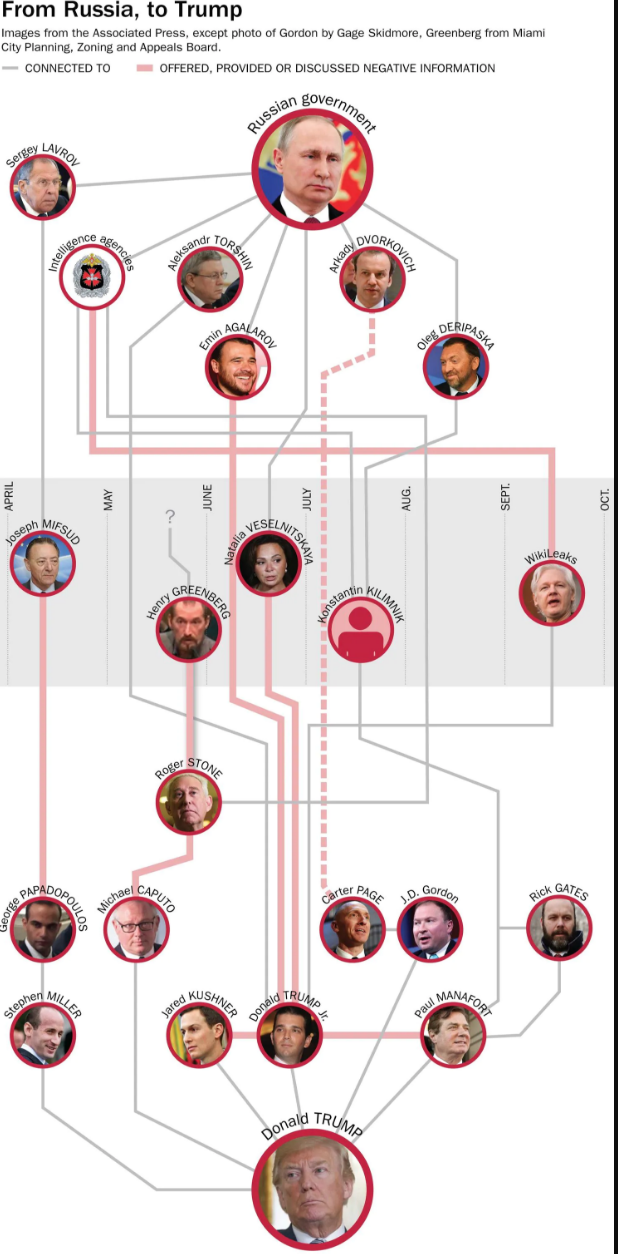
(When Trump operative Roger Stone admitted he was talking over Twitter with Guccifer 2.0, Stone was admitting he was talking with a Russian agent.)

➤ Eduardo Porter and Guilbert Gates explain How Trump’s Protectionism Could Backfire:

Republicans could not lose in this deep red enclave in the buckle of the Bible Belt. Still, in the 2016 election, Mr. Trump carried Lee County, where Tupelo sits, by a 38-percentage-point margin over Hillary Clinton — nine percentage points more than Mitt Romney’s lead over Barack Obama four years before.

And yet it’s not working out great for the working men and women of Tupelo. Indeed, President Trump’s first big trade barrier — tariffs against steel and aluminum imports — is, again, threatening to undermine their livelihood.

For every job in Tupelo producing steel or aluminum, there are 200 jobs in industries that consume them that could be put at risk as tariffs push up the prices of these metals, according to research from Jacob Whiton and Mark Muro of the Brookings Institution.

This is true across the country. The lesson the White House has yet to figure out is that the tariffs meant to protect the businesses that make these metals will end up hamstringing the industries that rely on them.

➤ Ron Brownstein asks Has Trump Already Sealed the GOP’s Fate in 2018?:

Every time Donald Trump breaks a window, congressional Republicans obediently sweep up the glass.

That’s become one of the most predictable patterns of his turbulent presidency—and a defining dynamic of the approaching midterm elections. Each time they overtly defend his behavior, or implicitly excuse him by failing to object, they bind themselves to him more tightly.

➤ The New York Times editorial board asks Why Is Trump So Afraid of Russia?:

The former C.I.A. director John Brennan pulled no punches on Wednesday when he was asked why President Trump had congratulated his Russian counterpart, Vladimir Putin, for his victory in a rigged election, even after Mr. Trump’s national security staff warned him not to.

“I think he’s afraid of the president of Russia,” Mr. Brennan said, on MSNBC’s “Morning Joe” program, of the phone call on Tuesday between the two presidents. “The Russians, I think, have had long experience with Mr. Trump and may have things they could expose.”

The possibility that Mr. Putin could have some hold on the American president has lurked in the background over the past year as Mr. Trump displayed a mystifying affection for the Russian leader and ignored or excused his aggressive behavior and nefarious activities, most important, his interference in the 2016 campaign, a subject of the special counsel Robert Mueller’s investigation.

➤ So, Has There Ever Been an Actual Case of Someone Being Pelted With Tomatoes During a Performance?:

Owner-Occupied Housing in the Whitewater Area

During these years I have written, and long before, one has heard from local officials and residents that the City of Whitewater needs more single-family housing. Single-family housing is a kind of owner-occupied housing (e.g., one owner, two adult owners, a single-family).

Indeed, one hears that the City of Whitewater needs more single-family housing the way it needs more sunny days or cute puppies: as an unalloyed good.

Despite all this talk, government-backed efforts to alter the housing mix this way are futile, and unnecessary.

Consider owner-occupied housing in the Whitewater area of the City of Whitewater, Fort Atkinson, Jefferson (city), and Milton (city):

 Community

Total Units

 Occupied Units

 Owner-Occupied

 Renter-Occupied

 City of Whitewater

 5,247

 4,754

 1,498 (31.5%)

 3,256 (68.5%)

 Fort Atkinson

 5,285

 5,014

 3,105 (61.9%)

 1,909 (38.1%)

 Milton

 2,452

 2,334

 1,551 (66.5%)

 783 (33.5%)

 Jefferson

 3,203

 2,911

 1,774 (59.4%)

 1,214 (40.6%)

American Fact Finder Selected Housing Characteristics 2012-2016 for WhitewaterFort Atkinson, Jefferson (city), and Milton (city).

A few key points:

Whitewater’s Not An Island. When people talk about the City of Whitewater needing more owner-occupied units, they overlook the vast, existing supply of owner-occupied housing in the area.

In all the area, there are no less than 7,928 owner-occupied units.

A Free and Voluntary Distribution. This distribution, with most owner-occupied units outside the city, and the largest number of renter-occupied units within it, did not come about by force, coercion, or command. People – buyers, sellers, and renters – chose this distribution.

Honest to goodness, they freely chose it because it makes practical sense: the greatest number of rental units are in the City of Whitewater, where there is a UW System campus.

Many attendees of UW-Whitewater choose to rent, and it’s practical for them to rent in the city; some homeowners have decided to live farther out, as is to their tastes.

Banana-Growing in Alaska? No Thanks. Suppose the people of Alaska decided that rather than importing bananas from tropical places where that fruit is commonly grown, they should grow their own. Indeed, imagine that a movement arose, with a slogan that captivated its residents: Go Bananas for Alaska!™

That would be a poor idea. There are many tropical places with banana plantations, producing delicious fruit economically, in abundance. There’s no need for Alaskans to produce a local variety that – owing to their climate – would require indoor growing at great cost, and likely for an inferior product.

The better distribution is for Alaska to produce oil and sled dogs, and tropical places to produce bananas.


The Crazy-High Price of Subsidies or Regulations. Imagine what it would take to produce even a 50-50 distribution of owner-occupied homes in Whitewater: to equal the number of rental units Whitewater has now, she would have to add 1,758 owner-occupied unitsmore than the entire stock of existing owner-occupied units.

What would a government program of getting to 50-50 require? It would require either vast sums to subsidize owner-occupied construction or – and this is even less plausible – restrictions on just about any rental opportunity in the futile hope that they’d all someone how become owner-occupied.

I am a homeowner within Whitewater’s city limits, and I would encourage others to purchase or rent within the city. It’s beautiful here.  One cannot imagine a better place. Whitewater should not be, however, a government-engineered community. To love something is not to force it by regulation or lure it by public spending into something it is not, by nature.

(Needless to say, arguing against government incentives for large-scale private builders has nothing to do with targeted existing programs to help the poor. The concern expressed here is closer, so to speak, to arguing against subsidizing banana plantations in Alaska.)

Whitewater would do better, and be better, if she allowed buyers, sellers, and renters to choose freely without government’s fruitless attempt to make the city something thousands of residents have not chosen for themselves.

Daily Bread for 3.22.18

Good morning.

Thursday in Whitewater will be sunny with a high of forty-eight. Sunrise is 6:52 AM and sunset 7:10 PM, for 12h 17m 26s of daytime. The moon is a waxing crescent with 26.1% of its visible disk illuminated. Today is the {tooltip}four hundred ninety-seventh day.{end-texte}Days since Trump’s election, with 11.9.16 as the first day.{end-tooltip}

Whitewater’s Community Development Authority meets at 5:30 PM.

On this day in 1765, Parliament imposes the Stamp Act on her American colonies:

The Stamp Act of 1765 (short title Duties in American Colonies Act 1765; 5 George III, c. 12) was an Act of the Parliament of Great Britain that imposed a direct tax on the colonies of British America and required that many printed materials in the colonies be produced on stamped paper produced in London, carrying an embossed revenue stamp.[1][2] Printed materials included legal documents, magazines, playing cards, newspapers, and many other types of paper used throughout the colonies. Like previous taxes, the stamp tax had to be paid in valid British currency, not in colonial paper money.[3] The purpose of the tax was to help pay for troops stationed in North America after the British victory in the Seven Years’ War and its North American theater of the French and Indian War. However, the Colonists had never feared a French invasion to begin with, and they contended that they had already paid their share of the expenses.[4] They suggested that it was actually a matter of British patronage to surplus British officers and career soldiers who should be paid by London.

On this day in 1854, Eugene Shepard, Father of the Hodag, is born:

On this date Eugene Shepard was born near Green Bay. Although he made his career in the lumbering business near Rhinelander, he was best known for his story-telling and practical jokes. He told many tales of Paul Bunyan, the mythical lumberjack, and drew pictures of the giant at work that became famous. Shepard also started a new legend about a prehistoric monster that roamed the woods of Wisconsin – the hodag. Shepard built the mythical monster out of wood and bull’s horns. He fooled everyone into believing it was alive, allowing it to be viewed only inside a dark tent. The beast was displayed at the Wausau and Antigo county fairs before Shepard admitted it was all a hoax. [Source: Badger saints and sinners, by Fred L. Holmes, p.459-474]

Recommended for reading in full —

➤ ABC News reports Mueller team zeroing in on political consulting firm with Trump ties:

➤ Daniel Bice and Mary Spicuzza report Wisconsin GOP operative Mark Block helped link Steve Bannon, Cambridge Analytica:

Of course, there’s a Wisconsin connection to the Facebook scandal involving Cambridge Analytica.

And, not surprisingly to some, it involves longtime Wisconsin GOP operative Mark Block.

Block, who has a history of campaign missteps, has been named as a key player in the international uproar over Cambridge Analytica, a London-based firm that mined data from 50 million Facebook users to try to influence the 2016 presidential race.

Christopher Wylie, a whistleblower who brought the scandal to light, identified Block as the middleman between former White House chief strategist Steve Bannon and Cambridge Analytica.

In a story posted earlier this week, the Guardian newspaper said Wylie offered “what sounds like a tall tale, though it’s one he can back up with an email.”

“Mark Block, a veteran Republican strategist, happened to sit next to a cyberwarfare expert for the U.S. Air Force on a plane,” the newspaper said. It continued, “And the cyberwarfare guy is like, ‘Oh, you should meet SCL (Group). They do cyberwarfare for elections.’ “

SCL Group is the parent company for Cambridge Analytica.

The firm, which was hired by President Donald Trump’s 2016 campaign, has been listed as having a New Berlin address in some Federal Election Commission filings. That P.O. Box has been used by Block in the past.

➤ Mary Spicuzza also reports Thousands of Milwaukee voters have been dropped from rolls, including some erroneously:

Thousands of Milwaukee voters have been dropped from voter rolls — including some erroneously — through the state’s registration system, city officials said Wednesday.

Some 44,000 voters were removed from city rolls after the state started using a new process in the Electronic Registration Information Center (ERIC), they said. It’s unclear how many of those were dropped in error.

“This is not a problem that has been caused at the local level,” Mayor Tom Barrett said at a City Hall news conference.

Barrett said problems were caused by incorrect data provided by the state Department of Motor Vehicles and the U.S. Postal Service, leading some voters who haven’t actually moved or changed addresses to be erroneously dropped from the rolls.

“We are very concerned with the number of legitimate voters whose records have been deactivated,” Barrett said.

➤ Jennifer Rubin observes Trump doesn’t bother to hide his submissiveness to Putin anymore:

Trump’s servility when it comes to Putin defies a benign explanation and takes us to the heart of the Russia scandal: What does Putin “have” on Trump, and why is Trump so reluctant to defend American interests when it comes to only this world leader? Mueller can ask Stephen K. Bannon and Michael Flynn about Trump’s mysterious passivity, but he might want to question outgoing secretary of state Rex Tillerson, too. He would no doubt be entirely candid and might have some important insights into Trump’s refusal to challenge Putin. Come to think of it, Mike Pompeo, the CIA director who has been nominated to replace Tillerson, might have something to say on this score as well.

➤ Meg Jones reports Clover, the adorable fox kit found abandoned last week, is improving at Humane Society:

A week after the shivering ball of fur was found, he has gained half a pound, is recovering from the maladies and is weaning off liquid food. His eyesight has improved and his ears, laid back when born, have now perked up.

“He’s like a true toddler now,” said Crystal Sharlow-Schaefer, wildlife supervisor at the Wisconsin Humane Society’s Wildlife Rehabilitation Center.

“Wild parents are good parents. For him to be in this shape, the fox family had to have been in crisis. He was a nugget of problems, but he has really rallied,” Sharlow-Schaefer said.