
Transcript from C-SPAN.
Author Archive for JOHN ADAMS
Elections, Fair Maps, Gerrymandering
Fair Maps
by JOHN ADAMS •
I am proud to stand with @GovEvers tonight as he calls for non-partisan redistricting in Wisconsin. In 2011 Republicans drew some of the worst gerrymanders in the country. It’s time to change that and make things fair. It’s time to give power back to the people-where it belongs. https://t.co/34jB9j04yZ
— Eric Holder (@EricHolder) January 23, 2020
Daily Bread
Daily Bread for 1.23.20
by JOHN ADAMS •
Good morning. 
Thursday in Whitewater will be cloudy, with morning snow, and a high of thirty-four. Sunrise is 7:17 AM and sunset 4:56 PM, for 9h 39m 18s of daytime. The moon is a waning crescent with 2% of its visible disk illuminated.
Whitewater’s Community Development Authority meets at 5:30 PM.
On this day in 1941, Charles Lindbergh testifies before Congress and recommends a neutrality pact between the United Staes and Nazi Germany. One reads: “President Franklin Roosevelt publicly decried Lindbergh’s views as those of a “defeatist and appeaser,” comparing him to U.S. Rep. Clement L. Vallandigham, who had led the “Copperhead” movement that had opposed the American Civil War. Lindbergh promptly resigned his commission as a colonel in the U.S. Army Air Corps, writing that he saw “no honorable alternative” given that Roosevelt had publicly questioned his loyalty.” (Roosevelt was right.)
Recommended for reading in full —
Laurel White reports Governor Uses State Of The State Speech To Call Special Legislative Session On Wisconsin’s Dairy Crisis:
Gov. Tony Evers used his second State of the State address Wednesday evening to call lawmakers into a special session to address Wisconsin’s dairy crisis.
Wisconsin lost 10 percent of its dairy farms in 2019, breaking the previous year’s record high.
“We’ve heard people who’ve said there’s no place for small farms anymore, they ought to go big or bust. Well, they’re wrong,” Evers said, referencing comments made by U.S. Department of Agriculture Secretary Sonny Perdue during a visit to Wisconsin in October. “They don’t know Wisconsin.”
Evers said he’s calling in lawmakers next week to take up “legislation to invest in our farmers, agricultural industries and our rural communities.”
The governor has previously called a special session on gun laws in Wisconsin, which GOP lawmakers gaveled in and adjourned without taking action.
See also How Walker, Trump Hurt Dairy Industry (‘Their policies helped fuel a dairy crisis’).
David Abel reports Trump’s EPA is said to cut scientists out of new water policy that threatens New England wetlands:
With the Trump administration poised to roll back key protections for much of the nation’s wetlands, scientists at the US Environmental Protection Agency are accusing the agency’s political appointees of ignoring their advice and barring them from shaping sweeping new guidelines, violating the agency’s longstanding policies.
One scientistwas so distraught that the agency veteran started to cry while explaining how EPA administrators have cut specialists out of the process of crafting rules that prevent development and pollution near streams, tidal waters, and ponds.
“This has been a very painful time to work for the agency,” the scientist said in a recent interview, speaking on condition of anonymity because of fear of reprisal. “We’re being asked to do things that most of us feel is the antithesis of what we’ve been trying to do, and, in some cases, undo things that we’ve worked very hard to accomplish.”
(‘Fear of reprisal’: when one considers how this federal administration acts, it’s a reasonable concern for these scientists.)
Babbittry, Bad Ideas, Boosterism, CDA, City, Corporate Welfare, Culture, Development, Economics, Economy, Local Government, Trump, WEDC
‘But Not in Conditions of Their Own Choosing’
by JOHN ADAMS •
It’s a truism to say that all people make history, but not in conditions of their own choosing:
Admittedly and sadly, the local boosterism of the pre-Trump years is now in retrospect worse than one might have initially believed: across America boosters who peddled false descriptions & junk solutions during the economic hardship of the Great Recession contributed, knowingly or unknowingly, to the erosion of reason and honesty. They were at first forgettable for their absurdities, later annoying for them, and how having contributed to our present degradation they are politically unforgivable.
CDA, City, Culture, Local Government
More Predictable Than an Atomic Clock
by JOHN ADAMS •
If one read beforehand the agenda for last night’s common council meeting (1.21.20), one would have seen the applicants for various boards (particularly the Whitewater Community Development Authority). Seeing them, and knowing what the last ten years on the CDA have been like, one could have confidently predicted which candidate would be recommended for appointment. Indeed, an atomic clock, so very accurate in its timekeeping, would not have been more predictable. Whitewater’s Community Development Authority – a public body meant to serve all the community – has been a failure in meaningful metrics but a great success in finding members mostly preferred by a few local landlords and bankers. (Obvious point – I’m sure all the applicants are fine people, but a change of pace is needed at the Whitewater CDA, of backgrounds that stretch the horizons of that public body.)
Appointments don’t have to follow along yesterday’s lines.
Yet they have been this way, and it’s a measure of Whitewater’s policymaking failure that she frets over the ‘same ten people’ serving on public boards in the city, while local government picks from among the preferences of those same ten people, and so she doesn’t expand the reach of local government much beyond those same ten people.
Embedded below is the relevant portion of the meeting. The full video is also available online.
Someone asked me a bit ago why I posted earlier today on Perspectives Narrow or Wide, mentioning in that post a letter to the editor from 2017. Here’s why: because the perspective in that letter from 2017 still holds noticeable sway in Whitewater, very much to the community’s disadvantage. A conventional and narrow perspective, fawning to one family or another, is unsuited to a robust and confident people (as Americans are and should always be).
These aren’t easy topics. We would do much better in a world of easier times and easier issues. We’ve not seen that world in many years (although other parts of America have).
It’s been a difficult decade for Whitewater (and many other rural communities); after so much time, it’s hard to see how promises now about doing better in the future are to anyone’s credit.
However much one may disagree with the solutions of the New Dealers (as I do), I find it impossible not to admire their sense of urgency and commitment to others. They broke from the past. See On the Upcoming 2011 Whitewater, Wisconsin Municipal Budget (“I’m not a progressive, but at least the New Dealers knew how to depict conditions honestly, so that they might spur their fellow citizens to action. Dorothea Lange’s pictures were haunting, yet useful”).
There’s no structural impediment that has prevented an attitudinal change in Whitewater. The fault is within us, that we have not embraced the urgency these times demand, exhibiting along the way an excessive deference.
It’s a great tragedy in many of these small rural places that next time should have happened long ago.
Addendum: When voting on recommendations for applicants to different boards or commissions, there should be a vote on each recommendation for each board. As it is, the Whitewater Common Council votes on all of these recommendations in one vote to approve. Now, councilmembers don’t have to declare for or against any given recommendation (and instead less controversial recommendations are – collectively – leveraged against more controversial ones).
Impeachment Trial, Law, Trump
Opening Remarks of Rep. Adam Schiff before the United States Senate, 1.21.20
by JOHN ADAMS •
Transcript from C-SPAN. Prepared statement below:
[embeddoc url=”https://freewhitewater.com/wp-content/uploads/2020/01/Schiff-Opening-Remarks.pdf” width=”100%” download=”all” viewer=”google”]
City, Culture, Ethics, Philosophy, Religion
Perspectives Narrow or Wide
by JOHN ADAMS •
One of the hopes for small-town living is that, among the residents of such a place, one will commonly find plain speaking and humility. Perhaps there are places like this, but sadly small towns, by themselves, are not enough to overcome unworthy pride. On the contrary, within such places, sometimes a tiny faction – confusing several square miles for the known universe – will slowly lose its perspective.
Consider a letter (identified as written by a Whitewater city councilman) to the editor of the local college newspaper, taking umbrage at the newspaper for failing to show what the letter-writer considered the proper regard for another resident.
Below, I’ve posted the letter, and thereafter words fitting in reply (a reply far better than anything I might ever say).
The Letter to the Editor:
One Response to “Premier Bank CEO talks Commercial merger” [click for screenshot]
Lynn Binnie on October 17th, 2017 10:28 pm
“Kachel” is undoubtedly the best known surname in Whitewater. The family has donated millions to the university, their name appears in a number of places on the campus, and DLK is the largest landlord in the community. Consequently it’s shocking to see the name spelled Catchall in this article. Not to mention that the former President of Commercial Bank spells his name Jon rather than John.
A Reply:
The Gospel of Mark, 12:38-39, 41-44
[38] As he taught, he said, “Beware of the scribes, who like to walk around in long robes, and to be greeted with respect in the marketplaces, [39] and to have the best seats in the synagogues and places of honor at banquets!
[41] He sat down opposite the treasury, and watched the crowd putting money into the treasury. Many rich people put in large sums. [42] A poor widow came and put in two small copper coins, which are worth a penny. [43] Then he called his disciples and said to them, “Truly I tell you, this poor widow has put in more than all those who are contributing to the treasury. [44] For all of them have contributed out of their abundance; but she out of her poverty has put in everything she had, all she had to live on.”
See also The Perimeter Fence and Newnan, Georgia & Whitewater, Wisconsin.
Daily Bread
Daily Bread for 1.22.20
by JOHN ADAMS •
Good morning.
Wednesday in Whitewater will be mostly cloudy with a high of thirty-two. Sunrise is 7:17 AM and sunset 4:55 PM, for 9h 37m 15s of daytime. The moon is a waning crescent with 5.9% of its visible disk illuminated.
On this day in 1968, the NBA awards a basketball franchise to Milwaukee.
Recommended for reading in full —
Scott Bauer reports Wisconsin voter purge ruling appealed to state Supreme Court:
A conservative law firm on Tuesday asked the Wisconsin Supreme Court to reverse a lower court’s order putting on hold a ruling that would have forced the removal of up to 209,000 people from the state’s voter rolls.
Attorneys for the Wisconsin Institute for Law and Liberty (WILL) asked the justices to overturn the state appeals court’s Jan. 14 decision. It also asked the high court to undo the stay of a contempt order against the state Elections Commission that the lower court had issued after the commission failed to proceed with the voter purge.
The state Supreme Court on Jan. 13 declined to take the case and bypass the state appeals court. Less than 24 hours later, the appeals court issued its orders that effectively hit the pause button on the case and halted any immediate change to the state’s voter registration rolls.
But WILL argued Tuesday that the state Supreme Court should reverse the appeals court orders because at the time they were issued the appeals court offered no rationale for its action.
However, hours after that motion was filed Tuesday, the appeals court issued its full ruling with its reasoning for putting the cases on hold.
The three judges on the appeals court panel said they granted the stay because the Elections Commission was likely to succeed on appeal. It also said the commission makes a “strong argument” that the power under the law to deactivate a voter applies to local election officials, not the state commission. The lower court judge ordered the commission to remove the voters.
Rob Mentzer reports He Acted As His High School’s ‘Indian.’ 50 Years Later, He Calls For Ending Native American Mascots:
Richie Plass was 16 when he became his high school’s mascot.
The school principal approached him about it, along with the basketball coach and the athletic director. The Shawano Community High School mascot at the time was the Indians. Plass is Menominee and Stockbridge/Munsee, and grew up on the Menominee Indian Reservation. He was one of maybe 15 Native Americans in the school, and the principal knew he could dance. Would he be willing, they asked, to dress up as the Shawano Indian and perform at halftime?
It was 1968. His time as mascot would last three games, and would end in tears. The experience would be with him for the rest of his life.
Today, Plass is an educator and the curator of “Bittersweet Winds,” an exhibit of more than 400 artifacts that show how Native Americans have been depicted in culture — from caricatured mascot images to plastic toys and old cowboy movies. In November, more than 50 years after he graduated, he came back to Shawano High School to show the exhibit in the school library. Plass is also an activist, calling for an end to Native American mascots in schools and professional sports.
The “American Dream” Under Threat. Does Higher Education Need a Change?:
Art, City, Culture, Local Government
Newnan, Georgia & Whitewater, Wisconsin
by JOHN ADAMS •
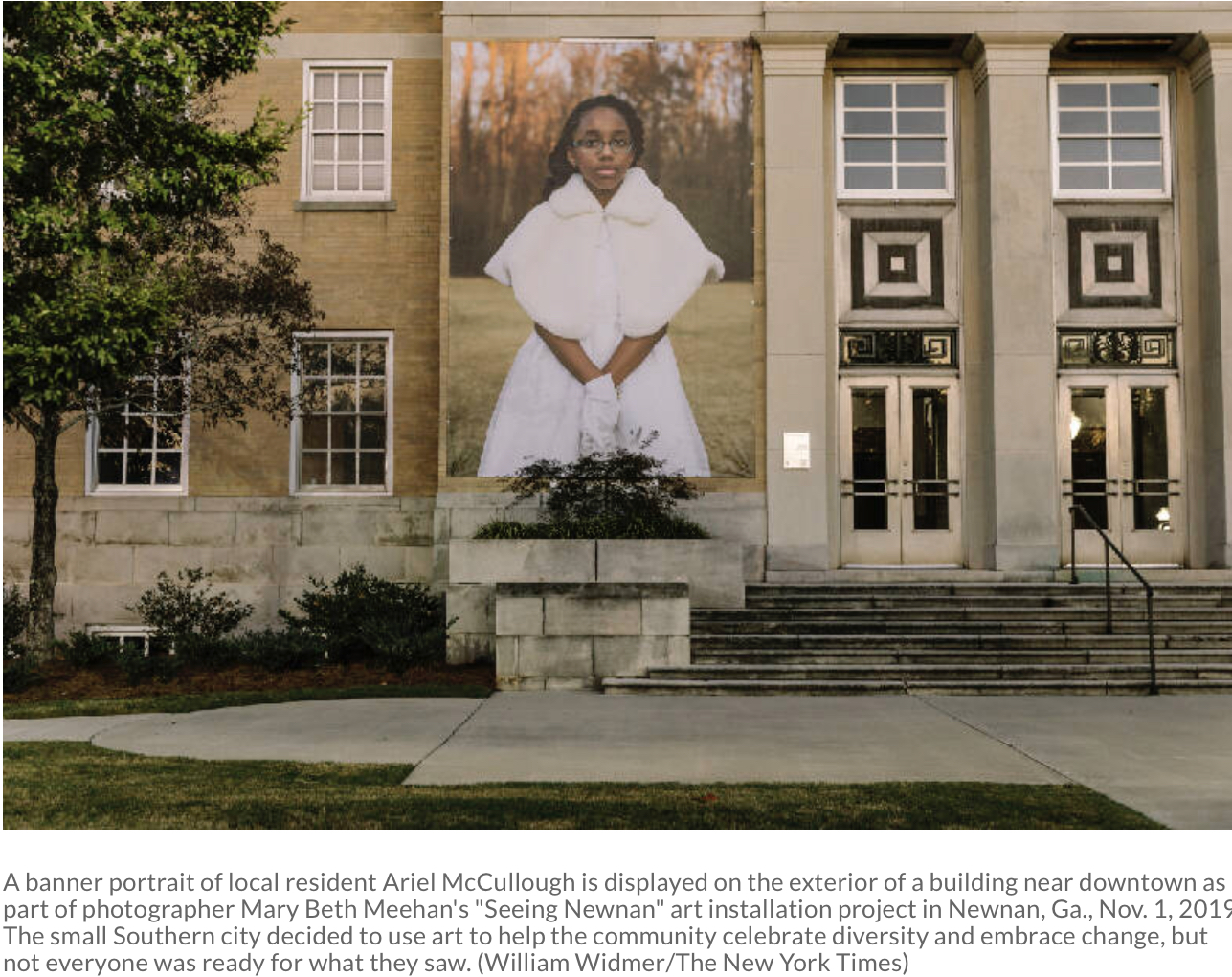
One reads, in the New York Times, about How 17 outsize portraits rattled a small southern town (‘Not everyone was ready for what they saw’). After a white-nationalist rally in Newnan, Georgia, that town
put up 17 large-scale banner portraits, images of the ordinary people who make up the town. They hang from the perches of brick buildings around downtown. There’s Helen Berry, an African-American woman who for years worked at a sewing factory. Wiley Driver, a white worker who folded and packed blankets at a local mill before his death in 2018. Jineet Blanco, a waitress who arrived in Newnan carrying her Mexican traditions and dreams.
….
The portraits were meant to be inclusive, upend stubborn preconceptions and unravel the cocoons people had created within the community. And they did — but they also exposed how immigration and demographic change have recast the racial dynamics that once defined the United States, adding new layers of anxiety on the old tensions that persist across the country and in small cities like Newnan.
I’m from Whitewater, not Newnan, and I’ll place that town’s particular selection of its residents aside. It’s also worth noting that a municipal government’s selection of residents’ portraits would be, even in less contentious times, fraught with complaining.
Instead, one has reason to wonder: how would Whitewater choose?
Ten or twenty years ago, one would have been able to answer that question easily and confidently: Whitewater’s government and self-described notables would have picked portraits of themselves. They most certainly would not have picked ordinary residents, on the basis of diversity or any other criterion. They would have put their own portraits, signs, banners, handprints, sayings, etc., all over town if they’d have thought of it. (Names they understood – they plastered those on walls; portraits, however, require an artistry and imagination they lacked.)
Today, however, the choice of residents’ portraits would be much harder. What’s left of the town’s self-designated notables would be widely ridiculed if they chose portraits of themselves. No awe – simply shock. They might – doubtless – want to pick themselves even now, but their diminishing numbers and serial policy failures have perhaps increased, if slightly, their caution in this regard.
(Although I would not pick portraits for Whitewater, or encourage Whitewater to pick, a principle of last becoming first would be a sound one – this city has had enough of first staying first.)
As it is, the city is now sufficiently diverse that yesterday’s majority is today only a minority of the city, and among that diminishing faction’s notables there are mostly the aged and addled, the entitled but empty.
Whitewater’s future will not recapitulate her past.
Daily Bread
Daily Bread for 1.21.20
by JOHN ADAMS •
Good morning.
Tuesday in Whitewater will be sunny with a high of twenty-three. Sunrise is 7:18 AM and sunset 4:53 PM, for 9h 35m 15s of daytime. The moon is a waning crescent with 11.8% of its visible disk illuminated.
Whitewater’s Alcohol Licensing Board meets at 6:10 PM, and Common Council at 6:30 PM.
On this day in 1997, the U.S. House of Representatives votes 395–28 to reprimand Newt Gingrich for ethics violations, making him the first Speaker of the House to be so disciplined.
Recommended for reading in full —
Katelyn Ferral reports Attorney General will review, may reopen botched Wisconsin National Guard sex assault investigations:
The Wisconsin Department of Justice will review a series of sexual assault investigations from the Wisconsin National Guard after a federal report released last month found that many were conducted improperly.
At least two Guard victims whose cases were initially investigated by the Guard were notified by the National Guard Bureau last week that Wisconsin’s DOJ would review some cases, according to an email from the NGB obtained by the Cap Times. The National Guard Bureau is the federal administrative agency that oversees Guard units nationwide and authored the report on the Wisconsin Guard.
One victim told the Cap Times she wants her case reviewed by the DOJ and the other is still considering it. The reviews could lead to some cases being fully reinvestigated and prosecuted.
Both victims were contacted by their special victim advocates, who are Guard-appointed advisers to help victims navigate the investigative process and access other resources. Victims can choose to opt out of the case review, according to the email. No case information or names will be publicly released.
Robert Costa and Rachael Bade report Trump’s lawyers, Senate GOP allies work privately to ensure Bolton does not testify publicly:
President Trump’s legal defense team and Senate GOP allies are quietly gaming out contingency plans should Democrats win enough votes to force witnesses to testify in the impeachment trial, including an effort to keep former national security adviser John Bolton from the spotlight, according to multiple officials familiar with the discussions.
While Republicans continue to express confidence that Democrats will fail to persuade four GOP lawmakers to break ranks with Senate Majority Leader Mitch McConnell (R-Ky.), who has opposed calling any witnesses in the trial, they are readying a Plan B just in case — underscoring how uncertain they are about prevailing in a showdown over witnesses and Bolton’s possible testimony.
One option being discussed, according to a senior administration official, would be to move Bolton’s testimony to a classified setting because of national security concerns, ensuring that it is not public.
To receive the testimony in a classified session, Trump’s attorneys would have to request such a step, according to one official, adding that it would probably need the approval of 51 senators.
Elections, Presidential race 2020, Trump, Wisconsin
Battleground Wisconsin 2020
by JOHN ADAMS •
Although Trump carried Wisconsin in ‘16, and although 2020 is likely to see a hard fight against him in Wisconsin, Trump has significant obstacles he did not have in the last election.
On Twitter, Joe Handrick (@joeminocqua) offers a sound analysis of Trump’s electoral position in the Badger State. Embedded below is the first of Handrick’s five tweets in a thread. (Jump over to Twitter to see the rest.)
For Trump, 1.4 million votes was enough in 2016. But remember Clinton fell 238,000 votes from Obama. If 2020 turnout returns to 2012 levels, Trump will need 1,515,000 to win. That's 110,000 more than he received in '16 or an increase of 8%. #wiright
— joe handrick (@joeminocqua) January 19, 2020
No one should underestimate Trump; at the same time, no one should doubt that Trump has meaningful electoral vulnerabilities.
Music
Monday Music: Charlie Parker, Now’s The Time
by JOHN ADAMS •
Daily Bread
Daily Bread for 1.20.20
by JOHN ADAMS •
Good morning.
The Dr. King holiday in Whitewater will be mostly sunny with a high of twenty-five. Sunrise is 7:19 AM and sunset 4:52 PM, for 9h 33m 17s of daytime. The moon is a waning crescent with 19.6% of its visible disk illuminated.
On this day in 1942, at the Wannsee Conference held in the Berlin suburb of Wannsee, senior Nazi German officials discuss the implementation of the “Final Solution to the Jewish question” whereby millions of Jews were to be, and systematically were, murdered.
Recommended for reading in full —
Laurence H. Tribe writes Trump’s lawyers shouldn’t be allowed to use bogus legal arguments on impeachment:
The president’s lawyers have made the sweeping assertion that the articles of impeachment against President Trump must be dismissed because they fail to allege that he committed a crime — and are, therefore, as they said in a filing with the Senate, “constitutionally invalid on their face.”
Another of his lawyers, my former Harvard Law School colleague Alan Dershowitz, claiming to represent the Constitution rather than the president as such, makes the backup argument that the articles must be dismissed because neither abuse of power nor obstruction of Congress can count as impeachable offenses.
Both of these arguments are baseless. Senators weighing the articles of impeachment shouldn’t think that they offer an excuse for not performing their constitutional duty.
The argument that only criminal offenses are impeachable has died a thousand deaths in the writings of all the experts on the subject, but it staggers on like a vengeful zombie. In fact, there is no evidence that the phrase “high Crimes and Misdemeanors” was understood in the 1780s to mean indictable crimes.
On the contrary, with virtually no federal criminal law in place when the Constitution was written in 1787, any such understanding would have been inconceivable. Moreover, on July 20, 1787, Edmund Randolph, Virginia’s governor, urged the inclusion of an impeachment power specifically because the “Executive will have great opportunitys of abusing his power.” Even more famously, Alexander Hamilton in Federalist 65 defined “high crimes and misdemeanors” as “those offenses which proceed from the misconduct of public men, or, in other words, from the abuse or violation of some public trust.”
….
The related suggestion that, even if some noncriminal offenses might be impeachable, “abuse of power” is not among them is particularly strange. No serious constitutional scholar has ever agreed with it. The suggestion turns the impeachment power on its head.
The logic of impeachment as applied to the presidency is that the president has unique authority conferred by Article II. If he abuses that authority for personal advantage, financial or political, he injures the country as a whole. That is precisely why the framers rejected the idea of relying solely on an election to remove an abusive president from office. Indeed, waiting for the next election is an option that is obviously insufficient when the abuse of power is directed at cheating in that very election.