
Author Archive for JOHN ADAMS
Daily Bread
Daily Bread for 8.8.18
by JOHN ADAMS •
Good morning.
 Wednesday in Whitewater will be partly sunny, with a high of eighty-one. Sunrise is 5:54 AM and sunset 8:06 PM, for 14h 11m 26s of daytime. The moon is a waning crescent with 11.5% of its visible disk illuminated.
Today is the six hundred thirty-third day.Days since Trump’s election, with 11.9.16 as the first day.
Whitewater’s Finance Committee meets at 6:30 PM.

On this day in 1974, Richard Nixon announces his resignation, to take effect the next day at noon.
Recommended for reading in full —
Isaac Arnsdorf reports The Shadow Rulers of the VA (“How Marvel Entertainment chairman Ike Perlmutter and two other Mar-a-Lago cronies are secretly shaping the Trump administration’s veterans policies”):
Last February, shortly after Peter O’Rourke became chief of staff for the Department of Veterans Affairs, he received an email from Bruce Moskowitz with his input on a new mental health initiative for the VA. “Received,” O’Rourke replied. “I will begin a project plan and develop a timeline for action.”
O’Rourke treated the email as an order, but Moskowitz is not his boss. In fact, he is not even a government official. Moskowitz is a Palm Beach doctor who helps wealthy people obtain high-service “concierge” medical care.
More to the point, he is one-third of an informal council that is exerting sweeping influence on the VA from Mar-a-Lago, President Donald Trump’s private club in Palm Beach, Florida. The troika is led by Ike Perlmutter, the reclusive chairman of Marvel Entertainment, who is a longtime acquaintance of President Trump’s. The third member is a lawyer named Marc Sherman. None of them has ever served in the U.S. military or government.
Yet from a thousand miles away, they have leaned on VA officials and steered policies affecting millions of Americans. They have remained hidden except to a few VA insiders, who have come to call them “the Mar-a-Lago Crowd.”
Dan Alexander reports New Details About Wilbur Ross’ Business Point To Pattern Of Grifting:
A multimillion-dollar lawsuit has been quietly making its way through the New York State court system over the last three years, pitting a private equity manager named David Storper against his former boss: Secretary of Commerce Wilbur Ross. The pair worked side by side for more than a decade, eventually at the firm, WL Ross & Co.—where, Storper later alleged, Ross stole his interests in a private equity fund, transferred them to himself, then tried to cover it up with bogus paperwork. Two weeks ago, just before the start of a trial with $4 million on the line, Ross and Storper agreed to a confidential settlement, whose existence has never been reported and whose terms remain secret.
It is difficult to imagine the possibility that a man like Ross, who Forbes estimates is worth some $700 million, might steal a few million from one of his business partners. Unless you have heard enough stories about Ross. Two former WL Ross colleagues remember the commerce secretary taking handfuls of Sweet’N Low packets from a nearby restaurant, so he didn’t have to go out and buy some for himself. One says workers at his house in the Hamptons used to call the office, claiming Ross had not paid them for their work. Another two people said Ross once pledged $1 million to a charity, then never paid. A commerce official called the tales “petty nonsense,” and added that Ross does not put sweetener in his coffee.
There are bigger allegations. Over several months, in speaking with 21 people who know Ross, Forbes uncovered a pattern: Many of those who worked directly with him claim that Ross wrongly siphoned or outright stole a few million here and a few million there, huge amounts for most but not necessarily for the commerce secretary. At least if you consider them individually. But all told, these allegations—which sparked lawsuits, reimbursements and an SEC fine—come to more than $120 million. If even half of the accusations are legitimate, the current United States secretary of commerce could rank among the biggest grifters in American history.
Joel Currier reports Wesley Bell ousts longtime St. Louis County prosecuting attorney:
Robert McCulloch’s 28-year run as St. Louis County’s elected prosecutor came to a stunning end Tuesday when he was upset by a Ferguson councilman who promised to reform the criminal justice system.
Wesley Bell, 43, earned 57 percent of the vote in the Democratic primary, according to unofficial results. With no candidate from any other political party in the race, Bell will run unopposed in November.
….
This was the first time McCulloch had faced a challenger since the Ferguson protests that erupted over the killing of Michael Brown by a Ferguson police officer in August 2014. Protesters criticized his office for its handling of the grand jury inquiry into the killing of Brown. The grand jury brought no charges against Officer Darren Wilson.
Heather Long reported (in July) that Inflation hits 6-year high, wiping out wage gains for the average American:
Prices rose at their highest clip since 2012 over the past year, the Labor Department reported Thursday.
The 2.9 percent inflation for the 12-month period ending in June is a sign of a growing economy, but it’s also a painful development for workers, whose tepid wage gains have failed to keep pace with the rising prices.
The cost of food, shelter and gas have all risen significantly in the past year. Gas skyrocketed more than 24 percent, rent for a primary residence jumped 3.6 percent and meals at restaurants and cafeterias rose 2.8 percent.
Prices have risen roughly at the same rate as wages, erasing any gains workers may have hoped to realize via bigger paychecks.
The Perseid meteor shower will be this summer’s best light show:
Libertarians, Trump, Trump-Russia
Appeasement Isn’t Peace
by JOHN ADAMS •
Sen. Rand Paul is a libertarian in the way that Gov. Walker is a free-market man: they prefer the titles, but act in ways contrary to the underlying principles. For Wisconsin, no man behind the Wisconsin Economic Development Corporation & Foxconn project could genuinely support free markets in capital, labor, and goods; for Kentucky, no man who advocates détente with Putin’s Russia could genuinely support either peace or liberty.
One reads that Senator Rand Paul invites Russian lawmakers to Washington:
MOSCOW (Reuters) – U.S. Senator Rand Paul on Monday invited Russian lawmakers to visit Washington after holding talks in Moscow with parliamentarians and pledging to obstruct new sanctions against Russia.
The Republican senator and ally of U.S. President Donald Trump said he had traveled to the Russian capital to encourage diplomacy amid tense relations between Moscow and Washington.
U.S. intelligence agencies say Russia interfered in the 2016 U.S. presidential election to try to tilt the race in Trump’s favor, an assertion Moscow rejects, and the two countries are also at odds over Syria and Ukraine.
There is tension in the American relationship with Putin’s Russia because Putin seized Crimea, foments war in eastern Ukraine, threatens NATO allies in the Baltics and elsewhere, interfered in the last presidential election and looks set to do so in congressional elections this fall, bolsters a dictator in Syria, murders expatriate Russians in other nations, and murders and oppresses his own people at home.
Rand Paul will not bring peace by appeasing a murderous anti-American dictator. It’s a common Russian (and was formerly a Soviet) trick to claim that if one resists Russian ambitions, all the world will crumble. In fact, the world comes closer to crumbling when one does what Russia wants than when the democratic world resists Russian encroachments.
Those of us from old libertarian families have never been much taken with Rand Paul, or his bigoted father. (If anything, we’ve done a poor job of explaining how far we are from the Pauls’ views or Walker’s corporate welfare.)
In any event, there is no one truly libertarian who was, is, or ever will be (as Reuters accurately describes Sen. Paul), an “ally of U.S. President Donald Trump.”
Daily Bread
Daily Bread for 8.7.18
by JOHN ADAMS •
Good morning.
Tuesday in Whitewater will be partly cloudy, with a high of eighty-one. Sunrise is 5:53 AM and sunset 8:07 PM, for 14h 13m 51s of daytime. The moon is a waning crescent with 20.2% of its visible disk illuminated.
Today is the six hundred thirty-second day.Days since Trump’s election, with 11.9.16 as the first day.
Whitewater’s Common Council meets at 6:30 PM.
On this day in 1782, Gen. George Washington creates the original Purple Heart:
The original Purple Heart, designated as the Badge of Military Merit, was established by George Washington – then the commander-in-chief of the Continental Army – by order from his Newburgh, New York headquarters on August 7, 1782. The Badge of Military Merit was only awarded to three Revolutionary War soldiers by Gen. George Washington himself. General Washington authorized his subordinate officers to issue Badges of Merit as appropriate. From then on, as its legend grew, so did its appearance. Although never abolished, the award of the badge was not proposed again officially until after World War I.[5][6]
Recommended for reading in full —
Cass Sunstein writes Trump’s Russia Admission Is No Mere Scandal. It’s a Betrayal:
No candidate for high office, and no presidential campaign, should even think about accepting Russia’s help “to get information on an opponent.”
This conclusion is not merely a matter of common sense. It is linked with the deepest fears of those who founded our nation. Many people are puzzled by the constitutional provision limiting eligibility for the presidency to “natural born” citizens. But it attests to the founders’ desire to ensure something they prized perhaps above all: loyalty.
In the decisive debates over the impeachment clause, James Madison pointed to the risk that a president “might betray his trust to foreign powers.” Focusing on the electoral process itself, George Mason asked, “Shall the man who has practised corruption & by that means procured his appointment in the first instance, be suffered to escape punishment?”
Aaron Blake writes Trump is trying to argue collusion isn’t illegal. But he’s admitted it is — on multiple occasions:
Last week, President Trump and his lawyer Rudolph W. Giuliani argued that collusion isn’t a crime. But on Monday, Trump suggested that Hillary Clinton should be investigated for this supposed non-crime.
“Collusion is very real with Russia,” Trump quoted conservative commentator Dan Bongino as saying on Trump’s favorite Fox News morning show, “but only with Hillary and the Democrats, and we should demand a full investigation.”
“Collusion with Russia was very real. Hillary Clinton and her team 100% colluded with the Russians, and so did Adam Schiff who is on tape trying to collude with what he thought was Russians to obtain compromising material on DJT. We also know that Hillary Clinton paid through….
….a law firm, eventually Kremlin connected sources, to gather info on Donald Trump. Collusion is very real with Russia, but only with Hillary and the Democrats, and we should demand a full investigation.” Dan Bongino on @foxandfriends Looking forward to the new IG Report!
Investigations, it bears emphasizing, are generally launched to find illegal activity. Trump’s call to investigate Clinton’s alleged collusion with Russia — a complex and strained theory having to do with the Steele dossier — would seem to belie his true opinion about whether collusion is, in fact, a crime.
But it’s hardly the first time he’s admitted the obvious: that while the word “collusion” doesn’t appear in the criminal code, it is synonymous with and related to very real crimes. Over and over, mostly through his allegations of Democratic collusion, he’s acknowledged the criminal nature of collusion in ways that would seem to make it much more difficult for his lawyers to press the case that collusion by Donald Trump Jr. or anybody else wasn’t criminal. [Blake lists 5 times that Trump, himself, conceded so-called collusion is illegal.]
Bob Bauer writes Trump’s Preposterous ‘Collusion is Not a Crime’ Defense: What Real Lawyers—If Asked—Would Have Advised His Campaign About the Trump Tower Meeting:
Federal election law pairs the these prohibitions on foreign national electoral activity with restrictions on the behavior of the would-be U.S. beneficiaries. U.S. nationals, including campaigns, cannot “substantially assist” a foreign national in any of these activities, and Americans cannot solicit, accept or receive any such illegal foreign-national support. Viewed together, these prohibited activities— assistance, solicitation, acceptance, or receipt—certainly capture the essence of what some might understand by references to “collusion.”
From the standpoint of a competent lawyer, the 2016 Trump Tower meeting with Kremlin emissaries directly implicates these rules. The Russians did not merely offer information, plucked from the sky: In the first place, they had to have procured it. To have done so would normally require the expenditure of funds “in connection with” a federal election: opposition material assembled on a U.S. presidential candidate. Certainly the Russian traveling party spent money to travel to the United States for the meeting. Both the material they proposed to provide and the expenses associated with creating and arranging to deliver it raise the serious question of in-kind contributions to the campaign. Moreover, the hypothetical campaign lawyer would have to be concerned that urging the campaign to invest its own resources in a specific line of attack on Hillary Clinton would constitute illegal “participation” in the campaign’s decision-making on its own spending.
….
But then again, Trump and his senior campaign team may not have asked the lawyers for their opinion. They could well have had their reasons: The most obvious and troubling of the possible explanations is that, anticipating a negative response, they may have chosen to proceed without the advice of counsel to pursue victory with Russian help. Then the lawyers would have been consulted only after the fact, to come up with whatever public defense they could devise. This is the road that may have brought the Trump team to this moment—that is, to Rudy Giuliani and the absurd “collusion is not a crime” theory of the president’s case.
The Committee to Investigate Russia has a page on Everything We Know About Russia and President Trump:
Donald Trump’s connection to Russia and Russian interests dates back more than 35 years. His family and associates also have well-documented ties.
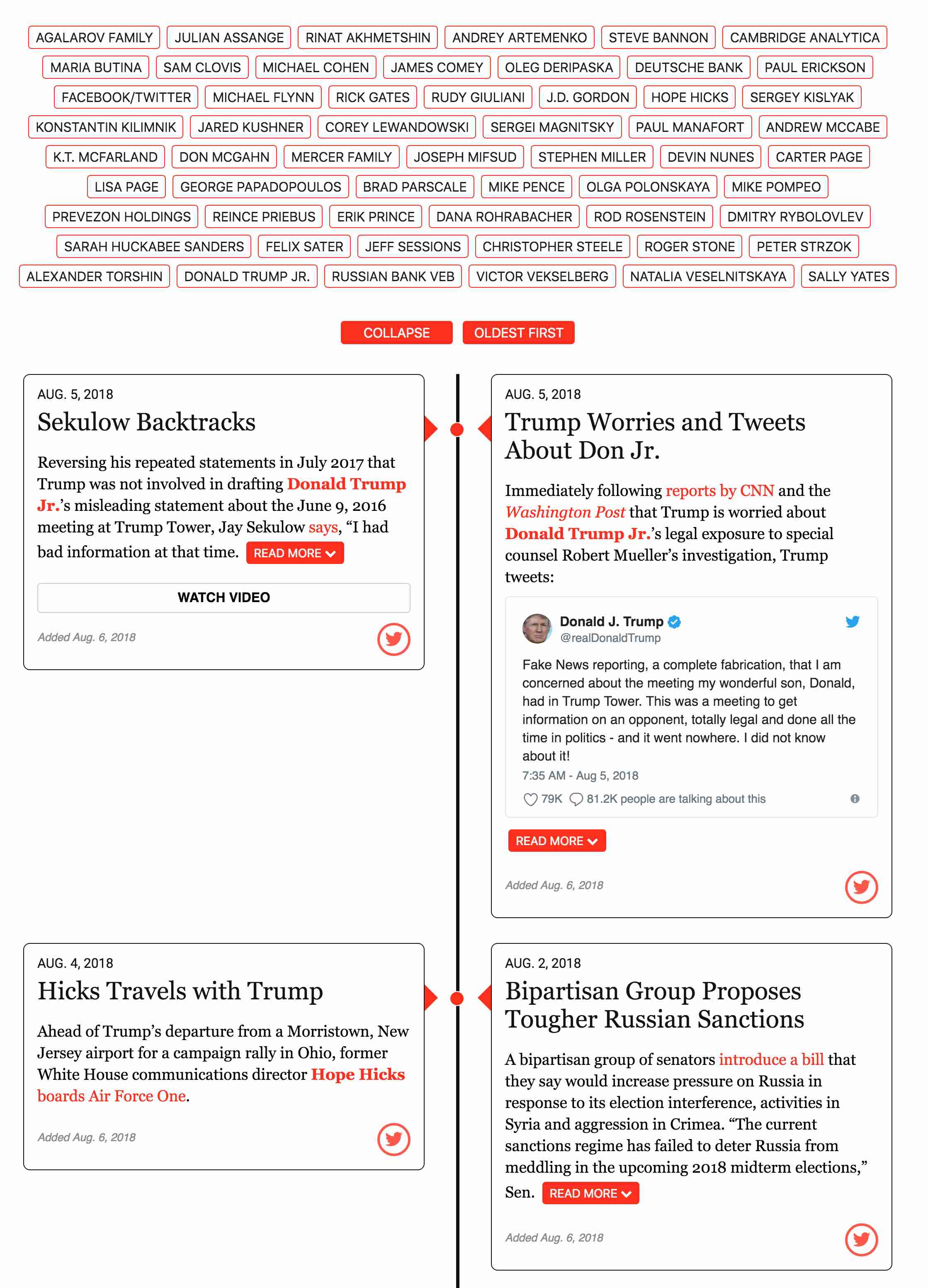
Since it can be challenging to keep track of all the players and moving parts in the ever-growing Russia investigations, lawyer Steven Harper and the producers at BillMoyers.com created this interactive Trump-Russia Timeline. It is a comprehensive, easy-to-navigate tool designed to show what has happened and what still is developing in the story of the president, his inner circle, and a tangled web of Russian oligarchs, hackers, and government officials.
First launched in February 2017, the Trump-Russia Timeline now contains more than 1,000 entries. View it in its entirety below, or select one or more names at a time and explore that particular storyline.
The timeline is updated regularly as new developments emerge.
Here is a screenshot from the interactive timeline – just a portion of a fine resource for Americans who want to know more about Russian influence over Trump:
Why 350°F is the magic number for baking:
Fellow Traveler, Russia, Trump-Russia
Why Wait? Aeroflot Offers Flights to Moscow from Several American Cities
by JOHN ADAMS •
Annnnd they’re finally being completely honest: They’re not Americans anymore. pic.twitter.com/ab0zpScFQK
— Charles Gaba (@charles_gaba) August 5, 2018
I’m not a Democrat, and never will be, but then I’ve never been tempted to abandon America for any reason, let alone because there are Democrats here, or because somehow being a Democrat in America might be more objectionable than living under Putin.
These gentlemen are sure that they’d be better off in Russia than as Democrats in America.
They are free to go, and to take others of their ilk with them – Aeroflot offers flights to Moscow’s Sheremetyevo Airport from several convenient U.S. locations.
Why delay even a day longer?
Music
Monday Music: That time the flight was delayed…
by JOHN ADAMS •
So, this is what happened.
The three of us came into the airport and the flight was delayed by nearly two hours. We could tell that everyone was a little bit unhappy about this and Geoff (the banjo player in the video) suggested that we play a bit of a music session. He played a set of traditional Irish dance tunes on the banjo and I (Daoiri Farrell) backed him on the Bouzouki. Robbie Walsh (Bodhran Player) then joined us and we had the attention of everyone in the room immediately. I then proceeded to sing a song. I picked one that I thought everyone would know, The Galway Girl. It went down really well. By this stage my dad had the Canon out and here is the video footage he took. His name is Desmond Farrell and his hobby is photography. Myself Geoff and Robbie are music pals for years. We were in Cumbria at a music festival called “Maddy Prior’s Steppingstones Folk Festival”. My website is Daoiri.com and Robbie’s is “The Bodhran Buzz” if anyone wants to check out any more of our music. I’ve recorded two solo albums now with Robbie and various things with Geoff also:
Daily Bread
Daily Bread for 8.6.18
by JOHN ADAMS •
Good morning.
Monday in Whitewater will see thunderstorms, with a high of eighty-one. Sunrise is 5:52 AM and sunset 8:08 PM, for 14h 16m 14s of daytime. The moon is a waning crescent with 30.2% of its visible disk illuminated.
Today is the six hundred thirty-first day.Days since Trump’s election, with 11.9.16 as the first day.
On this day in 1945, after more than three-and-a-half years of war since the Japanese attack on Pearl Harbor, and years more of Japanese aggression across Asia, the United States detonates an atomic bomb over Hiroshima:
The discovery of nuclear fission by German chemists Otto Hahn and Fritz Strassmann in 1938, and its theoretical explanation by Lise Meitner and Otto Frisch, made the development of an atomic bomb a theoretical possibility.[53] Fears that a German atomic bomb project would develop atomic weapons first, especially among scientists who were refugees from Nazi Germany and other fascist countries, were expressed in the Einstein-Szilard letter. This prompted preliminary research in the United States in late 1939.[54] Progress was slow until the arrival of the British MAUD Committee report in late 1941, which indicated that only 5 to 10 kilograms of isotopically enriched uranium-235 were needed for a bomb instead of tons of natural uranium and a neutron moderator like heavy water.[55]
The 1943 Quebec Agreement merged the nuclear weapons projects of the United Kingdom and Canada, Tube Alloys and the Montreal Laboratory, with the Manhattan Project,[56][57] under the direction of Major General Leslie R. Groves, Jr., of the U.S. Army Corps of Engineers.[58] Groves appointed J. Robert Oppenheimer to organize and head the project’s Los Alamos Laboratory in New Mexico, where bomb design work was carried out.[59] Two types of bombs were eventually developed, both named by Robert Serber. Little Boy was a gun-type fission weapon that used uranium-235, a rare isotope of uranium separated at the Clinton Engineer Works at Oak Ridge, Tennessee.[60] The other, known as a Fat Man device, was a more powerful and efficient, but more complicated, implosion-type nuclear weapon that used plutonium created in nuclear reactors at Hanford, Washington.[61]
Recommended for reading in full —
Michael D. Shear and Michael S. Schmidt report President Admits Trump Tower Meeting Was Meant to Get Dirt on Clinton:
WASHINGTON — President Trump said on Sunday that a Trump Tower meeting between top campaign aides and a Kremlin-connected lawyer was designed to “get information on an opponent” — the starkest acknowledgment yet that a statement he dictated last year about the encounter was misleading.
Mr. Trump made the comment in a tweet on Sunday morning that was intended to be a defense of the June 2016 meeting and the role his son Donald Trump Jr. played in hosting it. The president claimed that it was “totally legal” and of the sort “done all the time in politics.”
But the tweet also served as an admission that the Trump team had not been forthright when Donald Trump Jr. issued a statement in July 2017 saying that the meeting had been primarily about the adoption of Russian children.
Aaron Blake writes Trump just made 2 problematic admissions about the Trump Tower meeting:
The first is that Trump appears to have broken some new ground here when it comes to admitting the true purpose of the Trump Tower meeting with a Kremlin-aligned lawyer — and even further contradicted the initial statement he helped draft about it. At the time, Donald Trump Jr. issued a statement explaining that he and the lawyer, Natalia Veselnitskaya, had “primarily discussed a program about the adoption of Russian children.” We have since discovered that the elder Trump actually dictated that statement.
Quickly, though, that explanation fell apart, and we learned that Trump Jr. had actually been promised harmful information about Democrats, including Hillary Clinton. The president himself seemed to shrug it off, saying in July 2017 that, “from a practical standpoint, most people would have taken that meeting.” He added: “It’s called opposition research or even research into your opponent.” (Trump also tweeted along these lines.) But at the same time, he still suggested that the meeting was, in large part, about adoption.
….
But here’s the thing: This is a tweet about how the Trump Tower meeting was totally fine — nothing illegal to see here. If you’ve got no real concern about legal exposure from the meeting, why distance yourself from it? Trump seems to be arguing against his own point by assuring us that he had nothing to do with this meeting, which — oh, by the way — was totally on the up-and-up. Trump might as well have just confirmed The Post’s report that he is worried about what the meeting portends for his son.
Jennifer Rubin contends A Democratic House’s priority: The foreign money:
The reason we do not know much of anything regarding Trump’s receipt of foreign monies is because, unlike other modern presidents, Trump has refused to release his tax returns and the GOP House has refused to assume its constitutional power to determine whether the president can accept foreign emoluments. Right now litigation is trying to remedy this likely constitutional violation. However, after the midterms, a Democratic House on a simple up-or-down vote could determine that no, the president cannot accept any foreign emoluments from the Saudis or anyone else.
You see, the emoluments clause requires affirmative permission from Congress; by explicitly denying him that permission, Congress would put Trump squarely in violation of the Constitution. In other words, it would be telling Trump, “Your emoluments or your presidency.” And if Trump refuses to give up his emoluments while remaining president? Impeachment would be a remedy for a willful violation of the Constitution, but Congress might also obtain a court order (if it could survive standing issues and a host of other legal hurdles). Foreign funds, for example, might be impounded by court order at his properties. Like Iran sanctions, U.S. banks could be ordered to stop receipt of any overseas money from Trump properties.
In sum, Trump never thought he’d win the presidency and has had no intention of giving up any income. To the contrary, he’s using the presidency to hawk his properties and, in the case of Mar-a-Lago, ratchet up the price of membership and charge the Secret Service and other officials for their accommodations. Trump’s level of greed and indifference to legal and ethical norms is unsurpassed by any president. A Democratic House, however, might go a long way toward ending the grotesque corruption that characterizes his administration.
Julian E. Zelizer observes The Press Doesn’t Cause Wars—Presidents Do:
Although the press has routinely been blamed for some of the United States’s most controversial conflicts, the historical evidence demonstrates that the power to make wartime decisions rests in the Oval Office and on Capitol Hill—not in the newsroom. Yes, the news media has the power to influence public opinion and to focus attention on particular threats, but elected officials always have considerable leeway—outside of an immediate national-security crisis—to make decisions about how and when to use military force. Besides the fact that the “media” is rarely unified on any issue, the ultimate responsibility for war must be laid squarely on the shoulders of elected officials.
This was the case with the Spanish-American War in 1898, where the press is usually blamed for getting the nation into a conflict. According to the legend, the publisher William Randolph Hearst, whose newspapers loved to run sensational headlines and provocative stories, honed in on the Cuban revolt against Spain because the real-life drama attracted readers in an increasingly competitive newspaper market. When an accidental explosion blew up the USS Maine, the Hearst papers blamed Spain and drummed up patriotic sentiment. “Remember the Maine!” read the headline. Soon after, Congress declared war.
The myth vastly oversimplifies the reality. The U.S. fleet was already on its way toward Spanish territorial possessions when the explosion occurred. Joseph Campbell and other historians have effectively punctured most of the pillars of the conventional story. Numerous Republicans leaders had been moved by humanitarian concerns. Vermont Senator Redfield Proctor delivered a speech describing the condition of Cubans who had been detained in camps, “one half have died and one quarter of the living are so diseased that they cannot be saved.” A major diplomatic impasse with Spain set up the conditions for the conflict, and the growing imperial ambitions of numerous advisors who were working with President William McKinley also played a role. As the historian George Herring wrote in his book, From Colony to Superpower, the Republican platform in 1896 had “set forth a full-fledged expansionist agenda” and “the War of 1898 provided an opportunity to implement much of this agenda—and more.”
How Teenagers in Baltimore are Using Code to Stop Overdose Deaths:
In Baltimore, sometimes called the heroin capital of the U.S., a group of teenagers have developed an app that can track bad batches of drugs and alert nearby users. This helps drug users know when potentially lethal combinations of heroin and fentanyl are being distributed in their community. The so-called Bad Batch Boys believe that giving the information to the people that need it most has the potential to save countless lives.
(One small, sincere effort may have the power to help at least a few avoid disaster.)
Daily Bread
Daily Bread for 8.5.18
by JOHN ADAMS •
Good morning.
Sunday in Whitewater will be partly sunny, with a high of eighty-nine. Sunrise is 5:51 AM and sunset 8:10 PM, for 14h 18m 36s of daytime. The moon is a waning crescent with 41.7% of its visible disk illuminated.
Today is the six hundred thirtieth day.Days since Trump’s election, with 11.9.16 as the first day.
On this day in 1914, an American community installs an electric traffic signal:
An electric traffic light was developed in 1912 by Lester Wire, a policeman in Salt Lake City, Utah, who also used red-green lights.[14] On 5 August 1914, the American Traffic Signal Company installed a traffic signal system on the corner of East 105th Street and Euclid Avenue in Cleveland, Ohio.[6]:27–28[15] It had two colours, red and green, and a buzzer, based on the design of James Hoge, to provide a warning for colour changes. The design by James Hoge[16] allowed police and fire stations to control the signals in case of emergency. The first four-way, three-colour traffic light was created by police officer William Potts in Detroit, Michigan in 1920.[17] Ashville, Ohio claims to be the home of the oldest working traffic light in the United States, used at an intersection of public roads from 1932 to 1982 when it was moved to a local museum.[18][19]
Recommended for reading in full —
Anna Nemtsova and Philip Obaji Jr. report Murdered Russian Journalists In Africa Were Onto Something Dangerous for Putin (“They were on the trail of mercenaries with close ties to the Kremlin in a war-torn country full of diamonds and gold”):
Radchenko, Rastorguyev and Dzhema were focusing their report on the activities of Wagner, a private Russian military firm with links to the Kremlin and to the military intelligence agency known as the GRU. Its involvement in the Central African Republic is believed to have begun in January this year, when Russia began shipping arms to CAR along with five active duty military and 170 civilian instructors, many of whom presumably are ex-Russian military, to train two army battalions. It had won an exemption to a United Nations arms embargo in order to contribute small arms and ammunition to the country’s chronically weak military, which needed help to keep very determined rebel groups at bay.
But the Wagner Group is something special. Some have called it Russian President Vladimir Putin’s “private army.” The organization is led by Dmitry Utkin, who was once a member of the Russian special forces and is currently under U.S. sanctions for aiding Russian-backed separatists in the conflict in eastern Ukraine.
(According to a CNN report, Utkin was once head of security for Yevgeny Prigozhin, a Russian oligarch with close ties to the Kremlin. Prigozhin was one of 13 Russians indicted by Special Counsel Robert Mueller in February for interfering in the 2016 U.S. presidential election campaign. He became famous as a restaurateur, and earned the nickname,“Putin’s chef.” Russian business outlet RBC reported a year ago that Utkin’s name appeared in a corporate database as the general director of one of Prigozhin’s companies.)
Mindy Finn writes Trump has built a pyramid scheme of public fraud. It’s a taxpayer-backed cash grab:
Even after warnings that tariffs would wreak havoc on the economy, Donald Trump has staked his presidency on a series of trade wars that are now coming home to roost. With economic ruin looming over American farmers — a key constituency — he refuses to change course. Instead, he’s mulling a policy of clientelism, a $12 billion cash handout to the victims of his own bad ideas.
It’s a surprising development for many, especially the conservatives who have long lamented bailouts and subsidies, but it’s hardly out of character. On the contrary, it’s a natural fit for a White House that encourages corruption, exploitation and fraud in exchange for loyalty. As with his cabinet officials, he expects that the allure of taxpayer-funded kickbacks will be enough to keep farmers from holding him accountable for his own corruption and failures. It’s not an accident, it’s a strategy: grease the wheels of government so heavily that they spin in place.
Far from draining the swamp, Trump and his coterie of grifters, fraudsters and co-conspirators have filled it in entirely, dividing the land into personal fiefdoms to exploit.
Tory Newmyer writes Trump tariffs could drive U.S. factories overseas:
President Trump’s tariffs threaten to throw his “America First” vision into reverse, prompting manufacturers to ship production and jobs overseas to dodge new trade barriers.
That’s one takeaway from the Institute for Supply Management’s July survey, which tracks sentiment among industry executives. It reveals a rising tide of alarm among manufacturers about the direction of the administration’s trade offensive — even before the White House announced Wednesday that it is considering hiking proposed tariffs on $200 billion of Chinese imports from 10 percent to 25 percent.
“We’re seeing a lot of comments from the respondents about evaluating whether to manufacture something in the U.S. or make it in Canada or make it in Mexico,” Timothy Fiore, chairman of the Institute for Supply Management’s manufacturing survey, said Wednesday, per Bloomberg News. “If the end market is Europe or China … you’re going to want to move it outside the U.S. at this point.”
(Emphasis in original.)
Attorney Chuck Rosenberg contends There are enough pieces in the public record already for someone to be charged with a conspiracy to coordinate or receive assistance from a hostile power:
Chuck Rosenberg: There are enough pieces in the public record already for someone to be charged with a conspiracy to coordinate or receive assistance from a hostile power. pic.twitter.com/i3ggW9CrS2
— Maddow Blog (@MaddowBlog) August 1, 2018
In Tokyo, These Trains Jingle All the Way:
Daily Bread
Daily Bread for 8.4.18
by JOHN ADAMS •
Good morning.
Saturday in Whitewater will be sunny, with a high of ninety. Sunrise is 5:50 AM and sunset 8:11 PM, for 14h 20m 57s of daytime. The moon is a waning gibbous with 52.7% of its visible disk illuminated.
Today is the six hundred twenty-ninth day.Days since Trump’s election, with 11.9.16 as the first day.
On this day in 1862, the 8th Wisconsin Light Artillery participates in a reconnaissance at Bay Springs, Mississippi.
Recommended for reading in full —
Eli Rosenberg reports on ‘The most bizarre thing I’ve ever been a part of’: Trump panel found no voter fraud, ex-member says:
[Commission member Maine Secretary of State Matthew] Dunlap said that the commission’s documents that were turned over to him underscore the hollowness of those claims: “they do not contain evidence of widespread voter fraud,” he said in his report, adding that some of the documentation seemed to indicate that the commission was predicting it would find evidence of fraud, evincing “a troubling bias.”
In particular, Dunlap pointed to an outline for a report the commission was working on that circulated in November 2017. The outline included sections for “Improper voter registration practices,” and “Instances of fraudulent or improper voting,” though the sections themselves were blank as they awaited evidence, speaking to what Dunlap said indicated a push for preordained conclusions.
“After reading this,” Dunlap said of the more than 8,000 pages of documents in an interview with The Washington Post, “I see that it wasn’t just a matter of investigating President Trump’s claims that three to five million people voted illegally, but the goal of the commission seems to have been to validate those claims.”
After a career of more than 20 years that has included stints as a state representative and the chairmanship of a committee on fisheries and wildlife, Dunlap said that his time on the panel was “the most bizarre thing I’ve ever been a part of.”
Rosalind S. Helderman reports Trump associate socialized with alleged Russian agent Maria Butina in final weeks of 2016 campaign:
Maria Butina, the Russian gun-rights activist who was charged last month with working as an unregistered agent of the Kremlin, socialized in the weeks before the 2016 election with a former Trump campaign aide who anticipated joining the presidential transition team, emails show, putting her in closer contact with President Trump’s orbit than was previously known.
Butina sought out interactions with J.D. Gordon, who served for six months as the Trump campaign’s director of national security before leaving in August 2016 and being offered a role in the nascent Trump transition effort, according to documents and testimony provided to the Senate Intelligence Committee and described to The Washington Post.
The two exchanged several emails in September and October 2016, culminating in an invitation from Gordon to attend a concert by the rock band Styx in Washington. Gordon also invited Butina to attend his birthday party in late October of that year.
(Emphasis added. I’m not much for celebrating my own birthday, but even less for inviting Russian operatives. This fifty-year-old man took a twenty-nine-year-old woman to a Styx concert? YMBFKM.)
David Corn asks Did Alleged Russian Spy Maria Butina Cause a Leadership Shake-up at the NRA? (“Weeks after the feds raided Butina’s apartment, the gun group’s president made a hasty exit”):
On May 7, the National Rifle Association released a curious press release declaring that Oliver North, the key player in the Iran-contra scandal and an NRA board member, was “poised to become” the group’s president. Earlier that day, Peter Brownell, then finishing his first term as NRA president, had announced that he would not seek a second annual term in order to devote more time to his family business, a firearms retail company.
This changing of the guard—and how it happened—was odd. For fifteen years, the NRA leadership had followed a specific pattern: an officer was elected by the board to serve two consecutive annual terms as second vice president, then two as first vice president, and, finally, two as president. But the Brownell-to-North transition broke this orderly process. North at the time was serving in neither vice president position. And his ascension was a surprise—even to North. The day of the move, North told NRATV, “I didn’t expect this to be happening…This was very sudden.” (North also remarked, “A coup is being worked against the president of the United States and every conservative organization on the planet.”)
…
What wasn’t publicly known at the time was that on April 25—two weeks before this seemingly hasty NRA leadership makeover—FBI agents in tactical gear raided the apartment of Maria Butina, a 29-year-old Russian who three months later would be charged by federal prosecutors for allegedly serving as a secret agent for the Russian government in the United States. For years, Butina and her mentor, Alexander Torshin, a Russian official tied to Vladimir Putin, had hooked up with the NRA and other conservative groups, allegedly as part of what the Justice Department called a covert influence operation. Butina, who ran a gun rights group in Russia, and Torshin, who has been accused of money laundering (a charge he denies), had attended NRA events and other right-wing get-togethers, and during the 2016 campaign used their NRA contacts to try to arrange a meeting between Putin and Donald Trump. (It didn’t happen.) During this operation, according to prosecutors, Butina relied upon the assistance of conservative consultant Paul Erickson, her romantic partner and an active NRA member.
Jacob Bogage reports Sports broadcaster Dale Hansen, ‘a fat, white guy in a deep red state,’ is an unlikely liberal hero:
At some point, scrolling through Facebook or Twitter, you’ve likely met Dale Hansen, the 70-year-old Texas sportscaster who goes “Unplugged” at moments of national distress, sitting the nation on his grandfatherly knee and trying to make sense of calamity after calamity.
“It was another shooting in America,” he said almost casually after the 2016 ambush that killed five police officers in downtown Dallas. “This is what I have become.”
“I’m not taking a side tonight, although I know you think I am,” he said discussing the “March for Our Lives” rally this spring after a massacre at a South Florida high school. “I’m just hoping the kids from Parkland don’t lose the passion they have now.”
Hansen, who’s part of WFAA’s nightly news in Dallas-Fort Worth, has explained Michael Sam’s place in the social fabric of the NFL. He has chastised high school basketball fans who held “White Power” signs. He finger-wagged President Trump and NFL franchise owners who want to halt football players’ demonstrations during the national anthem.
(Liberal hero only? How unfortunate to omit #NeverTrump libertarians and conservatives, we who also will never accept a bigoted authoritarian.)
Here’s Why cartoon characters wear gloves:
Bad Ideas, CDA, City, Economics, Economy, Politics, Taxes/Taxation, That Which Paved the Way, Trump
The Trump Tax Bill: That’s Not Reform
by JOHN ADAMS •
 Whitewater’s Community Development Authority represents a specific part of the Trump tax bill as beneficial to this city. (See press release 1, press release 2.)
For today, looking at the bill generally, it’s bad for America: it’s a sham reform instead of a beneficial restructuring, and it makes this country’s outlook worse.
Benjamin H. Harris and Adam Looney, in their white paper The Tax Cuts and Jobs Act: A Missed Opportunity to Establish a Sustainable Tax Code, detail the dual deficiencies of the Trump bill (it’s sham reform and it makes matters worse):
The Tax Cuts and Jobs Act of 2017 leaves many promises of tax reform unfulfilled. In this paper, we examine the plan’s prospects to boost future growth, and discuss fundamental reforms that would boost the stock of capital and generate sustained, long-term growth. After making the case that the current tax code is unsustainable and that reform will be revisited, we recommend a series of strategies for future Congresses, including limiting windfall tax breaks on already-committed capital, providing targeted tax cuts on wages to boost labor supply, reducing the most harmful tax distortions, and administering the tax code more effectively.
The Tax Cuts and Jobs Act of 2017 (TCJA) leaves many promises of tax reform unfulfilled. The bill’s cost sets revenues far-below projected spending levels, and puts deficits and debt on an unsustainable trajectory. Many provisions are temporary and expire, require clarification in regulation, or may not survive court challenges from our trading partners—creating uncertainty for individuals and businesses and punting hard choices to future policymakers. While the bill provides temporary economic stimulus, it delivers only a meager boost to long-term economic growth, and even less for Americans’ future living standards. And it fails to achieve other goals of tax reform by making the tax system more complicated and more difficult to administer, and creating new opportunities for avoidance or noncompliance. These shortcomings, coupled with voters’ expressed dissatisfaction with the legislation, seem likely to drive efforts to repeal and replace it.
Fortunately, the tax system is fixable. In the 1980s, an ill-conceived deficit-burgeoning tax cut in 1981 was quickly revised in subsequent years, culminating in comprehensive reform in 1986. America would benefit if history repeated itself—and soon. When the time comes to revisit tax reform, policymakers will have the opportunity to install a tax code that is pro-growth, simpler, sustainable, and more equitable.
When Congress takes up another tax bill, a lasting and beneficial reform will include several ingredients. As a starting point, the most important function of the tax system is to raise revenue to pay for the spending Congress has authorized and that Americans expect. Hence, one objective of reform is to set federal tax revenues on a sustainable path. Given commitments to popular social programs and shifting demographics, and today’s strong economic situation, stabilizing the debt over the next 30 years would require revenues close to 21 percent of GDP (Auerbach, Gale, and Krupkin 2018).
(Emphasis added.)
The full paper is embedded at the bottom of this post. This isn’t a libertarian analysis, of course: setting revenues on a sustainable path would be easier if one set expenditures on a downward path. And yet, for it all, this is a reasonable and possible path (although not, to my mind, ideal).
By contrast, the Trump plan is junk economics. (Lightning would more probably strike the same place a hundred times than Trump would make his way through a white paper on tax policy even once.)
A consideration of particulars awaits, yet this much is now obvious to any reasonable person: a tax policy that hobbles America will never boost Whitewater.
Previously: About that Trump Tax Plan, On the Whitewater CDA’s Press Release (A Picture Reply Is Worth a Thousand Words, A Candid Admission from the Whitewater CDA, and More About that Trump Tax Bill.
[embeddoc url=”https://freewhitewater.com/wp-content/uploads/2018/08/es_20180524_harris-looney_taxreform.pdf” width=”100%” download=”all” viewer=”google”]
Cats, Nature, Wisconsin
Friday Catblogging: Milwaukee-Area Cougar
by JOHN ADAMS •
Henry J. Morgan reports The Wisconsin cougar has returned. This time reportedly in Lisbon as several residents see the wildcat:
According to the Wisconsin Department of Natural Resources, the cougar (puma concolor) is one of three wild cats native to the state, along with the bobcat and Canada lynx. It is the largest wildcat north of Mexico, with males ranging from 116-160 pounds and females from 75-110 pounds.
There have been several cougar sightings in southeastern Wisconsin in 2018. Kumitsch said she knows several people who spotted one in Sussex. The DNR asks that anyone who spots a cougar report it using the large mammal observation form on its website.
More information on cougars in Wisconsin can be found at dnr.wi.gov/topic/wildlifehabitat/cougar.html.
Daily Bread
Daily Bread for 8.3.18
by JOHN ADAMS •
Good morning.
Friday in Whitewater will be mostly sunny, with a high of eighty-one. Sunrise is 5:49 AM and sunset 8:12 PM, for 14h 23m 15s of daytime. The moon is a waning gibbous with 62.3% of its visible disk illuminated.
Today is the six hundred twenty-eighth day.Days since Trump’s election, with 11.9.16 as the first day.
On this day in 1776, the USS Nautilus (SSN-571) travels under the polar ice cap to the geographic North Pole:
She submerged in the Barrow Sea Valley on 1 August and on 3 August, at 2315 (EDT) she became the first watercraft to reach the geographic North Pole.[16] The ability to navigate at extreme latitudes and without surfacing was enabled by the technology of the North American Aviation N6A-1 Inertial Navigation System, a naval modification of the N6A used in the Navaho cruise missile; it had been installed on Nautilus and Skate after initial sea trials on USS Compass Island in 1957.[17] From the North Pole, she continued on and after 96 hours and 1,590 nautical miles (2,940 km; 1,830 mi) under the ice, surfaced northeast of Greenland, having completed the first successful submerged voyage around the North Pole. The technical details of this mission were planned by scientists from the Naval Electronics Laboratory including Dr. Waldo Lyon who accompanied Nautilus as chief scientist and ice pilot.
Navigation beneath the arctic ice sheet was difficult. Above 85°N both magnetic compasses and normal gyrocompasses become inaccurate. A special gyrocompass built by Sperry Rand was installed shortly before the journey. There was a risk that the submarine would become disoriented beneath the ice and that the crew would have to play “longitude roulette”. Commander Anderson had considered using torpedoes to blow a hole in the ice if the submarine needed to surface.[18]
The most difficult part of the journey was in the Bering Strait. The ice extended as much as 60 feet (18 m) below sea level. During the initial attempt to go through the Bering Strait, there was insufficient room between the ice and the sea bottom. During the second, successful attempt to pass through the Bering passage, the submarine passed through a known channel close to Alaska (this was not the first choice, as the submarine wanted to avoid detection).
Recommended for reading in full —
The Committee to Investigate Russia shares the trailer for the upcoming documentary ACTIVE MEASURES, about Russian covert actions against the United States:
ACTIVE MEASURES chronicles the most successful espionage operation in Russian history, the American presidential election of 2016. Filmmaker Jack Bryan exposes a 30-year history of covert political warfare devised by Vladimir Putin to disrupt, and ultimately control world events. In the process, the filmmakers follow a trail of money, real estate, mob connections, and on the record confessions to expose an insidious plot that leads directly back to The White House. With democracy hanging in the balance, ACTIVE MEASURES is essential viewing. Unraveling the true depth and scope of “the Russia story” as we have come to know it, this film a jarring reminder that some conspiracies hide in plain sight.
(The film will be in theaters on Friday, August 31st.)
The press secretary for the president of the United States refuses to say (refuses to deny, truly) whether she believes the press is the enemy of the people:
Here’s the video. Sarah Sanders is asked multiple times if she believes the media is the enemy of the people. She refuses each time to respond. (via Yahoo) pic.twitter.com/q9jvKSzl3u
— Kyle Griffin (@kylegriffin1) August 2, 2018
Jennifer Rubin writes Trump’s Tampa circus proves you can’t reason with his base:
First, this is the behavior Trump incites and amplifies with his attacks on the free press. When he says the media is the “enemy of the people” or the worst people or the most dishonest people, his followers take it as license to treat members of the media as something less than human. Trump has defined the press as part of “the other,” and his cult responds with the kind of venom used to keep a foreign body at bay.
The Trump administration blocked a CNN correspondent from attending an open media event. That’s an assault on press freedom.
Second, let’s not be surprised when 35 percent or so of voters consistently tell pollsters that the president is the victim of a witch hunt or that they agree with every policy position and action he takes. Trump fans’ politics is not the politics of rationality, considered judgment or empirical observation. Blind hatred and unthinking boorishness are not moderated by new facts or observable phenomena. We should stop marveling as his “success” in holding his base as if this were a reflection of his political skill, let alone the efficacy of his policies. Rather, the unbreakable and unblinking devotion of his unhinged base is confirmation that he now must rely on support from people oblivious to reality.
Third, we should stop infantilizing Trump supporters, treating them as hapless victims of forces beyond their control. We’ve done them wrong. They come from “real America.” Bunk. Whatever one’s economic hardships, any threatening, unhinged conduct and crude insults shouldn’t be excused. Trump cultists claim to be injured by the disrespect of “elites”; the only ones showing disrespect in Tampa were those in the mob. (And anyway, what ever happened to personal responsibility for one’s life choices?)
(Our forefathers opposed Tories, Know Knothings, Confederates, Copperheads, Klan, and Bund – we in our time are called to face Trumpism. The proper focus is Trump, His Inner Circle, Principal Surrogates, and Media Defenders and this focus necessarily extends to officials supportive of Trumpism Down to the Local Level, but Rubin correctly sees that Trump begets Trumpism, and Trumpism begets a threat to the democratic order.)
Peter Suderman explains How Republican Hypocrisy Lifts Social Democrats (“By its astoundingly cynical approach to deficits and debt, the G.O.P. has opened the door to an expansive left”):
Republican governance has shown how much the party actually cares about the deficit: not one bit.
The party’s hypocrisy on the budget is not new. After Bill Clinton dramatically shrank both deficits and government spending as a share of the economy, George W. Bush took office and proceeded to dramatically increase both.
Yet the thoroughness of the Republicans’ insincerity is still remarkable.Through their actions, they have proven that they cared about the deficit primarily for its usefulness as a political cudgel, an easy way to curtail Democratic policy goals.
So it is hardly surprising that Democrats, driven by young progressives, would respond by moving toward an agenda that no longer treats those concerns as genuine. True, even Ms. Ocasio-Cortez has not entirely given up the pretense of caring about deficits. In a recent “The Daily Show” appearance, she was asked how she would pay for her agenda, and she responded by proposing a series of tax increases and a significant reduction in military spending.
….
One can perhaps imagine a Republican Party that could defend conventional notions of fiscal responsibility with some semblance of integrity, a conservative movement that governed according to its professed principles; even some deficit doves might find such a party useful as a pragmatic counterweight to progressive ambitions.
But although Republicans will surely attack the new class of Democratic Socialists and their policies as debt-increasing budget busters — that is, after all, what Republicans do — their own actions will ensure that those criticisms have no real authority. Their opposition to the socialist agenda will be hollow, because they helped make that agenda possible.
(It’s worth noting that although I do not – indeed cannot – support Ocasio-Cortez’s economic agenda, I don’t dislike her, so to speak. Her economics are, to me, misguided, but then Trumpism is far worse than misguided, on matters far beyond economics. A libertarian could sit with Sanders or Ocasio-Cortez and discuss economic policy, although a deal would likely be impossible. By contrast, there’s no reason even to sit with Trump and his ilk.
This reminds of something LeBron James recently said about Trump:
Don Lemon asks LeBron what he would say to Trump if he were seated with them during today’s interview.
LeBron: “I would never sit across from him.”
Well said.)
Here’s What’s Up for August 2018:
Bad Ideas, CDA, City, Economics, Economy, Local Government, Politics, Taxes/Taxation, That Which Paved the Way, Trump
More About that Trump Tax Bill
by JOHN ADAMS •
In the spring, Whitewater saw two Community Development Authority press releases touting a specific part of the Trump tax bill. (See press release 1, press release 2.)
In response, this website replied
(1) with a link to a Congressional Budget Office study implying that, overall, the Trump bill will boost incomes for foreign investors but not for Americans (see About that Trump Tax Plan),
(2) a mention of how dense the release was to flack for Trump, Walker, Mnuchin, and Sensenbrenner in Whitewater (see On the Whitewater CDA’s Press Release (A Picture Reply Is Worth a Thousand Words), and
(3) to remark on the CDA’s admission that – even after a generation of CDA public spending – the particular tax provision was for “lower income communities like ours” (see A Candid Admission from the Whitewater CDA).
There’s more: William G. Gale, Hilary Gelfond, Aaron Krupkin, Mark Mazur, and Eric Toder have published Effects of the Tax Cuts and Jobs Act: A preliminary analysis:
They find that TCJA will stimulate the economy in the near term, but the long-term impact on gross domestic product (GDP) will be small. The impact will be smaller on gross national product (GNP) than on GDP because the law will generate net capital inflows from abroad that have to be repaid in the future.
The new law will reduce federal revenues by significant amounts, even after allowing for the impact on economic growth. It will make the distribution of after-tax income more unequal. If it is not financed with concurrent spending cuts or other tax increases, TCJA will raise federal debt and impose burdens on future generations. If it is financed with spending cuts or other tax increases, TCJA will, under the most plausible scenarios, end up making most households worse off than if it had not been enacted.
(Emphasis added.)
See Effects of the Tax Cuts and Jobs Act: A preliminary analysis (pdf) for the full report.
One has much more to write about the general and particular aspects of the Trump tax bill (including so-called opportunity zones).
There’s a more general consideration even than this, of course: Trumpism is wholly and particularly dangerous to our democratic tradition. It is, at its core, a rejection of the centuries of political and economic development on this continent, and thousands of years of political, economic, moral, and philosophical learning on which our tradition rests.
Even if, however, one were too ignorant to grasp this, it should be enough to know that federal officials Trump, Mnuchin, and Sensenbrenner have nothing good to offer Whitewater. Scampering off to thank Sensenbrenner, both as the act and as an account of it, shows how out of touch these development men are with the very town they seek to develop.
Indeed, the full application of Trumpism to this city would rend both its social and economic fabric.
Finally, as I made clear in an email to two city officials, no official in this city is owed a particular reply on this issue. That’s been my practice on smaller issues for these last eleven years, and it would be my practice on Trumpism even for the next eleven hundred, if it should take so long. The proper focus of one’s attention should be Trump, His Inner Circle, Principal Surrogates, and Media Defenders and this focus necessarily extends to officials supportive of Trumpism Down to the Local Level.
There’s no discussion to be had, no deal to be made, and no possible understanding to be reached. Trumpism, as was true with a few similarly malevolent movements from our past, deserves only a diligent opposition until its end.
Daily Bread
Daily Bread for 8.2.18
by JOHN ADAMS •
Good morning.
Thursday in Whitewater will see an occasional thunderstorm, with a high of seventy-five. Sunrise is 5:48 AM and sunset 8:13 PM, for 14h 25m 31s of daytime. The moon is a waning gibbous with 71.7% of its visible disk illuminated.
Today is the six hundred twenty-seventh day.Days since Trump’s election, with 11.9.16 as the first day.
Whitewater’s Landmarks Commission is scheduled to meet at 6 PM.
On this day in 1776, delegates to the Second Continental Congress sign the previously-approved Declaration of Independence:
The signing of the United States Declaration of Independence occurred primarily on August 2, 1776 at the Pennsylvania State House, Independence Hall in Philadelphia, Pennsylvania. The 56 delegates to the Second Continental Congress represented the 13 former colonies which had declared themselves the “United States of America,” and they endorsed the Declaration of Independence which the Congress had approved on July 4, 1776. The Declaration proclaimed that the former Thirteen Colonies then at war with Great Britain were now a sovereign, independent nation and thus no longer a part of the British Empire. The signers’ names are grouped by state, with the exception of President of the Continental Congress John Hancock; the states are arranged geographically from north to south.
Recommended for reading in full —
Ellen Nakashima and Craig Timberg report As midterm elections approach, a growing concern that the nation is not protected from Russian interference:
“Twenty-one months after the 2016 election, and only three months before the 2018 elections, Russian-backed operatives continue to infiltrate and manipulate social media to hijack the national conversation and set Americans against each other,” Sen. Mark R. Warner (D-Va.) said Wednesday at a hearing of Senate Intelligence Committee, of which he is vice chairman. “They were doing it in 2016; they are still doing it today.”
Experts say the lack of forceful administration leadership on the issue — with President Trump at times questioning the conclusions of the U.S. intelligence community about Russia’s disinformation and hacking campaign — renders less effective the efforts of agencies to mount a coordinated government action.
“If you can’t talk about Russia around the president, I don’t see how you get out in front of this, given that they’re the ones doing most of the foreign influence,” said Clint Watts, a former FBI agent and disinformation expert for the Foreign Policy Research Institute.
(Trump would rather win dishonestly with Russia than lose honestly with America.)
Max Boot explains Here’s why Trump wouldn’t have won without Russia:
See also Without the Russians, Trump wouldn’t have won.
Refuting Giuliani and Trump, U.S. Senator Chris Coons explains Here’s what the law actually says about ‘collusion’:
I’ve been hearing @realDonaldTrump and @RudyGiuliani claiming that ‘collusion is not a crime.’ Well, I took the liberty of reading the U.S. code myself. Here’s what the law actually says: pic.twitter.com/qW2GPxuDdC
— Senator Chris Coons (@ChrisCoons) August 1, 2018
E.J. Dionne Jr. Trump is working with the trolls:
In the face of active measures by our adversaries to widen our nation’s social gulfs, one might imagine a more responsible leader trying to bring us together, to ease our anxieties about each other and to stand against endless cycles of recrimination.
Instead, Trump is working in tandem with these outside trolls to aggravate resentment, stoke backlash and incite his opponents.
On the very day that Facebook revealed the new influence operation and announced it had deleted 32 pages and accounts connected to it, Trump went to Florida for a rally where he rehearsed some of his favorite incendiary themes.
Brazen Grizzly Bear Attempts To Hunt Down Elk Herd: