Author Archive for JOHN ADAMS
Daily Bread
Daily Bread for 10.7.19
by JOHN ADAMS •
Good morning. 
Monday in Whitewater will be mostly sunny with a high of sixty-five. Sunrise is 6:59 AM and sunset 6:25 PM, for 11h 25m 42s of daytime. The moon is a waxing gibbous with 67.1% of its visible disk illuminated.
Whitewater’s school board meets in closed session at 6:30 PM, with an open session scheduled for 7:30 PM.
On this day in 1774, Wisconsin becomes part of Quebec:
On this date Britain passed the Quebec Act, making Wisconsin part of the province of Quebec. Enacted by George III, the act restored the French form of civil law to the region. The Thirteen Colonies considered the Quebec Act as one of the “Intolerable Acts,” as it nullified Western claims of the coast colonies by extending the boundaries of the province of Quebec to the Ohio River on the south and to the Mississippi River on the west. [Source: Avalon Project at Yale Law School]
Recommended for reading in full:
Justin Baragona reports GOP Sen. Ron Johnson Loses It on ‘Meet the Press’: I Do Not Trust the FBI or CIA:
In an extremely contentious and heated interview with Meet the Press anchor Chuck Todd on Sunday, Sen. Ron Johnson (R-WI) declared that he does not trust the CIA or FBI while launching into a series of conspiratorial attacks on Democrats and intelligence officials regarding the Ukraine scandal.
Johnson—who last week said he was told about a quid pro quo involving Ukrainian investigation into the 2016 election and that President Trump blocked him from telling Ukraine military aid was coming—immediately began his interview on the defensive, complaining that Todd was biased and the president was being sabotaged.
The Republican senator then proceeded to accuse former members of the FBI and CIA of conspiring to set up the president after his election, claiming this has “everything to do with Ukraine.”
“Why a Fox News conspiracy propaganda stuff is popping up on here, I have no idea,” an exasperated Todd noted at one point.
Accord Sure enough…Ron Johnson really is America’s Dumbest Senator™. (Most people are sharp; Johnson is the exception to that plain truth.)
Desmond Butler, Michael Biesecker, and Richard Lardner report Aiming to profit, Trump allies pressed Ukraine over gas firm:
KYIV, Ukraine – As Rudy Giuliani was pushing Ukrainian officials last spring to investigate one of Donald Trump’s main political rivals, a group of individuals with ties to the president and his personal lawyer were also active in the former Soviet republic.
Their aims were profit, not politics. This circle of businessmen and Republican donors touted connections to Giuliani and Trump while trying to install new management at the top of Ukraine’s massive state gas company. Their plan was to then steer lucrative contracts to companies controlled by Trump allies, according to two people with knowledge of their plans.
Their plan hit a snag after Ukrainian President Petro Poroshenko lost his reelection bid to Volodymyr Zelenskiy, whose conversation with Trump about former Vice President Joe Biden is now at the center of the House impeachment inquiry of Trump.
Dairy, Economics, Economy, Free Markets, Language, Newspapers
Does Anyone at the Janesville Gazette Have a Dictionary?
by JOHN ADAMS •
Recently, the Janesville Gazette‘s editorialist tried to defend remarks from Trump’s secretary of agriculture, Sonny Perdue, about the demise of family farmers. See Our Views: Ag secretary’s reality check wasn’t callous. In that defense, one finds that the Gazette‘s editorialist neither understands the meaning of simple English words nor basic economics.
The secretary of agriculture said while in Wisconsin that he sees no future for family farmers:
“Now what we see, obviously, is economies of scale having happened in America — big get bigger and small go out. … It’s very difficult on economies of scale with the capital needs and all the environmental regulations and everything else today to survive milking 40, 50, 60 or even 100 cows.”
The Gazette complains that “Jim Goodman, board president of the National Family Farm Coalition, vented… ‘Small farmers were, again, surprised by Agriculture Secretary Perdue’s callousness when he casually told them that small farms would probably not survive.’ ”
 Hint for the Gazette: Walk around until you find a match between this photo and the volumes on the shelves in a bookstore.
What does the editorialist think callousness means? Anyone with a grasp of basic English vocabulary knows that to be callous is to be emotionally hardened; unfeeling (as in a callous indifference to the suffering of others). That’s exactly what Perdue was in his remarks. One might be right about something (although Perdue is not) and still be callous. Wisconsin family dairies are in crisis; that’s heartbreaking – or at least it should be.
To help, I’d suggest the American Heritage Dictionary. It’s available for purchase at Amazon. In the unlikely event that the editorialist stumbles into a bookstore, I’ve included a photo of a dictionary so he’ll know what to find.
Does the Gazette understand basic economics? The editorial wrongly blames market forces for Wisconsin’s dairy crisis (“nothing can stop the market forces reshaping Wisconsin’s agricultural landscape”).
It’s not market forces that have so reduced the number of family farms in America’s Dairyland – it’s Walker and Trump Administration government interference into the marketplace. Bruce Thompson ably explains – through good data and metrics – How Walker, Trump Hurt Dairy Industry:
Given declining demand for milk, one might expect that the last thing state government would decide to do is encourage more milk production. Yet, on March 13, 2012, Governor Scott Walker announced a new program called Grow Wisconsin Dairy 30×20. His accompanying news release explained the name came from the intention to “achieve an annual milk production of 30 billion pounds by 2020.”
….
This suggests that Walker and his administration were influenced less by farmers than by “the state’s growing processing industry.” Unfortunately, the demand for milk did not grow along with increased production.
A second blow to dairy farmers came more recently as the result of President Trump’s tariff war against America’s trading partners. This war was triggered by the Trump administration’s series of tariffs on imports of certain products from America’s trading partners. Several countries responded by imposing retaliatory tariffs on selected American products, including agricultural.
In its grasp of English and its economics, the Gazette‘s editorial is an embarrassment.
City, Film
Film: Tuesday, October 8th, 12:30 PM @ Seniors in the Park, Rocketman
by JOHN ADAMS •
This Tuesday, October 8th at 12:30 PM, there will be a showing of Rocketman @ Seniors in the Park, in the Starin Community Building:
Tuesday, October 8th, 12:30 PM
Biography/Drama/Musical
Rated R (Language, sexual content); 2 hours, 1 min (2019).Step inside the story of Sir Elton John (Taron Egerton) and see his rise to the superstar showman he is today. This is a film that is more a musical than a biopic. It is rated R, but then Elton hasn’t lived a PG13 life. He was knighted by Queen Elizabeth in 1998. Elton John will be at the Fiserv Forum in Milwaukee on October 19 (his concert is sold out).
One can find more information about Rocketman at the Internet Movie Database.
Enjoy.
Daily Bread
Daily Bread for 10.6.19
by JOHN ADAMS •
Good morning.
Sunday in Whitewater will be mostly sunny with a high of sixty-four. Sunrise is 6:58 AM and sunset 6:27 PM, for 11h 28m 33s of daytime. The moon is a waxing gibbous with 58.0% of its visible disk illuminated.
Whitewater’s CROP Hunger Walk takes place today, with a sign in at 12:30 PM at Fairhaven Senior Services, 435 W. Starin Road, and the walk beginning at 1 PM.
On this day in 1917, Sen. Robert La Follette supports free speech in wartime:
He responded to charges of treason with a three-hour defense of free speech in wartime. La Follette had voted against a declaration of war as well as several initiatives seen as essential to the war effort by those that supported U.S. involvement in the First World War. His resistance was met with a petition to the Committee on Privileges and Elections that called for La Follette’s expulsion from the Senate. The charges were investigated, but La Follette was cleared of any wrongdoing by the committee on January 16, 1919.
Recommended for reading in full:
Rosalind Helderman reports Mounting evidence buttresses claims in whistleblower complaint:
Since the revelation of an explosive whistleblower complaint that sparked an impeachment crisis for President Trump, he and his Republican allies have coalesced around a central defense: The document was based on secondhand information, mere hearsay riddled with inaccuracies.
But over the past two weeks, documents, firsthand witness accounts and even statements by Trump himself have emerged that bolster the facts outlined in the extraordinary abuse-of-
power complaint.The description of a July 25 phone call between Trump and the president of Ukraine, which formed the heart of the complaint and was still secret at the time the claim was filed in mid-August, matches a rough transcript of the call that the White House released a day before the complaint was made public.
The whistleblower’s assertion that records related to the phone call were transferred to a separate electronic system intended for highly classified material has since been confirmed by White House officials.
And the whistleblower’s narrative of the events that led up to the call — including a shadow campaignundertaken by Trump’s personal attorney Rudolph W. Giuliani and the attempts of State Department officials to navigate his activities — have been largely confirmed by the text messages of three diplomats released Friday, as well as Giuliani himself in media interviews.
Independent evidence now supports the central elements laid out in the seven-page document. Even if they disregarded the complaint, legal experts said, lawmakers have obtained dramatic testimony and documents that provide ammunition for the whistleblower’s core assertion: that the president of the United States used “the power of his office to solicit interference from a foreign country in the 2020 U.S. election.”
Trump Tramples Constitution, Aligns With Foreign Adversaries:
Daily Bread
Daily Bread for 10.5.19
by JOHN ADAMS •
Good morning.
Saturday in Whitewater will be rainy with a high of fifty-nine. Sunrise is 6:57 AM and sunset 6:28 PM, for 11h 31m 25s of daytime. The moon is a waxing crescent with 47.9% of its visible disk illuminated.
On this day in 2017, the New York Times publishes its investigation into allegations against Harvey Weinstein. See Jodi Kantor and Megan Twohey, Harvey Weinstein Paid Off Sexual Harassment Accusers for Decades. (Kantor & Twohey now have a book, She Said, about their reporting on Weinstein’s serial violence.)
Recommended for reading in full:
Adam Taylor writes Foreign allies who gambled on Trump face big losses:
The Trump administration has had a rough few weeks, but spare a thought for the president’s closest foreign allies. From Britain to Australia, Japan to Saudi Arabia, foreign leaders who decided to gamble on America’s unpredictable leader are probably wondering whether they made a losing bet.
In the United States, the ongoing scandal about President Trump’s July phone call with Ukrainian President Volodymyr Zelensky sparked a swell of momentum for impeachment. Democrats argue that the phone call, in which Trump said Zelensky should open a criminal investigation against the son of one of his rivals, amounted to an abuse of office.
But there was more than one world leader on that phone call. Some critics in Ukraine have condemned Zelensky’s attempts to placate Trump during the conversation. “Now we’re a part of American elections, and I don’t like it,” Oleksiy Honcharenko, a member of former president Petro Poroshenko’s party, told The Washington Post. “Ukraine has problems enough without this.”
(Emphasis in original. Foreign leaders who gambled on Trump were never worthy allies of the United States. If they were worthy allies, then they would not have been so solicitous to a bigoted autocrat who was a threat to the liberal democratic order that defines the American republic. We can do better.)
In Fighting Russian Disinformation, Brookings scholar Alina Polyakova on why the United States needs to go on the offense:
Russia’s attempt to swing the 2016 U.S. election campaign for Donald Trump was just one of dozens of such operations Moscow has waged in the West in recent years. Assessing the specific impact of each act of political interference is exceedingly difficult. But analysts increasingly point to a general trend that serves Russia’s interest: The operations are eroding Western voters’ overall trust in democracy.
This week on And Now the Hard Part, we trace the roots of Moscow’s political interference and talk about how countries can fight back.
“You have to send the message to those that try to undermine our democracies that there will be consequences for their actions,” says Alina Polyakova, the director of the Global Project on Democracy and Emerging Technology at the Brookings Institution and our guest this week.
When [Miguel] Gomez moved to a small town outside Philadelphia, he lamented its lack of a video store. So he opened one himself. Roy Power’s short documentary Memory Video is a portrait of Gomez and his homespun operation—one of the last rental stores of its kind.
America, Congress, Elections, Federal Government, Foreign Affairs, Impeachment, Poll, Presidential race 2020, Sen. Ron Johnson, Trump, Wisconsin
Sure enough…
by JOHN ADAMS •
Ron Johnson really is America’s Dumbest Senator™:
MIDDLETON – U.S. Sen. Ron Johnson said Thursday there’s nothing improper about President Donald Trump’s call on Chinese officials to investigate his top political rival in his 2020 re-election bid.
Trump extended the invitation Thursday to the foreign country as he faces impeachment over a similar request of the president of Ukraine and just months after Trump’s 2016 campaign was investigated over its ties to Russia officials.
Via Ron Johnson OK with President Trump asking China to investigate 2020 political rival.
City, Local Government, Police
Common Council, 10.1.19: A Reminder about Reminders
by JOHN ADAMS •
The Whitewater Common Council met in regular session on Tuesday, October 1st.
One wonders: what does it profit a leader to speak another language if he’s ineffectual in the face of injuries to speakers of that language?
In the video above, one hears from Whitewater’s city government (beginning at 9:10 on the video):
A reminder to be proactive in your community and in your neighborhood. If you see something, give us a call. If someone looks suspicious, don’t think ah it’s just me, and justify the one hundred reasons you shouldn’t make the call. Make the call. Let us know so our police force can go out and do their job in protecting the community.
A reminder about this government reminder: far more than once, peaceful residents of this city have told this city leader that they and members of their community are repeatedly stopped and questioned over their immigration status, often through a flimsy pretext.
The practice continues. They’ve made the call, so to speak, but their concerns have been unaddressed.
They ironic temerity of these repeated stops: these are peaceful residents of this city, but many of those stopping them live neither in the city nor even in any of the counties in which this city is situated.
These stops aren’t ‘protecting’ Whitewater; they’re crude and disruptive nativism under the color of law.
A reminder about protection first requires an understanding of the very concept.
Cats
Friday Catblogging: Stray Cat Mealtime
by JOHN ADAMS •
Daily Bread
Daily Bread for 10.4.19
by JOHN ADAMS •
Good morning.
Friday in Whitewater will be mostly sunny with a high of fifty-eight. Sunrise is 6:56 AM and sunset 6:30 PM, for 11h 34m 17s of daytime. The moon is a waxing crescent with 37.8% of its visible disk illuminated.
On this day in 1957, the Soviets launch Sputnik 1 into orbit.
Recommended for reading in full:
Patrick Marley reports Nearly 40,000 Wisconsinites would lose benefits under proposed Trump administration food stamp rule:
The change would boost costs for Wisconsin taxpayers by millions of dollars a year because the state would have to upgrade the computer systems that administer the FoodShare program, retrain workers and more thoroughly scrutinize the assets of people who apply for benefits.
The computer upgrade would cost $2.3 million, according to the state Department of Health Services. Operational costs would rise by $17.7 million a year. State and local taxpayers would have to pick up about half of both sets of costs, with the federal government paying for the rest.
“The bottom line is you’d have more cost on bureaucracy and administration and fewer benefits going to Wisconsinites,” Democratic Attorney General Josh Kaul said.
Kaul and 23 other attorneys general sent a letter last week urging the U.S. Department of Agriculture not to implement the new rule for the Supplemental Nutritional Assistance Program, which is widely known as the food stamp program. In Wisconsin, it is called FoodShare.
(This federal mandate asks too much, and takes from those who have too little.)
Jeff Stein, Tom Hamburger, and Josh Dawsey report IRS whistleblower said to report Treasury political appointee might have tried to interfere in audit of Trump or Pence:
An Internal Revenue Service official has filed a whistleblower complaint reporting that he was told that at least one Treasury Department political appointee attempted to improperly interfere with the annual audit of the president’s or vice president’s tax returns, according to multiple people familiar with the document.
Trump administration officials dismissed the whistleblower’s complaint as flimsy because it is based on conversations with other government officials. But congressional Democrats were alarmed by the complaint, now circulating on Capitol Hill, and flagged it in a federal court filing. They are also discussing whether to make it public.
The details of the IRS complaint follow news of a separate, explosive whistleblower complaint filed in August by a member of the intelligence community. That complaint revealed Trump’s request of Ukranian leaders to investigate former vice president Joe Biden, a political rival. It has spurred an impeachment probe on Capitol Hill.
Humor
Need a Lawyer? Call Crazy Rudy.
by JOHN ADAMS •
Someone is, apparently, is placing parody ads for Rudolph Giuliani in the New York subway system:
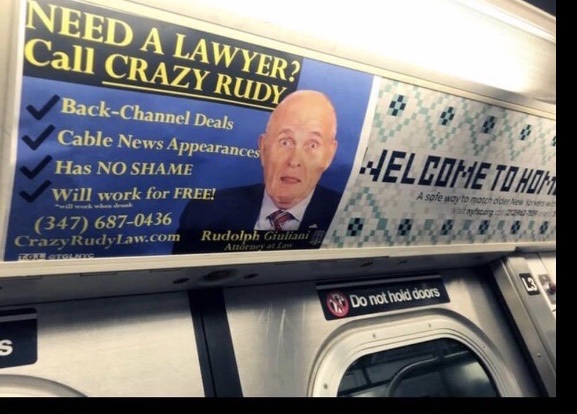
A website linked to the parody, crazyrudylaw.com, offers Giuliani’s unscrupulous services in back channel deals and cable news appearances.
Better still, the firm offers to work for free:
In an effort to shield money from my wife during our divorce, I’m willing to work for FREE! I only ask that you pick up the bar tab at the end of our session.
Via Front Page Live.
Foreign Affairs, Open Government, Trump
What else did Trump say on his call with Ukraine’s president?
by JOHN ADAMS •
Carol D. Leonnig, Craig Timberg, and Drew Harwell report Odd markings, ellipses fuel doubts about the ‘rough transcript’ of Trump’s Ukraine call:
President Trump said Wednesday that his controversial July call with his Ukrainian counterpart was transcribed “word-for-word, comma-for-comma,” an assertion that fueled growing questions about the nature and completeness of an official memorandum about the call released by the White House last week.
“This is an exact word-for-word transcript of the conversation, taken by very talented stenographers,” Trump said.
….
Current and former U.S. officials studying the document pointed to several elements that, they say, indicate that the document may have been handled in an unusual way.
Those include the use of ellipses — punctuation indicating that information has been deleted for clarity or other reasons — that traditionally have not appeared in summaries of presidential calls with foreign leaders, according to the current and former officials, who spoke on the condition of anonymity to describe the elaborate, non-public process.
….
The White House declined to comment Wednesday about the unusual markings or other apparent discrepancies. Shortly after the document’s release last week, a White House official had said that the ellipses did not indicate missing words but referred to “a trailing off of a voice or pause,” and called it standard practice for records of presidential phone calls.
Current and former officials said that would be slightly different from previous practice. They said when presidents simply trail off in a way that note-takers can’t hear, that point traditionally has been marked “[inaudible].” When fragments of sentences aren’t readily understood by note-takers, or when comments repeat a previous thought, they said, the transcripts had often been marked with dashes.
Trump, himself, claims there is a “word-for-word” transcript.
Well, then, where is it, and what does it say?
Daily Bread
Daily Bread for 10.3.19
by JOHN ADAMS •
Good morning.
Thursday in Whitewater will be cloudy & windy with a high of sixty-one. Sunrise is 6:55 AM and sunset 6:32 PM, for 11h 37m 09s of daytime. The moon is a waxing crescent with 27.5% of its visible disk illuminated.
Whitewater’s Landmarks Commission meets at 6 PM, and the Fire Department board of directors meets at 6:30 PM.
On this day in 1862, 17th Wisconsin Infantry fights at Corinth, Mississippi: “also known as the Irish Brigade, [they] led a bayonet charge with the Gaelic battle cry ‘Faugh a ballagh!’ or ‘Clear the Way.’ ”
Recommended for reading in full:
Patrick Marley reports Top Republican signals he won’t cover legal bills in Twitter case, says he was doing his job when he blocked liberal group:
A top GOP lawmaker is signaling he won’t help reimburse taxpayers for $200,000 in legal bills he and other Republicans racked up when a court found they had illegally blocked a liberal group on Twitter.
State officials in August agreed to pay for One Wisconsin Now’s legal bills after a federal judge determined Assembly Speaker Robin Vos and Rep. John Nygren violated the group’s First Amendment rights by preventing it from accessing and responding to their Twitter posts.
Vos and Nygren didn’t respond to questions about the settlement at the time and Nygren on Wednesday gave no sign he planned to pay the settlement.
“I’m not even answering that,” he said when asked if he would pay some of the settlement.
Last year, then-Rep. Dale Kooyenga paid the state $30,000 to cover a settlement in a lawsuit brought after he took a protest sign from a public area of the Capitol. Kooyenga, a Republican from Brookfield, won a seat in the state Senate in November.
Greg Sargent writes Here’s the next fake scandal Trump thinks will save him:
President Trump and Republicans are excitedly drawing attention to a breaking story in the New York Times that reports that the whistleblower gave advance notice to Rep. Adam B. Schiff (D-Calif.) about the subject of his complaint, before filing it to the intelligence community’s inspector general.
….
But there’s nothing in the story that says anything about Schiff having any substantive input into the whistleblower’s complaint. It says Schiff’s aide reported to him some of what the whistleblower said, and that the aide told the whistleblower to get a lawyer and go to the inspector general.
In so doing, the aide advised the whistleblower on how to follow the law. That’s not “rigging” the process. It’s the opposite.
Indeed, the Times piece itself describes the significance of this news by claiming it shows “how determined” the whistleblower was to make his discovery known. This, by itself, does not raise doubts about his motives or truthfulness, or about the complaint itself, in any way. All it does is underscore how serious the whistleblower thought his discovery was, and how urgent he thought it was to get it to Congress.
Art, Diversity, History
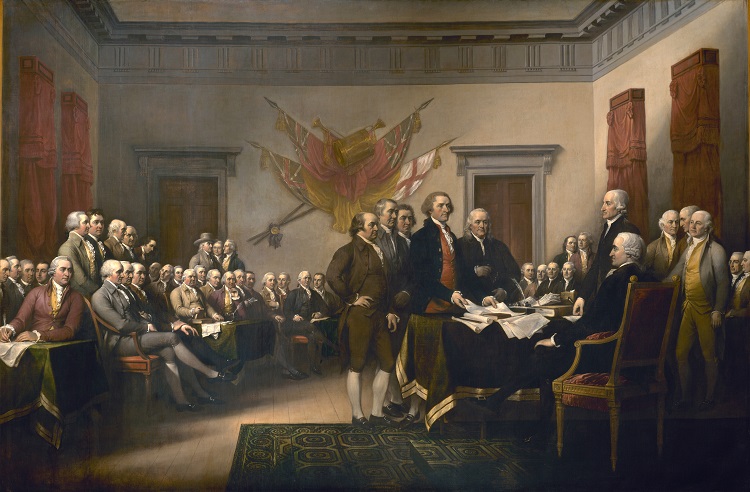
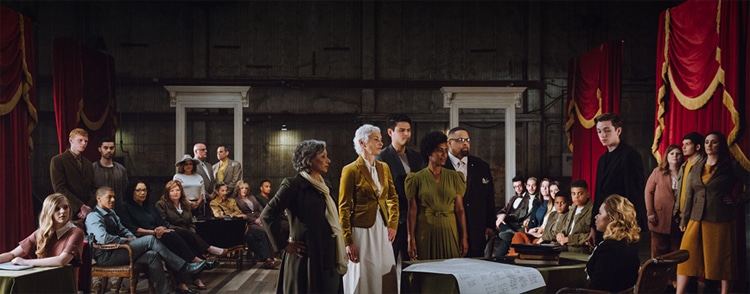
Recreating a Famous Painting, 241 Years Later
by JOHN ADAMS •
John Trumbull’s founding-era painting, Declaration of Independence, is one of the most famous in America. Recently, Ancestry.com commissioned the recreation of Trumball’s scene in a photograph with the descendants of the Declaration’s signers. The recreation is truly hopeful: