Friday in Whitewater will be sunny with a high of 82. Sunrise is 5:15 AM and sunset 8:36 PM for 15h 20m 07s of daytime. The moon is a waning gibbous with 86.9% of its visible disk illuminated.
“Here we are, then, on this so renowned river, all of whose peculiar features I have endeavored to note carefully.” It’s important to recall that Marquette and Joliet did not discover the Mississippi: Indians had been using it for 10,000 years, Spanish conquistador Hernan De Soto had crossed it in 1541, and fur traders Groseilliers and Radisson may have reached it in the 1650s. But Marquette and Joliet left the first detailed reports and proved that the Mississippi flowed into the Gulf of Mexico, which opened the heart of the continent to French traders, missionaries, and soldiers. View a Map of Marquette & Joliet’s route.
Why don’t communities move from government solutions to private ones? (A point about Whitewater that is key to understanding both private initiative and the city: there is no one private path. Business people talk endlessly about business uplift, as though there were a choice merely between government programs and business growth. That’s a myopic view of private life. Many private activities are cultural or charitable, and are significant parts of a thriving community.)
For now, back to the question as applied to Whitewater: why doesn’t Whitewater move past fixation on government activity (of the city government and school district)?
An answer: community leaders either (1) falsely tout local government’s ability to uplift the city (and so draw attention to supposed public solutions) or (2) make a hash of projects and proposals (and so attract attention to public mishaps).
The first is boosterism, the second is bungling, and they both keep the focus on public, not private, actions. Private activity struggles to take hold in a place where government takes up so much social space in a small town.
Appointed public officials who promise too much or deliver too little make themselves a burden on residents. Whitewater is a low-income community; many residents have enough to address without public officials’ commotions. Appointees should be afforded ample coaching, but they should not be coddled. (I am convinced that, however uncomfortable it may seem at first, willing and sincere people can be coached to handle all sorts of intense encounters.) If they’re receptive to good advice, and follow it, then so much the better for everyone.
The libertarian concern, so to speak, is that government should be limited, responsive, and humble so that a myriad of private accomplishments and associations become possible. Well-ordered public institutions should do only so much as to allow for a private, spontaneous order, an order that forms and grows to meet human needs and desires.
And until public institutions are limited & humble, there’s a need for a critique, so that they might not be millstones around the community’s neck.
Whitewater does not have a margin for empty public promises, hollow public achievements, or chronic public controversies.
There are many questions for which, after careful consideration, there is no certain answer. There are others, like the question raised in the tragedy below, in which there is greater moral certitude. Consider a talefrom Reddit in which a cat owner’s girlfriend mistreated his cat, leading him to evict the girlfriend from his house:
So I have a cat named Raven who’s 3 years old.
My girlfriend of 2 years moved in with me a few weeks ago and it was clear she didn’t like my cat. I didn’t think it was really a big deal until one day I got home and he was just gone.
He’s not an outdoor cat and he never goes outside.
He was gone for hours and I was worried sick until my buddy came to my house and returned him, saying he found him 2 blocks from my house.
I asked my girlfriend how my cat, who has never tried to go out before, ended up that far from my house and she admitted to kicking him out.
I was furious, saying she had no right to kick him out and told her that since she thought she had the power to kick my cat out, I wanted her out of my house by the end of the month.
She cried that she had nowhere to go and that she would have to live on the streets. I said I didn’t care and told her to leave by the end of the month.
My friends think I’m being too harsh, but my cat could have died because of her and I don’t want her trying anything else.
One always hopes for a fair outcome and, happily, a fair outcome unfolded in this case: the cat was restored to safety, the boyfriend will be able to find a new, more considerate girlfriend, and the miscreant former girlfriend will now have the needed solitary reflection, one hopes, to turn from the dark and sinister path she was on.
Thursday in Whitewater will be sunny with a high of 88. Sunrise is 5:15 AM and sunset 8:35 PM for 15h 19m 53s of daytime. The moon is a waning gibbous with 94% of its visible disk illuminated.
Whitewater’s Community Development Authority meets at 5:30 PM.
On this day in 1911, IBM is founded as the Computing-Tabulating-Recording Company in Endicott, New York.
Matt Levine, author of the Money Stuff column at Bloomberg Opinion, writes that Crypto Debt Can Be Trouble. In seeing the decline of crypto currencies’ value this way, Levine reminds that big events have multiple effects:
Crypto winter
One thing that has happened is that the prices of risky cryptocurrencies have gone down. Bitcoin traded above $40,000 two months ago; today it got close to $20,000. Ethereum went from $3,000ish to $1,100ish. The total market capitalization of all cryptocurrencies, “which topped $3 trillion in November, dropped below $1 trillion.”
In the abstract, this is just fine. Extremely speculative people had extremely speculative positions in extremely speculative assets, and the prices went up a lot, and then they went down a lot. Some gamblers made some money and then they lost some money; that’s how gambling works. People who put their life savings into Bitcoin should be told, very firmly, that they should not have done that; that was wrong, and now they know. Also though they still have like half of their life savings. If you put your life savings in the S&P 500 you haven’t had a great year either.
The deeper problem, always, is when you add leverage. Someone who gambled $40,000 on Bitcoin now has $20,000, fine. But someone who bought a Bitcoin with $20,000 of their own money and $20,000 borrowed from someone else now has roughly nothing, which is worse. Much worse, though, is that the person who loaned them the money — and who thought that money was safe — is now at risk of not getting paid back. Lots of people all around the ecosystem made overcollateralized loans against risky cryptocurrencies, lending speculators $100 against $200 or $300 or whatever worth of Bitcoin or Ethereum or Dogecoin or whatever. When the prices of those risky cryptocurrencies fall far enough fast enough, the lenders will ask for their money back. But the leveraged speculators won’t necessarily have the money: They were in the business of leveraged speculation on cryptocurrencies, which is a very bad business to be in right now, and all their money might be gone. A $100 loan overcollateralized by $200 worth of Ethereum two months ago is now undercollateralized, backed by about $70 worth of Ethereum. And this is happening to every leveraged crypto speculator and every crypto lender in every cryptocurrency all at once.
Levine, who’s insightful (he is!), shows that foresight requires looking at more than a single possibility. There are multiple effects from this crypto winter.
Levine’s training might suggest that he would be skilled at spotting these effects, as he was formerly “an editor of Dealbreaker, an investment banker at Goldman Sachs, a mergers and acquisitions lawyer at Wachtell, Lipton, Rosen & Katz, and a clerk for the U.S. Court of Appeals for the 3rd Circuit.” But Levine was also a classics major who taught high school Latin after he was graduated from college. That earlier experience likely shaped his analytical skills, too.
There’s no one training or background that has a monopoly on thinking about causes and (as it often turns out) multiple effects. One can come to that useful outlook through many paths, and benefit from having done so. Communities, all communities, have scores upon scores of people who show foresight however acquired and sharpened.
Wednesday in Whitewater will be partly sunny with a high of 95. Sunrise is 5:15 AM and sunset 8:35 PM for 15h 19m 35s of daytime. The moon is a waning gibbous with 98.4% of its visible disk illuminated.
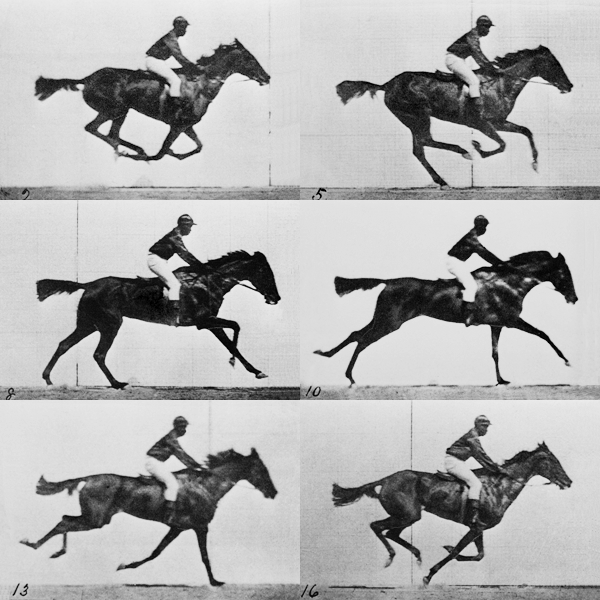
On this day in 1878, Eadweard Muybridge takes a series of photographs to prove that all four feet of a horse leave the ground when it runs; the study becomes the basis of motion pictures.
Eadweard Muybridge – The sequence is set to motion using these frames, originally taken from Eadweard Muybridge’s Human and Animal Locomotion series, (plate 626, thoroughbred bay mare “Annie G.” galloping) published 1887 by the University of Pennsylvania
A soft landing refers to the way that the Fed is attempting to slow inflation – and therefore economic growth – without causing a recession.
In order to stabilize prices while not hurting employment, the Fed is expected to increase interest rates rapidly in the coming months – and it currently forecasts rates to be at least 1 percentage point higher by 2023. It has already lifted its benchmark rate twice this year by a total of 0.75 percentage point.
Historically, when the Fed has had to raise rates quickly, economic downturns have been difficult to avoid. Can it manage a soft landing this time? Powell has insisted that its policy tools have become more effective since its last inflation fight in the 1980s, making it possible this time to stick the landing. Many economists and other observers remain uncertain. And a recent survey of economists notes that many anticipate a recession beginning next year.
Tuesday in Whitewater will be partly sunny with a high of 97. Sunrise is 5:15 AM and sunset 8:34 PM for 15h 19m 13s of daytime. The moon is full with 100% of its visible disk illuminated.
Whitewater’s Public Works Committee meets at 6 PM.
On this day in 1775, the Continental Army is established by the Continental Congress, marking the birth of the United States Armed Forces.
Many of Whitewater’s current challenges have no partisan or ideological cause. It’s not a matter of Republicans, Democrats, independents, etc. These problems are not a matter of left, center, or right. They are, instead, a matter of becoming inured to poor performance and poor results. Government delivers less, while either pretending that it is delivering more, or blaming residents for mistakes and controversies, for which those residents are not responsible.
Troubled communities remain troubled when they give up discussing, debating, and demanding better. These unfortunate places — victims of their own sloth and malaise — descend still lower. They become inured to failure and disappointment.
A story about Whitewater’s police department is about more than one set of allegations, or different sets of allegations. It’s not normal for a small town to go so long without a permanent police chief. It’s not normal for the public to know nothing about a supposed public investigation that’s carried on for seven months. That’s treating abnormal as normal, and expecting residents to accept that sad situation. (Key point: I don’t ‘dislike’ policing. Defunding the police, for example, has always seemed a clumsy idea to me. Rather, the city government needs a well-ordered department within a community that’s well-informed about news both good and bad. When a community hears both good and bad, residents will not overreact to either.)
It’s not normal for a school district to come through the controversies of a once-in-a-century pandemic only to have worse commotions after the pandemic. These aren’t complaints about national ideological topics, they are chronic local complaints, month after month, about a local administration. It was not normal to respond to those complaints with a seven-minute, prepared board statement before public comment even began. There is both arrogance and ignorance in thinking that approach would work. (It did not: the 5.24.22 board statement only brought more concerns at the 6.7.22 board meeting.)
It’s not normal to have a small city government that underestimates the cost of a dredging project by millions, the cost of a lift station by a million, while remaining silent on the status of its police department, and explaining little about its plans for its fire department.
It’s not normal for a small public university to have so many complaints over so many years about sexual harassment and assault (indeed, to be named as one of only 100 universities like this in the nation).
These are local problems of local administration. Whitewater’s residents are not less capable than the residents of other places. They deserve public institutions and officials that do not treat abnormal as normal.
Monday in Whitewater will see afternoon thundershowers with a high of 87. Sunrise is 5:15 AM and sunset 8:34 PM for 15h 18m 47s of daytime. The moon is a waxing gibbous with 98.5% of its visible disk illuminated.
On this day in 1777, Gilbert du Motier, Marquis de Lafayette lands near Charleston, South Carolina, in order to help the Continental Congress to train its army.
This morning, the Wisconsin Examiner has a story entitled Complaints mount over conduct of Whitewater PD (‘Reports of racial profiling and excessive force under suspended chief’). Isiah Holmes’s story has three main topics: (1) the experiences of D’Angelo Lux, a former UW-Whitewater student who has filed a federal civil rights lawsuit against the department and some of its officers, (2) the department’s record on managing complaints generally, and (3) Chief Aaron Raap’s career record in Milwaukee before he became Whitewater’s chief. (The story includes an embedded copy of Raap’s complaint case file while he was an employee of the Milwaukee Police Department.)
Update, Monday afternoon: I’ve received emails asking what I think of the details in the Examiner story. A quick reply, before a more detailed one tomorrow: it’s not typical for a town to go this long with a police chief on leave. Litigation is important both to a litigant, defendants, and the community, but there’s more than that at issue here. (That’s why, after all, I wrote the paragraph immediately following this one.) Whitewater’s local government has a closed and broken process in more places than one. The excerpts from the story were chosen with care, along with a recommendation to read the whole story.
While the story is about policing, it also implicates subjects of local government’s transparency and competency, and the lack of serious news reporting on myriad topics in Whitewater. Readers would do best to read the story in full; excerpts appear immediately below:
Since December, the department’s police chief Aaron Raap, has been on administrative leave pending an ongoing internal investigation. Raap, who was hired as chief in 2018, was taken into custody following an alleged Thanksgiving fight with a family member. Though the Waukesha County District Attorney’s Office declined to issue charges, other controversies have also emerged during Raap’s time in Whitewater.
No one on the city’s common council offered comment either, even after a council meeting was held regarding Raap’s continued employment by the city on May 3. Deputy Chief of Police Daniel Meyer, who has served as acting chief since Raap was placed on paid administrative leave, said no action was taken by the council that day. Meyer also provided data and reports on citizen complaints against officers since 2018, when Raap arrived at the department.
“Since Chief Raap has been employed by the WPD,” Meyer emailed Wisconsin Examiner, “two officers have been disciplined pursuant to internal investigations regarding use of force, however, neither investigation was complaint-driven.” A complaint of excessive force against a WPD officer was made on Feb. 5, 2022. There were 10 complaints in 2019. The number dropped to just three in 2020 as the COVID-19 pandemic set in. The following year in 2021, however, the number rose to 8 complaints against WPD personnel.
….
Every complaint filed in 2018 was classified as “exonerated,” meaning an investigation confirmed that an incident occurred but that it was justified. The 10 complaints the following year followed a similar pattern, from accusations of unreasonable searches with dogs to reports of excessive force and harassment.
In 2021 the trend continued. A complaint by a driver that an officer allowed another car to leave the scene of a hit and run was ultimately sustained by the department, and the driver who was at fault was later cited. Another complaint came from a person who reported having “almost died in custody, was transported with no seat belt, had an asthma attack, was fearful for their life, and that an officer had a vendetta against them,” police records state. The investigation found the complaint was without merit and unfounded. Other complaints involved officers who rang a citizen’s doorbell multiple times and refused to leave when asked. There were also reports of officers not fully investigating incidents, including one of an officer allegedly not taking a child’s complaint of abuse seriously enough. Unwarranted traffic stops also made a reappearance. Even during the 2020 slowdown, reports of race-based harassment continued.
….
Decades ago, Raap served as a police officer for the city of Milwaukee, where he was hired in 1990 and left the department at the rank of captain. While serving in the Milwaukee Police Department, Raap accumulated a lengthy disciplinary record. According to Milwaukee PD records obtained through open records requests, 22 internal investigations involving Raap were initiated from August 1995-December 2003. The accusations included battery of citizens, refusing to give his name and badge number, improper searches and seizures, entering the homes of residents without just cause, and issues with the filing of reports. Some of the complaints involved incidents where several officers responded, including Raap. In these complaints, Raap defended the actions of fellow officers.
Just one of those complaints, related to the filing of reports, was sustained by internal affairs in 1996. The last 2003 complaint involving misconduct in public office is listed as “warrant refused.” In such cases, a criminal allegation is presented to the district attorney’s office but no charges are issued. These decisions were made under former Milwaukee County District Attorney E. Michael McCann, who served as district attorney from 1969 to 2007 .
….
A complaint against Raap in the year 2000 related to battery accusations was also listed as “warrant refused”. Most of Raap’s complaints during his time in Milwaukee were listed as unfounded or baseless. Many of those decades-old complaints echo reports of misconduct by Whitewater officers under Raap’s leadership today. Raap’s future as head of WPD remains in limbo, and he continues to be on paid administrative leave. WPD did not provide details on the timeline for the investigation.
Sunday in Whitewater will be partly sunny with a high of 74. Sunrise is 5:15 AM and sunset 8:34 PM for 15h 18m 18s of daytime. The moon is a waxing gibbous with 94.5% of its visible disk illuminated.
On this day in 1899, the New Richmond Tornado devastates that small Wisconsin community:
On this date the worst tornado disaster in Wisconsin history occured. The storm virtually leveled New Richmond on the day the Gollmar Brothers Circus came to town. At the time, New Richmond was a prosperous town of 2500 people and one of the most scenic places in Wisconsin. On the day of the storm, the streets were filled with residents and tourists waiting for the afternoon circus parade. Shortly after the circus ended, the tornado passed through the very center of town, completely leveling buildings. Over 300 buildings were damaged or destroyed. Massive amounts of flying debris resulted in multiple deaths in at least 26 different families. In all, the storm claimed 117 lives and caused 150 injuries.
This episode contains strong language and details of a sexual assault accusation.
Since a jury ruled in favor of Johnny Depp in his defamation case against his ex-wife Amber Heard, there has been impassioned debate about what exactly the outcome means for the #MeToo movement.
It raises the question: If people being accused of sexual assault can potentially win defamation cases in court, what does that mean for the accused — and the accusers — moving forward?
Guest: Julia Jacobs, a culture reporter for The New York Times.
Saturday in Whitewater will see patchy fog this morning; otherwise, the day will be mostly cloudy with a thunderstorm this afternoon and a high of 73. Sunrise is 5:15 AM and sunset 8:33 PM for 15h 17m 44s of daytime. The moon is a waxing gibbous with 87.8% of its visible disk illuminated.
On this day in 1935, Inventor Edwin Armstrong gives the first public demonstration of FM broadcasting in the United States at Alpine, New Jersey.
Michael Gableman is a special counsel (a genuine if unnecessary position under law) charged to investigate the 2020 presidential election in Wisconsin.
Perhaps the world has forgotten, but he used to be a judge, and served, in fact, as a justice on the Wisconsin Supreme Court. (It’s true. Really.)
Remington reminded Gableman that he was under oath to answer questions from American Oversight attorney Christa Westerberg, and not to make a speech, but Gableman refused.
“You have a right to conduct and control your courtroom, judge, but you don‘t have a right to act as an advocate for one party over the other,” Gableman said. “I want a personal counsel if you are putting jail on the table. I want an attorney to represent me personally. I will not answer any more questions. I see you have a jail officer here. You want to put me in jail, Judge Remington … I’m not going to be railroaded.”
Gableman’s heated comments came two days after Remington ordered the former justice to answer questions under oath about how his office handled requested documents related to the ongoing probe. Near the close of that Wednesday hearing, Remington cautioned Gableman and his staffer Zakory Niemierowicz to consider seeking independent legal counsel, noting that remedial sanctions for contempt could include jail time.
….
“At no time did I suggest that that was a sanction that I intended to impose,” Remington said Friday. “Indeed, it was a question that was left for today’s proceeding to be determined based on the evidence and the request from American Oversight.”
The question of sanctions was left unanswered Friday. After finding Gableman’s office in contempt for not fully and completely complying with the court’s previous order to not delete requested records, Remington said he would issue a written order and sanctions at a later date.
Gableman’s made himself, through his grandstanding, more of the story than the supposed subject of his banana-republic-quality investigation.
As it turns out, real rodeo clowns require impressive agility. Gableman might want to re-think the prospect. A day in the life of a rodeo clown:
Friday in Whitewater will see scattered thundershowers with a high of 73. Sunrise is 5:15 AM and sunset 8:33 PM for 15h 17m 06s of daytime. The moon is a waxing gibbous with 79.1% of its visible disk illuminated.
On this day in 1837, State Capitol Workers Arrive in Madison: “On this date, workmen arrived in Madison to begin construction of the first state capitol building. A ceremony to lay the building’s cornerstone was to be held three weeks later, on July 4, 1837.” See Wisconsin Historical Society, Wisconsin Local History and Biography Articles.
The last months, notably the last eight to ten months, have seen both local malaise (the city) and local turmoil (the school district) in Whitewater. A few observations, at week’s end:
These regrettable tensions in Whitewater have not been the result of national trends. The pandemic has slipped into an endemic, and the most intense arguments over it have faded. National debates over COVID-19, policing, the economy, school curriculums, etc. are not the cause of residents’ complaints about Whitewater’s city government or school district.
These are local problems, involving local actions and reactions.
If these were, in fact, national problems having arrived also in Whitewater, it would be easier to predict their course through this community. As it is, one cannot easily find other communities with these kinds of complaints from which to draw quick lessons. They are homegrown.
Whitewater’s controversies are not dispassionate policy debates; they are rather questions of policy and culture, and that sort of turmoil, once begun, is more difficult to address.
As I have emphasized, these are not simply complaints from or about employees of the city or school district. They have become residents’ complaints — residents’ complaints are an order of magnitude more serious. They will lead to permanent resentments and community fissures.
The school board’s 5.24.22 prepared statement only made matters worse. It was perceived in this community as shifting blame onto residents. It should have been easy to see that it would be perceived that way. I’ll not bother to go through that statement line-by-line. On its own, however, it was the most counter-productive approach this board could have taken in the face of community concerns. No one on the board, not even all of the board members together, has the clout to quell these concerns through the board’s 5.24 approach. The district is now somewhat worse off than it was in May.
As these complaints stem from unique local actions and reactions, some known, some inscrutable, it’s hard to tell where this community is heading. As a baseline assumption, one could begin with the view that past is prologue, and that the community is in for more of the same. Beyond that, I’ll not offer a prediction.
Tuesday, June 14th at 1 PM, there will be a showing of The Batman @ Seniors in the Park, in the Starin Community Building:
Action/Crime/Mystery/Drama
Rated PG-13, 2 hours, 56 minutes (2022)
When a sadistic serial killer begins murdering key political figures in a grim, dystopian Gotham City, The Batman steps out of the dark shadows to investigate the city’s underlying corruption and question his own family’s Wayne Foundation involvement. Starring Robert Pattinson (The Batman), Zoe Kravitz (Catwoman), Paul Dano (The Riddler), and Colin Farrell (The Penguin).
Thursday in Whitewater will be partly sunny with a high of 76. Sunrise is 5:16 AM and sunset 8:32 PM for 15h 16m 24s of daytime. The moon is a waxing gibbous with 69.6% of its visible disk illuminated.
On this day in 1973, legendary horse Secretariat wins the Triple Crown.
On Tuesday, a Wisconsin Supreme Court decision in Wisconsin Manufacturers & Commerce v. Evers, 2022 WI 38 was a welcome win for advocates of government transparency. Although the particular circumstances involved COVID-19 data the state had collected, the ruling’s reach extends beyond any particular set of data.
In this case, Wisconsin Manufacturers & Commerce (and two other trade associations) sought to prevent the State of Wisconsin from releasing to the public a list of all Wisconsin businesses with over twenty-five employees that had at least two employees test positive for COVID-19 (or had two close-case contacts). The Wisconsin Department of Health Services had collected this information, but the private trade groups sought a court ruling barring release of those public records.
The case began when the Journal Sentinel requested from DHS public records about COVID-19 under Wisconsin’s Public Records Law, Wis. Stat. §§ 19.31–19.39, and Manufacturers & Commerce in response sought a court order to prevent the release of those records.
A lower court granted a temporary injunction against release, but a court of appeals ruling reversed that lower court decision. The trade associations then appealed to the Wisconsin Supreme Court to prevent the release of the records on COVID-19 cases or exposures. The Wisconsin Supreme Court affirmed the court of appeals decision, ruling that Wis. Stat. § 19.356(1) of the Public Records Law limited judicial review prior to an agency’s release of records:
Moreover, concluding that the Declaratory Judgments Act “otherwise provide[s]” for pre-release judicial review of a public records response would effectively repeal §19.356(1). As discussed previously, the legislature enacted §19.356 to limit the rights to pre-release notice and judicial review that this court created in Woznickiand Milwaukee Teachers.11 See Moustakis, 368 Wis.2d677, ¶27. Although those rights may have been enforceable via a declaratory judgment action while they existed, the legislature abrogated them when it adopted §19.356.
Wisconsin Manufacturers & Commerce v. Evers, 2022 WI 38 ¶ 19.
Wednesday in Whitewater will see showers and thunderstorms with a high of 65. Sunrise is 5:16 AM and sunset 8:31 PM for 15h 15m 39s of daytime. The moon is a waxing gibbous with 58.5% of its visible disk illuminated.
On this day in 1950, the iconic Volkswagen Type 2 “Bus” begins production.
The Whitewater Unified School District’s board met last night. One finds — month over month — that in the community there is increasing concern about the district’s course and the responsiveness of the board to that concern.
A few words about residents’ remarks, including their comments on retaliation, in practice and principle.
In practice. At a meeting of the Whitewater Unified School District’s board on 5.24.22, there was expressed both concern (and reassurance in reply) over the possibility of retaliation for speaking against district plans. On the night of that session and twice afterward, I’ve watched that meeting in full. The May session saw forceful, prepared remarks from the board before residents’ public comments.
(One resident mentioned during Tuesday’s 6.7.22 board meeting that the board’s May statement before public comment felt ‘invalidating.’ In the two weeks since that meeting, I’d guess that others in the community share that view. Credit where credit is due: one cannot say that the board did not make its sentiments known to the community through those prepared remarks. If the board’s statement was meant to quell public upset, however, then one can say that the May statement was unsuccessful.)
Any public institution should offer genuine reassurance against retaliation for speech against government; a well-ordered public institution should not need to offer many of these assurances.
Here, however, is the practical problem that confronts the district: there are too many people, too concerned, for this district’s board alone to settle these concerns. School boards and common councils have nowhere near the community clout they did twenty years ago. The decline in public boards’ strength within Whitewater, in particular, has not come because people have become more skeptical of government. It has come because the socio-economic changes since the Great Recession have made the community both more outspoken and more divided on dozens of issues. (I’d be happy to say that increased support for limited government has come as a matter of libertarian principle, but it of course hasn’t. It has come from cultural shifts beyond politics.)
Whitewater’s a beautiful place, well worthy of one’s love, but it’s not an easy place. (A candid confession: I don’t love this small city in spite of her sometimes irascible nature — I love her with that nature. Never have I loved a place more; the happiest moment of an enjoyable trip elsewhere is always when I return to this city again.)
Regardless of why Whitewater is as she is, as a matter of practical conditions, her school board cannot (for long) shield a superintendent from community debate (and in the same way, Whitewater’s common council cannot shield its city manager). It’s possible to do so for a meeting or two, but that’s not a long-term strategy.
This is especially true when significant numbers of residents, rather than city or district employees, are among those expressing concern. These concerns, especially for the district, now reflect residents‘ policy and cultural objections. The school board (or common council) can push these objections back for a while, but neither public body is influential enough to resolve them on behalf of appointed leaders.
If chronic concerns are to be resolved, then the resolution will require the appointed leaders of the district and the city to do so on their own, in extended public conversations with residents. There’s no other effective way; both public institutions will otherwise be engaged in repeated and debilitating community skirmishes.
Who can improve the position of the superintendent in this community? Only the superintendent in conversation in public meetings with residents. Who can improve the position of the city manager in this community? Only the city manager in conversation in public meetings with residents.
How can that condition be improved? In public discussions, on the record, with residents, through question and reply, month after month until conditions improve or until it becomes obvious no resolution is possible.
A private ‘call tomorrow’ (as offered during the 6.7.22 school board meeting) isn’t helpful. District success (if any) depends on comprehensive discussions in public meetings.
It doesn’t help the superintendent — in fact, it undermines her — when board members or subordinate administrators intervene on her behalf to represent district views. Honest to goodness, I’m not sure why this isn’t obvious, but it should be. Others’ intervention, even if well-meaning, is counter-productive to her situation.
A few words about communication: the first place to look for failures of communication is with the communicator. If the government is misunderstood, the first place to look for the source of that misunderstanding is with the government, not with residents. If a lawyer is misunderstood, the first place to look for the source of that misunderstanding is with the lawyer, rather than with paralegals, secretaries, or clients. If a blogger is misunderstood, the first place to look is toward the blogger, rather than toward readers.
As for speaking by the government, there is an obligation for leaders to speak plainly and at length about their plans for this community. There has been too little of that over the last year in the district and in city government, both. SeeBig Changes Require Big Explanations. Those formally educated owe it to the community to meet the standards of the schooling they have received, both in direct address and patient reply to questions.
(By the time the superintendent and some board members were turning around during the 6.7.22 meeting to answer a resident’s questions on early childhood programming, it was obvious there has been a failure of prior district communication about the early childhood program.)
It’s almost as though no one cares enough to offer effective guidance. While I would not expect government officials to take this libertarian blogger’s advice, it’s sound advice nonetheless.
I have no personal dislike for Whitewater’s superintendent or city manager. (Truly, to ascribe those feelings to me would be a mistake.) One can see, however, that existing controversies need to be resolved, as these controversies among residents are now widespread.
The problem is more significant than what some public employees think (although that matters). These concerns have become residents‘ concerns. Whitewater is an economically-challenged community that does not deserve, and cannot afford, chronic objections that have not been addressed directly by a superintendent (or city manager).
In theory. Speaking on controversial subjects invites the possibility (whether big or small) of retaliation. Almost as destructive is a waxing view in Whitewater that there has been or may be retaliation for speaking out. Perception can be destructive all on its own.
(As for retaliation in the case of speech, one prepares for difficult outcomes even if those outcomes are improbable. One does better — much better — if one begins every effort seeing oneself as a dark-horse underdog. A person may meet all sorts of reverses along the way, but should plan beforehand how to overcome them, pressing on with his or her case.)
It’s likely that the politics of those residents most concerned about this superintendent, for example, are different from mine. No matter — their concerns and complaints deserve to be heard and answered.
Again, it should be plain that this sort of ongoing controversy is not in Whitewater’s interest, educationally, economically, or politically. There is simply no margin for leaving these issues unaddressed.
How very odd, how very strange, to watch this unfold in Whitewater.