This Tuesday, August 14th at 12:30 PM, there will be a showing of The Commuter @ Seniors in the Park, in the Starin community building:
“The Commuter” (Action/Drama/Crime)
Rated PG-13 (action, violence, language); 1 hr, 45 min (2018)
An ex-cop, now an insurance salesman (Liam Neeson), is ensnared in a criminal conspiracy on his daily train commute home. A white-knuckle, edge of your seat “Strangers on a Train” thriller unfolds.
Monday in Whitewater will be mostly sunny, with a high of eighty-six. Sunrise is 6:00 AM and sunset 7:59 PM, for 13h 59m 02s of daytime. The moon is a waxing crescent with 6.6% of its visible disk illuminated.
Today is the six hundred thirty-eighth day.Days since Trump’s election, with 11.9.16 as the first day.
Whitewater’s Planning Commission meets at 6:30 PM, and the Whitewater School Board will meet in Central Office beginning at 7 PM.
On this day in 1961, the East German communist government begins construction of the Berlin Wall:
The Berlin Wall (German: Berliner Mauer … was a guarded concrete barrier that physically and ideologically divided Berlin from 1961 to 1989.[1] Constructed by the German Democratic Republic (GDR, East Germany), starting on 13 August 1961, the Wall cut off (by land) West Berlin from virtually all of surrounding East Germany and East Berlin until government officials opened it in November 1989.[2] Its demolition officially began on 13 June 1990 and finished in 1992.[1][3] The barrier included guard towers placed along large concrete walls,[4] accompanied by a wide area (later known as the “death strip”) that contained anti-vehicle trenches, “fakir beds” and other defenses.
President Donald Trump tweeted Sunday that it’s “great” some Harley-Davidson motorcycle owners plan to halt future purchases of the bike in response to plans by the Milwaukee-based company to move some production overseas.
Many @harleydavidson owners plan to boycott the company if manufacturing moves overseas. Great! Most other companies are coming in our direction, including Harley competitors. A really bad move! U.S. will soon have a level playing field, or better.
Trump’s 6 a.m. tweet followed a New York Times story Saturday that quotes several Harley owners attending the Sturgis Motorcycle Rally in Sturgis, South Dakota, who say they are angry with the company, which plans to move production of motorcycles destined for the European Union to its international factories in response to tariffs the EU has imposed on its bikes.
Harley has said the impact of the 31 percent tariffs, up from 6 percent previously, could be $100 million per year on the company, or roughly $2,200 per motorcycle.
(One reads “While saying nothing about the president’s latest swipe at Harley-Davidson, Republican U.S. Senate candidate Kevin Nicholson quickly issued a tweet of his own telling Baldwin, “you don’t understand our economy …. “We do need better trade deals, not the ones engineered by you and other members of the political class,” Nicholson said.” Nicholson’s reply is laughably rhetorical – anyone who truly understands the economics of this sees that tariffs are, in effect, bad taxes. It’s Nicholson who either doesn’t understand or simply battens on the ignorance of Trump-leaning voters.)
It seems the Founding Fathers had Donald Trump (or someone very like him) in mind when they wrote those clauses into the Constitution. They were concerned about our government officials being corrupted by foreign or domestic powers. Alexander Hamilton argued in Federalist Paper #73 that the domestic emoluments clause was designed to keep the president independent and incorruptible.
The key passage in the Constitution is Article I, Section 9: “No Title of Nobility shall be granted by the United States: And no Person holding any Office of Profit or Trust under them, shall, without the Consent of the Congress, accept of any present, Emolument, Office, or Title, of any kind whatever, from any King, Prince, or foreign State.”
The point of this clause is to prevent any foreign power from gaining influence over the U.S. government by providing gifts, titles, jobs or other benefits to its officials.
No exceptions
Article II, Section 1 specifically limits the president and does not allow Congress to approve exceptions: “The President shall, at stated Times, receive for his Services, a Compensation, which shall neither be encreased nor diminished during the Period for which he shall have been elected, and he shall not receive within that Period any other Emolument from the United States, or any of them.”
There was no secret about Manafort’s record as an influence-peddler on behalf of corrupt dictators and oligarchs when he went to work for Trump. On April 13, 2016, Bloomberg columnist Eli Lake wrote a prescient article headlined: “Trump Just Hired His Next Scandal.” Trump couldn’t have cared less. His whole career, he has surrounded himself with sleazy characters such as the Russian-born mob associate Felix Sater, who served prison time for assault and later pleaded guilty to federal fraud charges, as well as lawyer-cum-fixer Michael Cohen, who is reportedly under investigation for a variety of possible crimes, including tax fraud.
These are the kind of people Trump feels comfortable around, because this is the kind of person Trump is. He is, after all, the guy who paid $25 million to settle fraud charges against him from students of Trump University. The guy who arranged for payoffs to a Playboy playmate and a porn star with whom he had affairs. The guy who lies an average of 7.6 times a day.
And because everyone knows what kind of person Trump is, he attracts kindred souls. Manafort and Gates are only Exhibits A and B. There is also Exhibit C: Rep. Chris Collins (R-N.Y.), the first member of Congress to endorse Trump, is facing federal charges of conspiracy, wire fraud and false statements as part of an alleged insider-trading scheme. Exhibit D is Commerce Secretary Wilbur Ross, who has been accused by Forbes magazine, hardly an anti-Trump rag, of bilking business associates out of $120 million. (Both Collins and Ross have denied the charges.)
“Lindsey Graham, talk about confusing, he confuses me,” Capehart stated. “On some days he is ‘the president must be held accountable,’ and then here he seems to be carrying the president’s water. Can you explain what he is doing?”
“I can offer some theories. Lindsey Graham was one of the people who called for the investigation of the Trump campaign’s ties to the Kremlin,” Kendzior began. “He did that all the way back in 2016 before Trump was inaugurated. He has then done a complete 180. He’s been supporting Trump, he’s been covering for Trump.”
“There are a few things we should remember, ” she advised. “The RNC was hacked; no one knows what happened to those emails. Lindsey Graham personally was hackedand nobody knows who has those emails. The RNC is complicit financially and politically and broadly in what the Trump campaign has done in terms of illicit interactions with Russia.”
Sunday in Whitewater will be mostly sunny, with a high of eighty-six. Sunrise is 5:58 AM and sunset 8:00 PM, for 14h 01m 33s of daytime. The moon is a waxing crescent with 2.1% of its visible disk illuminated.
Today is the six hundred thirty-seventh day.Days since Trump’s election, with 11.9.16 as the first day.
According to the fan site, thewizardofoz.info [now http://thewizardofoz.info/wiki/Oz_FAQ], “The first publicized showing of the final, edited film was at the Strand Theatre in Oconomowoc, Wisconsin on August 12, 1939. No one is sure exactly why a small town in the Midwest received that honor.” It showed the next day in Sheboygan, Appleton and Rhinelander, according to local newspapers. “The official premiere was at Grauman’s Chinese Theatre in Hollywood on August 15, attended by most of the cast and crew and a number of Hollywood celebrities.”
Mr. Walker is still Wisconsin’s governor, still harboring national ambitions, and Wisconsin Democrats and Republicans have only grown more divided over Mr. Trump and the state’s place in national politics. Those dynamics are now on display as Wisconsin prepares for a major primary election on Tuesday: Mr. Walker’s bid for a third term is at stake; Wisconsin Democrats’ desire to deal blows to Trump Republicanism is intense; Republicans are deeply concerned about their future hold on state government; and the very identity of the state, which swings between progressivism and conservatism, feels up for grabs.
“This just wasn’t what Wisconsin was, not what it used to be,” said Sally Mather, 69, a retired social worker, who sat in the back room of a cafe in this village of 1,700 last week.
It’s here where Clark and her family begin work each day at 5:30 a.m., doing chores and milking cows. But times are tough. Milk prices have already fallen 4 percent this year, continuing a steady decline since 2014, according to data from the Labor Department. Meanwhile, net farm income, a broad measure of profits, is forecast to drop this year to its lowest level since 2006, according to the Department of Agriculture.
“It hits my bottom line,” Clark says about falling milk prices. “The last two years have been most challenging.”
Even tougher times might be ahead, she worries. Wisconsin is the number two dairy supplier in the country. In an industry where margins can be razor thin, farmers like Clark have come to rely on selling their milk products abroad, specifically Mexico, which is one of the biggest importers of U.S. dairy.
David A. Graham asks Why Can’t Trump Just Condemn Nazis? (“In marking the one-year anniversary of a white-supremacist rally in Charlottesville, the president again fails to differentiate between bigots and those who oppose them”):
Trump’s tweet Saturday shows that his vision of what happened hasn’t gotten any clearer with the passage of a year. He’s still unable to name Nazis, white supremacists, and white nationalists for what they are, and unable to differentiate between those groups and those that oppose them.
The condemnation of “all types of racism” is, on its face, a positive, but it can also be read as a coded reference to the idea that there is a anti-white racist movement seeking “genocide” of white people. White supremacists will certainly read it that way.
The condemnation of “all … acts of violence,” apologizes for the instigators in Charlottesville under the guise of reasonability. There’s no debating that violence is bad. There’s also no question who was responsible for touching off the violence in Charlottesville: the group of white supremacists and Nazis who marched on the town, many carrying weapons, to shout racist slogans and defend statutes that commemorate a traitorous rebellion that sought to preserve the enslavement of black people. One person, Heather Heyer, died when one of the ralliers drove a car into a crowd. Others were beaten.
(Trump knows precisely what he’s doing; he’s appealing to white nativists. His ‘base’ knows precisely what they’re supporting; they’re supporting white nativism.)
Now, the editorial board of the Boston Globe is proposing that newspapers across the nation express their disdain for the president’s rhetoric on Aug. 16 with the best weapon they have: their collective voice.
The rally calls for the opinion writers that staff newspaper editorial boards to produce independent opinion pieces about Trump’s attacks on the media. So far, according to the Associated Press, 70 news organizations have agreed — from large metropolitan daily newspapers such as the Miami Herald and Denver Post to small weekly newspapers with four-digit circulation numbers.
The Globe’s appeal is limited to newspaper opinion writers, who operate independently from news reporters and editors. As The Post’s policy explains, the separation is intended to serve the reader, “who is entitled to the facts in the news columns and to opinions on the editorial and ‘op-ed’ pages.”
(Trump’s hardcore supporters scream ‘fake news’ and ‘enemy of the people’ whenever they’re too shiftless or too stupefied to think and express themselves clearly.)
Saturday in Whitewater will be partly sunny, with a high of eighty-seven. Sunrise is 5:57 AM and sunset 8:01 PM, for 14h 04m 04s of daytime. The moon is new with 0% of its visible disk illuminated.
Today is the six hundred thirty-sixth day.Days since Trump’s election, with 11.9.16 as the first day.
On this date the Green Bay Packers professional football team was founded during a meeting in the editorial rooms of Green Bay Press-Gazette. On this evening, a score or more of young athletes, called together by Curly Lambeau and George Calhoun, gathered in the editorial room on Cherry Street and organized a football team.
THREE LAKES — Some 60 people showed up Thursday night for a special Three Lakes School Board meeting, demanding answers as to why a political ad appeared to show the district supporting Gov. Scott Walker’s re-election bid.
What they got was a public apology from District Administrator George Karling: “Recently, I failed to vet the purpose of the governor’s visit as thoroughly as I should have even though the intent and purpose was expressed to me,” Karling said, reading from a prepared statement. “This was a mistake on my part, and I apologize for that. It will not happen again.”
The board also adopted a new policy that expressively prohibits political actions and use of school resources by school employees and school board members while serving in a school role. The policy does not infringe, however, on their First Amendment rights, including political activities and speech, outside of a school setting.
Board president Tom Rulseh said the campaign ad, “Teach Our Kids” prepared by “Friends of Scott Walker,” caught board members by surprise, even through they knew the governor was coming to visit. But no one, apparently, thought the visit and the filming of the governor would turn into a political ad for television, online and social media. “I knew nothing of the visit turning into a campaign advertisement,” Rulseh said.
Governor Walker said today the controversial campaign ad which included footage at Three Lakes schools will finish its run this week and will not be taken down.
During a campaign swing through north central Wisconsin Friday, Walker said the ad will continue to conclusion…
“…The end of our ad cycle is at the end of this week, so we’ve run the full cycle on that one. The bottom line is we have a great story to tell. I’ve visited Three Lakes many times in the past and highlighted the work in the Fab Labs…”
Walker says the new ads will be about his agenda should he be reelected. He says his campaign office set up that particular session with Walker at the Three Lakes school…
ZHARKENT, Kazakhstan — First-of-its-kind courtroom testimony here has corroborated allegations that the Chinese government has built a network of internment camps in western China where Muslim minorities are held without charge for “reeducation.”
Sayragul Sauytbay, an ethnic Kazakh Chinese national, said she crossed from China’s Xinjiang region to Kazakhstan without proper papers after being forced to work at a camp where around 2,500 ethnic Kazakhs were being held for indoctrination.
“In China, they call it a political camp, but really it was a prison in the mountains,” she told a court last month packed with Kazakh villagers, reporters and a few tight-lipped Chinese diplomats.
Interviews by The Washington Post with 20 other people in Kazakhstan familiar with the experiences of ethnic Kazakhs in China, including three former detainees and more than a dozen people who say they believe a family member is in detention, provided similar accounts of the camps, with additional details.
Rising prices have erased U.S. workers’ meager wage gains, the latest sign strong economic growth has not translated into greater prosperity for the middle and working classes.
Cost of living was up 2.9 percent from July 2017 to July 2018, the Labor Department reported Friday, an inflation rate that outstripped a 2.7 percent increase in wages over the same period. The average U.S. “real wage,” a federal measure of pay that takes inflation into account, fell to $10.76 an hour last month, 2 cents down from where it was a year ago.
A video on how Trump, Ryan, and Walker are abusing eminent domain law and seek to destroy the homes of Wisconsinites to build the Foxconn plant is well worth watching. The short video was removed from YouTube over a bogus copyright claim, but it’s back online. (In the time since the video was first published, some homeowners have now succumbed to pressure and given up their homes.)
They felt that they had something nice in those homes, but neither Trump, nor Ryan, nor Walker cared about these homeowners and their private property.
In Whitewater, Kachel and Knight of the ‘Greater Whitewater’ Committee insist that they have a sincere interest in boosting single-family homeownership. Perhaps.
And yet, when they invited state operative Matt Moroney to speak on the benefits of Foxconn, these two men didn’t have any reported concerns about the taking of others’ single-family homes.
A principle that extends no farther than Howard Road isn’t a principle; it’s a situational expediency.
That way won’t lead to a greater Whitewater – it will lead only to a lesser Wisconsin, and a lesser America.
God’s Little People Cat Rescue, a cat sanctuary on the beautiful Greek island of Syros, is currently looking for someone to care for their charming and lovely 55 cats. As if hanging out with tons of cats in paradise wasn’t cool enough, the gig also comes with a fully paid for residence and private garden and a salary.
….
Dream job alert: A cat sanctuary on the Greek island of Syros is looking for a caretaker. Comes with 55 cats, a small house, and a little $$.
(Relatedly: What has happened in my life that I am not applying for this job??)
(Enjoyable as the job sounds, even a Greek island and fifty-five felines couldn’t tempt one to leave Whitewater. This small city and a few cats are a match for anywhere, anytime.)
Friday in Whitewater will be partly sunny, with a high of eighty-three. Sunrise is 5:56 AM and sunset 8:03 PM, for 14h 06m 33s of daytime. The moon is a waning crescent with 1% of its visible disk illuminated.
Today is the six hundred thirty-fifth day.Days since Trump’s election, with 11.9.16 as the first day.
The British scientist James Smithson (1765–1829) left most of his wealth to his nephew Henry James Hungerford. When Hungerford died childless in 1835,[10] the estate passed “to the United States of America, to found at Washington, under the name of the Smithsonian Institution, an Establishment for the increase & diffusion of knowledge among men”, in accordance with Smithson’s will.[11] Congress officially accepted the legacy bequeathed to the nation, and pledged the faith of the United States to the charitable trust on July 1, 1836.[12] The American diplomat Richard Rush was dispatched to England by President Andrew Jackson to collect the bequest. Rush returned in August 1838 with 105 sacks containing 104,960 gold sovereigns (about $500,000 at the time, which is equivalent to $11,491,000 in 2017).[13][14]
Once the money was in hand, eight years of Congressional haggling ensued over how to interpret Smithson’s rather vague mandate “for the increase and diffusion of knowledge.”[12][14] Unfortunately, the money was invested by the US Treasury in bonds issued by the state of Arkansas which soon defaulted. After heated debate, Massachusetts Representative (and ex-President) John Quincy Adams persuaded Congress to restore the lost funds with interest[15] and, despite designs on the money for other purposes, convinced his colleagues to preserve it for an institution of science and learning.[16] Finally, on August 10, 1846, President James K. Polk signed the legislation that established the Smithsonian Institution as a trust instrumentality of the United States, to be administered by a Board of Regents and a Secretary of the Smithsonian.[12][17]
Recommended for reading in full —
Conor Friedersdorf writes Laura Ingraham Doesn’t Love Her Country Anymore (“The Fox News host cites an increase in the numbers of legal and illegal immigrants as the reason for her diminished patriotism”):
Should she stay here rather than immigrate to a country with a whiter population that more closely approximates her preferred demographic profile, one might think her waning patriotism would jeopardize her job at a flag-waving network like Fox. But in Ingraham’s telling, a lot of her audience also feels like changes in the racial and ethnic composition of the country are causing the America that theyloved to cease to exist, so perhaps she can survive by holding onto the growing cohort of former patriots. Ratings are king.
Lest anyone worry that America won’t have enough patriots left, Ingraham is thankfully wrong when she implies that “most of us” feel as she does:
The survey by Pew Research Center, conducted June 5 through 12 among 2,002 adults, finds that 38% say legal immigration into the United States should be kept at its present level, while 32% say it should be increased and 24% say it should be decreased. Since 2001, the share of Americans who favor increased legal immigration into the U.S. has risen 22 percentage points (from 10% to 32%), while the share who support a decrease has declined 29 points (from 53% to 24%).
God bless America.
Adam Serwer contends The White Nationalists Are Winning (“Fox News anchors and high-profile politicians are now openly pushing the racism of the alt-right. The fringe movement’s messages have permeated the mainstream Republican Party”):
From the looks of it, the Nazis lost the battle of Charlottesville. After all, Donald Trump’s handling of the aftermath of the rally, in which he said there were “very fine people” on both sides of the protest, drew bipartisan condemnation. The attempted rebranding of white nationalism as the genteel and technologically savvy alt-right failed, the marketing campaign faltering after the murder of the counter-protester Heather Heyer and the attempted murder of several others revealed to the nation the logical conclusion of alt-right beliefs and arguments. The bloody outcome of that day foiled the white nationalists’ attempt to garner sympathy from the mainstream right, and in doing so, make themselves respectable.
But the alt-right and its fellow travelers were never going to be able to assemble a mass movement. Despite the controversy over the rally and its bloody aftermath, the white nationalists’ ideological goals remain a core part of the Trump agenda. As long as that agenda finds a home in one of the two major American political parties, a significant portion of the country will fervently support it. And as an ideological vanguard, the alt-right fulfilled its own purpose in pulling the Republican Party in its direction.
A year after white nationalists in Charlottesville chanted, “You will not replace us!” their message has been taken up and amplified by Fox News personalities. Tucker Carlson tells his audience that “Latin American countries are changing election outcomes here by forcing demographic change on this country.” Laura Ingraham says that “the America that we know and love doesn’t exist anymore” because of “massive demographic changes” as a result of “both illegal and sometimes legal immigration that progressives love.” They echo the white-nationalist claim that America is at risk because the nation is growing more diverse, an argument that treats the mere presence of nonwhite people, citizen or noncitizen, as an existential threat to the country. White nationalists like Cantwell are cheered to hear their beliefs championed on Fox. Cantwell wrote last year that Carlson “is basically telling white America to prepare for war as directly as he can get away with while remaining on Fox News.”
(One can reconcile the views of Friedersdorf and Serwer by their focus: Serwer sees that the nativist right has made gains on places like Fox, while Friedersdorf observes that the American majority yet rejects a race-laden view of citizenship.)
If Republicans retain control of the House in November, Trump will (correctly) claim victory and vindication. He will have beaten the political performances of Bill Clinton and Barack Obama in their first midterms. He will have proved the electoral value of racial and ethnic stereotyping. He will have demonstrated the effectiveness of circuslike distraction. He will have shown the political power of bold, constant, uncorrected lies. And he will gain many more enablers and imitators.
Perhaps worst of all, a victorious Trump will complete his takeover of the Republican Party (which is already far along). Even murmured dissent will be silenced. The GOP will be fully committed to a 2020 presidential campaign conducted in the spirit of George C. Wallace — a campaign of racial division, of rural/urban division, of religious division, of party division that metastasizes into mutual contempt.
This would leave many Americans entirely abandoned in U.S. politics: Catholics who are both pro-life and pro-immigrant. Evangelicals who are conservative but think that character matters, that compassion counts, that racial healing is a Christian calling. Traditional Republicans who miss a time — not so long ago — when leaders such as Ronald Reagan and George H.W. Bush modeled grace and led the West in defending freedom.
(Gerson is a conservative who writes about the need for GOP defeat; his concern shows how far and how fast the Republican party has become a tool of Trumpism.)
On balance, these sharpening divisions leave Democrats in a strong, but not guaranteed, position to win back the House by maximizing their gains in well-educated suburbs and picking off even a few Republicans outside of the major metropolitan areas. By the count of David Wasserman, the House race analyst for The Cook Political Report, there are 68 House Republican districts whose voting history leans less reliably toward the GOP than Ohio-12. “We won a district where we can nominate a bag of cement … and we won by [about] 1,000 votes,” says the longtime GOP strategist Mike Murphy, a Trump critic. “That means … they are playing 50 seats deep in our infield and almost winning. What does that tell you about our midterms?”
But Democrats will be operating with very little margin for error if they must win back the House almost solely by capturing white-collar suburban seats. Their path would be much easier if they could also win a respectable number of the Republican seats they are targeting outside of the major metro areas, including districts in upstate New York, northeastern and southwestern Iowa, downstate Illinois, California’s Central Valley, and Washington State, where Republican Representatives Cathy McMorris Rodgers and Jaime Herrera Beutler both showed weakness in Tuesday night’s primary.
….
The consistency of the voting patterns in the major elections since 2016 suggests the divisions around Trump are both hardening and nationalizing. That points toward a 2018 election in which Democrats are likely to solidify their control of the major metropolitan areas, but may struggle to establish widespread beachheads in the Republican strongholds beyond them. (If anything, Democrats have better odds of making gains on the latter battlefields than Republicans do of avoiding losses on the former.) That stark divergence promises intense conflict in Washington, D.C., after November. It also foreshadows a Trump reelection campaign in 2020 that could look like a Battle of the Bulge between what America has been and what it is becoming.
Laura Ingraham: "The America we know and love doesn't exist anymore. Massive demographic changes have been foisted on the American people, and they are changes that none of us ever voted for, and most of us don't like … this is related to both illegal and legal immigration" pic.twitter.com/s5G2qIY4W0
One sees that Laura Ingraham of Fox News laments the demographic changes that have, and will continue, to transform America. Of course she does: she’s a white nationalist, and hopes for a herrenvolk – a sham democracy – favoring her own ilk.
Ingraham bemoans, truly, the transformative power of liberty: the free movement of people, goods, and capital through thousands upon thousands of daily transactions. Through these free & voluntary encounters and exchanges, America has grown more productive and consequently more prosperous.
Those uncomfortable with a more productive society, as Jennifer Rubin observed, are on the wrong side of the divide between Trump vs. an America that works:
On one level, this is hardly surprising since Trump’s message is aimed at Americans who are resentful, feel left behind and are both physically and culturally marginalized. The flip side of this, however, is that Trump either ignores or vilifies urban America, refusing to acknowledge that diversity is part of the formula for their success. And, moreover, the presence of vibrant cities not just on the coasts but also in the heartland suggests Trump’s base would greatly benefit by moving from dead and dying Rust Belt towns to more economically vibrant places. Some of that has already gone on as the population has shifted from the Northeast and upper Midwest to the South and West, but it seems we should not be filling Trump voters with the false hope that coal jobs are coming back, but rather encourage them to be like immigrants — go to where the work is.
Trump fails to understand that immigrants go to places that have work, or at least work better than what they left. Every immigrant who comes is a vote of confidence in America, a bet that there is economic prosperity available at the end of the journey. The same immigrant mentality should be encouraged among native-born Americans.
America does not need to be made great again; she is already a great republic, made so by the ambitious many, both old and new.
Ingraham is right about one thing: the conditions she prefers are gone. Fortunately, they will not be coming back. Trumpism is an extreme-but-futile revanchism, a malevolent attempt to roll back the clock to a lesser time favorable only to Trump’s so-called base. (This base is cocooned and insular, so it overestimates its own strength and underestimates the strength of those in resistance & opposition.)
However long the conflict, the result is assured: every part of Trumpism, and most notably ethnic nativism like Ingraham’s, awaits only the gutter.
Thursday in Whitewater will be mostly sunny, with an even chance of a late afternoon shower, and a high of eighty-six. Sunrise is 5:55 AM and sunset 8:04 PM, for 14h 09m 00s of daytime. The moon is a waning crescent with 5% of its visible disk illuminated.
Today is the six hundred thirty-fourth day.Days since Trump’s election, with 11.9.16 as the first day.
Whitewater’s Police & Fire Commission meets at 7 PM.
“I am acutely aware that you have not elected me as your president by your ballots, and so I ask you to confirm me as your president with your prayers.”[50] He went on to state:
I have not sought this enormous responsibility, but I will not shirk it. Those who nominated and confirmed me as Vice President were my friends and are my friends. They were of both parties, elected by all the people and acting under the Constitution in their name. It is only fitting then that I should pledge to them and to you that I will be the President of all the people.[51]
He also stated:
My fellow Americans, our long national nightmare is over. Our Constitution works; our great Republic is a government of laws and not of men. Here, the people rule. But there is a higher Power, by whatever name we honor Him, who ordains not only righteousness but love, not only justice, but mercy. … let us restore the golden rule to our political process, and let brotherly love purge our hearts of suspicion and hate.[52]
Wisconsin, a state where candidates are jumping over each other to highlight the education bonafides of their campaigns, will be a significant test case. In June, Governor Walker told the Wisconsin State Journal that he’s “a pro-education governor … I’m going to continue to be a pro-education governor and build off of that.” He has boasted that the state has frozen tuition at the University of Wisconsin-system campuses for the last six years. And he has a stated goal of getting Wisconsin to have the highest high-school graduation rate in the country by 2023—it currently ranks ninth, down seven spots from 2011. And the Democratic primary field is no different. All the candidates support increased funding for schools, and Kelda Roys, a lawyer running for the state’s highest office, has advocated for guaranteed early-childhood education and free two-year college for all residents.
For his part, Evers has had virtually every school-related job you can imagine: He’s been a teacher, principal, and superintendent over his more than three decades in education. Running for governor was the farthest thing from his mind just a short few years ago, he says. But that changed after he won a third term as the state’s superintendent of public instruction. “It was clear to me that as much as I love my job as state superintendent—I think it’s a very important one—there are things that I just cannot accomplish for the kids of this state in my present role,” he told me. “And I don’t believe that Scott Walker will deliver on any promise he has around education.”
He offered a more blunt assessment of his motivations during his party’s state convention. “I am running for governor because I am goddamn sick and tired of Scott Walker gutting our public schools, insulting our hard-working educators, and destroying higher education in Wisconsin,” he said during his stump speech. According to a recent Marist/NBC survey, Evers is leading Walker by 13 points—and an Emerson College survey has him seven points ahead of the two-term incumbent—and he holds large leads over the rest of the Democratic field.
(It’s worth noting that although education may decide both the Democratic primary and the general election, Walker’s also brought a level of corporate welfare and crony capitalism to Wisconsin unlike anything we’ve before experienced.
In Whitewater, the Community Development Authority has been a tiny nest for these bad ideas. When someone like CDA executive director Dave Carlson gushes that he has more ‘tools’ in Whitewater than he did in his previous job, he truly means there are more government-directed ways to interfere in free markets of capital and labor. That must be impressive to him, or he would not have mentioned it in an interview; no doubt it’s impressive to the local business league that has such influence over Whitewater’s ‘Community’ Development Authority.
In any event, these ‘tools’ are no more impressive than a sorcerer’s spells or a witch doctor’s potions.)
Here’s what’s laid out in complaints from the US Securities and Exchange Commission and the US Attorney’s Office for the Southern District of New York (Collins has pleaded not guilty):
Collins sits on the board of Innate Immunotherapeutics, an Australian biopharmaceutical company in which he is also the largest shareholder.
On June 22, 2017, Collins learned that Innate’s main drug had failed clinical trials, a grave outcome for Innate’s financial condition.
Literally seconds after learning this news, Collins contacted his son, Cameron, who at the time owned 2% of Innate.
Over the following four days, Cameron Collins and several other associates of the Collinses proceeded to liquidate their positions in Innate before the public announcement of the drug failure on June 26, after which the stock fell 92%. They saved approximately $750,000 by selling before the announcement.
Innate is not an especially large company. As a result, per the SEC: “The sales by Cameron Collins, his girlfriend, and her parents, including Stephen Zarsky, made up more than 53% of the stock’s trading volume [on June 23] and exceeded Innate’s 15-day average trading volume by more than 1,454%.”
Perhaps it is sometimes possible to trade on insider information and have those trades go unnoticed amid a sea of non-insider trades. But if the nonpublic information you’re trading on is likely to tank the stock price by more than 90%, and your trades are going to make up about 15 times the stock’s typical daily trading volume, and your close associate sits on the company’s board of directors, it is probably not best to assume your trades will get lost in the shuffle.
At least three congressional candidates have already been hit with phishing attacks that strongly resemble Russian sabotage in the 2016 campaign. Among them was Senator Claire McCaskill, a Missouri Democrat in one of the year’s most hotly contested races.
Facebook has shut down dozens of accounts and pages to stop what appeared to be a coordinated disinformation campaign.
Three months ahead of the election, President Donald Trump’s top national security officials are sounding the alarm. Five of them went to the White House podium last week to warn of interference and outline the government’s preparations, even as Trump himself continues to publicly raise doubts about Russia’s involvement in the 2016 election that he won. Dan Coats, the director of national intelligence, warned that a major Russian effort to undermine the November election is “only one keyboard click away.”
(It’s worth noting that Trump, himself, isn’t sending an alarm about hacking; on the contrary, he shows no worry at all.)
With the primary election just days away, Leah Vukmir came out swinging against charges that she was a latecomer in supporting President Donald Trump.
In unusually blunt terms, Vukmir took issue with a digital ad by her rival Kevin Nicholson and criticized a third-party group that has attacked her with millions of dollars in spending during the heated Republican primary for U.S. Senate.
Vukmir’s counterattack came after last week’s release of a March 2016 video in which she called Trump “offensive to everyone” and held her nose while describing what Republicans thought of the idea of voting for him.
(A race to be Trump’s top backer is a race to the bottom.)
Wednesday in Whitewater will be partly sunny, with a high of eighty-one. Sunrise is 5:54 AM and sunset 8:06 PM, for 14h 11m 26s of daytime. The moon is a waning crescent with 11.5% of its visible disk illuminated.
Today is the six hundred thirty-third day.Days since Trump’s election, with 11.9.16 as the first day.
Isaac Arnsdorf reports The Shadow Rulers of the VA (“How Marvel Entertainment chairman Ike Perlmutter and two other Mar-a-Lago cronies are secretly shaping the Trump administration’s veterans policies”):
Last February, shortly after Peter O’Rourke became chief of staff for the Department of Veterans Affairs, he received an email from Bruce Moskowitz with his input on a new mental health initiative for the VA. “Received,” O’Rourke replied. “I will begin a project plan and develop a timeline for action.”
O’Rourke treated the email as an order, but Moskowitz is not his boss. In fact, he is not even a government official. Moskowitz is a Palm Beach doctor who helps wealthy people obtain high-service “concierge” medical care.
More to the point, he is one-third of an informal council that is exerting sweeping influence on the VA from Mar-a-Lago, President Donald Trump’s private club in Palm Beach, Florida. The troika is led by Ike Perlmutter, the reclusive chairman of Marvel Entertainment, who is a longtime acquaintance of President Trump’s. The third member is a lawyer named Marc Sherman. None of them has ever served in the U.S. military or government.
Yet from a thousand miles away, they have leaned on VA officials and steered policies affecting millions of Americans. They have remained hidden except to a few VA insiders, who have come to call them “the Mar-a-Lago Crowd.”
A multimillion-dollar lawsuit has been quietly making its way through the New York State court system over the last three years, pitting a private equity manager named David Storper against his former boss: Secretary of Commerce Wilbur Ross. The pair worked side by side for more than a decade, eventually at the firm, WL Ross & Co.—where, Storper later alleged, Ross stole his interests in a private equity fund, transferred them to himself, then tried to cover it up with bogus paperwork. Two weeks ago, just before the start of a trial with $4 million on the line, Ross and Storper agreed to a confidential settlement, whose existence has never been reported and whose terms remain secret.
It is difficult to imagine the possibility that a man like Ross, who Forbes estimates is worth some $700 million, might steal a few million from one of his business partners. Unless you have heard enough stories about Ross. Two former WL Ross colleagues remember the commerce secretary taking handfuls of Sweet’N Low packets from a nearby restaurant, so he didn’t have to go out and buy some for himself. One says workers at his house in the Hamptons used to call the office, claiming Ross had not paid them for their work. Another two people said Ross once pledged $1 million to a charity, then never paid. A commerce official called the tales “petty nonsense,” and added that Ross does not put sweetener in his coffee.
There are bigger allegations. Over several months, in speaking with 21 people who know Ross, Forbes uncovered a pattern: Many of those who worked directly with him claim that Ross wrongly siphoned or outright stole a few million here and a few million there, huge amounts for most but not necessarily for the commerce secretary. At least if you consider them individually. But all told, these allegations—which sparked lawsuits, reimbursements and an SEC fine—come to more than $120 million. If even half of the accusations are legitimate, the current United States secretary of commerce could rank among the biggest grifters in American history.
Robert McCulloch’s 28-year run as St. Louis County’s elected prosecutor came to a stunning end Tuesday when he was upset by a Ferguson councilman who promised to reform the criminal justice system.
Wesley Bell, 43, earned 57 percent of the vote in the Democratic primary, according to unofficial results. With no candidate from any other political party in the race, Bell will run unopposed in November.
….
This was the first time McCulloch had faced a challenger since the Ferguson protests that erupted over the killing of Michael Brown by a Ferguson police officer in August 2014. Protesters criticized his office for its handling of the grand jury inquiry into the killing of Brown. The grand jury brought no charges against Officer Darren Wilson.
Prices rose at their highest clip since 2012 over the past year, the Labor Department reported Thursday.
The 2.9 percent inflation for the 12-month period ending in June is a sign of a growing economy, but it’s also a painful development for workers, whose tepid wage gains have failed to keep pace with the rising prices.
The cost of food, shelter and gas have all risen significantly in the past year. Gas skyrocketed more than 24 percent, rent for a primary residence jumped 3.6 percent and meals at restaurants and cafeterias rose 2.8 percent.
Prices have risen roughly at the same rate as wages, erasing any gains workers may have hoped to realize via bigger paychecks.
Sen. Rand Paul is a libertarian in the way that Gov. Walker is a free-market man: they prefer the titles, but act in ways contrary to the underlying principles. For Wisconsin, no man behind the Wisconsin Economic Development Corporation & Foxconn project could genuinely support free markets in capital, labor, and goods; for Kentucky, no man who advocates détente with Putin’s Russia could genuinely support either peace or liberty.
MOSCOW (Reuters) – U.S. Senator Rand Paul on Monday invited Russian lawmakers to visit Washington after holding talks in Moscow with parliamentarians and pledging to obstruct new sanctions against Russia.
The Republican senator and ally of U.S. President Donald Trump said he had traveled to the Russian capital to encourage diplomacy amid tense relations between Moscow and Washington.
U.S. intelligence agencies say Russia interfered in the 2016 U.S. presidential election to try to tilt the race in Trump’s favor, an assertion Moscow rejects, and the two countries are also at odds over Syria and Ukraine.
There is tension in the American relationship with Putin’s Russia because Putin seized Crimea, foments war in eastern Ukraine, threatens NATO allies in the Baltics and elsewhere, interfered in the last presidential election and looks set to do so in congressional elections this fall, bolsters a dictator in Syria, murders expatriate Russians in other nations, and murders and oppresses his own people at home.
Rand Paul will not bring peace by appeasing a murderous anti-American dictator. It’s a common Russian (and was formerly a Soviet) trick to claim that if one resists Russian ambitions, all the world will crumble. In fact, the world comes closer to crumbling when one does what Russia wants than when the democratic world resists Russian encroachments.
Those of us from old libertarian families have never been much taken with Rand Paul, or his bigoted father. (If anything, we’ve done a poor job of explaining how far we are from the Pauls’ views or Walker’s corporate welfare.)
In any event, there is no one truly libertarian who was, is, or ever will be (as Reuters accurately describes Sen. Paul), an “ally of U.S. President Donald Trump.”
Tuesday in Whitewater will be partly cloudy, with a high of eighty-one. Sunrise is 5:53 AM and sunset 8:07 PM, for 14h 13m 51s of daytime. The moon is a waning crescent with 20.2% of its visible disk illuminated.
Today is the six hundred thirty-second day.Days since Trump’s election, with 11.9.16 as the first day.
On this day in 1782, Gen. George Washington creates the original Purple Heart:
The original Purple Heart, designated as the Badge of Military Merit, was established by George Washington – then the commander-in-chief of the Continental Army – by order from his Newburgh, New York headquarters on August 7, 1782. The Badge of Military Merit was only awarded to three Revolutionary War soldiers by Gen. George Washington himself. General Washington authorized his subordinate officers to issue Badges of Merit as appropriate. From then on, as its legend grew, so did its appearance. Although never abolished, the award of the badge was not proposed again officially until after World War I.[5][6]
No candidate for high office, and no presidential campaign, should even think about accepting Russia’s help “to get information on an opponent.”
This conclusion is not merely a matter of common sense. It is linked with the deepest fears of those who founded our nation. Many people are puzzled by the constitutional provision limiting eligibility for the presidency to “natural born” citizens. But it attests to the founders’ desire to ensure something they prized perhaps above all: loyalty.
In the decisive debates over the impeachment clause, James Madison pointed to the risk that a president “might betray his trust to foreign powers.” Focusing on the electoral process itself, George Mason asked, “Shall the man who has practised corruption & by that means procured his appointment in the first instance, be suffered to escape punishment?”
Last week, President Trump and his lawyer Rudolph W. Giuliani argued that collusion isn’t a crime. But on Monday, Trump suggested that Hillary Clinton should be investigated for this supposed non-crime.
“Collusion is very real with Russia,” Trump quoted conservative commentator Dan Bongino as saying on Trump’s favorite Fox News morning show, “but only with Hillary and the Democrats, and we should demand a full investigation.”
“Collusion with Russia was very real. Hillary Clinton and her team 100% colluded with the Russians, and so did Adam Schiff who is on tape trying to collude with what he thought was Russians to obtain compromising material on DJT. We also know that Hillary Clinton paid through….
….a law firm, eventually Kremlin connected sources, to gather info on Donald Trump. Collusion is very real with Russia, but only with Hillary and the Democrats, and we should demand a full investigation.” Dan Bongino on @foxandfriends Looking forward to the new IG Report!
Investigations, it bears emphasizing, are generally launched to find illegal activity. Trump’s call to investigate Clinton’s alleged collusion with Russia — a complex and strained theory having to do with the Steele dossier — would seem to belie his true opinion about whether collusion is, in fact, a crime.
But it’s hardly the first time he’s admitted the obvious: that while the word “collusion” doesn’t appear in the criminal code, it is synonymous with and related to very real crimes. Over and over, mostly through his allegations of Democratic collusion, he’s acknowledged the criminal nature of collusion in ways that would seem to make it much more difficult for his lawyers to press the case that collusion by Donald Trump Jr. or anybody else wasn’t criminal. [Blake lists 5 times that Trump, himself, conceded so-called collusion is illegal.]
Federal election law pairs the these prohibitions on foreign national electoral activity with restrictions on the behavior of the would-be U.S. beneficiaries. U.S. nationals, including campaigns, cannot “substantially assist” a foreign national in any of these activities, and Americans cannot solicit, accept or receive any such illegal foreign-national support. Viewed together, these prohibited activities— assistance, solicitation, acceptance, or receipt—certainly capture the essence of what some might understand by references to “collusion.”
From the standpoint of a competent lawyer, the 2016 Trump Tower meeting with Kremlin emissaries directly implicates these rules. The Russians did not merely offer information, plucked from the sky: In the first place, they had to have procured it. To have done so would normally require the expenditure of funds “in connection with” a federal election: opposition material assembled on a U.S. presidential candidate. Certainly the Russian traveling party spent money to travel to the United States for the meeting. Both the material they proposed to provide and the expenses associated with creating and arranging to deliver it raise the serious question of in-kind contributions to the campaign. Moreover, the hypothetical campaign lawyer would have to be concerned that urging the campaign to invest its own resources in a specific line of attack on Hillary Clinton would constitute illegal “participation” in the campaign’s decision-making on its own spending.
….
But then again, Trump and his senior campaign team may not have asked the lawyers for their opinion. They could well have had their reasons: The most obvious and troubling of the possible explanations is that, anticipating a negative response, they may have chosen to proceed without the advice of counsel to pursue victory with Russian help. Then the lawyers would have been consulted only after the fact, to come up with whatever public defense they could devise. This is the road that may have brought the Trump team to this moment—that is, to Rudy Giuliani and the absurd “collusion is not a crime” theory of the president’s case.
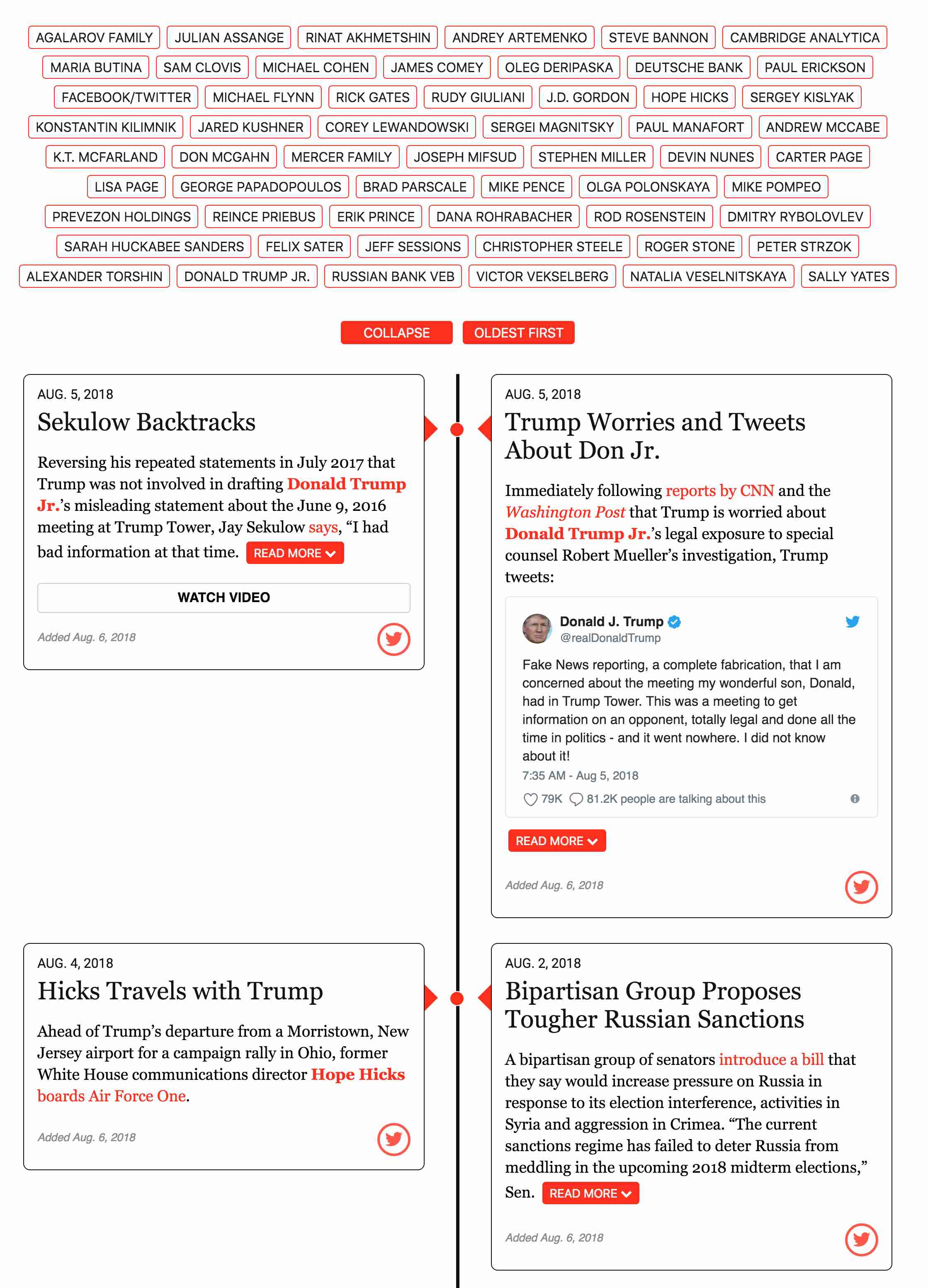
Donald Trump’s connection to Russia and Russian interests dates back more than 35 years. His family and associates also have well-documented ties.
Since it can be challenging to keep track of all the players and moving parts in the ever-growing Russia investigations, lawyer Steven Harper and the producers at BillMoyers.com created this interactive Trump-Russia Timeline. It is a comprehensive, easy-to-navigate tool designed to show what has happened and what still is developing in the story of the president, his inner circle, and a tangled web of Russian oligarchs, hackers, and government officials.
First launched in February 2017, the Trump-Russia Timeline now contains more than 1,000 entries. View it in its entirety below, or select one or more names at a time and explore that particular storyline.
The timeline is updated regularly as new developments emerge.
Here is a screenshot from the interactive timeline – just a portion of a fine resource for Americans who want to know more about Russian influence over Trump: