I’ve written before about the foul mess that is the ‘Warriors and Wizards’ festival in Jefferson (formerly a Harry Potter festival before Warner Bros. shut that usage down).
So, how is it that city officials, ‘development professionals,’ lying publishers, and bottom-shelf promoters get away with wasting tens of thousands in public funds each year while simultaneously cheating ordinary people out of tens or even hundreds of dollars for over-priced ticket fees, stomach-churning food, and wasted travel expenses? These dirty dogs roam with impunity.
One reason – of many, no doubt – is that while a city wastes tens of thousands (or more), each ordinary family is cheated for a smaller amount (meaningful to them, but perhaps in an amount of one-hundred to two-hundred dollars), and those families are stuck bearing that loss without a cost-effective individual remedy. (Obvious point: I’ve not been cheated, so I do not write from a personal grievance. It shouldn’t require a personal grievance, however, to see that the event cheats ordinary people.)
If a ‘mover and shaker’ in one of these towns suffered even a proportionately smaller injury, then it would be the Worst Misfortune Since the World Began So Very Long Ago™. One could expect petitions, objections, meetings, wailing, rending of garments, gnashing of teeth, etc.
So one has public waste on a large scale (in cases far worse than a cheesy festival in Jefferson, Wisconsin), and private individuals are left time and again to bear the loss.
If anyone’s looking for a little inspiration for their post-retirement career, you could do a lot worse than taking a cue from Wisconsin’s Terry Lauerman.
The 75-year-old man is a volunteer at the Safe Haven Pet Sanctuary in Green Bay. His primary job, as it seems, is to take naps with the various cats.
Save Haven’s founder, Elizabeth Feldhausen, says that Lauerman “just walked in” one day, with a cat brush and an intention.
He’s been there for about six months, so Feldhausen said “eventually we told him he was an official volunteer and had him fill out our volunteer form.”
His typical day on the job involves him spending an hour snoozing on the couch with one cat. And then he’ll wake up and move onto a doze with the next cat.
Friday in Whitewater will be partly sunny with a high of forty-four. Sunrise is 7:05 AM and sunset 6:16 PM, for 11h 10m 47s of daytime. The moon is a waxing crescent with 13.5% of its visible disk illuminated.
On this date Territorial Governor Henry Dodge was born in Vincennes, Indiana. The son of Israel Dodge and Nancy Hunter, Henry Dodge was the first Territorial Governor of Wisconsin. Prior to this position, he served as Marshall and Brigadier General of the Missouri Territory, Chief Justice of the Iowa County (Wisconsin) Court. During the Black Hawk War of 1832 he led the Wisconsin militia who ultimately brought the conflict to its tragic end. He served as Territorial Governor from July 3, 1836 to October 5, 1841 and again from May 13, 1845 to June 7, 1848. He also served as U.S. Territorial Senator from 1841 to 1846. When Wisconsin was admitted to the Union as a State, dodge was elected as a Democrat to the United States Senate; he was reelected in 1851 and served from June 8, 1848, to March 3, 1857. He was also twice nominated for President and once for Vice President, all of which he declined. Henry Dodge died on June 19, 1867 in Burlington, Iowa.
Recommended for reading in full — A five-year-old was persuaded to sign away her rights at the U.S. border, homegrown disinformation, Georgia Republican keeps thousands of voter registrations on hold, Ukrainian Christians break from Moscow’s political control, and a video about the Apollo space program’s origins —
Helen—a smart, cheerful five-year-old girl—is an asylum seeker from Honduras. This summer, when a social worker asked her to identify her strengths, Helen shared her pride in “her ability to learn fast and express her feelings and concerns.” She also recounted her favorite activities (“playing with her dolls”), her usual bedtime (“8 p.m.”), and her professional aspirations (“to be a veterinarian”).
….
According to a long-standing legal precedent known as the Flores settlement, which established guidelines for keeping children in immigration detention, Helen had a right to a bond hearing before a judge; that hearing would have likely hastened her release from government custody and her return to her family. At the time of her apprehension, in fact, Helen checked a box on a line that read, “I do request an immigration judge,” asserting her legal right to have her custody reviewed. But, in early August, an unknown official handed Helen a legal document, a “Request for a Flores Bond Hearing,” which described a set of legal proceedings and rights that would have been difficult for Helen to comprehend. (“In a Flores bond hearing, an immigration judge reviews your case to determine whether you pose a danger to the community,” the document began.) On Helen’s form, which was filled out with assistance from officials, there is a checked box next to a line that says, “I withdraw my previous request for a Flores bond hearing.” Beneath that line, the five-year-old signed her name in wobbly letters.
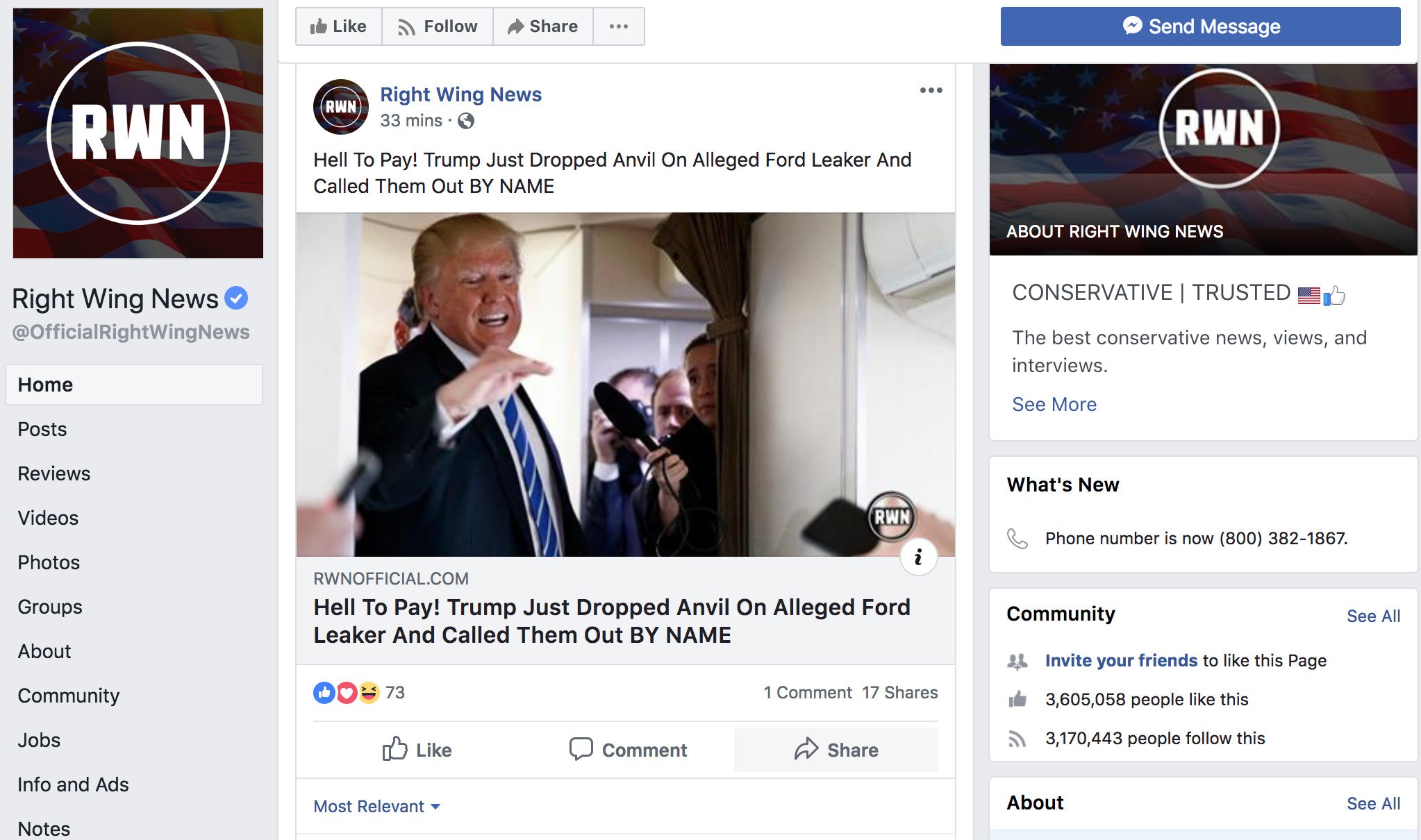
The conservative site, run by the blogger John Hawkins, had created a series of Facebook pages and accounts over the last year under many names, according to Facebook.
After Dr. Blasey testified, Right Wing News posted several false stories about her — including the suggestion that her lawyers were being bribed by Democrats — and then used the network of Facebook pages and accounts to share the pieces so that they proliferated online quickly, social media researchers said.
The result was a real-time spreading of disinformation started by Americans, for Americans.
What Right Wing News did was part of a shift in the flow of online disinformation, falsehoods meant to mislead and inflame. In 2016, before the presidential election, state-backed Russian operatives exploited Facebook and Twitter to sway voters in the United States with divisive messages. Now, weeks before the midterm elections on Nov. 6, such influence campaigns are increasingly a domestic phenomenon fomented by Americans on the left and the right.
Georgia has put more than 53,000 voter registrations on hold, with the state’s residents fearing that voter purges and delayed registrations will affect the outcome of the upcoming elections. [AP / Ben Nadler]
Nearly 70 percent of the flagged applications are from black voters, yet black people make up about one-third of Georgia’s population. [Vox / P.R. Lockhart]
Brian Kemp, Georgia’s secretary of state and the Republican nominee for the open governor’s seat, is in charge of the pending list. His Democratic opponent in the gubernatorial race is Stacey Abrams, the first black female governor candidate from a major party in the US. [NYT / Astead W. Herndon]
Voting rights advocates and civil rights groups have protested Kemp’s decision to stay in office until the election, saying it’s inappropriate that he controls voting systems. Abrams’s campaign has demanded his resignation. [CNN / Gregory Krieg]
Kemp has waged a years-long battle against voting rights groups and minority voter registration efforts, using an “exact match” program to approve voter IDs. [Talking Points Memo / Cameron Joseph]
Voters whose registrations are on hold will be notified via text to verify their information. Tuesday is the last day Georgians can register to vote. [Atlanta Journal-Constitution / Mark Niesse]
Voter ID rulings across the US could help decide which party controls the Senate come 2019. Courts issued rulings against restrictions in Missouri but in favor of them in North Dakota; both states have competitive Senate races. [Vox / German Lopez]
“This is a victory of good over evil, light over darkness.” That’s how Ukrainian President Petro Poroshenko describedthe announcement Thursday that the Orthodox Church’s Istanbul-based leader, Patriarch Bartholomew, will grant Ukraine’s Church independence from Russia.
In televised remarks, Ukraine’s president dubbed this a “historic event,” which it undoubtedly is: For more than three centuries, Ukraine and Russia have been religiously united within the Russian Orthodox Church. It was a union Poroshenko characterized this summer as a “direct threat to the national security of Ukraine,” given his view that the Russian Orthodox Church fully supports Kremlin policy; he said then that it was “absolutely necessary to cut off all the tentacles with which the aggressor country operates inside the body of our state.”
For three years, the Harry Potter Festival (in Edgerton and then Jefferson, Wisconsin) has been a fiasco and disappointment. (Note: I’ve not experienced personal disappointment: hundreds of patrons have.) It’s now re-branded as the Warriors and Wizards festival – because ignorant promoters ran afoul of the intellectual property rights of Warner Bros. – and with two weeks to go, it’s still a foul mess.
I am disappointed and also angered to say that I will not be appearing at the @WandWFestival in Jefferson, Wisconsin this month. This is due to incompetence and dishonesty on the part of Scott Cramer, the head of the festival, who has known for some time that the event is in trouble, has been lying about it, and is now in breach of contract with me.
My representative and I have planned our schedules and indeed our finances around this and are now out of pocket and have wasted a great deal of time on it. The event itself is unlikely to go ahead in my opinion, as it would appear they have no money to pay contributors, and I’d appreciate it if followers of mine who are involved in the convention scene would share this thread as much as possible.
I don’t want any more fans to spend their money on tickets/travel/accommodation only to be disappointed. Very sorry if anyone is booked to come in the hope of seeing me.
They are now continuing to advertise my appearance whilst taking down posts about problems with the event. In other words, *deliberately* selling tickets to fans based on false information.
Stay well clear of these absolute shysters.
Yeah, they’ve been waffling, bullshitting even downright lying their way through everyone’s concerns.
So why the hell are city councils getting into bed with these shysters?
Why, indeed?
These vulgar promoters and the scheming local officials who cater to them aren’t helping their city – they’re ruining it.
What’s telling is how (1) officials have insisted 50,000 previously attended last year when that’s almost impossible given the size of the town and reports from attendees, (2) Jefferson’s government signed on for five more years after the festival’s last three years of failure, (3) someone at UW-Whitewater apparently produced a ludicrous study claiming $33 million in economic benefits from this mess, (4) the promoters seem to be claiming tens of thousands in charitable contributions no one can or will identify, and (5) the Daily Union struggles between lying on behalf of city officials, laughable spokespeople, and not-worth-an-undergraduate-degree-let-alone-a-doctorate economic studies and telling the truth to people who actually live in Jefferson, Wisconsin.
(One can see how actual residents in Jefferson have been going online and debunking lies about how big the festival has been, how well it’s done, etc. That’s funny-sad: the Daily Union‘s publisher and editor are so dense – or so arrogant – that they’re asking readers to believe them over readers’ own eyes.)
Thursday in Whitewater will be partly sunny with a high of forty-eight. Sunrise is 7:04 AM and sunset 6:18 PM, for 11h 13m 37s of daytime. The moon is a waxing crescent with 7.2% of its visible disk illuminated.
Whitewater’s Finance Committee is scheduled to meet again today at 6:00 PM.
On this day in 1942, the United States engages Japanese naval forces at the Battle of Cape Esperance:
Shortly before midnight on 11 October, a U.S. force of four cruisers and five destroyers—under the command of Rear Admiral Norman Scott—intercepted [Rear Admiral Aritomo] Goto’s force as it approached Savo Island near Guadalcanal. Taking the Japanese by surprise, Scott’s warships sank one of Goto’s cruisers and one of his destroyers, heavily damaged another cruiser, mortally wounded Goto, and forced the rest of Goto’s warships to abandon the bombardment mission and retreat. During the exchange of gunfire, one of Scott’s destroyers was sunk and one cruiser and another destroyer were heavily damaged. In the meantime, the Japanese supply convoy successfully completed unloading at Guadalcanal and began its return journey without being discovered by Scott’s force. Later on the morning of 12 October, four Japanese destroyers from the supply convoy turned back to assist Goto’s retreating, damaged warships. Air attacks by U.S. aircraft from Henderson Field sank two of these destroyers later that day.
Recommended for reading in full — Nearly every line of Trump’s USA Today op-ed was false or misleading, Trump’s conflicts of interest with the Saudis, the Saudis don’t respect Trump, Republicans accept Trump’s corruption, and video on how to make a proper cup of tea (according to George Orwell) —
President Trump wrote an opinion article for USA Today on Oct. 10 regarding proposals to expand Medicare to all Americans — known as Medicare-for-All — in which almost every sentence contained a misleading statement or a falsehood.
Many of these are claims we have already debunked. Presumably, the president is aware of our fact checks — he even links to two — but chose to ignore the facts in service of a campaign-style op-ed. Medicare-for-All is a complex subject, and serious questions could be raised about the cost and how a transition from today’s health-care system would be financed. Trump correctly notes that studies have estimated that the program — under the version promoted by Sen. Bernie Sanders (I-Vt.) — would add $32.6 trillion in costs to the federal government over 10 years. (He doesn’t mention that costs in theory would go down for individuals, state governments and others, so overall national health expenditures may not increase and could even decrease.)
But this is not a serious effort to debate the issue. So as a reader service, we offer a guide through Trump’s rhetoric.
The grisly details of an alleged Saudi government plot to murder dissident journalist Jamal Khashoggi are roiling diplomatic and national security circles, but the Trump White House’s reaction has been strangely muted. Asked about the matter on Wednesday afternoon, President Donald Trump vaguely condemned the “bad situation,” while also praising King Salman, the Saudi monarch, as a “fine man.” He stressed that Saudi officials say it’s unclear what became of Khashoggi, who disappeared after entering the Saudi consulate in Istanbul on October 2. Turkish officials say he was killed within hours of entering the consulate by a Saudi hit squad on the orders of senior Saudi royal family members.
….
Trump’s meek response to the diplomatic crisis highlights the ongoing conflicts of interest posed by his business empire.
At a 2015 campaign stop, Trump bragged to the crowd about his business dealings with the Saudis. “Saudi Arabia, I get along with all of them,” Trump said. “They buy apartments from me. They spend $40 million, $50 million. Am I supposed to dislike them? I like them very much.”
In 2001, the Saudi government bought the 45th floor of the Trump World Plaza building in New York City as part of its mission to the United Nations. And shortly before entering the White House, Trump was aggressively pursuing deals with Saudi investors and attempting to build hotels in the Saudi Arabia. In August 2015, in the midst of his presidential run, Trump registered new corporations to manage a prospective hotel in Jeddah, the gateway city to the Muslim holy sites of Mecca and Medina. That project never came to fruition, but the Washington Post reported that at least two of Trump’s US hotel properties—both called the Trump International Hotel & Tower, in New York and Chicago—have benefitted hugely from Saudi business.
Shadi Hamid writes Saudi Arabia Is Taunting Trump (“The disappearance of the journalist Jamal Khashoggi at the hands of an American ally shows how little Saudi Arabia fears the repercussions of its actions”):
Even for those who care little about human rights in the Middle East, the disappearance of Khashoggi calls into question the reliability of an ally that has insisted on acting in such brazen fashion. If Trump’s foreign policy really is about “America first,” then allies who show blatant disregard for America, American values, and American interests should incur significant costs. What might those costs be? This is what the conversation over the future of U.S.-Saudi relationship must turn to. Trump is at least partly correct about Saudi dependence on the United States. As my colleague Bruce Riedel writes, the Saudi Air Force is “is entirely dependent on American and British support for its air fleet of F15 fighter jets, Apache helicopters, and Tornado aircraft. If either Washington or London halts the flow of logistics, the [air force] will be grounded.”
Bad allies, particularly in the Middle East where they abound, have been a recurring problem for successive U.S. administrations. U.S. policymakers need—or think they need—them, even when those allies go out of their way to undermine their relationships with the United States. Those allies believe—mostly correctly—that the United States will express concern and complain, but ultimately do little. The worst offenses will be forgotten in the name of national-security interests, as they have been so many times before. It is time to call Saudi Arabia’s bluff.
Senate Majority Leader Mitch McConnell (R-Ky.) sat down for an extensive interview with Associated Press reporters, the full video of which you can watch here. One of the most telling moments was this one, in response to a question from the AP’s Dustin Weaver: (emphasis added):
Question: Democrats have made clear that if they do win back the House, they plan to launch many, many investigations into the president and the administration. They’ve made clear that one of their lines of inquiry is going to be the president’s tax returns, the president’s businesses, the president’s hotel contract. . . . Do you think that’s a legitimate line of inquiry for Democrats to be talking about?
McConnell: I think it’ll help the president get reelected. I remember the price we paid — actually, we did impeach Bill Clinton. I remember all the enthusiasm, lots of Republicans in the House and Senate — “boy, this is the ticket, this is gonna make us have a great year.” . . . It worked exactly the opposite. The public got mad at us. . . . This business of presidential harassment may or may not quite be the winner they think it is.
McConnell was asked directly whether President Trump’s tax returns and self-dealing constitute a legitimate topic for congressional oversight. He didn’t directly answer, but he did dismissively characterize such an inquiry as “presidential harassment.”
One reads that the self-described Republican candidate for the 43rd Assembly District will hold a meet and greet next week at a private establishment in town. Good for him – free speech is a core political right. (He’s also scheduled to appear at a local candidate’s forum this week. SeeThe First & Last Questions.)
He’s a Republican, that simply expressed? No, that’s not quite candid enough. Gabriel Szerlong is either a Trumpist or he isn’t: that’s the political question of our time. His party is a Trumpist party. It lives and breathes Donald J. Trump.
As for seeing the country as merely a two-party universe, one can be assured that millions of independents (including libertarians) know the cosmos is wider and more diverse than that.
If, however, one hears that this is a Republican meet and greet, one should be clear about what that means.
Candidate Szerlong may euphemistically describe himself as a ‘Republican,’ but it’s Trumpism that rules that party, Trumpism that demands members’ allegiance, Trumpism that threatens this society and this small and beautiful town from which I write.
Trumpism fully implemented would destroy Whitewater’s society and economy.
When Community Development Chairman Larry Kachel met with James Sensenbrenner, he met with a Trumpist. When CDA Executive Director Dave Carlson told a radio audience that Sensenbrenner is ‘our guy,’ he was too familiar by far: Sensenbrenner is the city’s congressman, but he’s no more Whitewater’s guy (in a warm and supportive sense) than would be any other aged reactionary.
(Sensenbrenner votes in line with Trump’s positions 88.2% of the time; Sensenbrenner on 7.5.18, asking for support for Trump after an executive order reducing the effects of Trump’s own family separation policy: “I am waiting to hear any of my friends from the left stand up and say Trump did the right thing when he signed that executive order.” Sensenbrenner might as well ask for support for an arsonist who burns down house after house but then splashes a cup of water on the collapsing homes and expects praise for that meager effort.)
No bad empty economic deal (seeAbout that Trump Tax Plan) will compensate for an even worse policy of authoritarianism and ethnic favoritism.
Among the vast numbers who oppose Trump, those who are libertarian or conservative have often – as I have – signaled that opposition as part of Never Trump. (On Twitter, this is often written with a hashtag, as #NeverTrump.)
Funny, but even after years since Never Trump began (and many of us were opposed to him from the beginning), there’s a reflex among some to insist that Never Trump needs to concede, relent, and acquiesce to this new order in America.
A reply from Tom Nichols on Twitter, to a tweet from the self-described ‘Reagan Batallion’ sets one straight on what opposition to Trump means:
‘Never’ automatically expired on Election Day when Trump won, most of us can accept fact. We praise him when he does good, and criticize him when he does the opposite.
This is not what “Never Trump” means, at least to me. To me it means: rejecting the basis of how Trump governs, even when it accidentally produces outcomes I might otherwise like. That’s like accepting an abusive partner or friend because they’re nice every few weeks.
Nichols understands what never means. It means never accepting a bigoted autocratic grifter: never before, never now, never in the future. A civilized man or woman would not accept the Know Nothings, Confederates, Copperheads, Klan, or Bund even if (as they occasionally did) they had moments of political (or military) success.
Acceptance of wickedness isn’t maturity, it’s appeasement of evil.
Wednesday in Whitewater will see scattered thunderstorms with a high of seventy-one. Sunrise is 7:03 AM and sunset 6:19 PM, for 11h 16m 27s of daytime. The moon is a waxing crescent with 2.6% of its visible disk illuminated.
Whitewater’s Finance Committee is scheduled to meet at 6:00 PM.
Under increasing pressure to resign, Agnew took the position that a sitting vice president could not be indicted and met with Speaker of the House Carl Albert on September 25, asking for an investigation. He cited as precedent an 1826 House investigation of Vice President John C. Calhoun, who was alleged to have taken improper payments while a cabinet member. Albert, second in line to the presidency under Agnew, responded that it would be improper for the House to act in a matter before the courts.[171] Agnew also filed a motion to block any indictment on the grounds that he had been prejudiced by improper leaks from the Justice Department, and tried to rally public opinion, giving a speech before a friendly audience in Los Angeles asserting his innocence and attacking the prosecution.[172] Nevertheless, Agnew entered into negotiations for a plea bargain, and wrote in his memoirs that he did so because he was worn out from the extended crisis, to protect his family, and because he feared he could not get a fair trial.[173] He made his decision on October 5, and plea negotiations took place over the following days. On October 9, Agnew visited Nixon at the White House and informed the President of his impending resignation.[174]
Recommended for reading in full — An update on connections between a Russian bank and the Trump Organization, Putin’s popularity plummets, civility has its limits, Trump campaign official sought online manipulation plans from an Isreali firm, and video of a priest at Marquette who offers online music lessons in a folk instrument —
Readers may recall Franklin Foer’s October 31, 2016 story on possible connections between a Russian bank’s server and the Trump Organization (Was a Trump Server Communicating With Russia?). Now Dexter Filkins has a compelling update on computer scientists’ assessment of that electronic traffic in Was There a Connection Between a Russian Bank and the Trump Campaign? (“A team of computer scientists sifted through records of unusual Web traffic in search of answers”):
In June, 2016, after news broke that the Democratic National Committee had been hacked, a group of prominent computer scientists went on alert. Reports said that the infiltrators were probably Russian, which suggested to most members of the group that one of the country’s intelligence agencies had been involved. They speculated that if the Russians were hacking the Democrats they must be hacking the Republicans, too. “We thought there was no way in the world the Russians would just attack the Democrats,” one of the computer scientists, who asked to be identified only as Max [one of the computer researchers] told me.
As Max and his colleagues searched D.N.S. logs for domains associated with Republican candidates, they were perplexed by what they encountered. “We went looking for fingerprints similar to what was on the D.N.C. computers, but we didn’t find what we were looking for,” Max told me. “We found something totally different—something unique.” In the small town of Lititz, Pennsylvania, a domain linked to the Trump Organization (mail1.trump-email.com) seemed to be behaving in a peculiar way. The server that housed the domain belonged to a company called Listrak, which mostly helped deliver mass-marketing e-mails: blasts of messages advertising spa treatments, Las Vegas weekends, and other enticements. Some Trump Organization domains sent mass e-mail blasts, but the one that Max and his colleagues spotted appeared not to be sending anything. At the same time, though, a very small group of companies seemed to be trying to communicate with it.
Examining records for the Trump domain, Max’s group discovered D.N.S. lookups from a pair of servers owned by Alfa Bank, one of the largest banks in Russia. Alfa Bank’s computers were looking up the address of the Trump server nearly every day. There were dozens of lookups on some days and far fewer on others, but the total number was notable: between May and September, Alfa Bank looked up the Trump Organization’s domain more than two thousand times. “We were watching this happen in real time—it was like watching an airplane fly by,” Max said. “And we thought, Why the hell is a Russian bank communicating with a server that belongs to the Trump Organization, and at such a rate?”
Only one other entity seemed to be reaching out to the Trump Organization’s domain with any frequency: Spectrum Health, of Grand Rapids, Michigan. Spectrum Health is closely linked to the DeVos family; Richard DeVos, Jr., is the chairman of the board, and one of its hospitals is named after his mother. His wife, Betsy DeVos, was appointed Secretary of Education by Donald Trump. Her brother, Erik Prince, is a Trump associate who has attracted the scrutiny of Robert Mueller, the special counsel investigating Trump’s ties to Russia. Mueller has been looking into Prince’s meeting, following the election, with a Russian official in the Seychelles, at which he reportedly discussed setting up a back channel between Trump and the Russian President, Vladimir Putin. (Prince maintains that the meeting was “incidental.”) In the summer of 2016, Max and the others weren’t aware of any of this. “We didn’t know who DeVos was,” Max said.
The D.N.S. records raised vexing questions. Why was the Trump Organization’s domain, set up to send mass-marketing e-mails, conducting such meagre activity? And why were computers at Alfa Bank and Spectrum Health trying to reach a server that didn’t seem to be doing anything? After analyzing the data, Max said, “We decided this was a covert communication channel.”
Bad news has rained on Putin’s head lately. The leader of the pro-Russian Donetsk People’s Republic, the capital of Putin’s “Russkiy Mir,” died in a bombing attack in a restaurant. The Netherlands accused Russia of a cyber attack and expelled four officers from GRU, the Russia’s military intelligence agency. Great Britain had earlier found evidence that the two Salisbury suspects were state assassins from this same agency. Even Russia’s old friend, Greece expelled two Russian diplomats and banned two more from entry for undermining state security. Somebody drilled a hole in the Russian module of the International Space Station Even Cossacks, Putin’s previously reliable allies in United Russia have quit his party and condemned the Kremlin’s policy in a new video.
Russians are convinced that the “galley’s slave,” as Putin once described himself, is one of the world’s richest men and already has everything he needs. And yet, every year on his birthday the state television, news agencies and even independent media tell stories about Putin’s admirers giving him exotic or dull presents – puppets, swords, dachas or palaces. Earlier this year, the Chinese leader, Xi Jinping, presented Putin with a harp made thousands of years ago and a wooden statue with Putin’s face. On Sunday, among the first to greet Putin with tokens of appreciation and congratulations were leaders of Belarus, Serbia, Azerbaijan, China and Republica Srpska, all still convinced Russia can serve as a reliable ally.
Meanwhile in Moscow, analysts said that Putin had more bad than good news on this day. “Putin has given himself two big presents this year: an unpopular pension reform, causing the loss of his popularity, and a complete failure in foreign policy,” a Moscow politician, Dmitry Gudkov, told The Daily Beast.
“This year the world witnessed a complete failure of Putin’s secret services, his secret agents shamed the nation in several countries, his lies became obvious during the investigation of MH-17 downing over Donbas – his own lies and actions are his worst birthday presents.”
A top Trump campaign official requested proposals in 2016 from an Israeli company to create fake online identities, to use social media manipulation and to gather intelligence to help defeat Republican primary race opponents and Hillary Clinton, according to interviews and copies of the proposals.
The Trump campaign’s interest in the work began as Russians were escalating their effort to aid Donald J. Trump. Though the Israeli company’s pitches were narrower than Moscow’s interference campaign and appear unconnected, the documents show that a senior Trump aide saw the promise of a disruption effort to swing voters in Mr. Trump’s favor.
The campaign official, Rick Gates, sought one proposal to use bogus personas to target and sway 5,000 delegates to the 2016 Republican National Convention by attacking Senator Ted Cruz of Texas, Mr. Trump’s main opponent at the time. Another proposal describes opposition research and “complementary intelligence activities” about Mrs. Clinton and people close to her, according to copies of the proposals obtained by The New York Times and interviews with four people involved in creating the documents.
Peter Beinart observes Civility Has Its Limits (“The conflict over Brett Kavanaugh’s nomination centered not on tribalism, but on a lack of justice”):
Describing Democrats and Republicans as warring tribes has become a political cliché, but it’s wrong. If tribal implies unthinking or inherited group loyalty, then Democrats and Republicans were actually more tribal in the mid-20th century. Back then, when being a Democrat or a Republican signified less about your view of the world, party identity was more a function of regional or ancestral ties. Whether or not they supported civil rights or higher taxes or the Korean War, Irish Catholics from Boston were mostly Democrats; Presbyterians from Kansas were mostly Republicans. Today, party identity is more a function of what you believe. The parties are so bitterly polarized not because they’ve become more tribal but because they’ve become more ideological.
But for [David] Brooks, depicting the supporters of Kavanaugh and Ford as tribes is useful because it doesn’t only suggest moral equivalence, it also implies an equivalence of power. The “tribalization” of American politics, Brooks argues, “leads to an epidemic of bigotry. Bigotry involves creating a stereotype about a disfavored group and then applying that stereotype to an individual you’ve never met. It was bigotry against Jews that got Alfred Dreyfus convicted in 1894. It was bigotry against young black males that got the Central Park Five convicted in 1990. It was bigotry against preppy lacrosse players that led to the bogus Duke lacrosse scandal.”
This is misleading. There is no equivalence between the “bigotry” faced by preppy lacrosse players and that faced by black males. There’s no equivalence, because preppy lacrosse players, in general, enjoy far more privilege and power and thus, the stereotypes people hold of them don’t generally land them in jail or dead. Similarly, there is no equivalence between the “bigotry” faced by men accused of sexual assault and the “bigotry” faced by women who suffer it. There’s no equivalence, because men wield far more power. If you don’t think that matters, try imagining Kavanaugh getting confirmed by a Senate composed of 79 women.
The Republican Party’s Trumpization is complete. It’s not a conservative party, or a small government party or an anti-authoritarian party (to the contrary!). It has become the caricature of the left from days gone by — all power, no principle, dismissive of courtesy and reasoned persuasion. Anger, not ideas, is its animating force. We have a nativist party that views America not as a creedal nation, but as a white Christian nation that is diminished by immigrants and is threatened by outsiders. If it possesses any coherent philosophy, it is one of victimhood — which in turn justifies any and all bad behavior.
There’s a local debate candidate forum scheduled for this weekend between the Democrat and Republican running for the 43rd Assembly district (a portion of which includes Whitewater).
The Whitewater Area League of Women Voters is hosting this event, and writes to reassure prospective attendees that they may “ask questions of the candidates by writing them on cards, which are forwarded to the forum moderator after being checked for redundancy by a panel of League question checkers.” (One might have thought that a single person would be able to check questions for redundancy, in the way a single person can tell if she’s buying too many of the same item or standing in the same line twice, but perhaps if one member of the League panel dozes off, at least others yet awake will be able to carry on the work of redundancy-checking.)
Although there may be a hundred interesting questions, there is one critical political question:
Do you favor or do you oppose Trumpism?
During a fire, questions about sports, art, or literature – however curious on their own – work by diversion against firefighting and in favor of a worse conflagration.
The question of Trumpism properly begins and ends all political discussion. Any other questions by their nature avoid this topic, and through avoidance work an implicit acceptance.
Tuesday in Whitewater will see scattered afternoon thunderstorms with a high of eighty. Sunrise is 7:02 AM and sunset 6:21 PM, for 11h 19m 18s of daytime. The moon is new with 0.2% of its visible disk illuminated.
Whitewater’s Public Works Committee is scheduled to meet at 6:00 PM.
The father of the Soviet hydrogen bomb, Andrei Sakharov, was awarded the Peace Prize in 1975 for his opposition to the abuse of power and his work for human rights. The leaders of the Soviet Union reacted with fury, and refused Sakharov permission to travel to Oslo to receive the Prize. His wife, Jelena Bonner, received it on his behalf. Sakharov was subsequently deprived of all his Soviet honorary titles, and the couple was for several years kept under strict surveillance in the town of Gorkij. Only when Gorbachev came to power in 1985 were they allowed to return to Moscow.
Sakharov revealed his talent for theoretical physics at an early age, and got a doctorate in 1945. From 1948 on, under the supervision of the Nobel Laureate Igor Tamm, he worked on the development of a Soviet hydrogen bomb. Sakharov was patriotic, and believed it was important to break the American monopoly on nuclear weapons. But from the late 1950s on, he issued warnings against the consequences of the arms race, and in the 1960s and 1970s he voiced sharp criticism of the system of Soviet society, which in his opinion departed from fundamental human rights.
Recommended for reading in full — Trump drowns America in red ink, asking to whom Trump has a personal indebtedness, the darkness that’s overcome conservativism, a Plan B in response to Trumpism, and video of a New York rat so big even a cat clears out —
As most of America was glued to the final twists of the Brett M. Kavanaugh vote last Friday, the Congressional Budget Office dropped a whopper of a report. The United States federal government ran a deficit of $782 billion in fiscal 2018, the CBO said, the highest since 2012 and substantially higher than last year’s $666 billion.
This isn’t supposed to happen. The U.S. economy is humming, and a hot economy is supposed to translate into higher tax revenue and very tiny deficits. In fact, the last time unemployment was around this level — in 2000 and 1969 — the U.S. government ran a surplus.
President Trump vowed to eliminate the debt in eight years while he was campaigning for president. Instead, he is presiding over ballooning deficits, an unprecedented situation during strong economic times. In fiscal 2018, which concluded at the end of September, spending jumped 129 percent while tax receipts rose 0.4 percent.
Congress could still investigate itself or empower an independent investigation. This Congress won’t. The next Congress should.
Perhaps it should start on exactly the terrain put off limits to Mueller: The pre-2015 history of connections between Trump and Russia. Congress has power to subpoena the business records of the Trump Organization. It can trace the complex system of holding companies within which (according to Trump biographer Timothy O’Brien) Trump hides his enormous debts. It can order a forensic audit to clarify exactly what the Trump family has received from Russian sources over the years, and what it may still owe.
Very likely none of this is illegal. It is, however, burningly relevant.
This generation’s variant of “What did the president know, and when he know it?” Is “What does the president owe, and to whom does he owe it?”
Not: “Is the president a crook?” (We had available all the information needed to determine that on election day.)
But: “Is the president a risk to national security?”
In 1964, the GOP ceased to be the party of Lincoln and became the party of Southern whites. As I now look back with the clarity of hindsight, I am convinced that coded racial appeals had at least as much, if not more, to do with the electoral success of the modern Republican Party than all of the domestic and foreign policy proposals crafted by well-intentioned analysts like me. This is what liberals have been saying for decades. I never believed them. Now I do, because Trump won by making the racist appeal, hitherto relatively subtle, obvious even to someone such as me who used to be in denial.
In fairness, many Republican voters and their leaders, from Wendell Willkie to Mitt Romney, have been a lot more moderate. Their very centrism stoked the fury of some on the right. The pattern was set early on, in 1964, with Phyllis Schlafly’s best-selling tract “A Choice Not an Echo.” Schlafly was baffled why Republicans candidates had lost presidential elections in 1936, 1940, 1944, 1948 and 1960. “It wasn’t any accident,” she wrote, ominously. “It was planned that way. In each of their losing presidential years, a small group of secret kingmakers, using hidden persuaders and psychological warfare techniques, manipulated the Republican National Convention to nominate candidates who would sidestep or suppress the key issues.” These nefarious “kingmakers” were New York financiers who supposedly favored “a policy of aiding and abetting Red Russia and her satellites.” And how did these “kingmakers” manipulate the GOP? By promulgating “false slogans” such as “Politics should stop at the water’s edge.” In other words, for Schlafly the very idea of bipartisanship was evidence of incipient treason.
This was not the ranting of some marginal oddball. Schlafly was one of the leading lights of the right who in the 1970s would lead the successful campaign against the Equal Rights Amendment. Trump’s claim that he is going to “Make America Great Again” — after it has been betrayed by disloyal elites — is simply an echo, as it were, of Schlafly’s conspiratorial rants.
The history of the modern Republican Party is the story of moderates being driven out and conservatives taking over — and then of those conservatives in turn being ousted by those even further to the right. A telling moment came in 1996, when the Republican presidential nominee, Bob Dole, visited an aged Barry Goldwater. Once upon a time, Dole and Goldwater had defined the Republican right, but by 1996, Dole joked, “Barry and I — we’ve sort of become the liberals.” “We’re the new liberals of the Republican Party,” Goldwater agreed. “Can you imagine that?”
The Republican Party’s Trumpization is complete. It’s not a conservative party, or a small government party or an anti-authoritarian party (to the contrary!). It has become the caricature of the left from days gone by — all power, no principle, dismissive of courtesy and reasoned persuasion. Anger, not ideas, is its animating force. We have a nativist party that views America not as a creedal nation, but as a white Christian nation that is diminished by immigrants and is threatened by outsiders. If it possesses any coherent philosophy, it is one of victimhood — which in turn justifies any and all bad behavior.
Four weeks from this Wednesday (the day after the midterm elections), sorry, will commence the lead-up to the 2020 presidential race. Any Republicans thinking of challenging President Trump because they recoil from the party of Trump is, I hate to break it to them, out of luck. The party wants the mocking cruelty, the attacks on the press and on women, the protectionism and the white nationalism. These things define it.
Are we then destined to have only a choice in 2020 between President Trump (or a clone) and the Democratic Party nominee? Perhaps, and if so, we should pray Democrats pick a unifying figure, one who can restore our institutions and rebalance our politics. And what if the Democratic Party selects Sen. Bernie Sanders (I-Vt.)? Well then, it’s time for Plan B.
Perhaps a potential ticket independent is waiting to be constructed from among the few Republicans who have refused to join the Trump cult. There are center/right governors — John Kasich (Ohio), Charlie Baker (Mass.), Brian Sandoval (Nev.) and former Indiana governor Mitch Daniels. Democrats such as Gov. Steve Bullock (Mont.), Sen. Heidi Heitkamp (N.D.), and Gov. John Hickenlooper (Colo.) would be solid additions on a ticket if you wanted to go the bipartisan route — perhaps with the promise of a one-term “reset” to rinse out the toxic remnants of the Trump era. Alternatively, Sen. Lisa Murkowski (R-Alaska) — a true independent voice — would be on any short list for vice president.
As technological capabilities progress, the threat of political warfare is becoming an even more serious threat to democratic elections. David M. Rubenstein Fellow Alina Polyakova analyzes past disinformation campaigns and political warfare tools employed by hostile foreign actors in Russia and elsewhere. She also discusses how these tactics are influencing U.S. midterm and other elections and what the U.S. can do to protect its electoral system.
One of the goals of Russian information warfare is to create a society in which we can’t tell the difference between fact and fiction.
The Russian government is becoming more sophisticated in mastering the tools of political warfare for the digital age. This includes the use of bots, trolls, microtargeting to spread disinformation.
The strategies are not new but the digital tools are.
Over the next few months we are going to see more disinformation campaigns, including fake websites that work together as a network to spread disinformation, fake personalities and entities on Twitter and Facebook, and manipulation of social media networks’ algorithms, including Google, YouTube, and others. And we’re not really paying enough attention to algorithmic manipulation.
The more frightening development that we are likely to see in the next 12-16 months is the use of artificial intelligence to enhance the tools of political warfare.
This Tuesday, October 9th at 12:30 PM, there will be a showing of Victoria and Abdul @ Seniors in the Park, in the Starin community building:
Victoria and Abdul (biography, drama, romance, history)
Tuesday, October 9, 12:30 pm
Rated PG-13. 1 hour, 51 min. (2017)
In 1887, when Abdul Karim, an Indian clerk in his twenties, comes to Queen Victoria’s Golden Jubilee, he stays long after and develops a close and sometimes controversial friendship with the aging queen (portrayed by Dame Judi Dench). A BBC Film production that garnered nominations for Best Actress, Set and Costume Designs.
Monday in Whitewater will see scattered thunderstorms with a high of eighty-one. Sunrise is 7:01 AM and sunset 6:23 PM, for 11h 22m 09s of daytime. The moon is a waning crescent with 3.6% of its visible disk illuminated.
Whitewater’s Planning Commission is scheduled to meet at 6:30 PM.
On this date Peshtigo, Wisconsin was devastated by a fire which took 1,200 lives. The fire caused over $2 million in damages and destroyed 1.25 million acres of forest. This was the greatest human loss due to fire in the history of the United States. The Peshtigo Fire was overshadowed by the Great Chicago fire which occurred on the same day, killing 250 people and lasting three days. While the Chicago fire is said to have started by a cow kicking over a lantern, it is uncertain how the Peshtigo fire began.
Recommended for reading in full — Another conservative leaves the Republican party, junk science in the service of Kavanaugh, Kasparov explains protests, Fox News won’t die away, and video of a diver riding a baby whale —
Conservative Tom Nichols writes Why I’m Leaving the Republican Party (“The Kavanaugh confirmation fight revealed the GOP to be the party of situational ethics and moral relativism in the name of winning at all costs”):
The Republicans, however, have now eclipsed the Democrats as a threat to the rule of law and to the constitutional norms of American society. They have become all about winning. Winning means not losing, and so instead of acting like a co-equal branch of government responsible for advice and consent, congressional Republicans now act like a parliamentary party facing the constant threat of a vote of no-confidence.
That it is necessary to place limitations, including self-limitations, on the exercise of power is—or was—a core belief among conservatives. No longer. Raw power, wielded so deftly by Senator Mitch McConnell, is exercised for its own sake, and by that I mean for the sake of fleecing gullible voters on hot-button social issues so that Republicans may stay in power. Of course, the institutional GOP will say that it countenances all of Trump’s many sins, and its own straying from principle, for good reason (including, of course, the holy grail of ending legal abortion).
Politics is about the exercise of power. But the new Trumpist GOP is not exercising power in the pursuit of anything resembling principle, and certainly not for conservative or Republican principles.
Free trade? Republicans are suddenly in love with tariffs, and now sound like bad imitations of early 1980s protectionist Democrats. A robust foreign policy? Not only have Republicans abandoned their claim to being the national-security party, they have managed to convince the party faithful that Russia—an avowed enemy that directly attacked our political institutions—is less of a threat than their neighbors who might be voting for Democrats. Respect for law enforcement? The GOP is backing Trump in attacks on the FBI and the entire intelligence community as Special Counsel Robert Mueller closes in on the web of lies, financial arrangements, and Russian entanglements known collectively as the Trump campaign.
In days leading up to the confirmation vote, the same notion was implicit in the rationale of every senator who attempted to defend Kavanaugh without wholly dismissing Ford’s accusations — her vivid testimony that he pinned her to a bed and tried to rape her when they were teens in the 1980s:
“I believe that she is a survivor of a sexual assault and that this trauma has upended her life,” said Susan Collins (R-Maine), who gave Kavanaugh his crucial 50th vote.
“Something happened to Dr. Ford; I don’t believe the facts show it was Brett Kavanaugh,” said Sen. Joe Manchin III (D-W.Va.), the only Democrat to support the nominee.
“That would get me off the hook of having to make a hard decision,” said Sen. Lindsey O. Graham (R-S.C.), one of Kavanaugh’s most loyal defenders. “I don’t know if this is a case of mistaken identity.”
It’s easy to forget that less than three weeks ago, when the mistaken-identity theory was first formulated, it was so widely ridiculed that a pundit who advanced it on Twitter subsequently apologized and offered to resignfrom his job. But for many cognitive researchers who study how memories actually form during traumatic events, the theory never stopped sounding ridiculous.
“The person lying on top of you — who she’d previously met — you’re not going to forget that,” said Richard Huganir, a neuroscientist at Johns Hopkins School of Medicine. “There’s a total consensus in the field of memory … If anything, fear and trauma enhances the encoding of the memory at a molecular level.”
As he and several other researchers told The Washington Post, being attacked floods the brain with chemicals, including norepinephrine, which helps people remember whatever they are focused on. (Ford, a psychologist herself, even mentioned it in her testimony.)
When they say that they just don’t like *how* you’re protesting it’s because they don’t like that you’re protesting at all. They aren’t supposed to like it. That’s the point.
Maxwell Tani writes Why Fox News Will Never Die (“The past two years saw the network weather a host of sexual harassment scandals and boycotts—and yet it’s emerged stronger than ever”):
In many ways, Trump built his campaign on the main programming themes that Fox News has run for years: the perceived victimization of conservatives by the left and the media.
Charlie Sykes, a longtime conservative radio host, noted that the scandals and boycotts haven’t hurt Fox because the network understands it will stay in business by “tending to and feeding the tribe.”
“Fox followed their audience into full-on Trumpism, making themselves into a safe space for the right,” Sykes said. “The scandals don’t hurt Fox for the same reasons that Trump’s scandals and lies don’t seem to hurt him. Fox is a reflection of this new political culture as much as they are its creator.”
“The audience/base don’t care as long as they own the libs.”

 I’ve written before about the foul mess that is the ‘Warriors and Wizards’ festival in Jefferson (formerly a Harry Potter festival before Warner Bros. shut that usage down).
 So, how is it that city officials, ‘development professionals,’ lying publishers, and bottom-shelf promoters get away with wasting tens of thousands in public funds each year while simultaneously cheating ordinary people out of tens or even hundreds of dollars for over-priced ticket fees, stomach-churning food, and wasted travel expenses? These dirty dogs roam with impunity.